Index spread betting brokers let you take a position on stock market benchmarks such as the FTSE 100, S&P 500, Nasdaq 100 and DAX without buying their constituent shares. The broker you choose affects more than the price on the deal ticket. Minimum stakes, overnight charges, trading hours and stop order rules can all change whether an account suits your approach.
The best fit is the provider whose terms work for the index, stake and session you actually trade. A low advertised spread is useful, but not if it disappears outside the hours you can trade. Start with the wider spread betting broker comparison, then assess each candidate at the individual index contract level.
This guide focuses on UK retail accounts. Spread betting can produce rapid losses, including the loss of all money dedicated to trading in the account.
Index spread betting brokers to compare
IG, CMC Markets and Pepperstone provide a starting shortlist, rather than a ranked recommendation. IG and Pepperstone feature in DayTrading.com’s spread betting provider comparison, which also covers platform and account considerations. Their inclusion here does not establish that either offers the lowest cost for your chosen index.
| Provider | Focus of your comparison | What to establish before opening an account |
|---|---|---|
| IG | Index contract choice and the trading platform you intend to use | The live spread during your session, minimum stake, stop restrictions and funding terms for each contract |
| CMC Markets | Index spread betting within its wider trading offering, confirmed in the London Stock Exchange company factsheet | Cash versus forward contract costs, order ticket controls and the terms available on your selected platform |
| Pepperstone | Spread betting account and platform compatibility | Whether the exact index, account type and order tools you need are available through your preferred connection |
Use the same comparison process for other providers. Do not assume that a broker’s CFD terms also apply to its spread betting account, or that every platform connected to that broker offers identical markets and order controls.
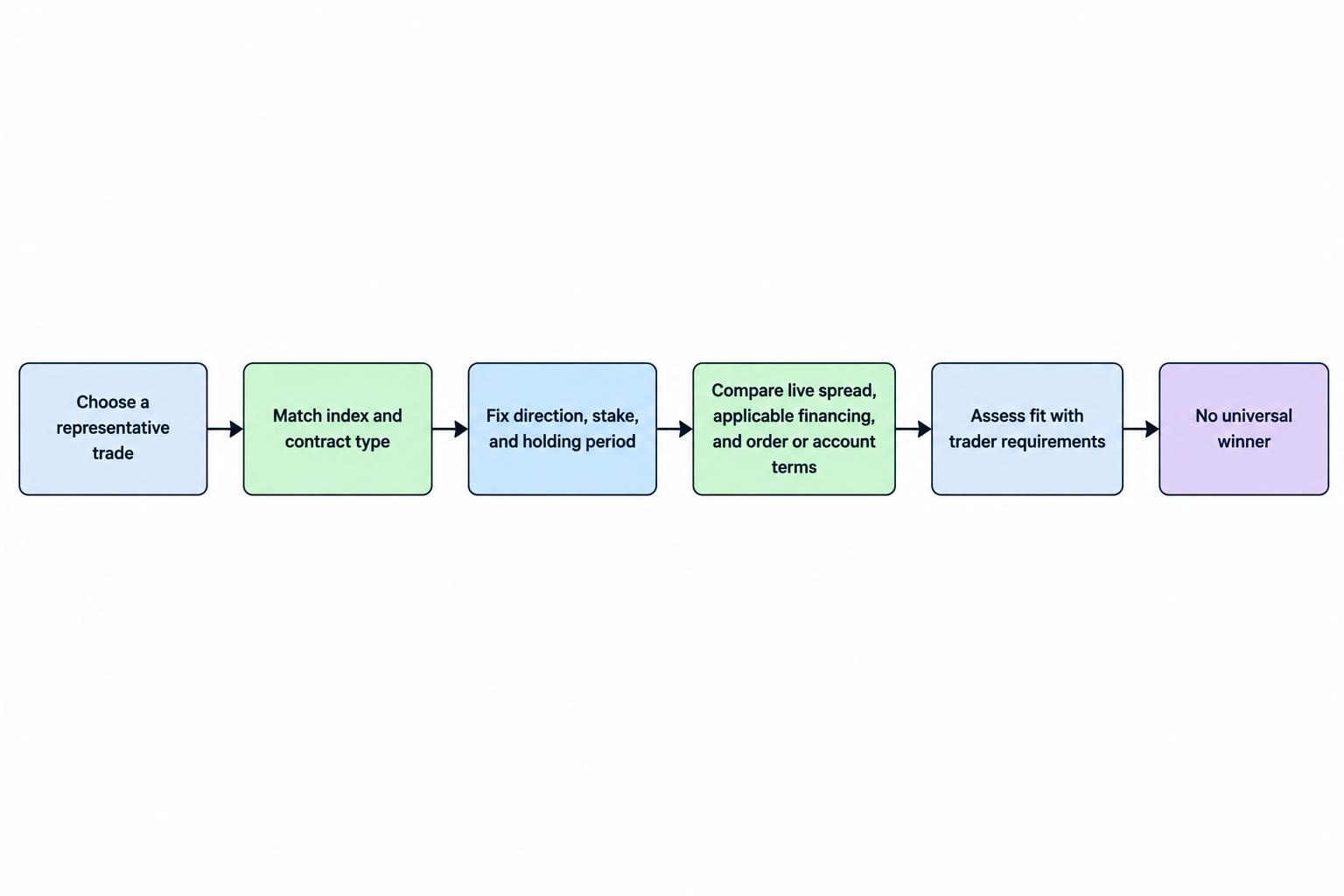
There is no defensible universal winner without a common comparison basis. A provider can be attractive for a small FTSE 100 day trade and less suitable for a larger Nasdaq position held for several weeks. Naming a winner without fixing the market, trade size and holding period would answer the wrong question.
Set your requirements before comparing prices
Write a short trading brief before looking at account features. It should identify your main index, usual trading hours, expected holding period and maximum acceptable loss per trade. Those four details remove much of the noise from broker comparisons.
A trader closing every position before the daily funding cutoff should give more weight to spreads and execution. Someone holding positions for ten nights needs to compare financing and dated contracts. A small account needs a workable minimum stake before either of those discussions becomes useful.
Separate essential requirements from conveniences. An account that cannot accept your intended stake or provide the order protection your plan requires should leave the shortlist. A missing chart colour scheme probably should not.
It also helps to choose one representative trade. Compare the same index, direction, stake and holding period at each provider. Otherwise, it is easy to compare one broker’s cheapest cash contract with another broker’s dated contract and mistake a product difference for a pricing advantage.
Check the exact index contract, not just the market name
Broker labels do not always match the benchmark’s familiar name. A market called UK 100 may reference the FTSE 100, while US 500 may reference the S&P 500. Read the contract description rather than relying on the label. The broader index spread betting guide covers how these markets work.
Next, establish whether you are comparing a cash contract, a dated contract or another index product. Two prices can differ without either being wrong because the contracts use different pricing and adjustment methods.
Check what one point means on the deal ticket. The displayed decimal place, minimum price movement and stake convention should be clear before you enter an order. A £1 stake per whole index point is not the same exposure as £1 per smaller quoted increment.
For every candidate account, record the underlying benchmark, contract type, minimum stake, stake increment and expiry arrangements where relevant. Also check whether the contract can be opened during your intended session or is available only for closing existing positions.
Market count should come after these checks. Access to dozens of indices offers little practical benefit if you trade only two, and neither has suitable terms on the account you are considering.
Compare the cost of the trade you plan to place
Use live spreads, not just advertised minimums
The spread is the difference between the broker’s buying and selling prices. Multiply its width by your stake per point to express that spread in pounds. At £2 per point, a one point spread represents £2; a 1.5 point spread represents £3.
These figures describe the loss from buying and immediately selling at unchanged quotes. Do not automatically charge a full spread twice in a comparison. For a completed trade, the spread effect relative to midpoint prices reflects half the entry spread plus half the exit spread, assuming no other execution differences.
| Measure | Provider A | Provider B |
|---|---|---|
| Spread at entry | 1 point | 1.5 points |
| Stake | £2 per point | £2 per point |
| Immediate spread cost at unchanged quotes | £2 | £3 |
| Spread cost across 40 trades with unchanged entry and exit widths | £80 | £120 |
The £40 difference matters, but this example assumes identical trade frequency, spread widths and execution. It excludes funding and other charges. Use a total spread betting cost comparison before treating the cheaper spread as the cheaper account.
Record quotes during the hours you expect to trade, preferably across several ordinary sessions. Note the date, time, contract and stake alongside each observation. A single screenshot tells you what the price was at that moment, not what it normally costs to trade.
Include overnight financing
For positions held beyond the funding cutoff, financing can outweigh a small spread advantage. The FCA’s review of CFD and spread betting firms’ charging practices identifies wide differences in overnight funding charges and weaknesses in how firms communicate them. Compare the calculation, not just the headline rate.
Ask which reference rate applies, what adjustment the broker adds, which position value enters the calculation and which day count convention it uses. Establish the cutoff time and how weekends and holidays are charged. Do not assume that a short position will earn a credit.
As a hypothetical example, £20,000 of exposure charged at an annualised 7%, using a 365 day basis, costs about £3.84 for one night or £38.36 for ten nights. That is not a broker quote. It shows why saving £1 on the spread may be the smaller issue.
Check both directions separately if you expect to buy and sell the index at different times. The overnight financing guide covers the calculations in more detail.
Look beyond commission
“Commission free” does not mean cost free. Check spread charges, financing, guaranteed stop premiums and any account or platform charges that apply to your intended use. Where a charge does not apply, record that too, rather than leaving the comparison blank.
Separate charges from adjustments. An index dividend adjustment, for example, should not automatically be treated as an extra broker fee or as free income. Read how the contract handles it before comparing account statements.
Compare cash and dated index bets
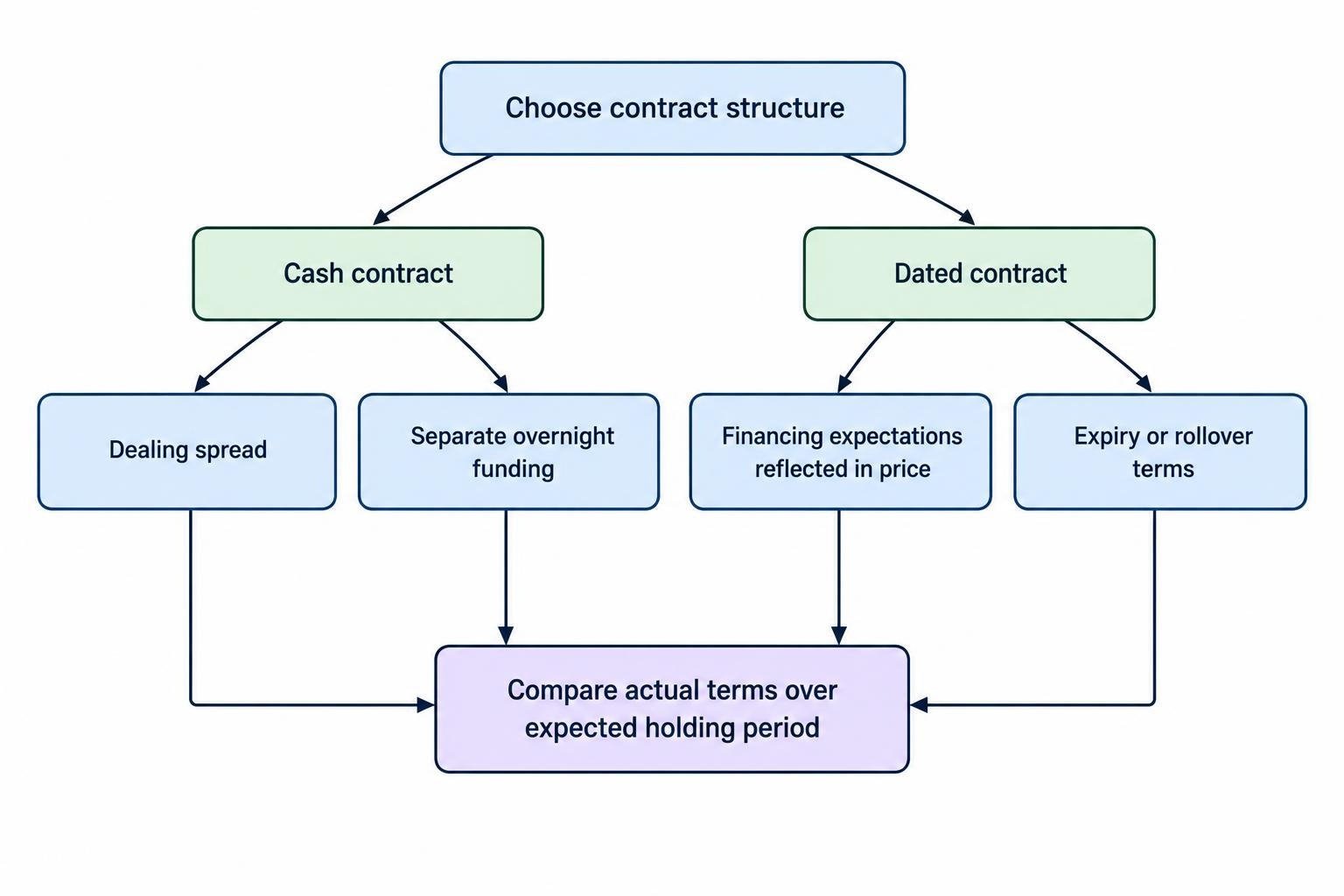
A broker offering both cash and dated index contracts gives you another decision to make. Cash contracts commonly combine a narrower dealing spread with separate overnight funding. Dated contracts incorporate financing expectations into their pricing and have expiry or rollover arrangements to consider. The relevant question is which structure costs less for your expected holding period.
Suppose a hypothetical cash contract has a one point spread and a dated alternative has a five point spread. At £2 per point, the spread difference is £8, assuming unchanged widths at entry and exit. If the cash position then costs £2 per night to fund, that initial advantage disappears after four nights, before allowing for other differences.
The arithmetic is straightforward; the inputs need care. Use the actual funding formula, contract prices and rollover terms. If you close earlier or later than planned, the result changes.
Do not select a dated contract simply because there is no separate daily funding debit. That does not remove financing from its economics. The comparison of daily funded bets versus futures spread bets explains the distinction without treating either structure as automatically cheaper.
Trading hours must match your availability
Ask when the broker accepts opening trades, not just when the underlying stock exchange is open. Also record daily maintenance breaks, holiday arrangements and any changes to dealing spreads outside the main session.
If you trade after work in the UK, a spread advertised during another session may tell you little about your likely cost. Compare quotes at the times you will use the account. Check the time zone stated in the contract details rather than assuming that every schedule uses UK time.
Out of hours access does not make the contract identical to its daytime version in every respect. Review price formation, order availability and spread terms. The index trading hours guide provides the market context; the broker’s contract schedule determines when that account can deal.
If a provider offers weekend markets, establish how those contracts relate to weekday positions. Do not assume a weekend quote or hedge automatically carries over in the way you expect.
Minimum stakes and margin are different checks
Can the minimum stake fit your loss budget?
A low deposit requirement says little about whether an index contract fits a small account. Minimum stake and sensible stop distance matter more.
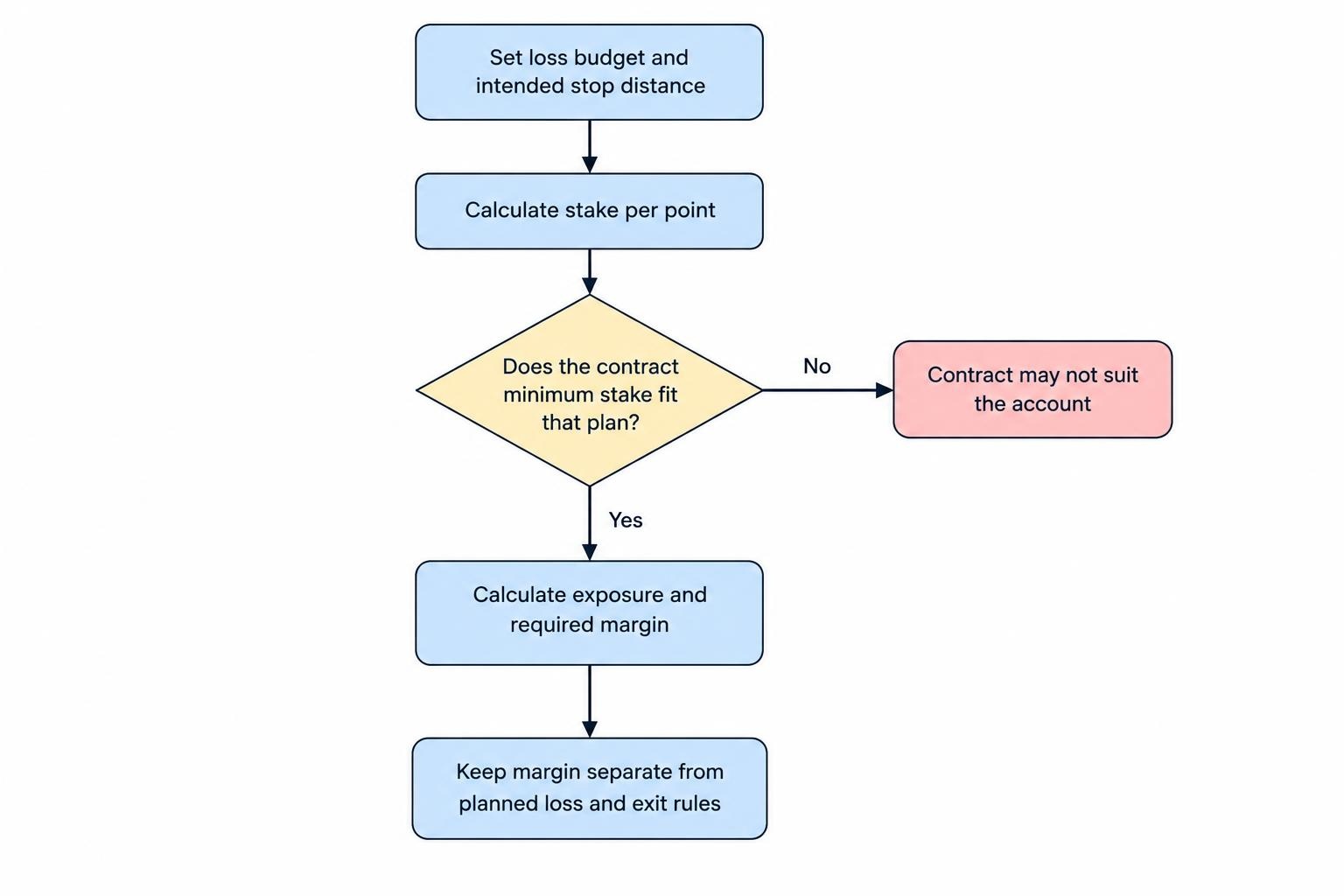
Suppose your planned loss budget is £15 and your intended stop is 60 points from entry. The arithmetic gives a stake of £0.25 per point before allowing for charges or adverse execution. If the contract’s minimum is £1 per point, the same stop implies a £60 loss at the stop price.
Moving the stop closer just to meet the broker’s minimum stake changes the trade. It does not solve the account mismatch. Apply your position sizing rules first, then find a contract that accommodates them.
How much margin will the account require?
For UK retail clients, the FCA rules require initial margin of at least 5% for major stock market indices and 10% for minor stock market indices, equivalent to maximum exposure of 20 and 10 times that margin respectively. They also require account level margin closeout below the prescribed 50% threshold, as soon as market conditions allow, and negative balance protection for funds dedicated to these products. These requirements appear in FCA Handbook COBS 22.5. Brokers can require more margin.
For an illustrative contract quoted per whole index point, an index level of 8,000 at £2 per point gives approximately £16,000 of exposure. At a 5% margin rate, the initial requirement is £800. A 100 point adverse move produces a £200 trading loss before charges.
The £800 is a deposit supporting the position, not a statement that £800 is an acceptable loss. Nor is the regulatory closeout threshold a substitute for your own exit plan. Ask how the broker calculates its account threshold, sends warnings and selects positions for closure.
Check the legal entity and protection arrangements
Establish the company that will hold your account before transferring money. Use the legal name and firm reference number in the account documents, then follow the process for checking a broker on the FCA Register. Match the contact details as well as the name, and examine permissions and restrictions relevant to the service.
A familiar trading brand should not replace that check. Where a group offers accounts through several companies, establish which entity your application uses and which client classification applies.
Eligible investment claims may receive FSCS compensation of up to £85,000 per person, per firm, subject to its requirements. This is not cover for ordinary trading losses or disappointing returns. The FSCS investment protection requirements distinguish eligible failures and shortfalls from poor investment performance.
Keep these protections separate in your comparison. Negative balance protection, margin closeout arrangements and compensation eligibility address different risks. None makes an index spread betting account a protected savings account.
Assess stops at the contract level
An ordinary stop loss sets an exit instruction; it does not guarantee the execution price. If the available price moves past the trigger, the loss can exceed the amount calculated from the stop distance.
Where guaranteed stops are available, compare their eligibility, minimum distance and premium. Establish when the premium is charged and whether changing the stop affects its terms. A general statement that a broker offers guaranteed stops does not establish availability on every index or platform.
This matters particularly when your trading plan depends on a capped exit price. Use the comparison of brokers with guaranteed stops to narrow the search, then confirm the chosen contract’s terms.
Check which quoted price triggers each order. A chart showing a midpoint or another price feed may not display the bid or offer used to trigger your stop. That distinction can explain an execution that otherwise looks surprising.
Judge the platform by order control, not appearance
A useful index trading platform should make the contract, direction, stake, margin requirement and attached orders easy to identify. Test how much information remains visible when you change the stake or amend a stop. A clear ticket is worth more than another screen of indicators.
Check whether placing an opposite trade closes an existing position or creates a separate position. Test partial closures, order cancellation and what happens to attached orders after the position closes. These are operational details, but they can become expensive details.
Execution deserves its own comparison. Record requested and filled prices, timestamps and rejected orders where available. One favourable fill proves little, and a headline speed figure does not describe every market condition. The broker execution quality research sets out the measurements worth examining.
If you expect to manage positions by phone, repeat the main tasks in the mobile app. Confirm that you can inspect the full ticket and amend orders without guessing which contract or position you are changing.
Use a demo to test the account workflow
A demo account is useful for checking whether you can operate the platform correctly. It is not proof that live orders will receive identical prices or execution.
Use a repeatable test rather than placing random practice bets. On each candidate platform, find the same index, open the same hypothetical stake, attach a stop and target, amend the stop, close part of the position and cancel a pending order. Then inspect the account history to see whether the records are clear.
Compare the account’s cash and dated contracts as part of that exercise. Check whether the ticket makes expiry, estimated funding and order restrictions easy to find. The spread betting demo account guide covers other checks before live trading.
Do not deposit simply because the demonstration is easy to use. Review the live account agreement and contract terms separately, and trade only with money you can afford to lose.
A final checklist for choosing an index broker
Before opening an account, you should be able to answer these questions without relying on a marketing headline:
- Which legal entity will hold the account, and what relevant permissions and restrictions apply?
- Does the exact index contract accept a stake that fits your loss budget?
- What spread applies during your usual trading session?
- What would the position cost over your expected holding period?
- Do the stop rules and margin arrangements fit your plan?
- Can you place, amend and close orders reliably on the device you will use?
For a smaller account, minimum stake is often the first filter. Compare brokers supporting small spread betting stakes before spending time on features that cannot fix an oversized position.
Choose the provider whose documented terms fit your planned trades, not the one with the longest feature list. If two accounts meet those requirements, compare their expected total cost and order workflow. If neither does, keeping both off the shortlist is a valid decision.