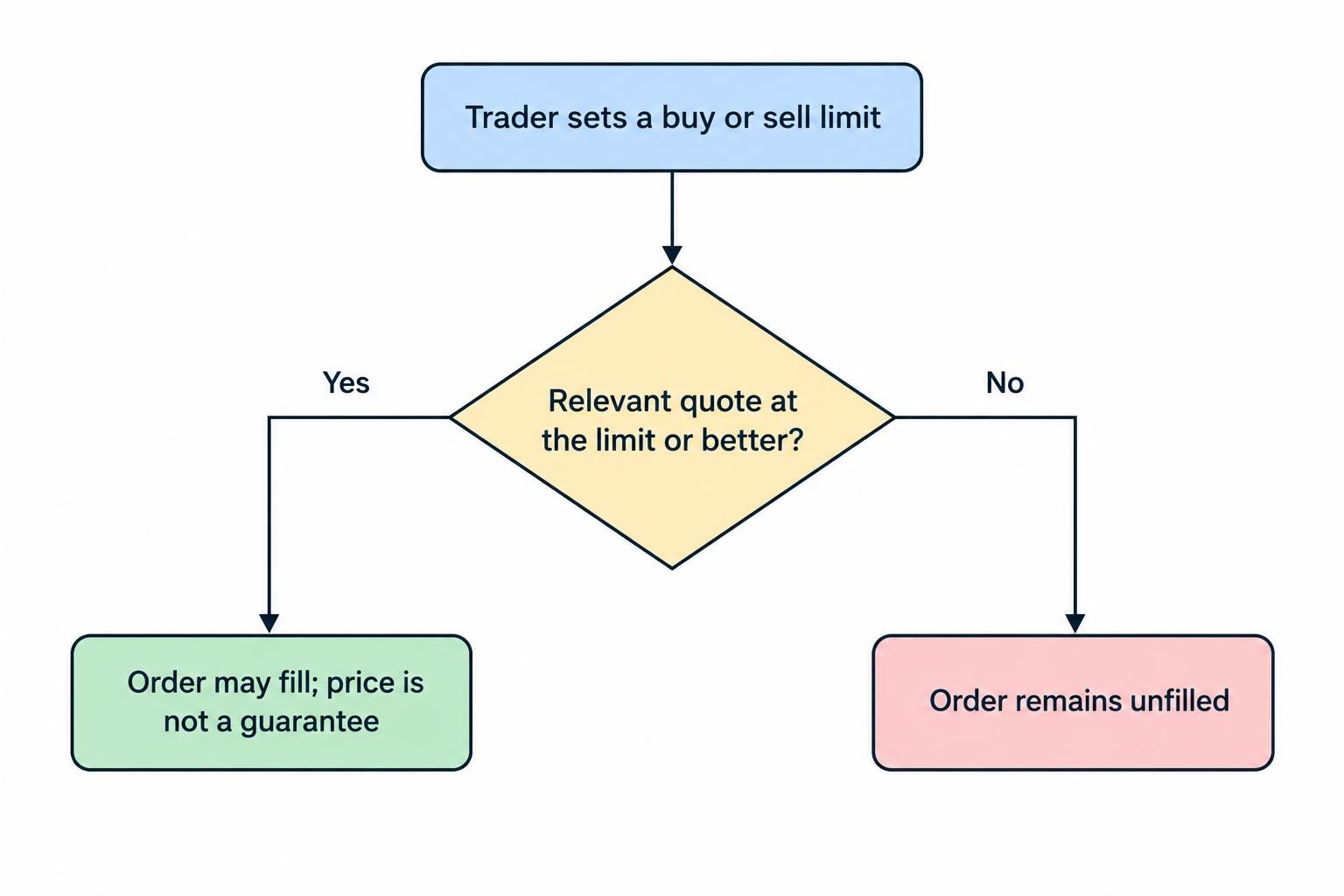
A limit order is an instruction to buy or sell at a chosen price or better. In spread betting, you can use one to enter after a pullback, sell after a rally, or close an existing position at a target price. The trade-off is straightforward: you control the acceptable price, but execution is not guaranteed.
Among spread betting order types, a limit order suits situations where price matters more than entering immediately. It can remove the temptation to chase a moving market. It cannot make an unsuitable trade sensible.
How Limit Orders Work
A buy limit sets the highest price you will accept when buying. A sell limit sets the lowest price you will accept when selling. If execution takes place under those conditions, the price must be your limit or better: lower for a purchase, higher for a sale. The distinction between price control and execution certainty is set out in the SEC investor bulletin on order types.
In spread betting, the order concerns your contract with the provider rather than ownership of the underlying shares, currency or commodity. Spread bets belong to the group of OTC derivatives covered by the FCA review of CFD providers’ pricing and value. Do not assume that placing an order adds it to an exchange’s public order book.
Your provider’s terms determine the available order settings, relevant quotes and execution process. Check what the platform means by “limit”, particularly whether the stated price is a binding execution boundary rather than just an activation level.
Buy Limits and Sell Limits
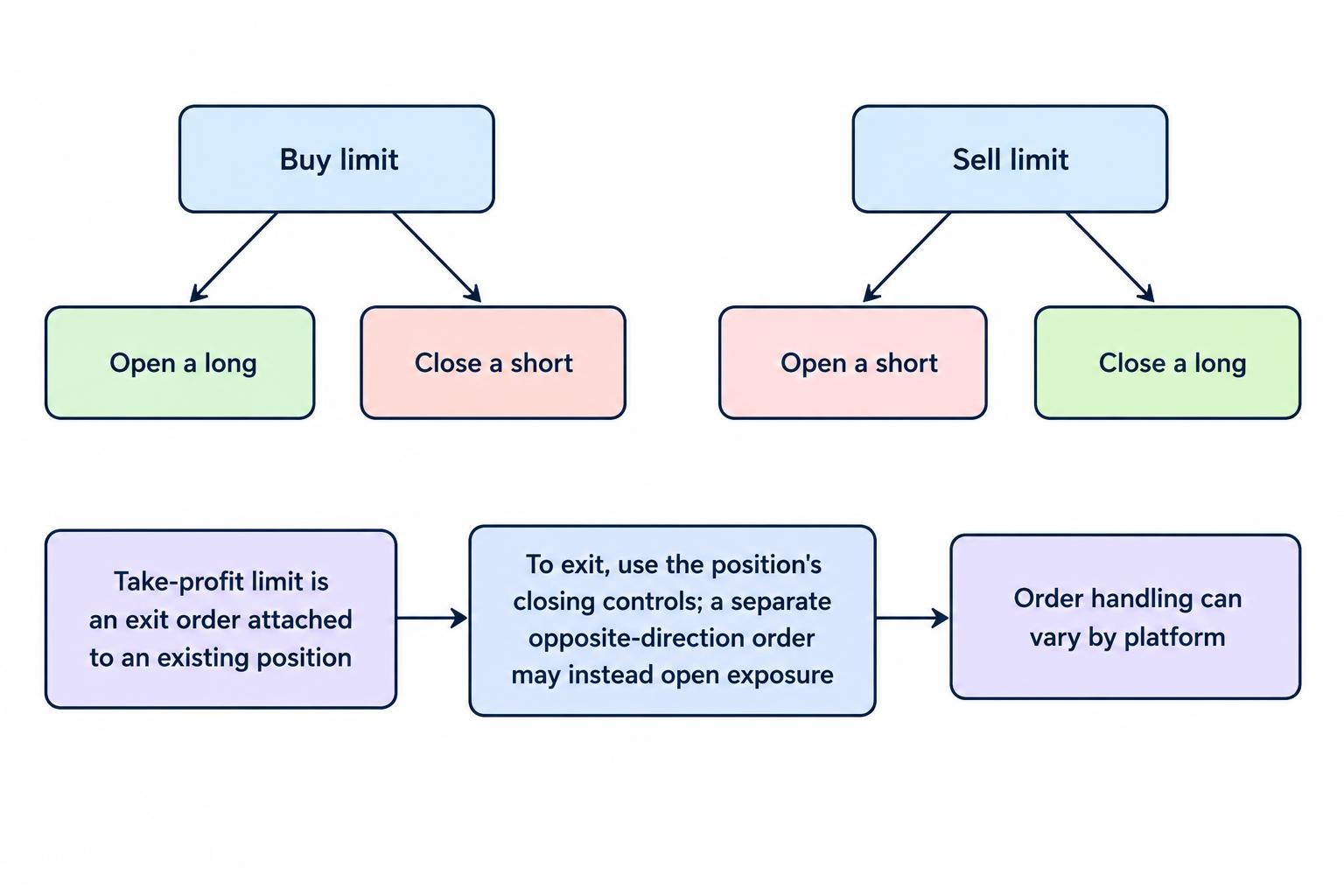
A resting buy limit normally sits below the current buy quote. A resting sell limit normally sits above the current sell quote. Either can open or close a position; the direction of the order alone does not tell you which.
| Order | Usual placement | Possible use |
|---|---|---|
| Buy limit | Below the current buy quote | Open a long position after a fall, or close a short position at a lower price |
| Sell limit | Above the current sell quote | Open a short position after a rise, or close a long position at a higher price |
These are the usual placements for orders waiting to execute. They are not universal restrictions. A buy limit above an available buy price is already executable in principle, although a spread betting platform may reject that placement or handle it differently. Read the ticket before submitting.
Entry Limits Versus Take-Profit Limits
An entry limit creates exposure if it fills. An attached take-profit limit closes some or all of an existing position. That difference matters when submitting an opposite-direction order: a separate sell order might open a short instead of closing your long, depending on the account’s position settings.
Use the position’s closing controls when your intention is to exit. Check the amount being closed too. A take-profit order covering half your stake leaves the other half exposed.
Which Price Must Reach the Limit?
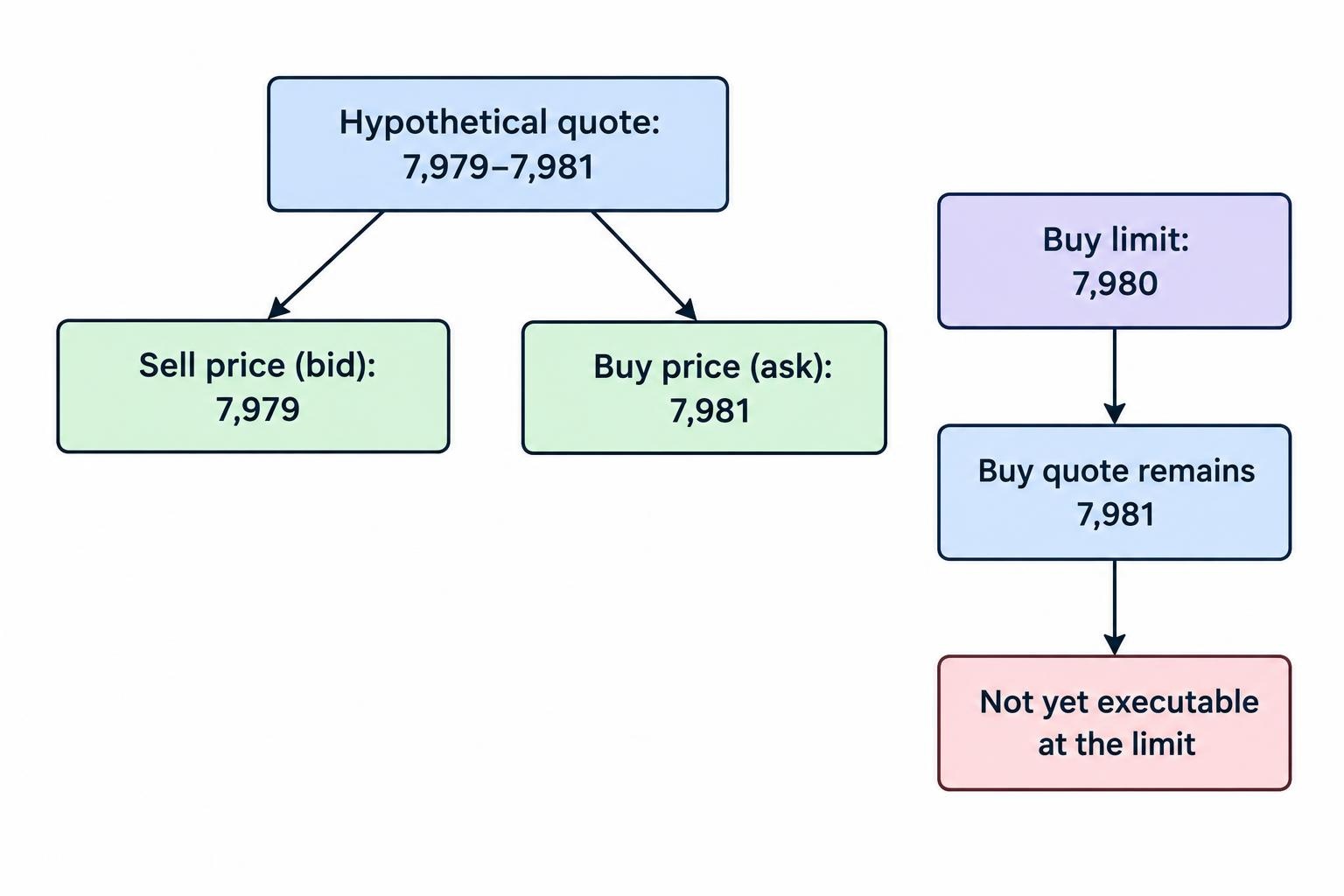
Spread betting quotes have a sell price, or bid, and a buy price, or ask. Buy orders use the buy side; sell orders use the sell side, subject to the provider’s stated execution rules. The distinction is covered in more detail in how spread betting spreads work.
Suppose an index is quoted at 7,999–8,001. You place a buy limit at 7,980. Later, the quote falls to 7,979–7,981. The sell price has passed your chosen level, but the buy price is still 7,981. Your buy limit has not yet become executable at 7,980.
This explains why an order can remain pending even when a chart appears to touch its level. The chart may display the bid, midpoint or underlying market rather than the quote relevant to your order. Compare like with like before treating a missing fill as an execution error.
Worked Example: Buying an Index With a Limit Order
Assume a hypothetical index spread bet is quoted at 7,999–8,001. You want to buy at 7,980, with a stake of £2 per point, rather than enter at the current buy price.
You submit a buy limit at 7,980. Later, the provider quotes 7,978–7,980 and confirms that your order has filled at 7,980. If you closed immediately at the sell price of 7,978, the trading loss would be £4: two points multiplied by £2.
You then attach a sell limit to close the full position at 8,040. If that order fills at 8,040, the trading profit is:
(8,040 − 7,980) × £2 = £120.
The opening buy price and closing sell price already account for the spread in this calculation. Any separate financing charges, fees or adjustments would still affect the account result.
There is another possible outcome: the market rises without falling to your entry level. Your buy limit remains unfilled and you miss the move. That is not necessarily an order failure. It is the consequence of refusing to buy above 7,980.
Limit Orders Versus Market and Stop Orders
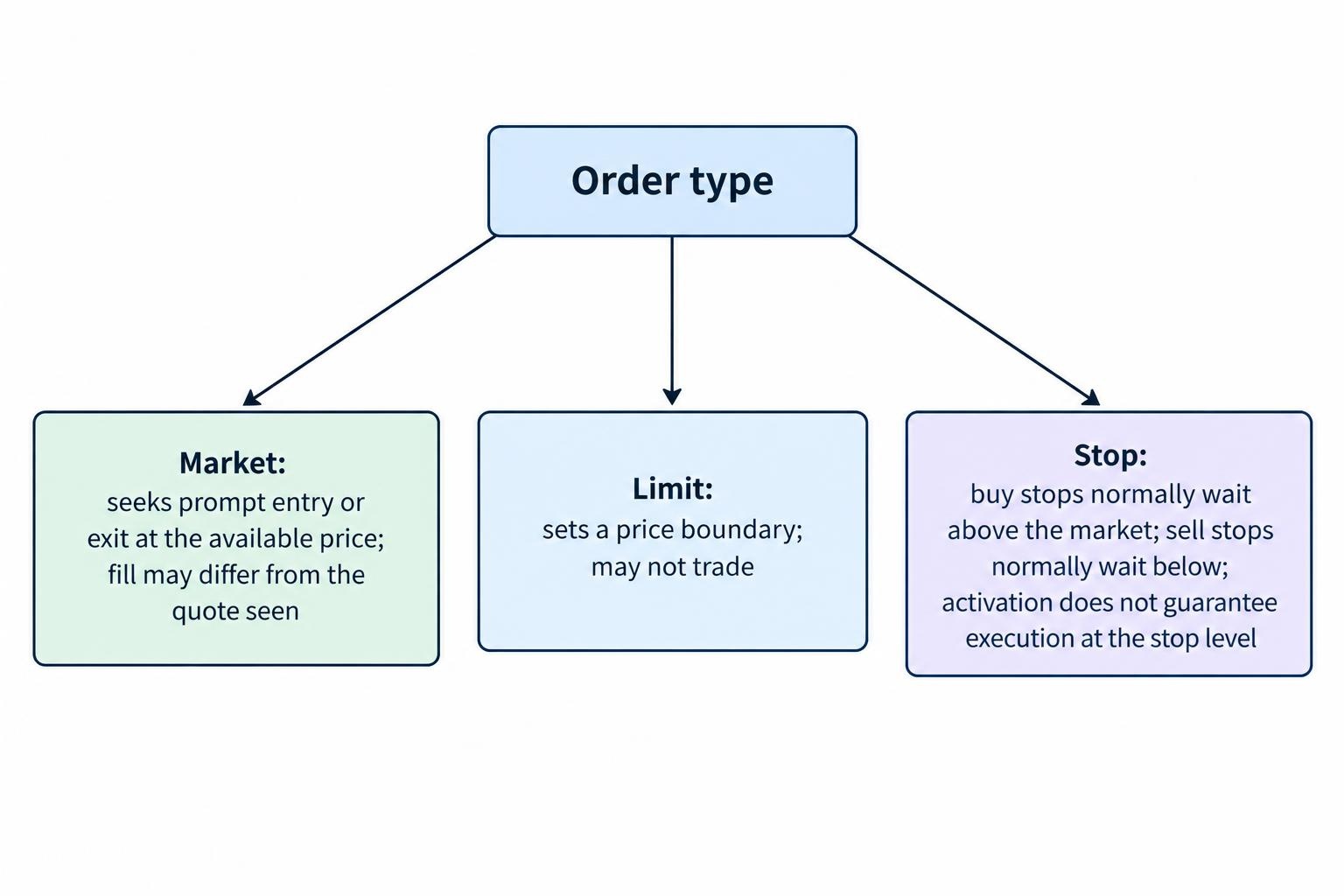
A market order requests execution at the available price without imposing your own limit price. It prioritises entering or exiting promptly, but the eventual fill may differ from the quote you saw. A limit order prioritises an acceptable price and accepts the possibility of no trade.
A stop order serves a different purpose. A buy stop normally waits above the market; a sell stop normally waits below it. Traders use them for breakout entries or exits after an adverse move. See how stop orders work before treating a stop level as a guaranteed execution price.
A stop-limit combines an activation level with a limit price. Once activated, its price restriction can prevent execution. Do not assume that this order type is available on every spread betting platform.
Why a Limit Order Might Not Fill
The simplest reason is that the relevant quote never reaches an acceptable price. Other possibilities depend on the provider: the order may have expired, trading may be suspended, or the requested stake may exceed what can be executed under the order’s conditions.
For an entry order, available margin can also matter. Do not assume that an order accepted earlier will still be executable after other positions have reduced your free funds. Check whether margin is assessed when the order is placed, when it triggers, or both.
The FCA best execution rules require firms to consider factors including price, costs, speed and likelihood of execution. They also require checks on the fairness of proposed OTC prices. Those duties do not turn every requested level into a promise of a fill.
A price gap does not automatically justify execution worse than a genuine limit. A buy might receive a lower price, or a sell a higher price, where the provider’s terms allow price improvement. Check the execution confirmation rather than assuming you received the level entered.
Order Duration, Amendments and Cancellation
The limit price answers “at what price?” Order duration answers “for how long?” Platforms may offer settings such as good for the day, good until a chosen date, or good until cancelled. Availability and expiry cutoffs vary, so check the setting instead of relying on the label alone.
A pending order’s expiry is separate from the expiry of the spread betting contract. Letting an unfilled entry order expire does not close another position you already hold.
Review orders when the reason for the trade changes. A buy limit placed before a company announcement may still execute afterwards, even though the announcement has invalidated your original reasoning.
When amending or cancelling, wait for confirmation. A cancellation request is not the same as a cancelled order. Check both pending orders and open positions before submitting a replacement, particularly during fast price moves.
A Limit Order Does Not Limit Your Loss
A buy limit caps the acceptable purchase price, not the loss after entry. If a position opens at 7,980 and the market keeps falling, losses continue to grow with the adverse movement and your stake per point.
A take-profit limit does not protect the other side of the trade either. You need a separate exit plan for an adverse move. Ordinary stop-loss orders can help implement that plan, but their execution price is not guaranteed.
Choose the stake from the planned risk, not from how attractive the entry looks. With a £2 stake and a planned stop 40 points from entry, the intended price risk is £80 before slippage and separate charges. The position sizing guide covers that calculation in more detail.
Before submitting, confirm the market, buy or sell direction, stake, limit price, duration and whether the order opens or closes exposure. Then check its status. A well-placed limit order provides price discipline; it does not remove the need to manage the trade.