Crude oil spread betting lets you take a position on changes in an oil price without buying barrels or owning an oil company’s shares. You choose a stake per point, buy if you expect the quoted market to rise, or sell if you expect it to fall. Your profit or loss depends on the price movement and your stake, after trading costs.
The difficult part is not choosing between buy and sell. It is knowing exactly what the quote represents. Brent and WTI are different benchmarks; daily funded and dated contracts behave differently; and a one dollar move can represent 100 betting points rather than one. A small mistake in the contract details can produce a large mistake in the account.
This guide covers crude oil within the broader commodity spread betting market, with examples for a sterling account. All prices, spreads and stakes below are hypothetical. Oil spread bets are leveraged products: losses can exceed the margin allocated to an individual position, and money held in the trading account remains at risk.
Which crude oil market are you trading?
“Oil” is not a single price. Before analysing a chart, identify the benchmark, contract month and pricing method behind it. A headline about Brent does not necessarily describe the WTI contract on your dealing ticket.
WTI crude oil
West Texas Intermediate, usually shortened to WTI, is associated with the US crude oil market. The benchmark NYMEX WTI futures contract connects to physical delivery at Cushing, Oklahoma. That delivery connection matters because storage availability, pipeline movements and local supply conditions can affect the price relationship between WTI and other oil markets. The mechanics are covered in CME Group’s explanation of the WTI delivery hub.
A spread betting platform may label its WTI market “US Crude”, “WTI Oil” or something similar. Treat the label as a starting point, not a contract specification. Check which futures month or constructed price the provider uses.
Brent crude oil
Brent is another major oil benchmark, associated with the North Sea market. The standard ICE Brent futures contract represents 1,000 barrels and is quoted in US dollars and cents per barrel. Its settlement structure allows exchange of futures for physical delivery, with an option to cash settle against the ICE Brent Index. The ICE Brent contract specifications set out those exchange terms.
Your retail spread bet is a separate agreement with the provider. It does not turn into a delivery obligation for 1,000 barrels. The exchange contract helps establish the reference price; your spread betting contract determines your stake, expiry, charges and cash settlement.
Brent and WTI prices need not match, and the difference between them is not fixed. Do not transfer a price level from one chart to the other without checking it. “Oil has reached resistance” is incomplete unless you can name the market and contract.
How oil prices translate into betting points
The most useful question on an oil ticket is straightforward: what price movement counts as one point?
Suppose the contract defines one point as $0.01 per barrel. A move from $78.40 to $78.41 is one point. A move from $78.40 to $79.40 is 100 points. At £2 per point, that one dollar movement changes the position’s value by £200.
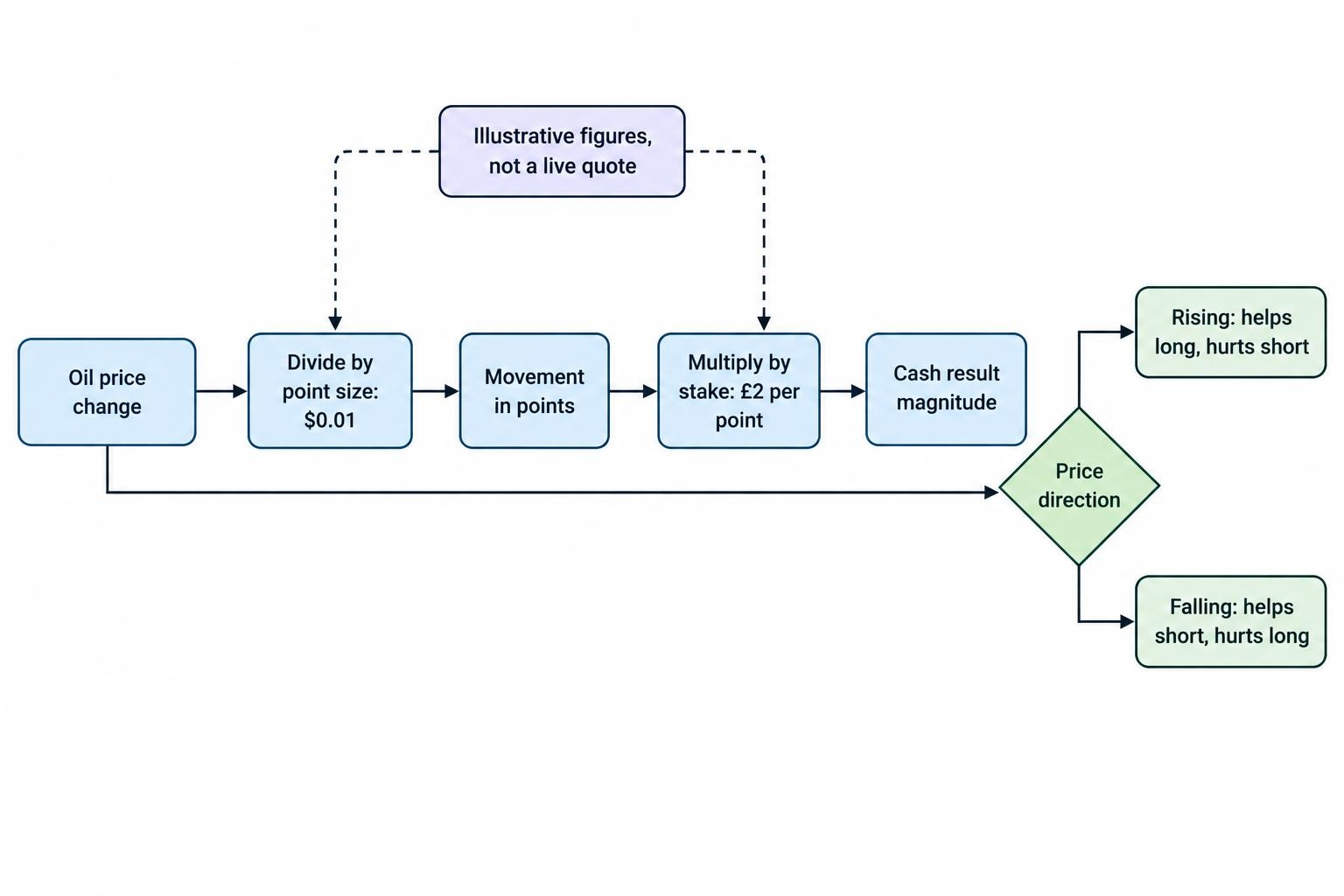
| Oil price movement | Movement in points | Profit or loss magnitude at £2 per point |
|---|---|---|
| $0.01 | 1 | £2 |
| $0.10 | 10 | £20 |
| $0.50 | 50 | £100 |
| $1.00 | 100 | £200 |
| $3.00 | 300 | £600 |
These figures show the size of the result, not whether it is a gain or loss. Direction decides that. A rising price helps a long position and hurts a short position.
Providers can display prices differently. A screen showing 7,840 may represent the same underlying price as $78.40, with the decimal moved for dealing purposes. Never infer the point value from the number of digits. The contract’s stake per point definition controls the calculation.
A sterling stake also does not mean you must convert every price movement from dollars into pounds yourself. If the agreement pays £2 per defined point, use that amount. Currency conversion charges, where applicable, are a separate contractual matter.
Crude oil spread betting examples
Assume an oil market has a sell price of $78.40 and a buy price of $78.44. One point equals $0.01, so the quoted spread is four points. The stake is £2 per point.
Buying oil: a long position
You expect the price to rise and buy at $78.44. Later, the provider’s sell price reaches $79.14, and you close the position.
Profit = ($79.14 − $78.44) ÷ $0.01 × £2 = £140.
The calculation uses the buy price at entry and sell price at exit. It does not use the chart’s highest price, a news headline price or the midpoint of the quote.
If the market instead falls and you close at a sell price of $78.04, the result changes:
Loss = ($78.44 − $78.04) ÷ $0.01 × £2 = £80.
Both results exclude any separate funding charges or other fees. The quoted spread is already reflected in the entry and exit prices, so do not subtract it again.
Selling oil: a short position
For a separate trade, assume the original quote is again $78.40/$78.44. You expect a decline and sell at $78.40. You later close by buying at $77.90.
Profit = ($78.40 − $77.90) ÷ $0.01 × £2 = £100.
If the price rises and you close at a buy price of $78.95, the loss is 55 points multiplied by £2, or £110.
Shorting does not reverse the spread. You still enter at the less favourable side of the quote and exit at the other side. Immediately opening and closing either position at an unchanged $78.40/$78.44 quote would cost four points, or £8.
Use executable prices when calculating spread betting profit and loss. A forecast can be directionally correct while the trade still loses money because the movement was too small to cover its costs.
Oil margin and leverage: the deposit is not the risk
For UK retail business covered by the FCA’s rules, crude oil falls within commodities other than gold, requiring initial margin of at least 10% of exposure, equivalent to maximum leverage of 10:1. Providers can require more. The rules also require account level margin close out when net equity falls below 50% of the required margin, with closure as soon as market conditions allow, and negative balance protection for the covered account. These requirements appear in FCA COBS 22.5 on retail leveraged products.
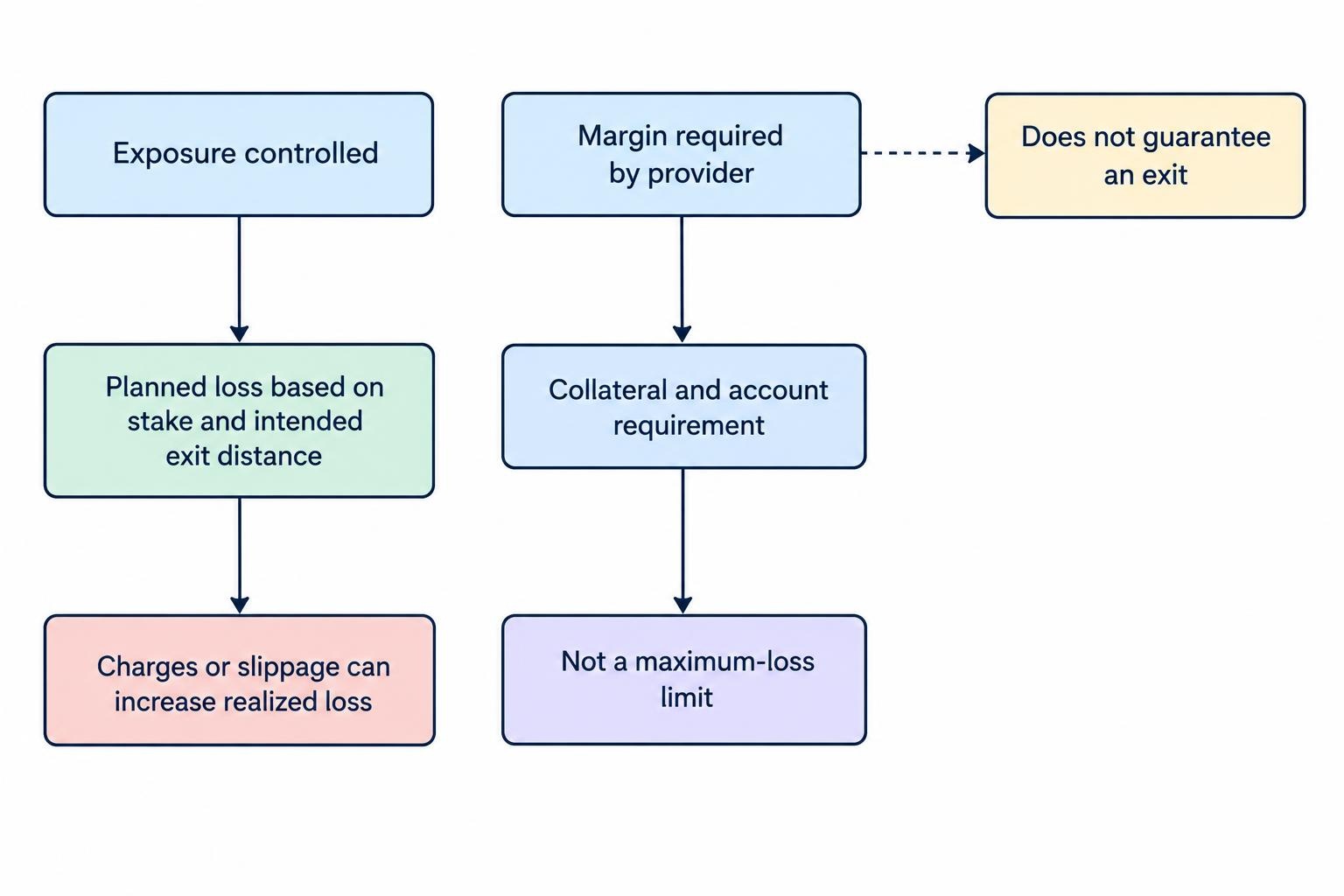
Those protections do not make the margin deposit a maximum loss for each bet. Other money in the account can support a losing position, while forced closure can happen before your planned exit.
Using the earlier example, a price of $78.44, a $0.01 point size and a £2 stake give an illustrative exposure of:
7,844 points × £2 = £15,688.
At a 10% margin rate, the initial margin would be £1,568.80. A one dollar adverse price move would still lose £200 before separate charges. The calculation does not become £20 because you deposited only one tenth of the exposure.
Actual margin can depend on the provider’s valuation method, position size and contract terms. Confirm the amount on the ticket rather than treating this example as a quotation.
The useful separation is between three numbers: the exposure you control, the margin required to open it, and the loss you intend to accept. They answer different questions. Having enough available margin says nothing about whether the position is sensibly sized.
Daily funded oil bets versus dated contracts
The benchmark is only half the product choice. You must also decide how the bet handles time. A daily funded oil market and a dated oil market can show different prices without either quote being wrong.
Daily funded or undated oil markets
An undated market does not present the same fixed expiry as a dated contract. That can simplify holding a position, but it does not remove the economics of the underlying futures market.
Check how the provider constructs its oil price. A contract may reference nearby futures and use adjustments as that reference changes. Its overnight charge may include more than a straightforward interest calculation. Do not apply an equity index funding formula to oil without checking the terms.
The questions to answer are practical: when is the adjustment booked, can it be a debit or credit, how does the futures curve affect it, and what administrative charge applies? A trade held for several weeks needs a different cost estimate from one closed that afternoon.
Dated oil spread bets
A dated bet references a stated contract period and has a last dealing time or expiry procedure. Funding may be reflected in the quoted price and spread rather than charged in the same way as an undated position. That does not make it free to hold.
The choice between daily funded bets and futures style spread bets should reflect the intended holding period, total cost and pricing method. A narrower entry spread is not automatically the cheaper choice for a month long position.
Read the provider’s last dealing date. It may precede the exchange contract’s expiry. Also check whether an open position closes automatically, rolls only on request, or rolls under a standing account instruction. The mechanics of spread betting expiry dates matter more than the month printed beside the market name.
Why the futures curve matters
Oil contracts for different delivery months can trade at different prices. An upward sloping curve, where later contracts cost more than nearer ones, is commonly called contango. A downward sloping curve is called backwardation.
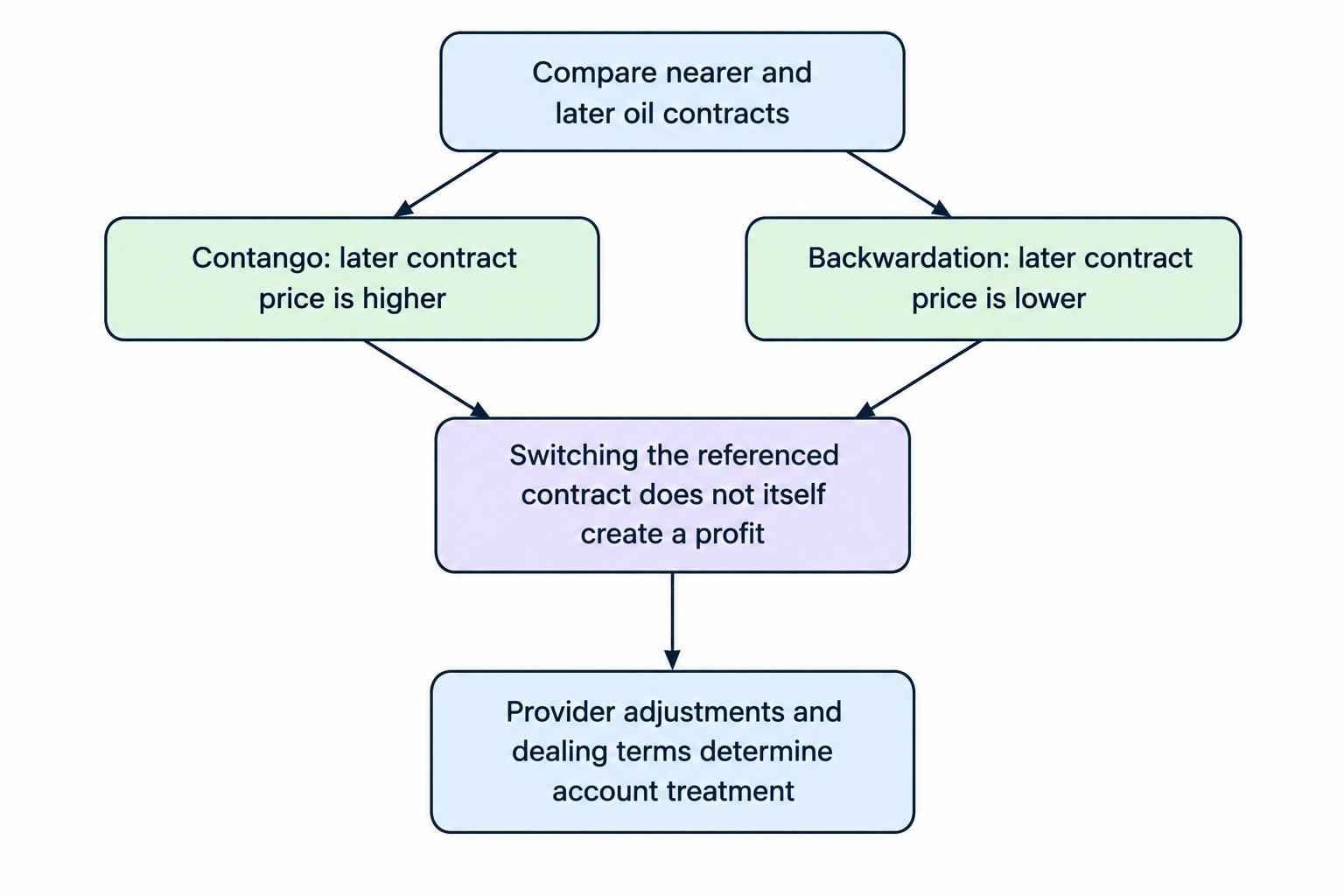
Suppose the nearby contract trades at $78 and the next contract at $79. Replacing one with the other does not create a one dollar profit because the displayed price rises. You have changed the contract being referenced.
The account treatment depends on how the provider closes, reopens or adjusts the position. Look for dealing spreads and adjustment entries as well as the price difference. A continuous chart may also be adjusted across contract changes, so its historical price levels may differ from those of the individual contract you can trade.
What moves crude oil prices?
Oil prices respond to changes in expected supply and demand. Economic activity affects fuel consumption, producer decisions affect available supply, and disruptions can alter how readily oil reaches buyers. Production and consumption cannot always adjust quickly, which can amplify price changes. The US Energy Information Administration’s oil price analysis covers these relationships, including production targets, inventories, weather and transport disruptions.
Production decisions and supply disruptions
For a trader, the useful distinction is between an announcement and a change in expected available barrels. Ask whether a proposed production change is new, when it would take effect, and whether other supply could offset it.
A hypothetical production cut can disappoint buyers if they expected a larger reduction. Equally, an alarming headline may have little lasting effect if it does not change the amount of oil reaching the market. The headline’s tone is not a trading signal.
Demand and refinery activity
Separate demand for crude from demand for finished fuels. Consider a hypothetical refinery shutdown: it could reduce that refinery’s crude purchases while also reducing its output of petrol or diesel. “Energy supply disruption” alone does not tell you which price should rise.
Build the trade around a testable proposition. “Crude demand will weaken because refinery purchases are falling” is clearer than “the news looks bearish”. It also gives you something to reassess when fresh information arrives.
Inventories and the EIA release
The EIA’s Weekly Petroleum Status Report normally releases its main weekly data on Wednesday at 10:30 a.m. US Eastern Time. Holidays can change both the day and time; check the official EIA petroleum release schedule before using it in a trading plan. Convert the time for the date concerned rather than assuming a permanent UK time.
A stock draw means inventories fell; a build means they rose. Neither is a complete instruction to buy or sell. Compare the result with the expectation you were trading against, then examine the report’s other components rather than relying on one headline number.
For example, an expected draw of three million barrels followed by an actual draw of one million represents less tightening than expected. That hypothetical result could challenge a bullish trade even though stocks fell. Plan this interpretation before the release; news trading with spread bets also requires an execution plan for a fast market.
Trading hours and choosing when to deal
Do not confuse exchange trading hours with the hours available on your spread betting account. The provider sets its dealing schedule, including breaks, holiday changes and the availability of individual dated contracts.
Confirm whether your orders remain active during each session and what happens when the market is closed. An order waiting on the platform is not the same as an order that can currently execute.
Use the relevant commodity trading hours as a starting point, then check the actual contract. Time zone labels deserve attention, particularly around clock changes and US data releases.
Choose a dealing window that fits the strategy and your ability to monitor it. If a position depends on your reaction to an inventory report, opening it before stepping away creates a mismatch between the plan and its management. A stop order helps manage that problem, but it does not make every exit price certain.
The costs that matter on an oil spread bet
The spread is the most visible cost. In the worked example, four points at £2 per point created an £8 entry to exit hurdle at an unchanged quote. At a £10 stake, the same quoted spread would represent £40.
Compare spreads at the times you intend to trade. A minimum advertised spread does not tell you what the quote will be during your planned entry, around a release or near a contract change.
For positions held beyond the provider’s funding cut off, estimate the overnight financing and adjustment costs under that oil contract’s formula. Do not assume a short position will receive a credit, or that a price adjustment is entirely an administrative fee. Separate the components shown in the terms and statement.
Execution can change the result too. Slippage is the difference between the price expected or requested and the price obtained. An otherwise modest spread offers little comfort if an urgent exit executes well beyond the intended level.
For a fair comparison, use the same benchmark, point definition, stake, holding period and order protection. Comparing an undated Brent quote with a dated WTI quote is not a cost comparison; too many variables have changed.
Set the stake from the exit, not the available margin
Start with the reason for the trade and the price at which that reason would no longer hold. Convert the distance to that exit into points, then calculate the stake that fits your planned loss.
Suppose a hypothetical entry and stop are 80 points apart, and the intended price loss budget is £100:
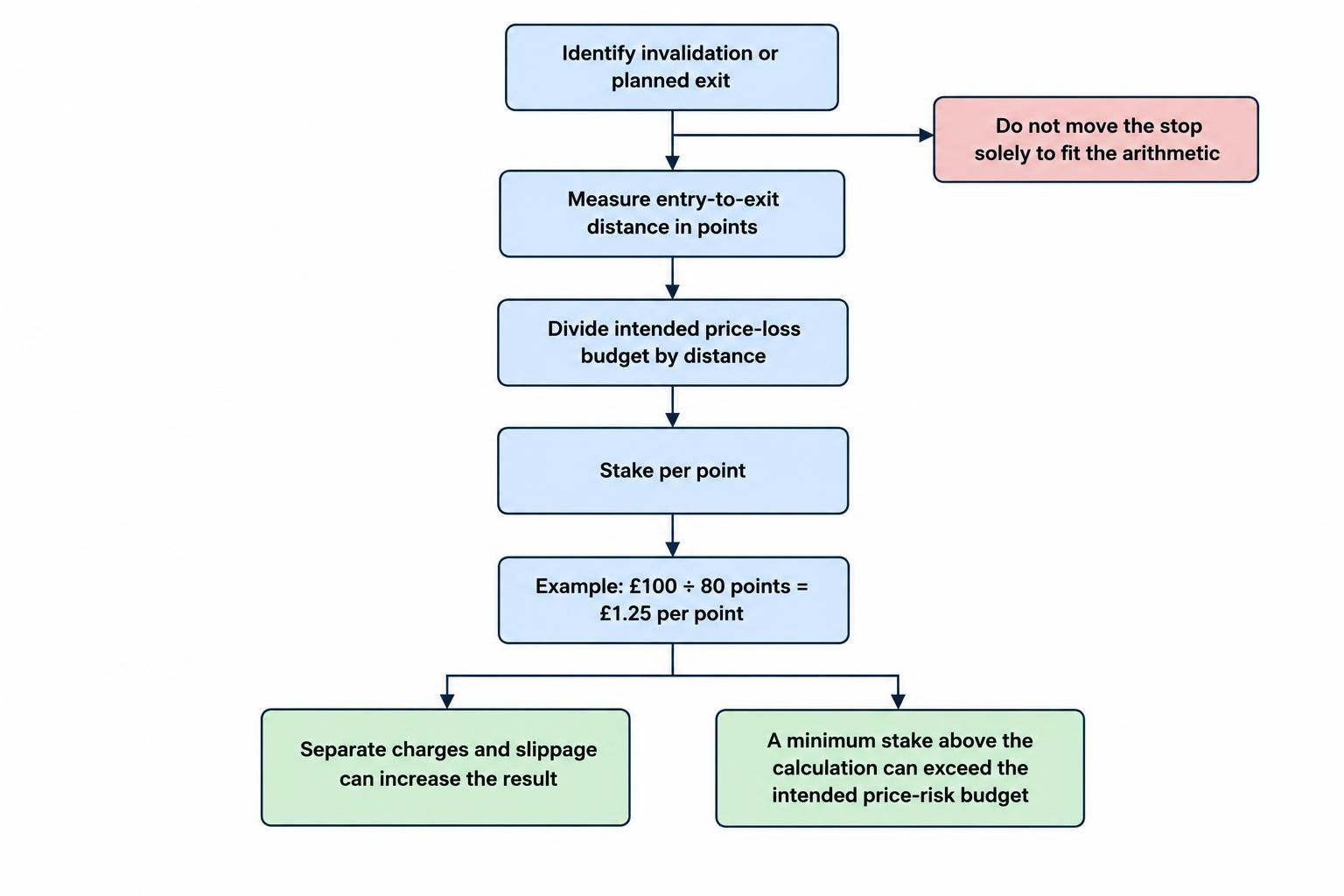
Stake per point = £100 ÷ 80 = £1.25.
That is the planned loss if execution occurs at the assumed stop price. Separate charges and adverse slippage can increase the result. If the contract’s minimum stake is £2, the same 80 point distance creates £160 of price risk before those additions.
The answer is not to move the stop closer solely to make the arithmetic fit. Either the smaller position is available, the trade meets a different valid plan, or you leave it alone. A minimum stake is a product condition, not a reason to increase your risk budget.
This is the purpose of position sizing for spread betting: translating an exit distance into an affordable exposure. Margin comes afterwards as a separate account constraint.
Ordinary stops and guaranteed stops
An ordinary stop is an instruction that triggers an exit process; it does not promise the requested execution price. If the quote jumps past the level, the fill can be worse. Check whether the stop is triggered by the bid, ask or another stated reference.
That detail matters in oil. A long position normally closes by selling, so a bid based trigger may behave differently from the single price shown on your chart. Spread changes can also affect when an order triggers.
Where offered, guaranteed stops provide a contractual exit price subject to their terms. Check availability for the oil contract, premiums, minimum distances and restrictions on amendments. Do not assume protection available on one market is available on another.
Oil does not have a dependable zero floor
On 20 April 2020, the May 2020 NYMEX WTI futures contract settled at minus $37.63 per barrel, one day before expiry. That was a particular futures contract, not a universal price for every barrel or every oil related product. The event is documented in the CFTC’s report announcement on negative WTI prices.
The trading lesson is not to predict another negative settlement. It is to avoid treating an assumed price floor as protection. Check how your provider handles exceptional prices, contract changes and market disruption. No physical delivery obligation does not mean no exposure to the pricing consequences of the physical market.
A separate problem is market gap risk. A price can move beyond an ordinary stop between executable quotes. Your risk plan should distinguish the intended exit from the loss you could face if that exit slips.
Applying a trading setup to crude oil
A useful setup states the entry condition, exit condition and circumstances in which no trade should be taken. “Oil should rise eventually” does none of those jobs.
Breakouts and failed breakouts
A hypothetical breakout plan might require a close above a recent trading range, followed by an entry only if the executable quote remains within a maximum distance of that level. That final condition helps prevent a planned breakout trade becoming an impulsive chase.
Define failure too. Would a return inside the range invalidate the trade, or would you require a closing price there? These are different rules. A structured breakout trading approach makes the distinction explicit rather than changing it after entry.
Volatility and stop distance
A fixed 30 point stop is a fixed monetary distance, not a fixed amount of market breathing room. Review the recent price range before deciding whether that distance suits the setup.
Average True Range can help describe recent movement, but it does not identify a safe stop or forecast the next headline. If the chosen exit needs more room, reduce the stake to preserve the planned monetary risk rather than accepting a larger loss by default.
Also review exposure beyond the single ticket. Two oil positions can express much the same underlying view. Buying Brent and buying WTI should not automatically be treated as two independent trades simply because the platform lists them separately.
Choosing an oil spread betting account
Choose the contract before comparing the headline offer. A provider can be suitable for one style of oil trading and unsuitable for another because of its minimum stake, pricing method, expiry process or order restrictions.
When comparing commodity spread betting providers, concentrate on the details that change your intended trade: benchmark coverage, point value, normal dealing spread, funding formula, margin schedule, last dealing date and stop availability.
Look for clear explanations of exceptional market handling as well. You need to know how pricing interruptions, reference contract changes and disputed executions are treated before they become relevant to an open position.
Use a spread betting demo account to practise ticket mechanics. Confirm that a ten cent move produces the cash result you expect, place and amend an order, and inspect how the platform presents expiry and funding information. Demo trading can help catch unit errors, but it does not establish that live execution will match the simulation.
Before placing an oil spread bet
A complete trade plan should let you describe the exposure without referring vaguely to “a small oil position”. Before submitting the order, check:
- The market: Brent or WTI, and the correct dated or undated contract.
- The units: the price movement represented by one point and the cash value of that point.
- The exit: the invalidation level, order type and potential effect of slippage.
- The costs: spread, expected holding adjustments and any protection premium.
- The timing: relevant releases, dealing breaks and the last dealing date.
- The account: margin headroom and exposure from other open positions.
The practical test is simple: can you state what a one dollar adverse move would cost, what closes the trade, and what holding it overnight changes? If any answer is unclear, resolve it before placing the bet. Oil already supplies enough uncertainty without adding uncertainty about the contract.