Spread betting and contracts for difference (CFDs) can give you almost identical exposure to a financial market. Both let you trade rising or falling prices without owning the underlying asset. Both use margin, and both can turn a modest market move into a substantial account loss.
The main differences are how you size the position, how charges appear and how the result is treated for UK tax purposes. A spread bet uses a monetary stake per point. A CFD uses a quantity of contracts or units, with a defined value for each price movement.
Neither product is automatically cheaper or safer. To compare them properly, match the exposure first, then examine costs, account protections and tax treatment. If you need the underlying mechanics before comparing the two, start with what financial spread betting involves.
Spread betting and CFDs: the main differences
| Feature | Spread betting | CFDs |
|---|---|---|
| Position size | A monetary stake for each point of price movement | A number of contracts or units, multiplied by the contract’s value |
| Profit and loss | Points gained or lost × stake per point | Price movement × quantity × any contract multiplier |
| Market direction | Buy to trade a rise; sell to trade a fall | Buy to trade a rise; sell to trade a fall |
| Underlying ownership | No ownership of the referenced shares or other assets | No ownership of the referenced shares or other assets |
| Execution charges | Can be incorporated into the quoted spread | Can involve the spread, separate commission or both |
| Overnight costs | Depend on whether the bet is daily funded or dated | Depend on the cash, rolling or dated contract structure |
| Settlement currency | Determined by the bet’s stake currency and contract terms | Determined by the contract and account arrangements; conversion may apply |
| Expiry | Daily funded and fixed expiry bets are different contract types | Rolling and fixed expiry contracts are different contract types |
Tax is covered separately below because a simple “tax free versus taxable” label leaves out loss relief, commercial hedging and company accounts. Those distinctions can change the comparison.
How position sizing differs
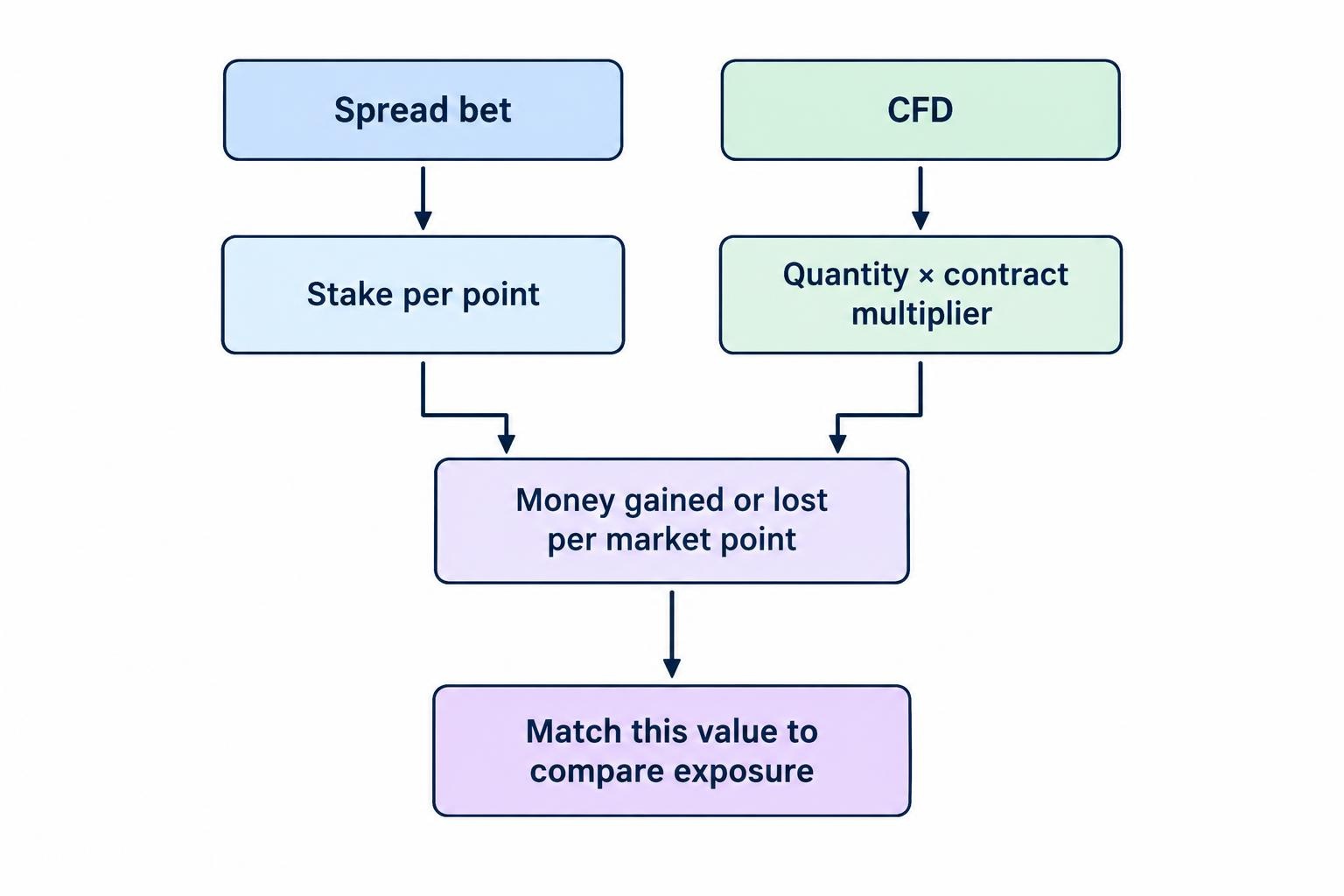
Spread betting: money per point
With a spread bet, you choose how much each point is worth. At £2 per point, a favourable movement of 40 points produces an £80 trading profit. An adverse movement of 40 points produces an £80 trading loss, before any separate charges.
For a long position:
Trading profit or loss = (closing sell price − opening buy price) × stake per point.
The word “point” needs checking. On one market it may mean a whole index point; on another it may represent a penny, pip or another defined increment. The number printed in the stake box tells you little until you know the contract’s point definition.
This is why stake per point and total exposure must be considered together. A £1 stake is not a £1 maximum loss. It is the amount gained or lost for each point the market moves.
CFDs: contracts, units and multipliers
A CFD expresses the same price sensitivity through quantity. For a straightforward share CFD, 100 units may represent exposure equivalent to 100 shares. A £0.20 rise would then produce a £20 trading profit on a long position, before charges.
Index and commodity contracts may use a multiplier. If one index CFD pays £1 per index point, two contracts create £2 per point of exposure. Another provider’s contract might use a different multiplier, so “two contracts” is not a universal position size.
For a long position:
Trading profit or loss = (closing sell price − opening buy price) × quantity × contract multiplier.
Currency conversion may then be needed to express that result in your account currency. The practical task is to reduce both tickets to the same measure: how much money do you gain or lose for one market point? Once those values match, the comparison becomes much clearer.
A worked example with equal exposure
Assume a fictional sterling index market has a sell price of 7,999 and a buy price of 8,001. You expect it to rise. These are illustrative prices, not live quotations.
You could open either a £2 per point spread bet or two CFDs, each worth £1 per index point. Assume both products have identical dealing prices and, for this example, require 5% initial margin. Ignore separate commission, funding and other adjustments for the moment.
| Trade detail | Spread bet | CFD position |
|---|---|---|
| Opening buy price | 8,001 | 8,001 |
| Position size | £2 per point | 2 contracts at £1 per point each |
| Equivalent notional exposure | £16,002 | £16,002 |
| Initial margin at 5% | £800.10 | £800.10 |
| Closing sell price after a rise | 8,051 | 8,051 |
| Trading profit | 50 points × £2 = £100 | 50 points × 2 × £1 = £100 |
| Alternative closing sell price after a fall | 7,951 | 7,951 |
| Trading loss in that alternative | 50 points × £2 = £100 | 50 points × 2 × £1 = £100 |
The economic exposure is the same. Changing the product label has not changed the £100 gain or loss.
The spread also works the same way. If you buy at 8,001 and immediately close at an unchanged sell price of 7,999, you lose two points, or £4. The market must move far enough in your favour to cover that initial difference before the position breaks even, assuming no other charges.
Do not subtract the spread again after calculating profit from the actual opening and closing execution prices. It is already reflected in those prices. Separate commission or funding charges are another matter.
The £800.10 margin is collateral, not a loss ceiling. A 400 point adverse move would represent an £800 trading loss at this position size, before charges and subject to any earlier account close out.
Short positions follow the reverse calculation: you open at the sell price and close at the buy price. Both products can express that view. The mechanics of long and short spread bets explain why a falling market can produce a profit, but also why an adverse rise creates a loss.
UK tax: where the comparison changes
This section concerns UK tax treatment, mainly for individuals trading their own money. It is not a statement about taxation in other countries. Tax residence, the contract’s purpose and the capacity in which you trade all matter.
Spread betting gains and losses
For an individual placing genuine private financial spread bets, winnings are generally outside Capital Gains Tax. The statutory basis is the exemption for betting winnings in section 51 of the Taxation of Chargeable Gains Act. That can make spread betting attractive where an otherwise comparable CFD profit would create a tax liability.
The reverse side is that private spread betting losses are not allowable capital losses. You cannot normally use them to reduce taxable gains from a separate share portfolio or CFD account. The capital loss rules in section 16 of the same Act connect the treatment of losses with the distinction between chargeable and exempt gains.
Income Tax needs a separate distinction. Profits from genuine gambling or wagering contracts are outside its scope for individuals, but commercial use, such as a business hedge, can change the treatment. Companies generally fall under different derivative contract rules. These boundaries appear in HMRC’s guidance on CFDs and spread betting for individuals and companies.
Do not extend the private betting treatment to a company account or a commercial hedge without advice. Equally, an account described as “professional” by a provider does not, by itself, answer a tax question.
CFD gains and losses
For individuals, retail CFD outcomes generally fall within the capital gains regime unless profits are taxable as trading income. A closed position can produce a chargeable gain or an allowable loss. Commission and amounts equivalent to interest and dividends enter the net contract calculation, rather than being treated automatically as ordinary investment income. Standard share CFDs also avoid the share acquisition charge to Stamp Duty Reserve Tax because the trader does not acquire the underlying shares. These points are covered in HMRC’s tax guidance for retail contracts for difference.
An allowable loss is not a refund of the whole loss. Its usefulness depends on the relevant tax rules and your circumstances. Nor does a potentially taxable CFD profit mean that every profitable trade creates an immediate tax bill.
The sensible comparison is the cash result after costs and any applicable tax, not the headline treatment alone. For reporting, loss relief and less straightforward arrangements, use the separate spread betting versus CFD tax comparison. Keep statements and transaction records for either product, even when you expect private betting profits to be exempt.
Which costs more: spread betting or CFDs?
There is no reliable product wide winner. A fair comparison needs the same underlying market, monetary exposure, direction, trading time and expected holding period. Comparing a tiny index spread bet with a larger share CFD tells you little about either product’s value.
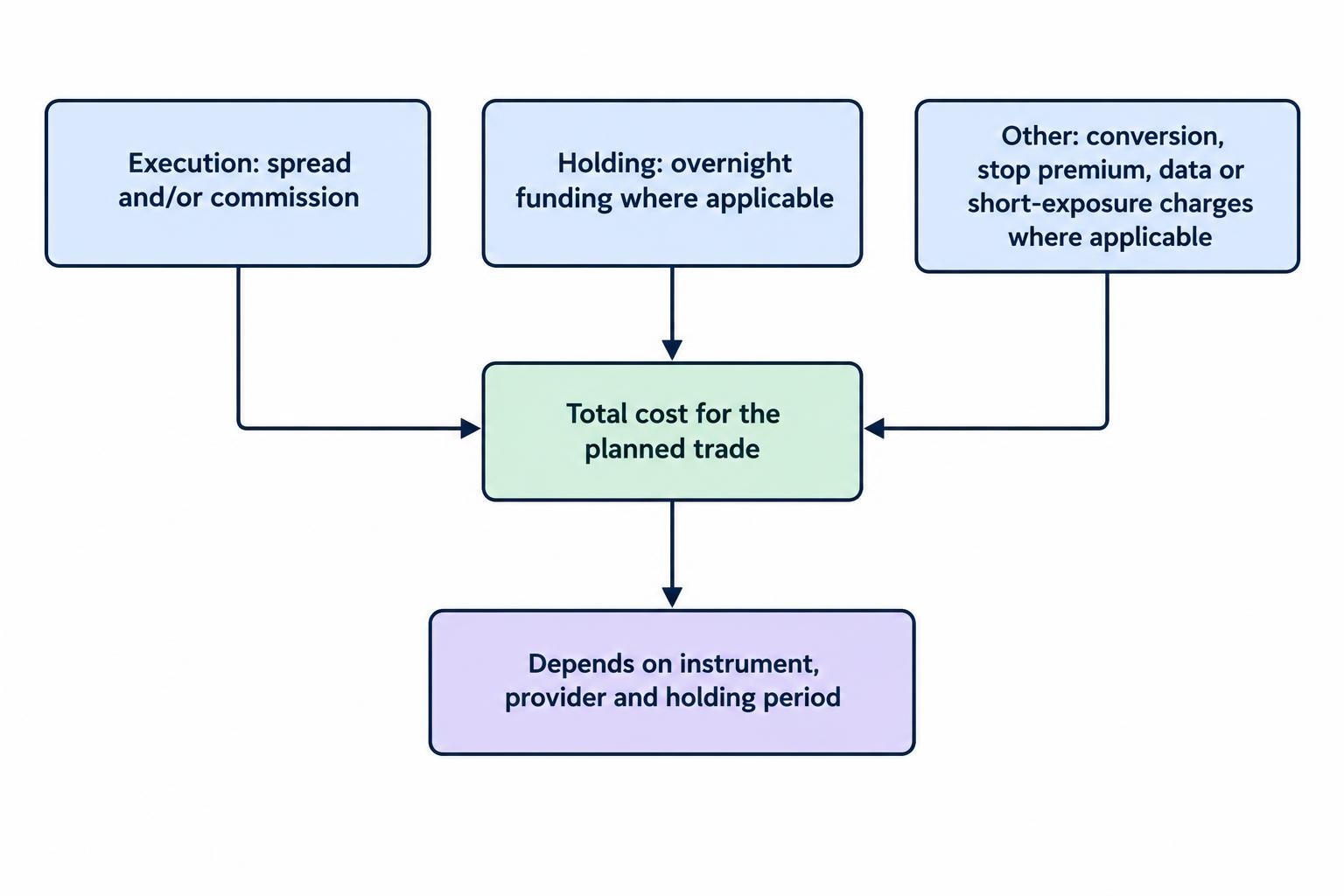
Spreads and commission
A spread bet may incorporate its execution charge into the quoted bid and offer. A CFD may use a spread, separate commission or both. The charging model depends on the instrument and provider, not just the account label.
A tighter spread does not automatically mean a cheaper trade. Suppose one hypothetical contract costs £6 through its spread with no separate commission. Another costs £2 through the spread plus £3 commission to open and £3 to close. The second contract has the more attractive spread but costs £8 for the completed trade.
Minimum commissions deserve attention on small positions. A percentage charge can look modest until a minimum fee applies at both entry and exit. Compare the pounds paid for your intended trade size, rather than percentages in isolation.
Use quotes from the hours you expect to trade. An advertised minimum spread is not a promise that the same price difference will be available around an economic announcement or outside the underlying market’s main session.
Overnight financing
Holding period can change the result more than a small difference in spread. Cash or daily funded positions can incur financing for remaining open across the provider’s funding cut off. The calculation may depend on the reference rate, provider adjustment, position direction and contract terms.
Funding rates vary between firms and assets, and their presentation can make comparisons difficult. The FCA’s October 2026 findings on CFD pricing and overnight charges identify continuing concerns about both the level of charges and how firms disclose them. The findings cover spread bets as well as CFDs.
For a simple illustration, assume the £16,002 position in the earlier example carries a flat annual funding charge of 8%, calculated on full notional exposure using a 365 day basis:
Illustrative daily charge = £16,002 × 8% ÷ 365 = approximately £3.51.
That is an assumed rate and calculation method, not a market quote. It shows why funding matters: ten equivalent daily charges would consume about £35 of a £100 trading profit. Posting extra collateral would not reduce this hypothetical charge, because the assumed formula uses notional exposure rather than the margin balance.
Check weekend treatment, holiday adjustments and the funding cut off before holding a position. The separate guide to overnight financing costs covers the calculations without assuming every contract works identically.
Execution and other charges
The expected price and executed price can differ. A one point worse fill costs £2 on either of the matched positions above. A cheaper published spread can therefore be outweighed by execution differences, especially for a strategy that trades frequently.
This is slippage, and it affects both products. Consider order handling, available trading hours and the prices used to trigger stops rather than judging execution from a platform screenshot.
Other possible costs include currency conversion, guaranteed stop premiums, market data and charges associated with maintaining short exposure. Only include charges that apply to the actual contract. A total spread betting cost comparison provides a more useful framework than choosing an account from its narrowest advertised spread.
Risk and retail protections are closely related
A spread bet is not made safer by being called a bet, and a CFD is not made safer by being called a contract. If both positions gain or lose £2 per point, their immediate market risk is the same.
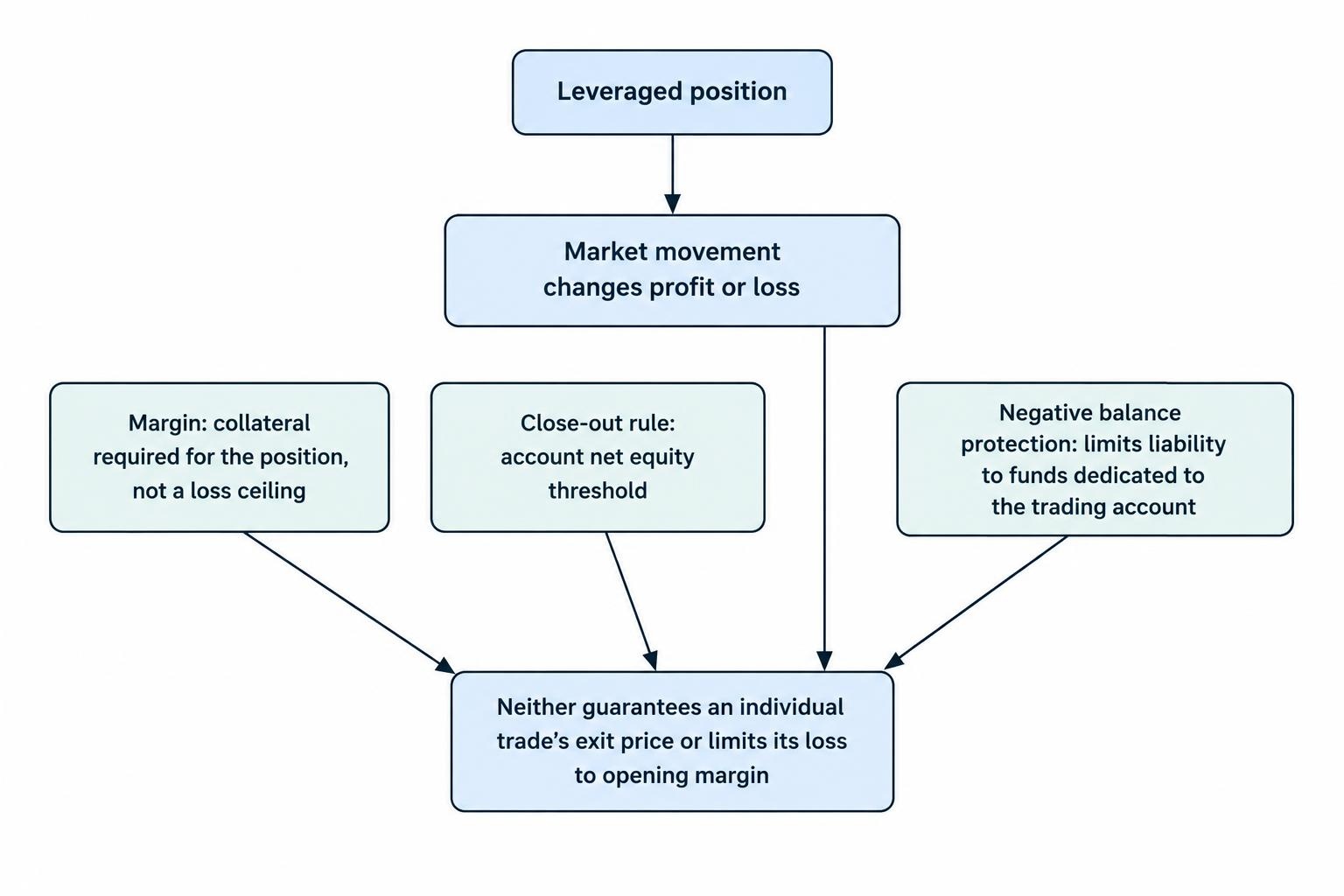
UK retail restrictions cover leveraged spread bets as well as CFDs. Minimum initial margin includes 5% for major stock market indices and 20% for individual shares; providers can require more. Firms must close positions as soon as market conditions allow when account net equity falls below 50% of the required margin. Negative balance protection restricts liability to funds dedicated to the relevant trading account. These requirements are set out in FCA Handbook COBS 22.5 on retail CFD and spread betting restrictions.
These are account safeguards, not promises that an individual trade cannot lose more than its opening margin. Nor is the 50% close out threshold a guaranteed execution price.
If an account required £800 margin to maintain its positions, the regulatory threshold would be £400 of net equity. That is not “half of the original cash deposit” unless the numbers happen to coincide. Other open positions and changes in their values can affect the account calculation.
Before relying on any protection, confirm your client classification and the legal entity holding the account. The guide to UK retail client protections separates those safeguards from the risks that remain.
Position size matters more than the product label
Consider a planned exit 50 points from entry. At £2 per point, the intended trading loss is £100 before charges. At £10 per point, it is £500. Neither switching to CFDs nor changing the display from “stake” to “contracts” alters that arithmetic.
Work backwards from the monetary loss you can tolerate, then calculate a position that fits the distance to the planned exit. Do not start with the largest position the margin calculator permits. That reverses the decision. A structured approach to position sizing for spread betting applies equally to an economically matched CFD.
An ordinary stop order does not guarantee its execution price. A market gap can produce a larger loss than planned. A guaranteed stop loss, where offered and subject to its terms, addresses that execution risk differently, but may involve a premium and restrictions on placement.
A small deposit does not make a large position small. It just changes how much collateral is needed to open it.
Currency, market access and contract duration
Settlement currency can change the comparison
A sterling denominated spread bet can express the result on an overseas market directly in pounds per point. A CFD on that market may instead generate profit or loss in another currency, followed by conversion into sterling. Check the actual terms rather than assuming either arrangement applies everywhere.
A £1 per point spread bet on a US index is not the same sterling exposure as a CFD paying $1 per point. The market point is the same; the monetary value is not. Convert both into a common account currency before comparing position sizes.
Settling a bet in pounds does not remove all currency related economic influences on the underlying market. It does, however, differ from receiving a dollar result and paying a conversion charge. The guide to currency conversion costs helps separate those issues.
Check the instrument, not just the market name
Two tickets labelled “gold” or “UK 100” need not reference identical contracts. One may use a cash style price and another a dated futures reference. They can differ in expiry, funding, price adjustments and the process for maintaining exposure beyond the contract’s end date.
That difference can be larger than the distinction between a spread bet and a CFD. Compare the underlying reference, point size, trading hours, expiry and settlement method before comparing prices.
A dated contract without a separate daily funding debit is not necessarily free of financing costs; carrying costs can be reflected in its price. The comparison of daily funded bets and futures based spread bets covers this contract choice in more detail.
Availability is another practical filter. Check whether the account offers the instrument, minimum size, order types and platform functions your approach requires. This is a UK focused comparison, not confirmation that either product is available or suitable in another jurisdiction.
Which product fits different trading purposes?
Private speculative trading
For a UK individual comparing otherwise similar private speculative trades, spread betting’s tax treatment deserves attention. But “otherwise similar” must do some work here. Compare exposure, execution, financing and settlement before treating tax as the deciding factor.
CFDs may fit better where their contract sizes, currency arrangements or available instruments match the intended trade more closely. Conversely, a pounds per point ticket may make a spread bet easier to size and monitor. Ease of use is useful only if you can still explain the position’s full exposure.
For frequent trading, small execution costs accumulate. For a position held for weeks, funding can become the larger expense. The preferred product can therefore change with the strategy even when the underlying market stays the same.
Hedging an existing position
Both products can create short exposure against an existing holding. A share CFD quantity can make it straightforward to express exposure equivalent to a number of shares. A spread bet can do the same after converting the stake into equivalent price sensitivity.
Matching the headline value is only a starting point. An index hedge may not move in line with a portfolio of individual shares. Dividends, currency, trading hours and the hedge’s duration can leave residual exposure.
Tax needs attention too: do not assume the treatment of a private speculative bet carries across to a commercial hedge. The guide to hedging with financial spread bets examines the practical trade structure. For business use, obtain advice on the arrangement before relying on a particular tax outcome.
Long term ownership
If the aim is to own shares, receive shareholder rights and hold them for years, neither product does that job. Both provide contractual price exposure rather than ownership, and maintaining a leveraged position introduces collateral and contract management demands.
That does not make every longer holding period impractical, but it changes what needs comparing. Assess financing and maintenance costs against direct ownership rather than treating a derivative as a cheaper share purchase. The spread betting versus share dealing comparison is more relevant to that decision.
How to compare two actual accounts
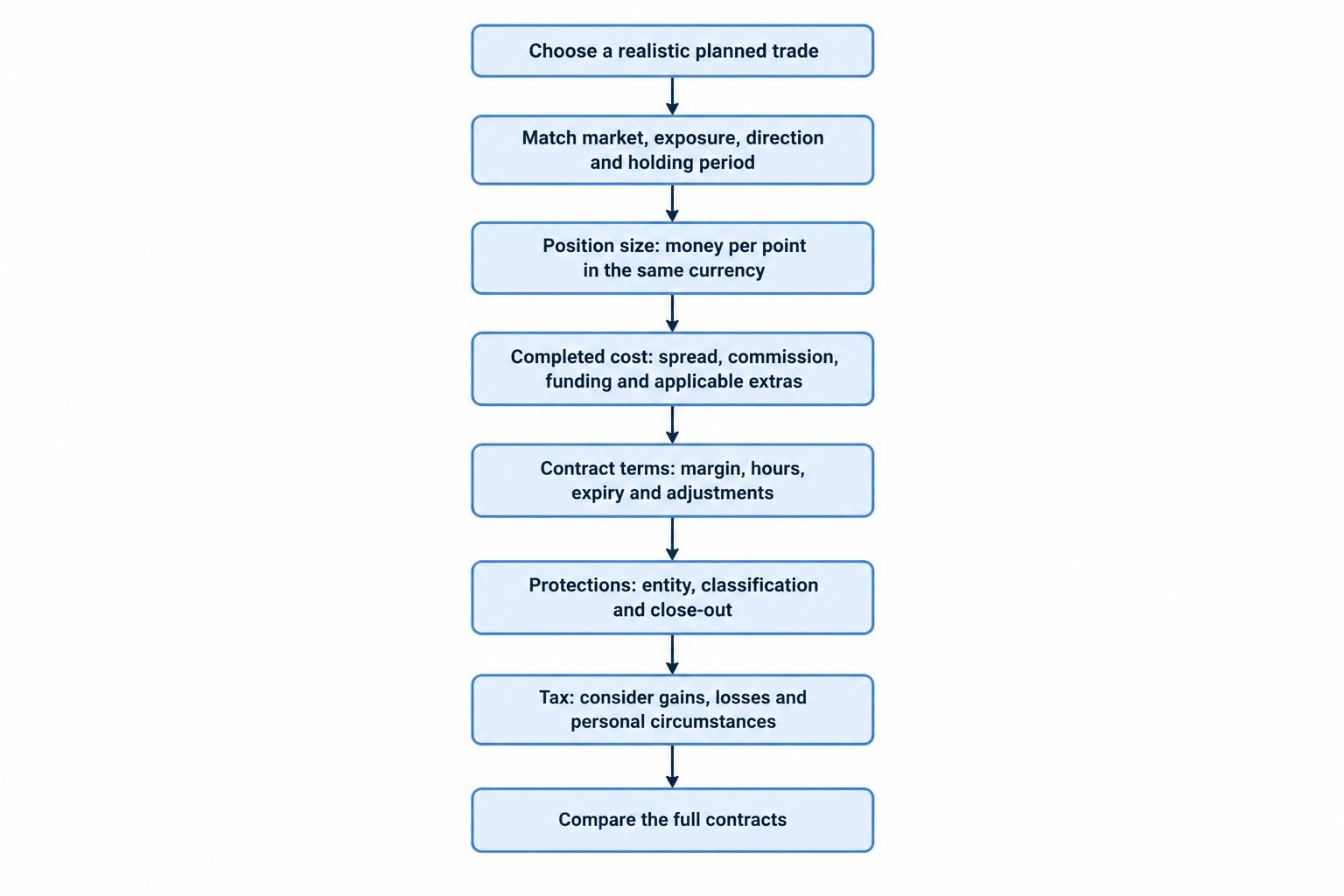
Build the comparison around a trade you might genuinely place. Use the same underlying reference, intended exposure, direction and holding period. Then answer five questions:
- Does the position size match? Express both tickets as money gained or lost per point in the same currency.
- What is the completed trade cost? Include the spread, entry and exit commission, expected financing and any applicable conversion or stop premium.
- What can change during the trade? Check margin requirements, funding terms, trading hours, expiry and adjustment policies.
- What protections apply? Confirm the contracting entity, client classification and account close out arrangements.
- How is the result treated for tax? Consider both gains and losses, using your own circumstances rather than a promotional headline.
A spread betting demo account can help you check point values, order entry and the platform’s exposure display. It cannot establish what every live fill will cost, but it can expose a sizing mistake before money is involved.
Before funding either type of account, verify the firm and its permissions rather than relying on a brand name or logo. The process for checking a broker on the FCA Register should form part of that assessment.
Spread betting and CFDs are different ways to express closely related market exposure. Choose between them only after matching that exposure and comparing the full contract. If the potential loss would put money needed for living costs at risk, neither product is the appropriate choice.