Spread betting brokers for day trading need to do more than display a narrow headline spread. They need to offer competitive dealing costs during your trading session, dependable order handling, usable risk controls and minimum stakes that fit your account.
The right choice depends on what you trade and how you place orders. A broker that suits a trader holding two FTSE 100 positions through the morning may be a poor fit for someone making frequent, short trades around US economic announcements. Compare the account against your actual trading routine, not a list of features you might never use.
This guide focuses on choosing a UK spread betting account for intraday trading. Use the wider spread betting broker directory to build an initial shortlist, then compare the details below. Closing positions within the day can avoid overnight exposure, but it does not remove the risk of rapid losses.
Spread Betting Brokers to Put on Your Shortlist
IG, CMC Markets and Pepperstone offer starting points for a UK spread betting comparison. Their platform arrangements give you different routes to assess, rather than an automatic first, second and third place.
| Provider | Platform route to examine | What to verify for day trading |
|---|---|---|
| IG | Its own online trading platform | Order entry, stop placement and the price of your chosen spread betting markets during your trading hours |
| CMC Markets | Its Next Generation platform | Chart and dealing ticket workflow, position management and market settings for your intended trades |
| Pepperstone | Third party platform integration, including TradingView | Which connections support the spread betting account, available instruments and order functionality |
Do not assume every platform advertised by a broker supports every account type. Before opening an account, confirm that the platform, instrument and order type you want are available together on the UK spread betting service. A feature on an international CFD account is not evidence that the same feature is available on your account.
These names are candidates for further checks, not a claim that they produce the best fills or lowest costs for every trader. Read individual spread betting broker reviews alongside the current account documents. Prices, platform connections and product availability can change, so a shortlist should lead to verification rather than straight to a deposit.
Start With Your Trading Routine
Write a short account requirement before comparing brokers. Specify your main markets, usual trading hours, approximate stake range, expected holding period and the orders you intend to use. “FTSE 100, weekday mornings, £1 to £3 per point, positions held for several minutes” gives you something useful to assess. “Good for day trading” does not.
Give the most weight to the parts of the service you will use repeatedly. For frequent index trades, dealing costs and order management deserve more attention than the number of overseas shares available. For individual share trading, instrument availability, minimum stakes and any market data requirements may decide the choice before platform appearance gets a vote.
Separate requirements from preferences. Being able to attach a protective stop when entering a trade might be a requirement. Having a particular chart colour scheme is a preference. Reject accounts that fail a requirement; compare convenience only among those that remain.
Keep scalping and ordinary day trading separate during this process. If your approach depends on very brief holding periods, automated orders or trading around price feeds, ask whether the broker’s terms permit that activity. A broad claim that a platform welcomes active traders does not answer every question about how you intend to trade.
Compare the Cost of a Completed Trade
Use spreads from your trading session
A spread advertised as “from” a certain figure is a starting point, not a reliable estimate of your daily bill. Record the bid and ask on the exact instrument you intend to trade, at the times you expect to enter and exit. Repeat the exercise across several sessions rather than choosing the most flattering screenshot.
Check that both accounts use the same point convention. Two quotes cannot be compared properly if a one point move represents different price changes. Also compare like with like: a cash index spread bet and a dated contract are not interchangeable simply because they reference the same index.
The spread matters more when the intended price move is small. If a strategy looks for an eight point move, a one point spread represents a substantial hurdle before other trading frictions enter the calculation. That is arithmetic, not a prediction about whether the strategy will work.
Do not count the same spread twice
For an immediate opening and closing trade at unchanged quotes, the loss equals one full spread multiplied by the stake. Suppose an index is quoted at 7,999.5–8,000.5. Buying at 8,000.5 and immediately selling at 7,999.5 loses one point. At £2 per point, that is £2 before any other charges.
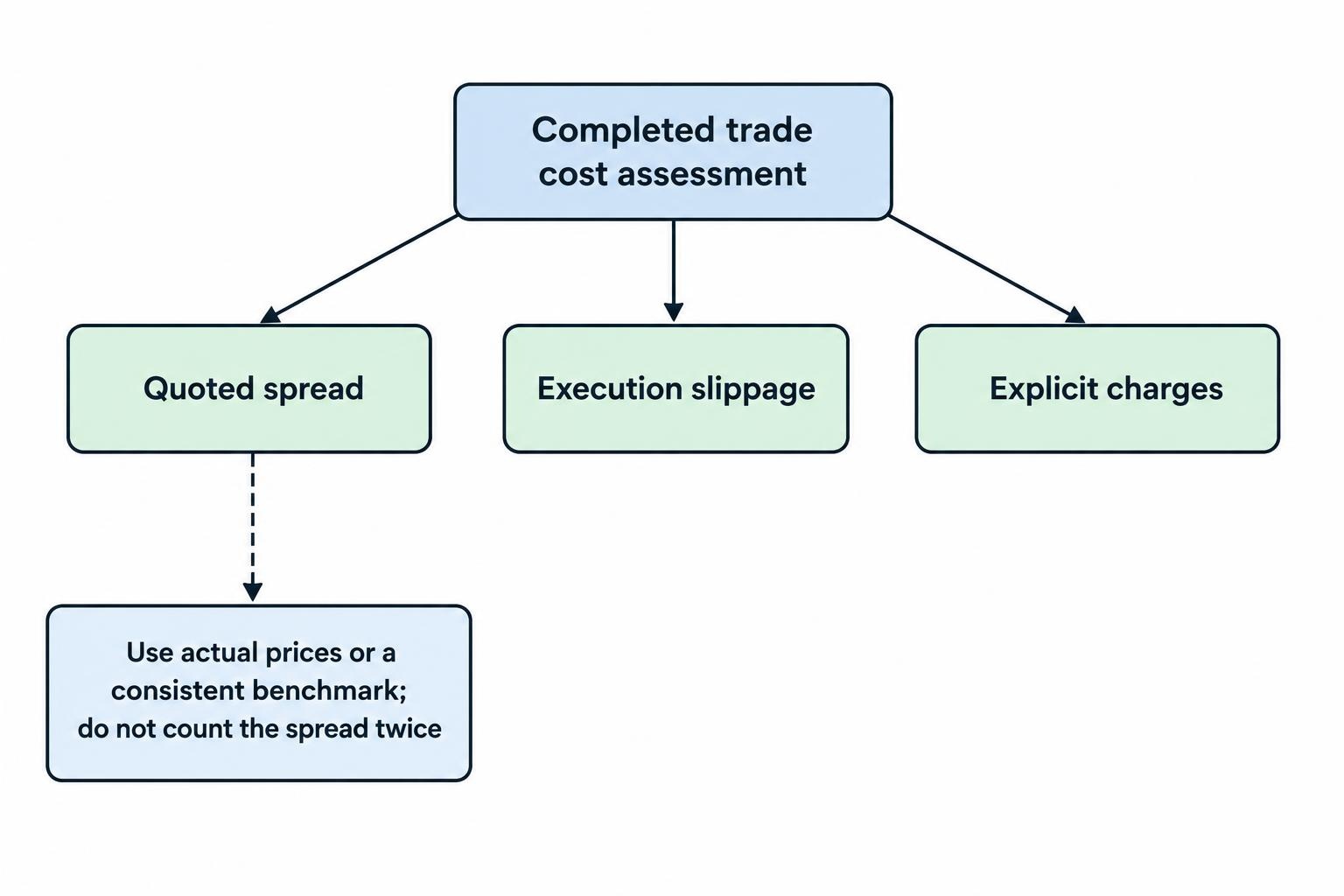
You do not add another identical spread just because there are two transactions. Where entry and exit spreads differ, assess the actual dealing prices or use a consistent benchmark for both legs. Mixing an assumed spread charge with profit and loss already calculated from executed bid and ask prices can double count costs.
A useful comparison separates quoted spread, execution slippage and any explicit charges. The guide to comparing total spread betting costs covers the wider calculation. For a day trading shortlist, the aim is simpler: estimate what your normal completed trade costs at each account.
Small differences can accumulate
Consider two hypothetical accounts with average spreads of 0.8 and 1.2 points on the same instrument during the same session. At £4 per point, the difference is £1.60 per completed trade, assuming unchanged spread conditions and no difference in execution or other charges.
Across 12 completed trades, that becomes £19.20. Across 20 identical sessions, it becomes £384. These are illustrative assumptions, not broker quotes or a suggested trading frequency. They show why a modest difference deserves attention when it repeats.
The narrower spread does not automatically make the first account cheaper in practice. Worse fills, paid platform access or other charges could change the result. Compare the entire trade, not just the number that looks best in an advert.
Check funding cutoffs even if you intend to close
For an intraday plan, verify the product’s funding cutoff and leave time to close before it. A position opened and closed on the same calendar date is not necessarily exempt from a charge if it crosses the relevant cutoff. Check the contract terms rather than relying on the word “daily”.
The FCA’s 15 October 2026 review of CFD and spread betting charges identified continuing concerns about overnight funding charges and how firms communicate them. For a day trader, the practical response is to establish what happens if a position stays open longer than planned, including a position left open during a service interruption.
Execution Quality Matters More Than a Speed Slogan
Order execution deserves its own assessment. A fast acknowledgement is not the same thing as a favourable fill, and neither proves that a broker will handle a larger order or a volatile session well. Treat a published speed figure as a prompt for questions, not a complete verdict.
Ask what the measurement covers. Does timing begin when the order reaches the broker’s server, or when you click? Does it include rejected orders? Which instruments and market conditions were measured? Without a clear basis, two impressive looking figures may describe different things.
For your own records, note the requested price, executed price, order type, time and market conditions. Include favourable as well as adverse slippage. A record containing only disappointing trades cannot give a fair picture of execution.
Compare similar orders under similar conditions. A market order during a major announcement should not be judged against a quiet period limit order. The broker execution quality research guide provides a framework for assessing the evidence without turning a handful of fills into a sweeping claim.
Check how orders behave, not just whether they exist
Confirm whether you can attach a stop and profit target when opening a position. Check how the platform links those orders, what happens after a partial close, and whether an unused exit order disappears when the position closes. Do not discover these settings while a trade is moving against you.
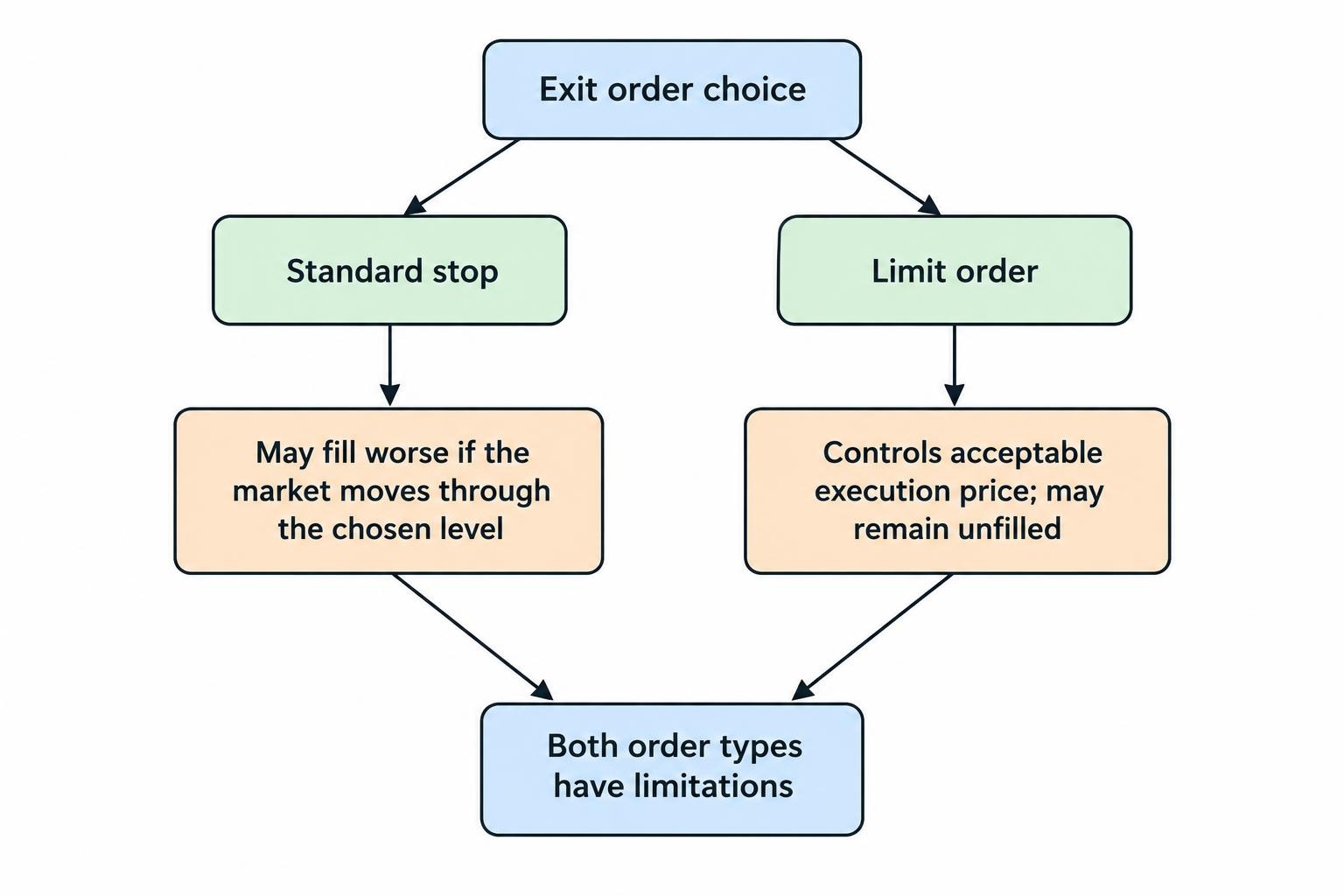
A standard stop is not a promise of execution at the chosen price. If the market moves through that level, the eventual fill can be worse. A limit order controls the acceptable execution price but may remain unfilled. Each solves a different problem; neither makes execution risk disappear.
If you want a guaranteed exit price, compare brokers offering guaranteed stops. Check eligible markets, minimum stop distances, premiums and amendment rules. A guarantee that requires a stop much farther away than your trade plan allows may be unsuitable, even if the feature sounds reassuring.
Also inspect minimum distances for ordinary stops and limits. If your plan needs an exit five points away but the account requires a larger distance, the account does not fit that plan. Increasing the stake or changing the stop just to accommodate the dealing ticket reverses the decision process.
Choose a Platform You Can Operate Accurately
For day trading, a platform should make routine actions clear and repeatable. You need to identify the instrument, confirm the stake, place the order and see the resulting position without unnecessary uncertainty. More buttons are not always more capability.
Test the complete workflow rather than admiring the chart. Open a position in the demo environment, amend its stop, reduce its size, cancel an order and close the remainder. Check which settings the platform remembers. A dealing ticket that retains yesterday’s larger stake deserves particular attention.
One click dealing can reduce the steps involved in submitting an order, but it also removes a chance to catch mistakes. Enable it only after checking default size, confirmation settings and the difference between closing a position and placing an opposing trade. A fast route to the wrong order is not an upgrade.
Verify external platform connections
If charting software is central to your routine, confirm the connection before selecting the account. Check the instrument list, supported orders, account currency and how positions appear across the connected platform and the broker’s own interface.
The comparison of TradingView spread betting brokers is relevant if you want that particular workflow. Do not assume a TradingView logo means every spread betting market or protective order is available through the integration.
Check the chart’s price basis too. Establish whether it displays bid, ask, midpoint or another reference, and compare it with the dealing ticket. A chart level and an executable price can differ without either display being faulty.
Treat mobile access as a separate test
Even if you trade from a desktop, test the mobile account interface. Can you identify the correct position, amend its stop and close it without hunting through menus? Does it show pending orders as clearly as open positions?
Mobile access is useful as a contingency, but it is not a guarantee against disruption. A broker service problem may affect both interfaces. Ask about an alternative dealing contact and how orders are handled if the platform becomes unavailable during your session.
Check Market Hours, Stake Sizes and Account Practicalities
Compare the hours you will actually use
Verify opening hours for the exact spread betting contract, including daily breaks, holiday changes and any restrictions outside its main session. Being able to view a quote does not necessarily mean every type of transaction is available.
Keep account availability separate from market conditions. A longer dealing window is useful only if the quoted spread, available order types and execution conditions fit your plan. For index trading, check the index trading hours guide before deciding which account best covers your session.
If you trade market openings or economic releases, compare those periods separately from ordinary trading. Record what happens to quotes and order settings around the event. A quiet afternoon sample does not answer a question about opening minute trading.
Minimum stakes must fit the risk budget
A low deposit requirement says little about whether an account is workable. Minimum stake and a sensible stop distance are more useful. If the smallest permitted position risks more than your planned amount, adding money to the account does not fix the mismatch in the trade.
Suppose a hypothetical trade needs a 20 point stop and the minimum stake is £1 per point. The planned price risk is £20 before slippage or charges. If your trade budget is £5, that account does not support the intended position size. The comparison of spread betting brokers for small stakes addresses this account selection problem.
Check stake increments as well as the minimum. An account may permit the initial size you want but make gradual adjustments awkward. Also ask whether minimum sizes differ between instruments or platforms.
Support and records are part of the service
Confirm support hours against your own trading hours. Ask how to raise an execution query, which information to retain and how to reach dealing support rather than general account assistance. Clear answers before funding are more useful than discovering the process after a disputed trade.
Inspect downloadable trade records. For a useful journal, you should be able to reconcile opening and closing prices, stakes, timestamps and charges. Check the displayed time zone so that your records line up with the session you are analysing.
Verify the UK Entity and Retail Protections
Check the legal company that will hold your account, not just the brand on the application screen. Match the company name, firm reference number, contact details and relevant permissions. Use the process for checking a broker on the FCA Register before transferring money.
For UK retail accounts within the FCA’s spread betting rules, minimum opening margin depends on the underlying asset. The rules require at least 5% for a major stock market index and 20% for an individual share. They also require account based margin closeout when net equity falls below 50% of the required margin, with positions closed as soon as market conditions allow, and negative balance protection for the funds dedicated to the covered trading account. These requirements appear in the FCA Handbook rules on margin, closeout and negative balance protection.
Those protections do not set a sensible loss allowance for an individual trade. Negative balance protection is not a guaranteed stop, and a margin closeout threshold is not an exit plan. You can still lose the money committed to the account.
Do not choose an account simply because it offers more borrowing capacity. Keep the decision about retail versus professional client classification separate from the search for a convenient day trading platform. Establish the protections and account terms that would apply before considering a different classification or contracting entity.
Test the Shortlist Before Committing Capital
Use a repeatable comparison rather than opening several demos and clicking around at random. The purpose is to find account mismatches early, not to prove that a few profitable practice trades make the broker suitable.
- Choose a representative session. Use the instruments and hours you intend to trade, with a realistic practice balance and stake range.
- Record comparable quotes. Note the bid, ask, instrument name and time. Keep event periods separate from ordinary conditions.
- Test order management. Practise attached exits, stop amendments, partial closes and cancellation. Check the position afterwards rather than assuming the instruction worked as intended.
- Check account documents and support. Confirm fees, funding cutoffs, platform eligibility and the process for urgent dealing queries.
- Review the evidence. Reject an account that fails a requirement, even if another part of its service looks attractive.
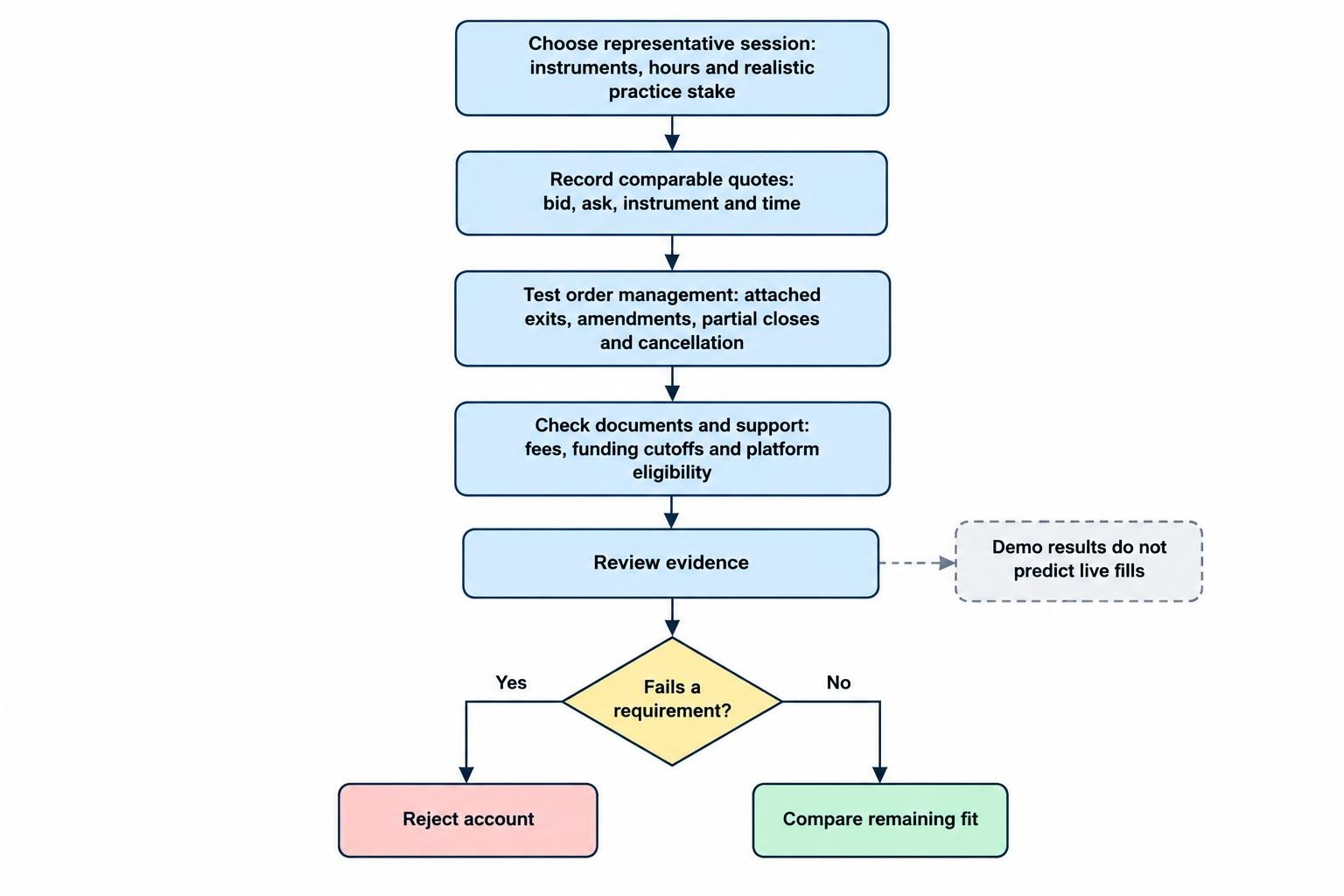
A spread betting demo account is useful for this workflow assessment. Treat its results as practice results, not evidence of the live fills you will receive. Simulation cannot establish how your own live orders will perform across future market conditions.
If you later decide to trade live, use only capital you can afford to lose and a size compatible with your risk plan. Review actual statements and fills before making any decision to increase activity. There is no need to manufacture extra trades just to collect a larger sample.
Keep a simple scorecard containing total trading cost, order handling, platform usability, market access and account safeguards. Give each category a weight based on your routine. Reject serious failures outright rather than allowing attractive charting tools to average away an unsuitable minimum stake or missing order feature.
Make the Final Choice Against the Trading Plan
Choose the broker that meets your requirements at an acceptable total cost, not the one with the longest feature list. For one trader, that may mean a straightforward native platform and small stakes. For another, it may mean a verified charting connection and better access during a particular session.
Keep broker selection separate from strategy selection. The guide to day trading with financial spread betting covers the trading approach; the account’s job is to let you carry it out without avoidable cost or operational friction. A suitable broker cannot turn an unprofitable method into a profitable one.
Reassess the account when your markets, trading hours or position sizes change. The best fit is conditional on how you use it, and the useful comparison is the one based on your actual requirements.