Spread betting scams use the appearance of a trading business to obtain money, account access or personal information. The offer might involve a copied broker website, invented trading profits, a paid signals group or an “account manager” who keeps finding reasons for another deposit.
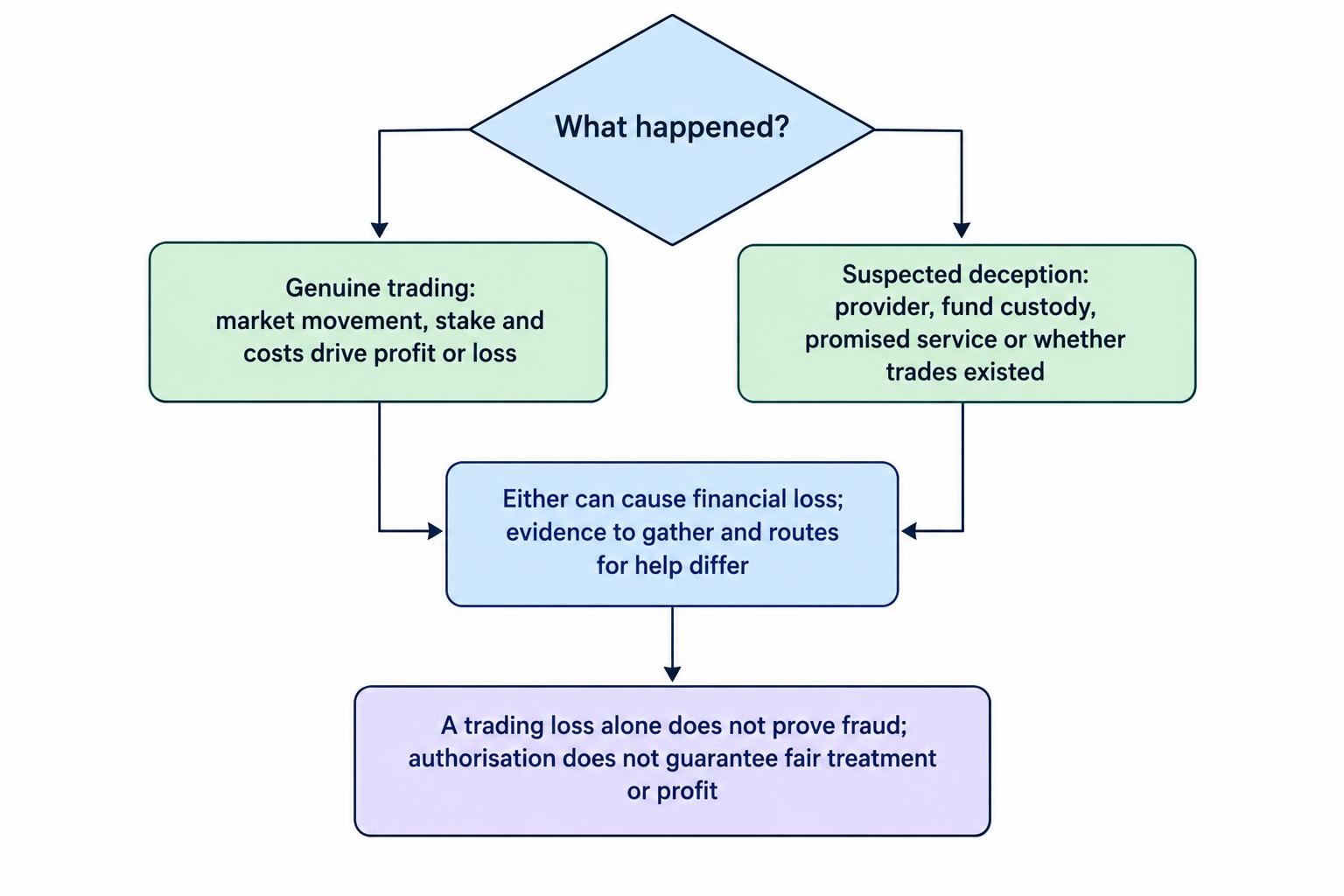
The central distinction is between losing money through genuine trading and being deceived about who holds your money, what service you are buying or whether the trades exist. Both can cause serious losses, but the evidence and routes for help differ.
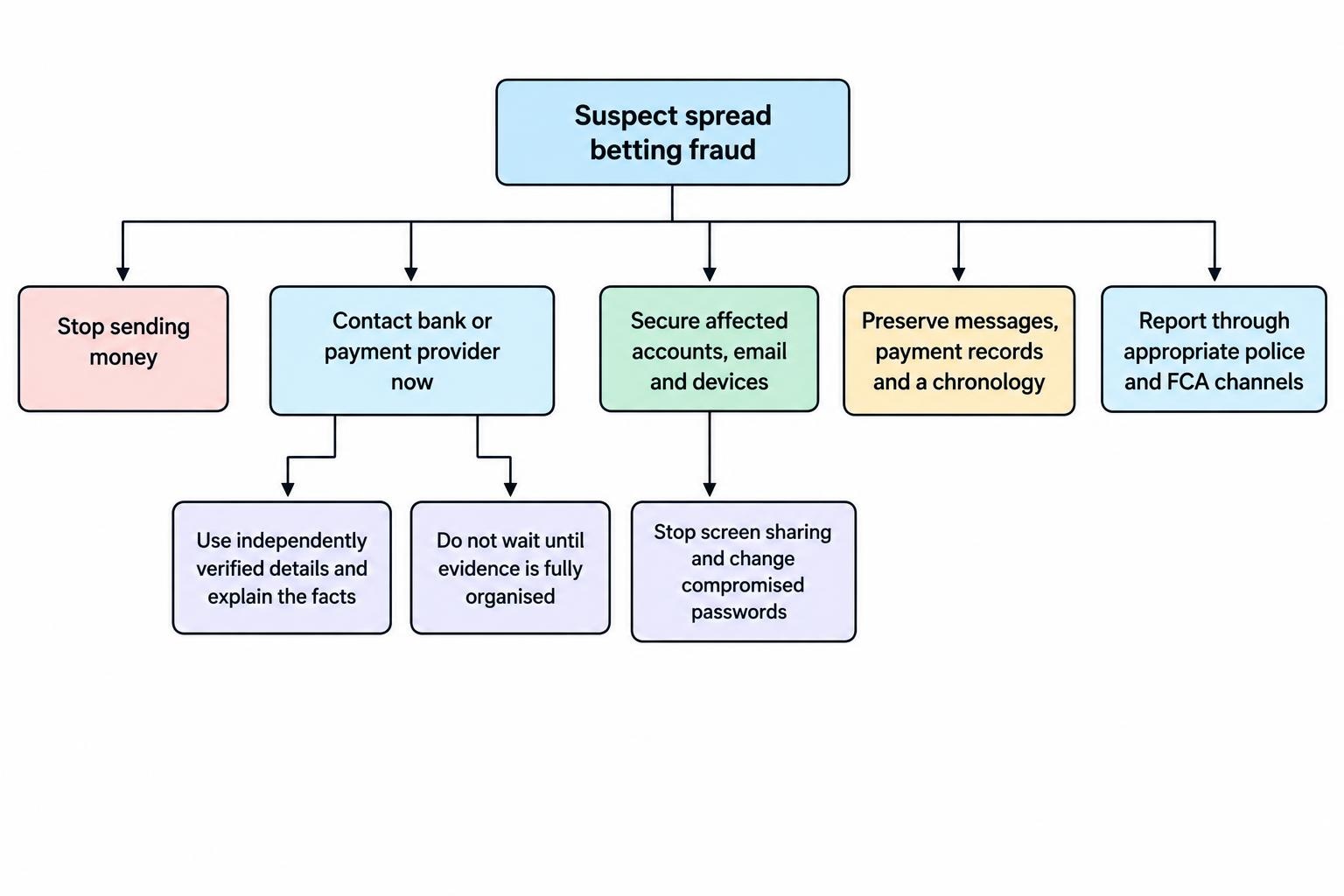
If you suspect fraud after making a payment, stop sending money and contact your bank or payment provider immediately. Do not wait for the supposed broker to finish its investigation or pay another charge to release your balance.
Is Spread Betting Itself a Scam?
No. Financial spread betting is a financial service that can be offered by authorised firms. That does not make every business using the label legitimate, or every transaction with an authorised business fair. The checks begin with the firm and the service, not the product name.
A genuine spread bet produces a profit or loss based on a market movement multiplied by your stake per point, with trading costs affecting the result. The mechanics of spread betting explain why a small market move can produce a substantial account loss without any fraud taking place.
A fraudulent operation may instead show invented trades, impersonate an authorised provider or take payments for a service it never intends to deliver. The screen might resemble a trading platform, but its appearance says nothing about where your deposit went.
Keep three questions separate: is the provider genuine, did it treat you properly, and did your trading decision lose money? The broader UK spread betting regulatory framework provides the background, but authorisation is not a promise of profitable trading.
How Spread Betting Scams Work
Clone firms borrow a genuine broker’s identity
A clone firm uses details belonging to a real financial business. These can include its legal name, address, branding and FCA firm reference number, or FRN. The fraudster then substitutes a different telephone number, email address, payment instruction or website.
This is why finding a genuine FRN is not enough. You may have verified the business being impersonated rather than the person contacting you. A copied certificate or link to a real regulatory entry does not connect that caller to the authorised firm.
The FCA’s guidance on clone firms identifies copied websites and altered contact details as impersonation tactics. Make contact using independently obtained regulatory details, not the number supplied in the sales message.
Consider the difference between checking an identity and checking a connection. A real firm can exist, hold the right permissions and have no relationship whatsoever with your “account manager”. All three statements can be true at once.
Fake platforms manufacture apparent profits
A trading dashboard can display a rising balance without proving that any genuine trading occurred. Fraudsters can manipulate account information and supply false screenshots. Some even allow an early withdrawal to make later deposit requests more convincing; these tactics feature in the SEC investor alert on relationship investment scams.
The practical mistake is treating an on-screen figure as money already earned and recoverable. A balance of £18,000 is not evidence that £18,000 exists, belongs to you or can be withdrawn.
Nor does a £100 withdrawal validate a later £10,000 transfer. It establishes that one payment arrived. It does not independently verify the operator, its permissions or the rest of the displayed balance.
Do not use a small deposit as your main test of legitimacy. Complete the identity and permission checks before funding an account. Testing a stranger’s honesty with your own money is an expensive research method.
Signals, courses and “AI trading” offers sell certainty
A course, trading tool or signals service is not automatically fraudulent. The concern is what the seller claims and what evidence supports it. Be cautious when education becomes a promise of dependable income, or a software demonstration becomes a guarantee against losses.
Ask what a performance claim actually measures. Does it show a complete trading record, or selected winning trades? Are costs included? What happened during the worst losing period? Does the seller distinguish a simulation from trading with real money?
An unexplained “95% success rate” tells you little without the size of the wins and losses. A strategy can win frequently and still lose money if its occasional losses are large enough. “AI” does not change that arithmetic.
Keep the service boundaries clear. Buying training, receiving personal recommendations, handing over trading access and depositing with a broker are different decisions. Evidence that a course exists does not verify the broker promoted inside it, and a broker account does not validate an outside tutor’s claims.
Warning Signs That Should Stop a Deposit
Unexpected approaches, pressure to decide quickly and promises of high returns with little risk are established investment fraud warning signs. Professional branding and convincing customer portals can form part of the deception, rather than evidence against it. These patterns are covered in MoneyHelper’s investment scam guidance.
| What you encounter | What to do before proceeding |
|---|---|
| Guaranteed profits or dependable daily income | Reject the guarantee as a basis for depositing. |
| A deposit deadline during a call or message exchange | End the conversation and check the offer independently. |
| An FCA number accompanied by different contact details | Contact the genuine firm through its regulatory listing. |
| Payment instructions naming an unrelated person or business | Ask for a written explanation and verify it outside the sales conversation. |
| Instructions to misdescribe a payment to your bank | Do not follow them; explain the true purpose to your bank. |
| A fresh payment required to release supposed profits | Stop paying and investigate the withdrawal demand. |
One warning sign is not always proof of fraud. It is enough reason to pause. You do not need to establish a criminal case before declining an offer or asking your bank for help.
Do not let the conversation become a debate about whether you are confident enough to trade. The question is whether the business can withstand ordinary checks. A refusal to deposit immediately is not a knowledge gap that a salesperson needs to correct.
How to Check a Spread Betting Provider Before Paying
Verify the business independently
Use the FCA Firm Checker to check authorisation and permission for the service being offered. The Financial Services Register contains further information, including details that the consumer tool does not display, such as the ability to handle client money.
Make the checks yourself. Do not rely on a screenshot, a certificate attached to an email or a screen shared by the salesperson.
- Identify the contracting entity. Obtain the full legal name from the proposed account agreement, not just the trading brand.
- Check its status and relevant permissions. A regulatory entry is useful only if it relates to the service you intend to use.
- Compare contact details. Examine the website address, telephone number and email details against the official record.
- Start a fresh conversation. Contact the firm through independently verified details and ask whether the proposed account and representative are genuine.
- Verify payment instructions. Resolve any unexplained difference between the contracting firm and the recipient before transferring money.
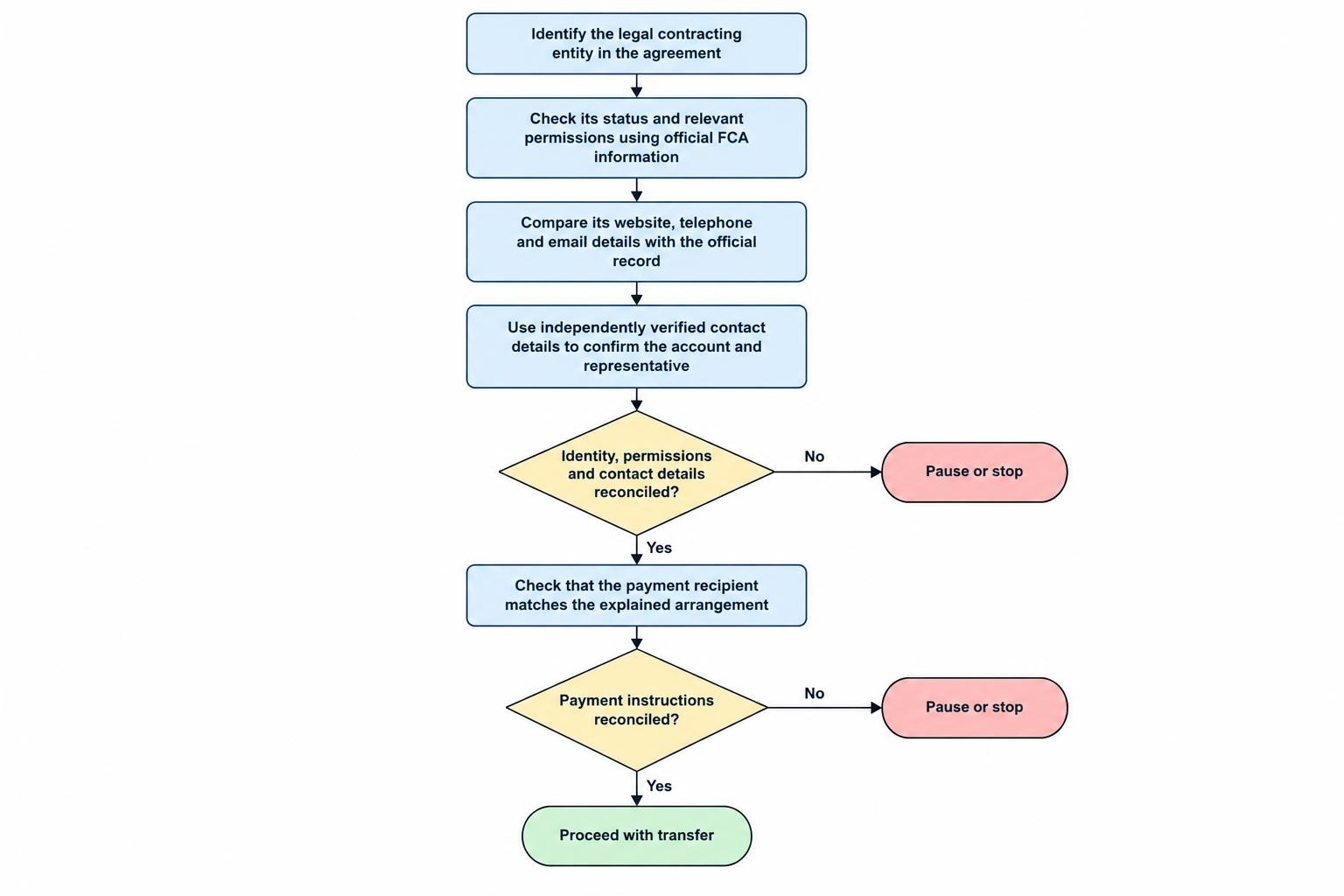
Keep a dated record of what you checked. Our guide to checking a broker on the FCA Register covers the register process in more detail.
A company registration certificate does not answer the same question as financial services authorisation. Treat company details as another identity check, not a substitute for checking the financial service.
Search warnings, but do not mistake silence for approval
Search the FCA Warning List of unauthorised firms for the name and other identifying details. Read the warning itself: it may distinguish a fraudulent clone from the genuine business whose identity it copied.
Absence from the list is not clearance. The FCA states that a firm may still be unauthorised or a scam even when no warning has been published.
Use reviews as prompts for further questions, not as regulatory evidence. A complaint about withdrawals deserves attention, but a positive review cannot establish permission to provide spread betting. Reviews and regulatory checks answer different questions.
Check the Legal Entity, Not Just the Brand
A familiar brand name does not tell you which business will hold your account. Read the agreement to identify the contracting entity and its jurisdiction, particularly if the application redirects you to another company.
Moving to an overseas provider or being encouraged to become a professional client can change your protections. The FCA’s guidance for the CFD and spread betting sector warns about inappropriate professional classification and redirection to associated overseas firms.
An overseas entity is not automatically fraudulent. The mistake is assuming that the protections associated with a UK business follow its branding everywhere. The separate guide to offshore spread betting brokers addresses those jurisdiction risks.
Before accepting professional status, ask what changes in writing. Do not treat it as a loyalty badge, a reward for depositing more or a convenient way around restrictions. Compare retail and professional client classification before agreeing.
The decision should stand on its own merits, without pressure from someone whose immediate objective is another deposit. If the explanation is simply “you get better trading conditions”, the explanation is incomplete.
Withdrawal Problems: Delay, Dispute or Fraud?
A delayed withdrawal needs investigation, but delay alone does not establish fraud. Ask for a written explanation identifying the amount requested, the reason it has not been released, any outstanding checks and the expected next step.
Distinguish the account’s cash balance from the amount available to withdraw. Check whether open positions, unsettled transactions or stated charges explain the difference. Use the account agreement and transaction record, rather than accepting a verbal explanation.
Then examine whether the explanation changes. A document request followed by a new “release fee”, followed by a further “tax payment”, is a different pattern from a clearly explained administrative check. In September 2026, a Police Service of Northern Ireland investment fraud warning described criminals demanding further payments before supposed investment funds could be released.
Do not make another payment solely because someone says it will recover the money already sent. Verify the demand independently, including who receives it and the contractual basis claimed.
A hypothetical withdrawal demand
Suppose you deposit £2,000 and a platform later displays £9,500. When you request a withdrawal, the operator demands £950 for “clearance”. After you pay, it requests another £600 for “verification”.
The displayed £9,500 should not be treated as a verified asset when deciding whether to send the next £600. The immediate evidence is that £2,950 has left your control and the conditions for withdrawal have changed.
Record the promised withdrawal and both demands. Ask your payment provider to investigate the money actually transferred. Do not let the invented balance become the reason for increasing the real loss.
For an ordinary charge dispute, compare the demand with the disclosed spread betting costs and fees. A familiar label does not make an unexplained payment legitimate.
Trading Events That Are Not Automatically Evidence of a Scam
A stop filling at a worse price, an account losing money or positions closing because of insufficient margin can occur without fraud. The Financial Ombudsman considers what happened in the market, the agreement and what the business told the customer when assessing spread betting and CFD complaints.
For an execution dispute, preserve the instrument name, order type, requested level, execution price and timestamp. Note the time zone. Compare like with like: a cash index quote and a futures quote are not interchangeable evidence.
The guide to slippage in spread betting explains why an ordinary stop may execute away from its requested level. That possibility does not excuse an error, but it changes what you need to investigate.
For a forced closure, reconstruct the account equity, margin requirement and positions immediately before the event. Check the relevant margin close-out rules rather than assuming a prior telephone warning was guaranteed.
Account application questions also serve a purpose. Do not let a salesperson supply answers about your knowledge and experience merely to get the application accepted. Read about the spread betting appropriateness test if someone suggests treating it as a box-ticking obstacle.
“I lost money” and “the firm did something wrong” are different propositions. A useful complaint identifies the conduct, the supporting evidence and the resulting loss. That is more persuasive than an accusation built around a losing trade alone.
What to Do If You Suspect a Spread Betting Scam
Contact your payment provider immediately
Use your banking app, a statement or another independently verified contact route. Explain that you suspect investment or trading fraud, identify the payments and ask what can be done to prevent further loss.
State how each payment happened. A transfer you approved after deception is not the same event as someone accessing your account and making a payment without permission. Describe the facts accurately rather than choosing the label you think will produce a refund.
The Financial Ombudsman’s guidance on payments made after deception recommends contacting the bank or payment provider immediately and keeping correspondence. Ask the provider to record your fraud report and explain its investigation and complaint process.
Tell it about any instructions to misdescribe payments, ignore warnings, borrow money or use an intermediate account. Those details help establish the sequence. Do not wait until every document is neatly organised before making the first call.
Secure accounts and devices
Stop sharing your screen, passwords and verification codes. If someone has access to your device, stop using it for sensitive activity and obtain trusted technical help. Tell your bank that device access may have been involved.
For compromised accounts, follow the provider’s recovery process, change affected passwords, check account settings and enable two-step verification. The NCSC account recovery guidance provides a practical sequence for regaining control.
Secure your email account as well as your banking and trading accounts. Keep evidence safely, but do not remain in contact with a suspected fraudster just to collect more material.
Preserve a clear evidence trail
Save messages, email attachments, payment confirmations, account agreements, advertisements and screenshots of withdrawal requests. Keep original files where possible, not just cropped images.
Build a short chronology showing when contact began, what was promised, when each payment occurred and when you first raised concerns. Separate actual payments from the platform’s displayed profits.
Download genuine transaction records where safely available. Our guide to spread betting account statements can help distinguish deposits, trading results, charges and withdrawals.
Record the domains, email addresses and telephone numbers used, including changes. Do not publish identity documents or full banking details when asking others for help.
Report through the correct channels
In England, Wales and Northern Ireland, use Report Fraud or call 0300 123 2040. It replaced Action Fraud on 4 December 2025. In Scotland, report to Police Scotland on 101. These routes are set out in the official Report Fraud service announcement.
Report suspected financial firm impersonation or unauthorised activity to the FCA as well. Keep the reporting reference numbers with your evidence, and provide them to your payment provider when requested.
Can You Get Money Back After a Spread Betting Scam?
Possibly, but the route depends on what happened, how you paid and which business may be responsible. A police report, bank reimbursement claim, complaint against a broker and compensation claim are not interchangeable.
Bank transfer reimbursement
Mandatory APP fraud reimbursement protections apply to qualifying UK Faster Payments and CHAPS transfers made on or after 7 October 2024. The reimbursement cap is £85,000, subject to eligibility and exceptions. Report promptly; the Payment Systems Regulator’s reimbursement guidance states that claims should be reported as soon as possible and within 13 months of payment.
These rules are not insurance against trading losses. Ask the payment provider to assess the alleged deception and explain which rules apply to each transaction. Card payments, international transfers and payments involving cryptocurrency require their own assessment.
If the provider rejects your claim, request its reasoning in writing. Challenge factual errors with documents and dates. Do not assume that approving the original payment means there is nothing to investigate.
Complaints about an authorised business
If your concern involves the conduct of a genuine provider, make a formal complaint identifying what it did wrong and the remedy requested. Preserve its response and follow the applicable escalation deadlines. The guide to spread betting complaints and the Financial Ombudsman covers that route.
Be precise about the respondent. A complaint against the firm impersonated by a clone is not automatically a claim that the genuine firm caused the loss.
FSCS protection after firm failure
FSCS eligibility generally requires an authorised firm to have failed, a regulated activity, a financial loss and a legal liability owed to the claimant. These conditions appear in the FSCS compensation eligibility rules.
A copied FCA number does not make a fraudster’s operation protected. Nor does an ordinary trading loss, by itself, establish a compensation claim. Check the circumstances rather than relying on an FSCS logo in a sales document.
The separate guide to FSCS protection for spread betting accounts addresses provider failure without confusing it with protection against market losses.
Watch for Recovery Scams After the First Loss
Fraudsters may return claiming to be investigators, lawyers, regulators or recovery specialists. They can know details of the original loss because the same criminals are involved or the victim’s information has been passed on.
The next demand may be described as an administration charge, legal expense or tax needed to release recovered funds. These tactics are documented in the FCA warning on recovery room scams.
Knowing your account balance or the date of a transfer does not prove official involvement. Ask how the person obtained the information, then verify their identity through an independent route. Do not use contact details or regulatory links they provide as your sole check.
Do not confuse a commercial recovery pitch with your bank’s fraud process or a complaint you can pursue yourself. A promise of certain recovery deserves the same scrutiny as the original promise of certain profit.
If you have already paid a recovery service and now suspect deception, report those payments too. Keep them separate in your chronology so the payment provider can assess each event.
A Practical Rule Before Your Next Deposit
Before funding an account, be able to name the legal entity, explain how you verified its identity and identify the agreement governing your money. Know which contact route you will use if something goes wrong.
Only after those checks should you compare platforms, pricing or FCA-regulated spread betting providers. A lower spread does not compensate for an unresolved identity mismatch.
If you are helping someone else, focus on one verifiable question at a time: who received the payment, does the official firm recognise the account, and what written basis supports the latest demand? Avoid turning the discussion into an argument about whether they should have trusted the offer.
You can stop paying before you have proved exactly how a scheme works. An unexplained recipient, unverifiable identity or escalating withdrawal demand is enough reason to pause and obtain independent help. Protecting the money still under your control comes before rescuing a balance shown on somebody else’s screen.