Spread betting psychology concerns the decisions you make when money, uncertainty and emotion meet. It shows up when you move a stop to avoid accepting a loss, increase your stake after a winning run, or enter a trade because watching from the sidelines feels unbearable.
The aim is not to become emotionless. It is to stop temporary feelings from rewriting decisions that should depend on evidence, account risk and a trading plan. Confidence cannot rescue a strategy that loses money after costs, and discipline does not make an unsuitable product suitable. The FCA’s guidance on CFDs and spread betting identifies these as high risk products that are not suitable for all retail consumers.
A practical approach combines written rules, affordable exposure, honest records and clear reasons to stop. These behavioural controls belong alongside the financial controls covered in spread betting risk management, rather than replacing them.
What Good Spread Betting Psychology Looks Like
Good trading psychology means following a defensible decision process without demanding that every trade reward you. You can accept a planned loss, leave an unsuitable opportunity alone and question a winning trade if you broke your rules to enter it.
That distinction matters because the result and the quality of the decision are separate questions. A poorly planned position can make money. A carefully planned position can lose. Neither outcome, on its own, tells you whether the decision deserves repeating.
A 2005 study followed 80 day traders over five weeks and found that stronger emotional reactions to gains and losses were associated with worse trading performance. It did not establish that emotion caused the poorer results, nor did it identify a single successful trader personality. The evidence comes from the NBER study of emotions and day trading performance, not a trial of UK spread bettors.
Use that evidence cautiously. It supports paying attention to emotional reactions, not trying to manufacture a permanently calm personality. You can feel disappointed after a loss and still manage the next decision properly.
A more useful test than “Was I confident?” is: “Did I follow the rules, and were those rules worth following?” Both parts matter. Faithfully repeating a poor method is not progress.
Why Spread Betting Can Put Pressure on Your Decisions
Spread betting expresses exposure as a cash stake per point. That makes profit and loss easy to calculate, but the stake shown on an order ticket does not tell you enough about the position’s risk.
Consider a hypothetical position with an initial stop 50 points from entry. At £2 per point, that distance represents £100. At £10 per point, it represents £500. The chart and entry signal are identical; the financial consequences are not. The mechanics are covered in stake per point explained.
Those figures assume execution at the intended stop level and exclude costs. An ordinary stop does not guarantee its execution price. Allow for the possibility of a worse fill rather than treating the number on your planning sheet as an absolute loss ceiling; see how slippage affects spread bets.
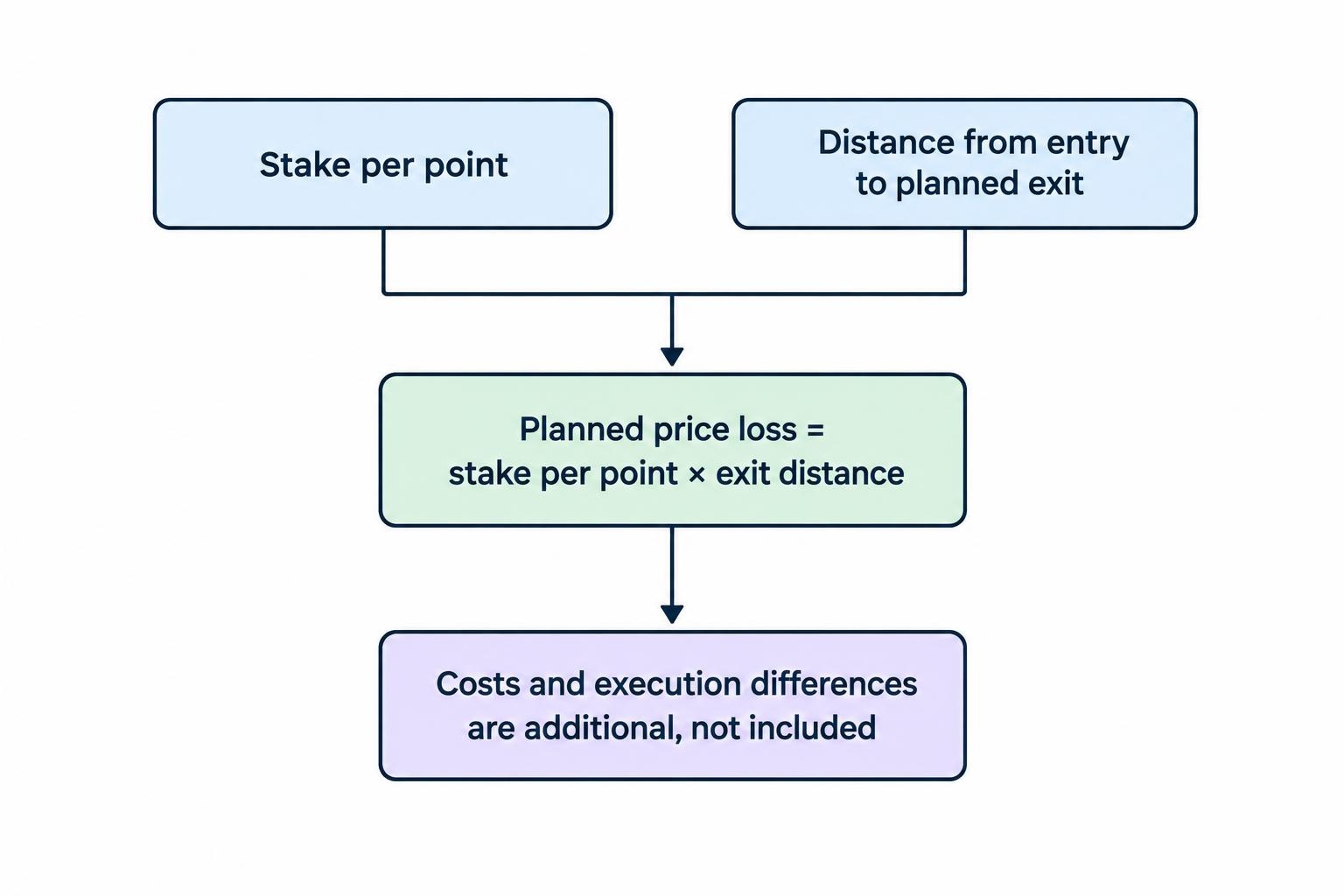
Assess your reaction to the cash amount before opening the position. If losing the planned amount would threaten household spending, cause you to conceal the trade or make you desperate to recover it immediately, do not treat that as a confidence problem to overcome.
Also separate available margin from acceptable exposure. A platform allowing you to open a position is not a reason to take it. Your own risk assessment should come first, particularly where spread betting leverage risk is concerned.
The Behavioural Traps That Distort Trading Decisions
Loss aversion and refusing to close a loser
Loss aversion concerns the weight people place on avoiding losses relative to obtaining gains. In trading, one related pattern is the disposition effect: holding losing positions while being more willing to realise winners. Research using 10,000 brokerage accounts documented a strong preference for realising gains rather than losses in Terrance Odean’s study of the disposition effect.
For a spread bettor, the practical warning sign is a change in reasoning after entry. You entered because a price level supported your trade. Once that level fails, you decide the position deserves “a bit more room”. Then a short trade becomes an overnight position because closing it would make the loss feel final.
Ask what has changed in the market, rather than what has changed in your willingness to accept the result. A revised exit needs a valid rule, not a more comfortable explanation.
Write the condition that invalidates the trade before entering. Use the principles in managing risk with stop losses, and do not widen the exit simply to postpone admitting that the original trade failed.
The reverse deserves attention too. Closing a winner early can be sensible if your exit conditions have arrived. Closing it solely because you cannot tolerate seeing an unrealised profit shrink is a different decision.
Revenge trading and the need to get back to even
Revenge trading starts when recovering a previous loss becomes the purpose of the next position. The new trade may be larger, earlier or less selective because you want the account balance repaired now.
“Back to even” is a personal reference point, not a market signal. A £150 loss does not make the next opportunity better, and it does not create an obligation to earn £150 before the session ends.
Before taking another position, ask whether you would enter it at the same size if the previous trade had never happened. If the honest answer is no, step away from the order ticket and review the decision.
Set your response before a losing run occurs. That might mean ending the session after a serious rule breach or taking a planned review break. The broader recovery process belongs in managing losing streaks; the immediate psychological task is to stop yesterday’s result controlling the next trade.
Overconfidence after a winning run
A run of profits gives you results to review. It does not automatically justify larger stakes, more markets or weaker entry standards.
In a historical study of 66,465 US households holding common stocks, the most active traders earned poorer net returns than less active traders. The findings were consistent with models linking overconfidence to excessive trading. Barber and Odean’s research on trading frequency and investor returns concerns share investors, so it should not be treated as a forecast for spread betting accounts.
The practical question is whether success has changed your behaviour before it has changed the evidence. Have you started taking trades outside your method? Are you counting recent profits as money that can be risked carelessly? Would you approve the same position after three losses?
Keep any decision to increase exposure separate from the excitement of a profitable session. Review it later, against written conditions. Recent winnings are still your capital, not a free bet.
Fear of missing out and chasing price
Fear of missing out, usually shortened to FOMO, replaces “Does this meet my conditions?” with “What if it keeps going without me?” A fast move or a stream of profitable screenshots can make waiting feel like a mistake.
Suppose your planned entry was close to a price level that would invalidate the trade. By the time you act, price has moved away. The same exit now requires a larger potential loss, while the remaining distance to your intended target has shrunk.
That is a changed trade, not the original opportunity with a slightly inconvenient entry. Recalculate it using your risk and reward criteria. If it no longer qualifies, leave it alone.
A missed trade has no cash loss attached to it. Do not create one simply to relieve the discomfort of watching. Rules for avoiding overtrading should cover unnecessary entries as well as an excessive trade count.
Confirmation bias, recency bias and judging by the result
Confirmation bias means favouring information that supports your existing view. In practice, you might keep searching for bullish commentary while dismissing evidence that contradicts your long position.
Recency bias means giving recent events too much weight. After several winning breakouts, you might start treating every break of a price level as an opportunity. After several losses, you might reject a qualifying trade without reviewing whether anything about the method has changed.
Outcome bias concerns judging a decision by its result rather than the information and rules available when you made it. An oversized winner can look like proof of skill even though the same exposure would have made an ordinary adverse move expensive.
Counter these habits with questions that can produce an uncomfortable answer: What would disprove the trade? Which rule permits this entry? Would I classify the decision the same way if it had lost? Record the answers before you know the result.
Separate a Psychology Problem From a Strategy Problem
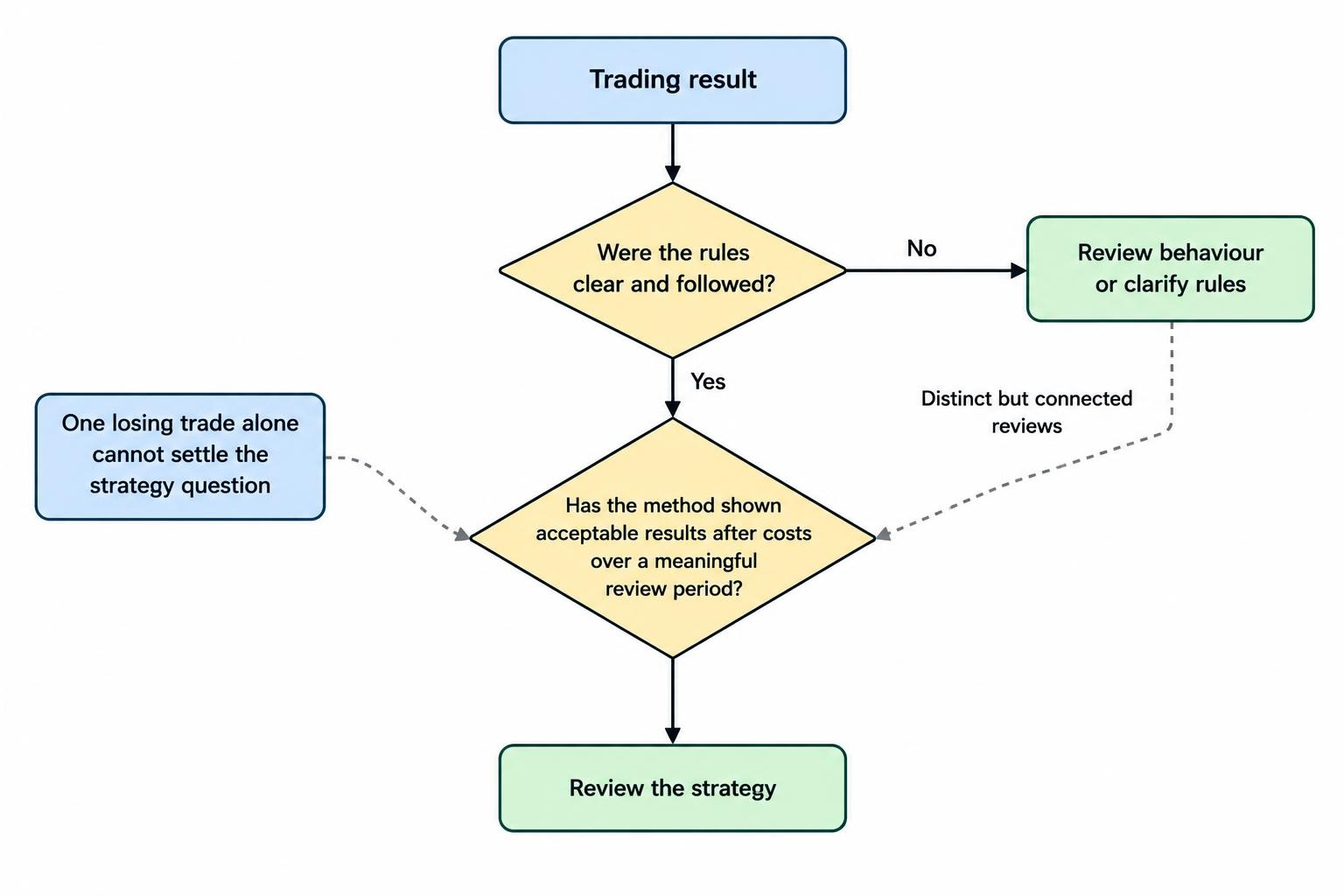
Not every losing period is a failure of discipline. Review three possibilities separately: you broke the rules, the rules were unclear, or the method itself has not shown that it can produce acceptable results after costs.
If you entered before the signal, doubled the stake or cancelled a planned exit, there is a behavioural issue to examine. If the instruction was simply “buy when momentum looks strong”, the immediate problem may be that the rule gives you too much room to improvise.
If you followed clear rules and still lost money over a meaningful review period, examine the method rather than telling yourself to become more positive. Confidence is not evidence of an advantage.
Your spread betting strategy should define what qualifies as an entry, how you size it and how you exit. Psychology concerns whether you can apply that process without repeatedly changing it under pressure.
Keep the two reviews connected but distinct. Changing the strategy after every disappointing result makes it hard to assess. Blaming every disappointing result on your mindset makes it hard to recognise a poor strategy.
Turn Discipline Into Rules You Can Actually Follow
Choose exposure before looking for reassurance
Work out the position’s planned cash risk before opening it. Do not enter a large trade and then search for reasons to feel comfortable with the exposure.
Use an exit distance justified by the trading method, then assess the stake that fits your cash risk budget. Moving the exit closer simply to make a larger stake fit changes the trade. So does using the maximum stake the platform will accept.
The calculations belong in position sizing for spread betting. The behavioural rule is straightforward: do not increase the stake because a trade feels unusually convincing.
If the smallest available position still exposes more money than you can reasonably accept losing, skip the trade. Reducing the discomfort by ignoring the loss calculation is not risk management.
Replace vague promises with if–then instructions
“Be more disciplined” does not tell you what to do when you are angry, excited or tempted to interfere. An if–then instruction connects a recognisable situation with a response decided beforehand.
This planning format is called an implementation intention. Research on goal pursuit supports its use for translating intentions into action, although that is not evidence that it makes a trading strategy profitable. The method is set out in the Gollwitzer and Sheeran resource on implementation intentions.
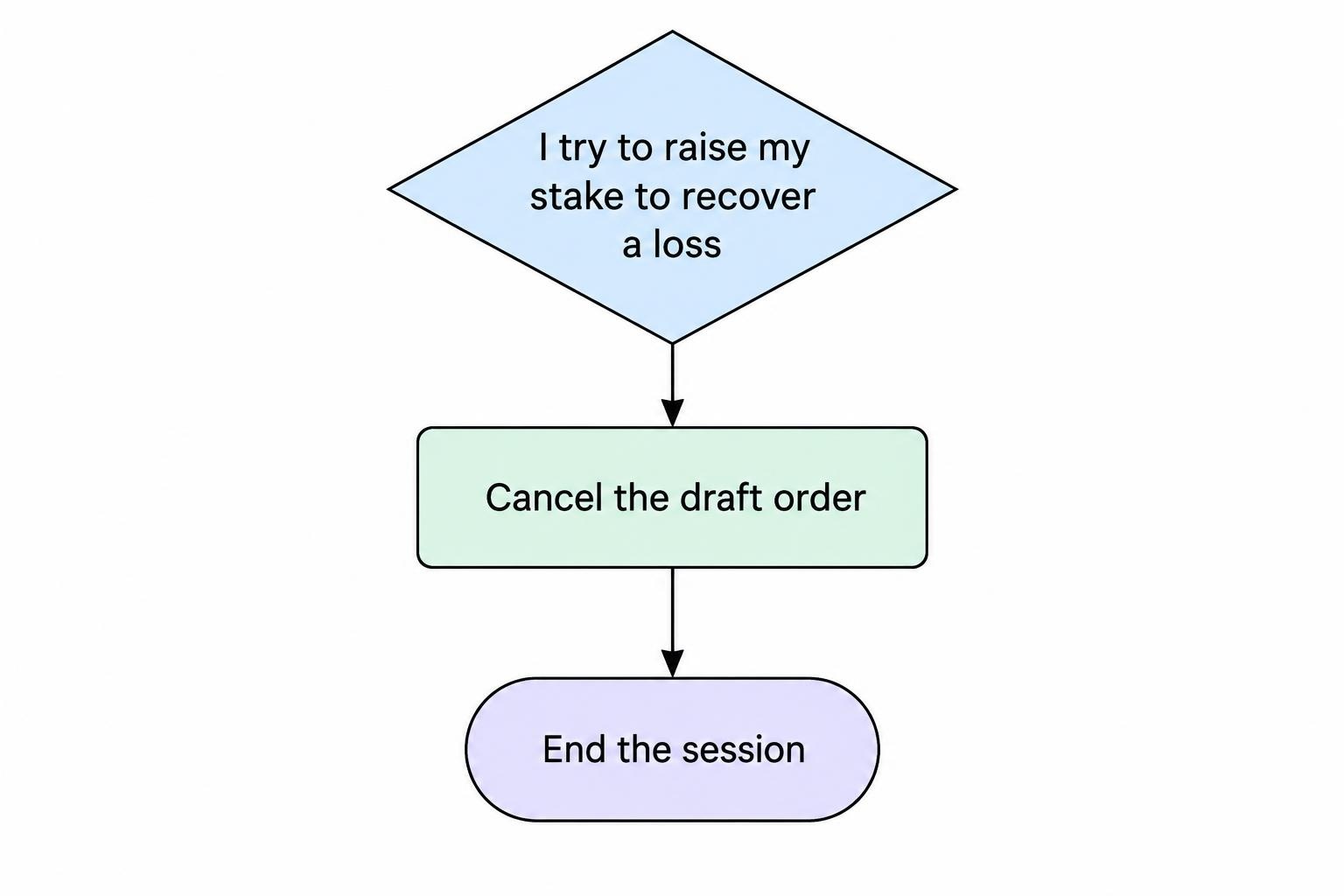
A trading instruction might read: “If I want to increase my stake to recover a loss, I will cancel the draft order and end the session.” Another might be: “If the entry moves beyond my permitted range, I will leave the trade rather than chase it.”
Make the trigger observable. “If I feel emotional” is open to negotiation. “If I try to place an order above my written stake limit” is much harder to explain away.
Set stopping conditions before you need them
Define when you will stop opening new positions. Possible triggers include a session loss threshold, an unauthorised increase in exposure or repeated entries outside your rules. These are personal operating controls, not universal numbers that suit every account.
Distinguish a stopping rule from a guaranteed financial limit. Open positions can move, costs can accrue and exits may execute at worse prices than expected. Specify how existing exposure will be managed when your threshold is reached.
Also decide what happens after a longer decline. A planned review point is more useful than waiting until you feel sufficiently worried. The financial side is covered in managing trading drawdown.
Do not write a stopping rule that allows an immediate exception for “one excellent opportunity”. That leaves the decision with the very impulse the rule was supposed to control.
A Worked Example: The Same Loss, Two Different Responses
Consider a hypothetical trader using £2 per point with an initial exit 50 points away. The planned price loss is £100, before costs and any difference between the intended exit and the actual fill. The trade closes at that planned price loss.
In the first response, the trader records the result and checks whether the entry and exit followed the plan. They feel annoyed, but do not change the next trade’s stake. If no further qualifying opportunity appears, the session ends without another position.
In the second response, the trader decides that the market “owes” a recovery. They raise the next stake to £6 per point, reasoning that a modest move will erase the loss. With the same 50 point exit distance, the planned price loss is now £300.
The second position might win. That would not make the recovery logic sound. It would mean the trader received a favourable outcome after increasing exposure for a reason unrelated to the new trade’s merits.
The first response can also be followed by another loss. That does not make restraint a mistake. Evaluate whether the method and its execution remain defensible, rather than whether a single session finished positive.
The useful journal entry is not “I should have been braver” or “I knew it would reverse”. It records the signal, the stake, the exit, the result and whether the decision complied with the plan. That gives the next review something firmer than regret to work with.
Build a Routine Around the Trading Session
Before opening the platform
Decide whether trading deserves your attention that day. If you are exhausted, distracted or preoccupied with recovering money, do not make opening a position the default activity.
Check scheduled events relevant to your markets and confirm when you can supervise positions. A trade requiring attention during a work meeting is a poor fit, even if the chart meets your entry conditions.
Review existing exposure before adding more. Several positions can depend on the same underlying move despite having different market names. Include portfolio correlation in that assessment rather than treating every order ticket as a separate risk decision.
A short pre-trade check can ask:
- Does the entry meet the written rules, at the current price?
- What market condition invalidates the trade?
- What is the planned cash risk, including existing exposure and expected costs?
- Am I changing the stake because of a recent win, loss or missed move?
- What will make me stop trading, and how will I manage positions already open?
If you cannot answer those questions without improvising, leave the order unplaced. The checklist should be short enough to use, but not so vague that every trade passes.
While a position is open
Keep management tied to the method. If the plan calls for decisions at the close of a particular chart period, do not replace it with constant reactions to every small movement unless an agreed risk control requires action.
When you want to change an order, name the reason before making the change. “The exit condition has occurred” is different from “I cannot bear to give back this profit”. Naming the reason does not settle the decision, but it makes the distinction visible.
Consider reducing avoidable prompts to interfere. That could mean closing social feeds, silencing nonessential notifications or removing markets outside your plan from the watchlist. Treat these as practical barriers to impulsive action, not as substitutes for managing open risk.
After the session
Record the trades before rewriting the day into a story about what you should have known. Keep observations factual: “Entered before the candle closed” is more useful than “Terrible discipline again”.
Do not redesign the entire method while reacting to the session’s profit or loss. Save proposals for a scheduled review, where you can compare them with more than one memorable trade.
A session without a qualifying trade needs no apology. Record why you stayed out if that decision tested your patience. Not placing an order is part of the process too.
Keep a Trading Psychology Journal That Records Behaviour
A psychology journal should connect situations, decisions and consequences. A page of feelings without trade details is difficult to assess. A spreadsheet of profit and loss without reasons for the decisions leaves out much of the behaviour you are trying to review.
Keep the record compact enough to complete after each trade. The following fields provide a workable starting point.
| Field | What to record |
|---|---|
| Planned trade | Market, entry condition, intended exit and stake per point. |
| Cash exposure | Planned price loss, relevant costs and other open positions. |
| Emotional trigger | The urge or concern present before the decision, described plainly. |
| Actual behaviour | Whether you followed the plan, changed an order or took an unplanned action. |
| Result and review | Actual profit or loss, execution differences and one question to investigate. |
Use consistent labels. “Recovery urge”, “chased entry” and “unplanned stake increase” are easier to compare across a month than a different description every day.
Reconcile the result with actual charges and adjustments. Otherwise, you can mistake a gross trading result for the amount the account earned or lost. The relevant charges are covered in spread betting costs explained.
At a scheduled review, count behaviours as well as pounds. How many trades met the entry rules? How many had unauthorised changes? Did rule breaches cluster after losses, late in the session or when you watched social media?
Keep the interpretation modest. A handful of trades cannot establish that a feeling caused a result. Use the journal to identify questions and repeated actions, then change one operating rule at a time so you can assess whether your behaviour changes.
Use Demo Trading to Practise a Process, Not Prove Your Nerves
A demo account gives you a place to rehearse order entry, position calculations, record keeping and stopping rules without putting trading capital at risk. It does not reproduce the financial consequences of a live loss.
Use spread betting demo accounts with realistic operating conditions: a plausible account balance, stakes you would consider using and the same rules you intend to apply elsewhere. An oversized virtual balance makes it too easy to ignore exposure that would matter in practice.
Define the purpose of the exercise. You might practise calculating the stake correctly, placing the intended orders and completing the journal without omissions. Those are observable tasks. “Feel confident enough to trade” is a less reliable standard.
Do not treat a profitable demo run as proof of a durable advantage or an obligation to start live trading. Review the method, execution assumptions and costs separately. If you choose to trade live, assess the emotional response at an affordable exposure rather than trying to recreate the virtual account’s profits.
There is no requirement to graduate to larger stakes. If live trading repeatedly leads to broken rules or unacceptable financial pressure, returning to simulation—or stopping altogether—is a valid decision.
When Trading Psychology Becomes a Reason to Stop
Some situations call for more than a better checklist. Borrowing to continue, hiding losses, using money needed for bills or repeatedly chasing losses are reasons to stop putting money at risk and seek support.
Do not diagnose yourself from an article. The NHS guidance on gambling related harm and support identifies chasing losses, borrowing and harm to finances or health among its warning signs, and sets out routes to professional help.
If trading feels out of control, contact your provider about restrictions or account closure and speak with someone you trust. A GP or an appropriate support service can help you assess what support is needed. Do not assume tools intended for gambling websites will automatically restrict a financial trading account; confirm available controls directly.
A temporary pause should not become a countdown to the next attempt to recover the balance. Address the financial and personal harm before considering whether trading has any place in your plans.
Make Your Next Decision Easier to Audit
You do not need a perfect mindset before making a sound decision. You need clear rules, exposure you have assessed honestly and a record that shows what you actually did.
Choose one recurring behaviour to address: moving exits, chasing entries, increasing stakes after a result or trading outside your plan. Write the trigger, the permitted response and the point at which you stop. Then review whether you followed that instruction, without letting a lucky profit excuse a breach.
The purpose is not to become fearless or trade more often. It is to make decisions that remain defensible when the result disappoints, while protecting your trading capital and keeping the option not to trade firmly on the table.