Commodity trading hours depend on the market, contract and spread betting provider. The useful opening time is the time your provider accepts executable trades in that exact instrument, not simply the opening bell shown on an exchange calendar.
This distinction matters if you trade around US announcements, hold positions through a daily break or expect to close a bet late on Friday. For commodity spread betting, check three things before relying on any timetable: the product name, the time zone and the next scheduled closure.
Commodity Trading Hours in UK Time
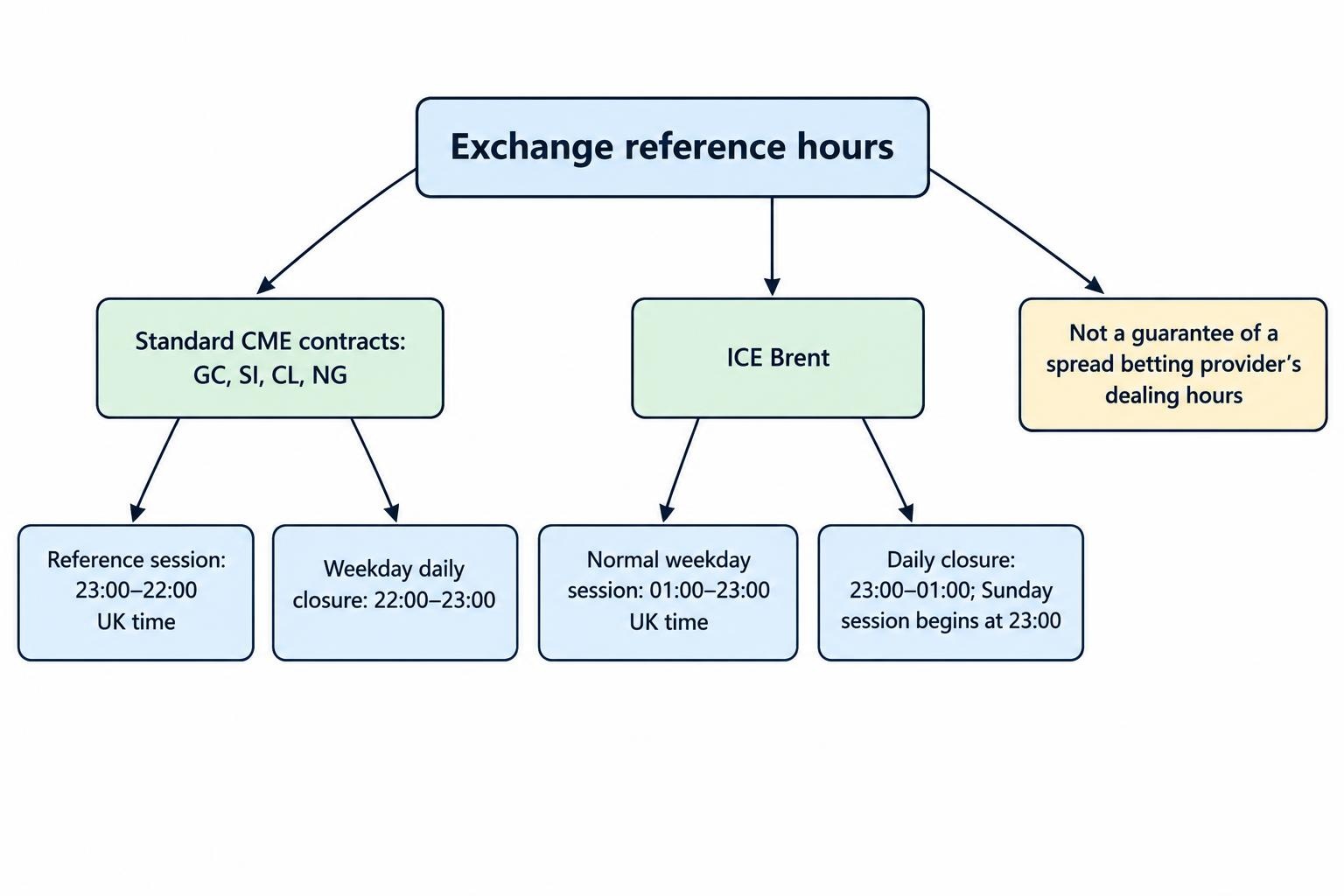
The table below covers standard benchmark futures that provide useful reference hours for major commodity markets. It is not a promise that your spread betting account follows the same schedule. The CME entries reflect its regular electronic sessions, subject to changes shown in the CME Globex regular and holiday trading schedules.
| Commodity and benchmark | Normal session | Daily closure |
|---|---|---|
| Gold: COMEX GC futures | 23:00 to 22:00 the following day, from Sunday evening to Friday evening | 22:00 to 23:00 between weekday sessions |
| Silver: COMEX SI futures | 23:00 to 22:00 the following day, from Sunday evening to Friday evening | 22:00 to 23:00 between weekday sessions |
| WTI crude oil: NYMEX CL futures | 23:00 to 22:00 the following day, from Sunday evening to Friday evening | 22:00 to 23:00 between weekday sessions |
| Henry Hub natural gas: NYMEX NG futures | 23:00 to 22:00 the following day, from Sunday evening to Friday evening | 22:00 to 23:00 between weekday sessions |
| Brent crude oil: ICE futures | 01:00 to 23:00 on normal weekdays; the opening session begins at 23:00 on Sunday | 23:00 to 01:00 between normal weekday sessions |
The CME contracts use a standard session of 17:00 to 16:00 US Central Time, with an hour between sessions. Their Friday close starts the weekend closure, rather than another one-hour pause. UK conversions move earlier during the short periods when British and American clock changes do not line up.
Brent follows a different timetable. The ICE Brent crude futures contract specification lists normal London hours of 01:00 to 23:00, with Sunday trading beginning at 23:00. Do not assume that WTI and Brent close together just because both appear under “oil” on your platform.
Exchange Hours Are Not Your Broker’s Dealing Hours
Use exchange hours as a reference, then check the dealing ticket and market information for your actual spread bet. Look for the full instrument name rather than a shortened watchlist label. “US crude”, a dated WTI contract and a daily funded oil market should not be treated as interchangeable without checking their terms.
Record the opening time, closing time, any daily pause and the time zone used by the platform. A timetable labelled “GMT” is not automatically the same as UK local time throughout summer. A server clock can introduce another difference.
Also check whether a displayed price is executable. An indicative quote, an updating chart or an available order-entry screen does not by itself establish that you can open or close a position. If the market is marked closed, check when execution resumes rather than assuming that a submitted order will trade immediately.
The distinction between the two main oil benchmarks deserves particular attention. Our crude oil spread betting guide covers the product differences; here, the practical rule is to keep a separate schedule for each oil instrument you trade.
How GMT, BST and US Clock Changes Affect Trading Hours
The UK moves clocks forward on the last Sunday in March and back on the last Sunday in October. In 2026, those dates are 29 March and 25 October, listed in the UK government clock-change calendar. British Summer Time is one hour ahead of GMT.
A US-based session therefore needs a date-aware conversion, not a permanent “add six hours” note beside your screen. Save the exchange’s local time as well as the UK equivalent so you can check the calculation.
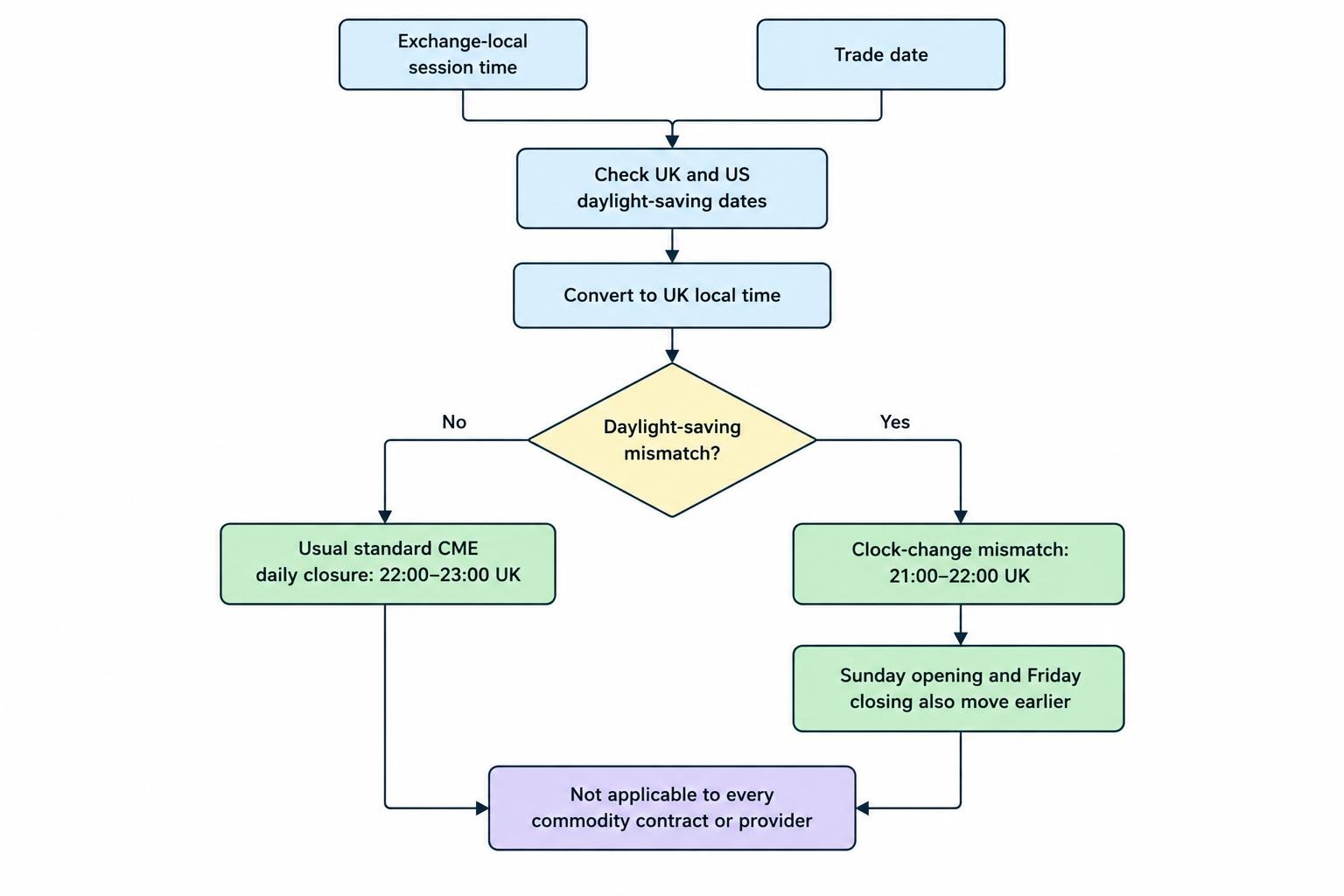
US daylight saving time runs from 8 March to 1 November in 2026 under the NIST daylight saving time rules. During the March and autumn mismatch periods, the UK sits one hour closer to Chicago and New York than usual.
For the standard CME contracts in the table, that shifts the usual UK daily closure from 22:00–23:00 to 21:00–22:00. Their Sunday opening and Friday closing times move earlier too. Check alerts, scheduled orders and your intended exit time after each clock change; changing the clock on your phone does not check your trading plan for you.
Which Hours Should You Plan Around?
Choose a trading window around the information you intend to monitor and the time you can actually supervise a position. An open market is not automatically a suitable market to trade. Compare the quoted spread with your planned stop distance and the size of the move your strategy needs.
For energy traders, the US data calendar provides useful checkpoints. The Weekly Petroleum Status Report normally arrives on Wednesday at 10:30 US Eastern Time, and the Weekly Natural Gas Storage Report normally arrives on Thursday at 10:30 Eastern. These are usually 15:30 UK time, or 14:30 during the clock-change mismatch periods. Check the EIA release schedules for holiday exceptions rather than relying on a recurring calendar alert.
Decide beforehand whether you want exposure through a release. If your plan requires an exit before publication, leave time to place and confirm that trade. “I will close at the announcement” leaves no room for an order problem or a price that moves before you act.
For natural gas spread betting, confirm that the instrument references US Henry Hub rather than a British or European gas benchmark. The word “gas” alone does not identify the relevant contract, timetable or announcement calendar.
Weekends, Holidays and Daily Breaks
Do not apply a blanket “commodities are closed at weekends” rule to every exchange product. Some contracts now have different arrangements. The CME 1-Ounce Gold futures FAQ, for example, specifies trading seven days a week, subject to maintenance windows. That is a different contract from the standard GC benchmark in the table, and it does not establish weekend availability for your spread bet.
Before holding through a closure, decide whether you accept the possibility of reopening at a different price. A stop level is not necessarily an executable exit price across a gap. The practical consequences are covered in our guide to market gap risk.
Holiday schedules also need a fresh check. ICE publishes contract and market calendars through its holiday trading hours resources, with some arrangements announced nearer the holiday. Check the relevant exchange calendar alongside your provider’s notice, including both the early close and the next reopening.
Separately, check whether your dated spread bet reaches its final dealing time before the normal session ends. A market can remain open while your chosen contract is approaching settlement. Our guide to spread betting expiry dates covers that distinction.
A Practical Trading-Hours Check Before Entry
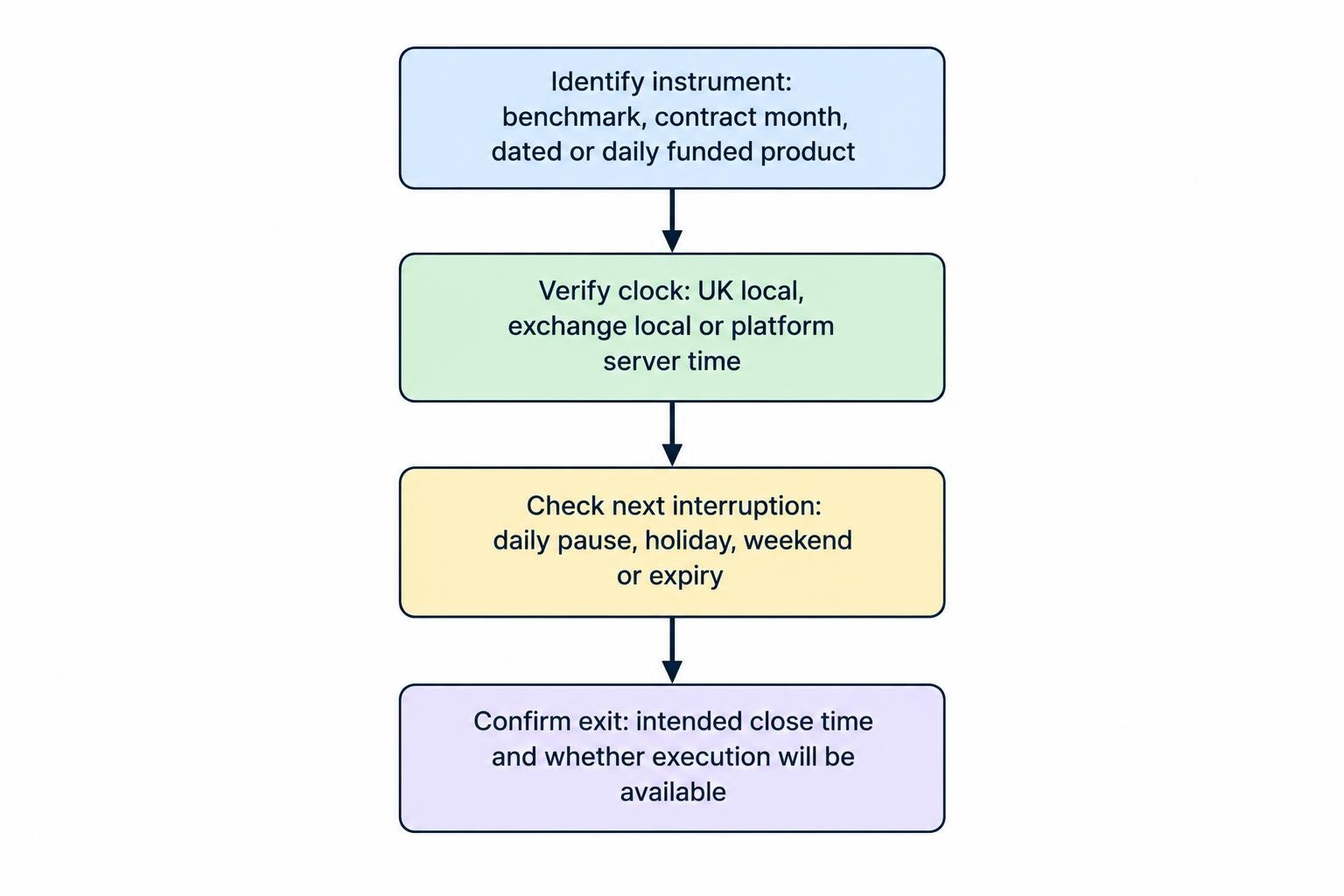
Build the timing check into each trade rather than treating it as account setup paperwork. Before placing an order, confirm:
- The instrument: benchmark, contract month and daily funded or dated product.
- The clock: UK local time, exchange local time or platform server time.
- The next interruption: daily pause, holiday close, weekend closure or expiry.
- The exit: when you intend to close and whether execution will be available.
For example, suppose your platform lists a 22:00 closure and you intend to exit at 21:55. Set a reminder before that deadline and confirm the position has actually closed. If you instead decide to carry it, reassess the trade as an overnight position rather than allowing a missed exit to make that decision.
Trading availability and holding costs are separate checks. Review the product’s funding terms before holding a spread bet overnight. The timetable tells you when you can deal; it does not tell you what keeping the position open will cost.