Client money rules govern how a UK spread betting firm must hold and account for money belonging to its customers. Their purpose is to separate client funds from the firm’s own finances, rather than leave customers relying only on the broker’s ability to repay them.
That protection needs careful interpretation. Segregation is not insurance against trading losses, a guarantee of immediate withdrawals or proof that every pound displayed on a platform sits in a separate account bearing your name.
This guide covers the client money arrangements relevant to UK spread betting accounts. For the wider framework, see our guide to UK spread betting regulation.
What Do Client Money Rules Protect?
The distinction is between money held for customers and money belonging to the business. A broker needs its own funds to pay staff, meet operating expenses and support its trading activities. Client money should not become an informal extension of that working capital.
The legal foundation goes beyond putting cash in a differently labelled account. CASS 7.17 establishes the statutory trust framework, with clients retaining beneficial ownership of money held for them; the framework recognises an agency basis in Scotland. It also prevents the firm from using the trust to advance credit to itself, another client or another person. Following failure, costs properly attributable to distributing client money can be charged to the trust. These provisions sit in the FCA’s statutory trust rules.
The practical point is ownership. A customer should be asking whether money is held for clients under the applicable rules, not simply whether the broker has enough cash somewhere in its business.
Consider two hypothetical descriptions of an account. One identifies the contracting company, explains its client money arrangements and sets out the treatment of customer funds. The other relies on statements about the group’s financial strength. Those descriptions answer different questions. A strong balance sheet is not a substitute for clear client money terms.
How Segregated Client Accounts Work
Segregation means separating client money from the firm’s own money. Under the normal approach, client money must generally be received directly into a client bank account rather than pass through the firm’s operating account first. CASS also permits an alternative approach subject to further conditions.
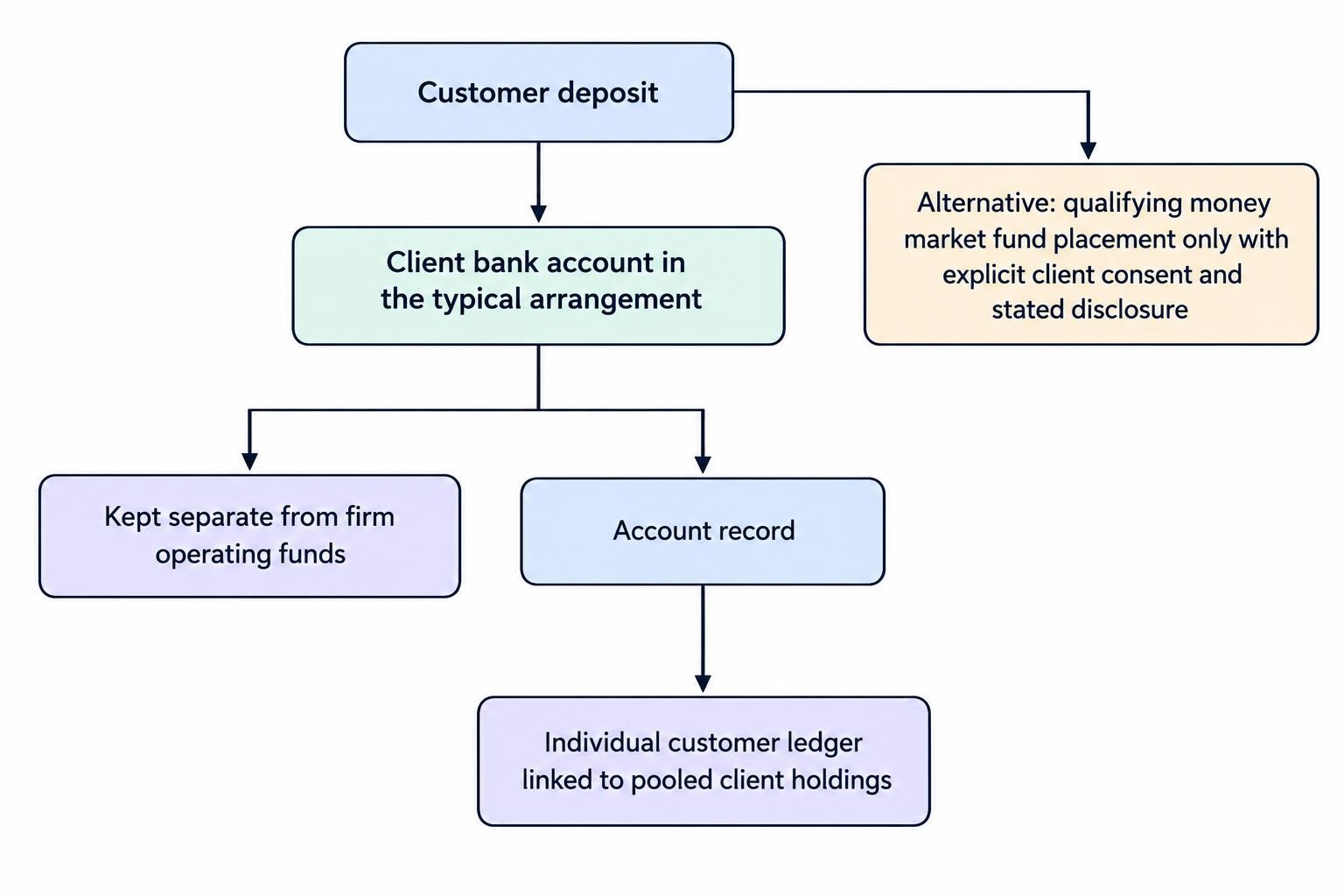
The rules require care in selecting and reviewing institutions holding client money, including consideration of diversification. They do not require every customer’s money to remain at a UK bank. Qualifying money market funds are another permitted route, but placement requires explicit client consent and disclosure that the money will not be held under the ordinary client money requirements; the resulting fund holdings fall under applicable custody requirements. These distinctions appear in CASS 7.13 on segregation and permitted placements.
When reviewing a broker’s arrangements, ask where the money can be held, not just where it is held on the day you open the account. Read the contractual permissions as well as the shorter explanation on the funding page.
Also separate two questions: whether money is segregated from the broker, and whether the institution holding it presents another risk. Naming a familiar bank answers neither question completely. You still need to know which legal entity holds the account and what arrangements apply to your funds.
Segregated Does Not Mean Individually Banked
Do not read “segregated account” as a promise of a personal bank account opened in your name. Client funds can be held in pooled arrangements, with individual interests identified through the firm’s records.
For your own checks, focus on the connection between the pooled money and your account ledger. Can you follow your deposits, withdrawals, trading results and charges? Could you assemble a clear record of your balance without relying on the platform remaining accessible?
Those questions are more useful than treating the word “segregated” as the end of the investigation.
Cash Balance, Margin and Equity Are Different Figures
A spread betting platform can display several balances at once. They serve different purposes, and confusing them makes client money arrangements harder to assess.
Suppose a hypothetical account has a £6,000 cash balance, a £400 unrealised loss and a £1,200 margin requirement. Ignoring other adjustments, the display might look like this:
| Account measure | Illustrative amount | What it represents |
|---|---|---|
| Cash balance | £6,000 | The account ledger before the open position’s unrealised result |
| Unrealised loss | £400 | The current loss on the open position |
| Account equity | £5,600 | Cash balance adjusted for that unrealised loss |
| Margin requirement | £1,200 | The amount required to support the position |
| Free margin | £4,400 | Equity remaining after the margin requirement |
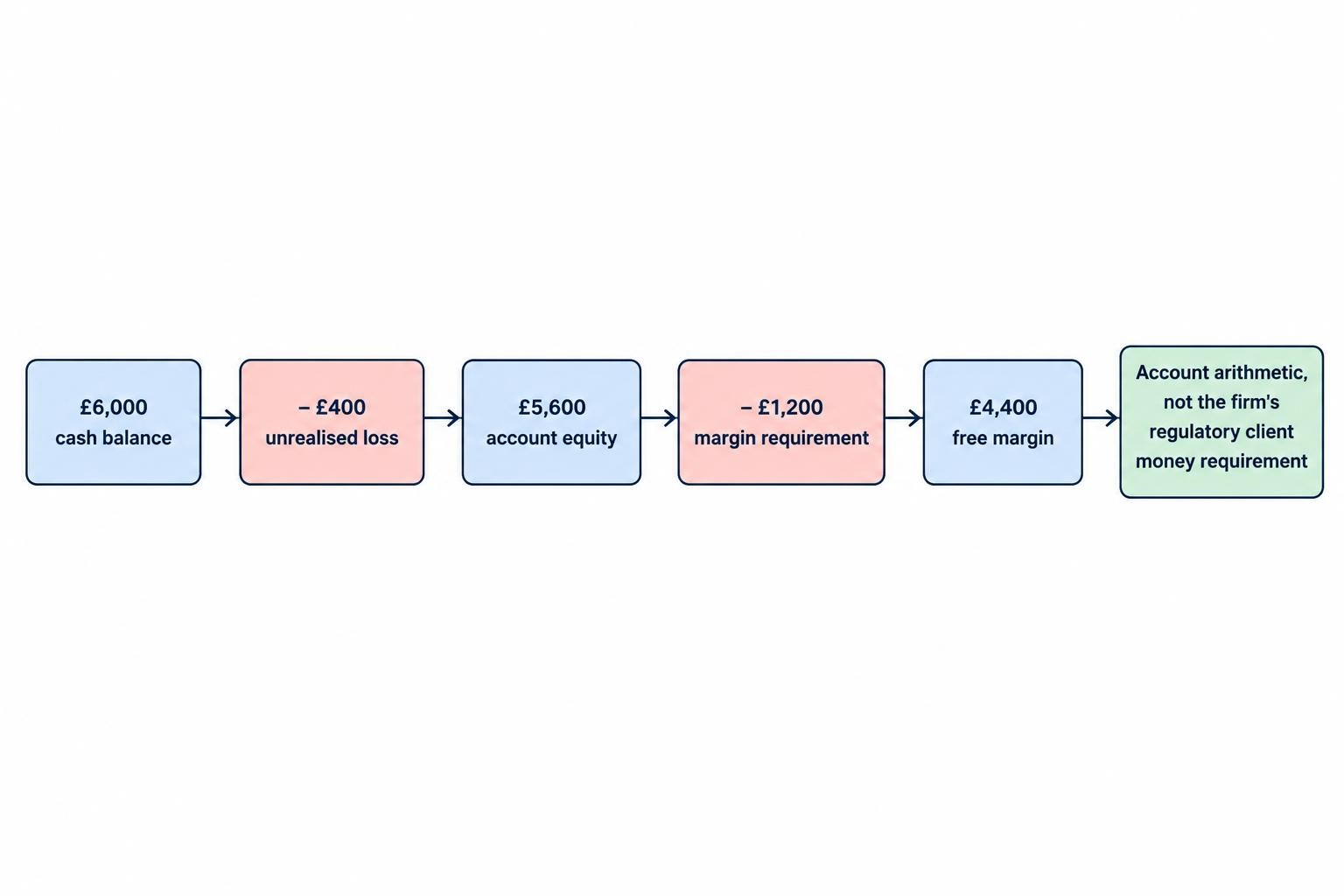
This is an account arithmetic example, not a calculation of the firm’s regulatory client money requirement. Platform labels and withdrawal calculations can differ. Our guide to spread betting margin covers how margin supports an open trade.
The £1,200 margin figure should not automatically be read as £1,200 permanently spent. Nor should the £6,000 cash balance be treated as an unconditional withdrawal entitlement while positions remain open.
If the position closes at a £400 loss, with no further charges, the cash balance becomes £5,600. Client money protection does not restore the lost £400. The trading result and the safeguarding arrangements answer separate questions.
Keep that distinction when checking your spread betting account statements. Reconcile actual transactions rather than comparing two headline figures that measure different things.
When Money Stops Being Client Money
Client money status is not permanent simply because a payment began as a customer deposit. Under CASS 7.11, money ceases to be client money when it becomes properly due and payable to the firm for its own account. The contractual arrangements help determine when that happens.
A separate issue is a title transfer collateral arrangement, or TTCA. This transfers full ownership of money to the firm rather than leaving it as protected client money. Firms must not enter into TTCAs over money belonging to retail clients. For non-retail clients, a valid TTCA can place the money outside client money protection, with written terms and other safeguards required. The distinction is set out in the FCA rules on treatment of client money and title transfer.
For an ordinary account review, check the provisions covering trading losses, financing charges, other fees and collateral. You need to distinguish a payment settling an amount you owe from money still held for you.
A useful question to send the firm is: does any part of my account funding transfer into the firm’s ownership as collateral, and which contractual clause governs that treatment? Ask for an answer about your account category, not a general description of the broker’s customers.
Professional Status Needs a Separate Review
Do not assume that a change to professional classification affects only trading terms. Before accepting it, ask whether your client money treatment would change and whether any title transfer agreement would apply.
Professional classification does not, by itself, tell you that a TTCA exists. Equally, a familiar trading platform does not establish that the contractual treatment remains unchanged.
Review the proposed agreement alongside the existing one. Keep copies of both and ask the firm to identify changes to custody, collateral and compensation eligibility. Our comparison of retail and professional client classification covers the broader decision.
Why Reconciliation Matters as Much as Segregation
A separate bank account is only useful if the records show the correct amount owed to clients. Reconciliation is the process of checking those figures.
Before failure, firms generally must perform an internal client money reconciliation each business day using the previous business day’s closing records. External reconciliations compare internal records with third-party records. Their frequency must reflect the business, with daily external checks expected in most circumstances for firms transacting daily. A shortfall identified through an internal reconciliation generally must be paid into a client bank account by the close of business that day. These duties appear in CASS 7.15 on records and reconciliations.
For a simplified illustration, suppose the calculated requirement is £12 million but the recorded resource is £11.8 million. The £200,000 difference needs investigation and correction; a positive bank balance does not make the discrepancy disappear.
You cannot reproduce a firm-wide reconciliation from your personal statement. What you can do is maintain a clear record of your own account and question unexplained differences promptly.
Be precise when asking about daily checks. Ask whether the explanation covers internal reconciliation, comparison with bank records, or both. A broad statement about checking balances every day leaves room for ambiguity.
What Happens to Client Money if the Broker Fails?
Failure brings distribution rules into play. Under CASS 7A.2, a firm’s failure triggers a primary pooling event. Relevant client money is treated as belonging to the applicable notional pool, and distributions are linked to clients’ calculated entitlements. The general pool and any recognised sub-pools are treated under their respective rules. The legal mechanism is contained in the FCA rules on primary pooling events and distribution.
A simplified example shows why segregation and full recovery are not identical. Assume a pool has valid entitlements of £10 million but only £9 million available for distribution. Ignoring costs, later recoveries and compensation, a proportionate distribution would return 90% of each entitlement. A £20,000 entitlement would produce £18,000.
This is an illustration, not a prediction about any firm. Actual recovery depends on the relevant pool, established entitlements and the money available.
Do not build your emergency cash plan around an assumption that access will be uninterrupted. Keep copies of recent statements, payment confirmations and account correspondence outside the trading platform. Record the contracting company’s name as well as the brand.
If a failure occurs, compare any proposed entitlement with those records and raise discrepancies through the announced process. Follow verified communications rather than unsolicited offers to recover your money. Our guide to what happens when a spread betting broker fails covers the wider process without treating segregation as a promise of immediate repayment.
Client Money Rules and FSCS Protection Are Separate
Segregation concerns how money is held. The Financial Services Compensation Scheme concerns eligible claims when a financial firm fails. Neither should be used as shorthand for the other.
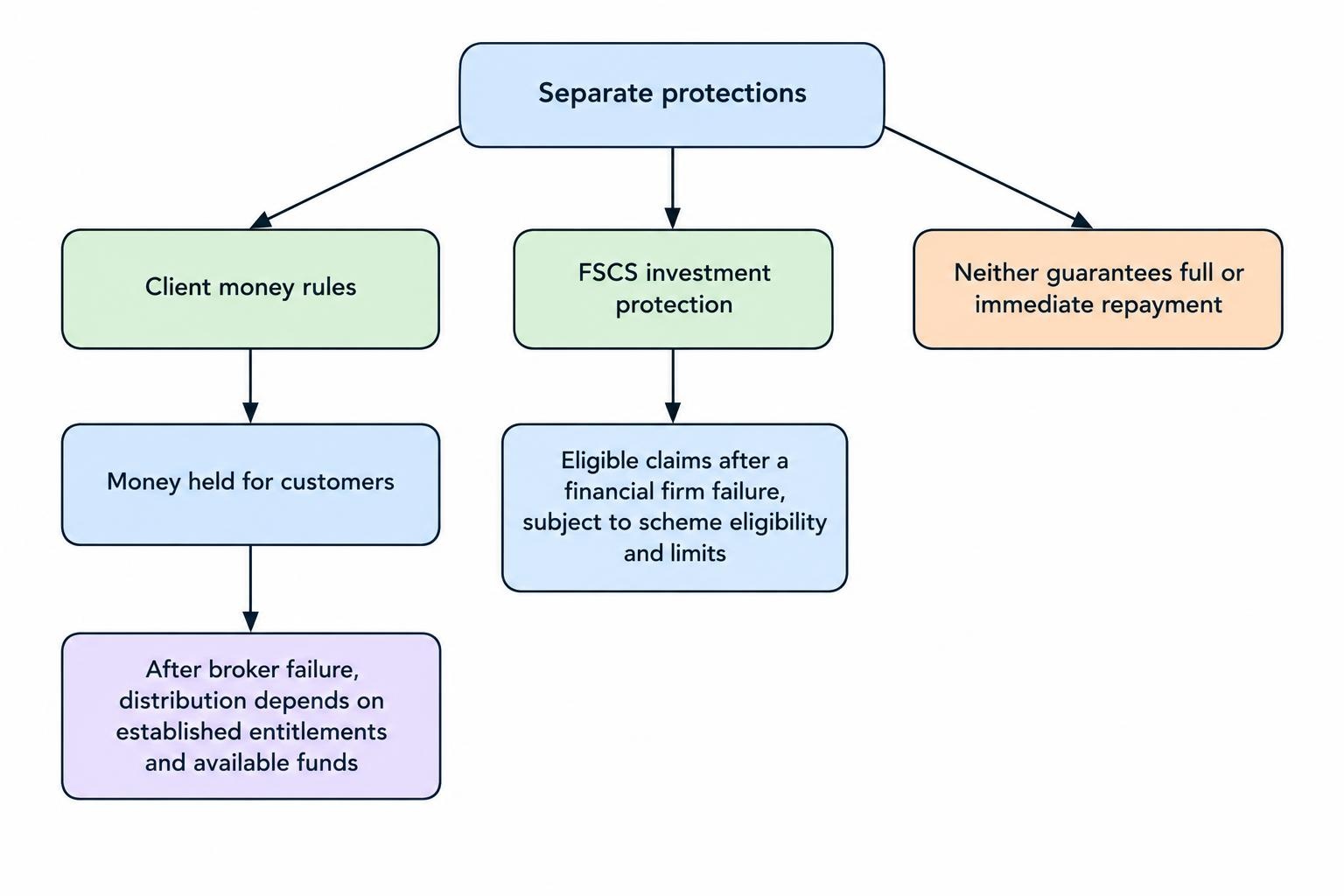
As at 21 October 2026, FSCS investment protection can pay up to £85,000 per eligible person, per firm, subject to the claim meeting its requirements. Authorisation alone does not make every activity or product protected, and FSCS does not compensate for poor investment performance. These boundaries are stated in the FSCS investment protection and eligibility guidance.
The compensation limit is not a ceiling on the amount that can be returned from client money arrangements. If your valid entitlement exceeds £85,000, the separate question is how much can be recovered from the funds held for clients. Compensation becomes relevant to an eligible loss, not automatically to the entire displayed balance.
Bank Failure Is a Different Event
If the bank holding client funds fails, deposit protection is a separate consideration. The current standard deposit protection limit is £120,000 per eligible person, per authorised bank or banking group sharing the relevant authorisation. FSCS includes money held as a beneficial owner through a client account when assessing the total held with that bank. Personal savings and an attributable client account balance may therefore need to be considered together. The FSCS deposit protection questions and answers explain this treatment.
Do not substitute the £120,000 deposit limit for the £85,000 investment limit when assessing a broker failure. They address different claims. Our guide to FSCS protection for spread betting accounts examines eligibility in more detail.
What to Check Before Funding an Account
A useful review follows the money from your payment instruction to the legal agreement. It does not need to become a research project, but it should leave you with written answers to the main questions.
- Identify the contracting company. Record its full legal name and firm reference number, rather than relying on the trading brand.
- Confirm your client category. Check whether the agreement classifies you as retail or professional and whether any proposed change affects money treatment.
- Read the client money terms. Look for segregation arrangements, pooled accounts, permitted holding institutions and collateral provisions.
- Check the payment route. Compare funding instructions with the account details supplied through a verified channel.
- Save the evidence. Keep the agreement, statements and payment confirmations somewhere you control.
Start with the legal entity. Use our guide to checking a broker on the FCA Register to structure that check. Match the company in your agreement, not just a similar name appearing in search results.
Then ask the firm to explain any terms you cannot reconcile. If its short client money statement sounds broader than the agreement, request clarification before depositing. A useful answer identifies the account, entity and relevant contractual provisions.
Repeat the review if you are asked to move to another group company. Treat that as a fresh decision, not routine account housekeeping. Our guide to offshore spread betting brokers covers the questions raised by a change of jurisdiction.
What a Withdrawal Test Can Tell You
A modest withdrawal test can help you check payment instructions, processing steps and the documents requested. It cannot establish the condition of the entire client money pool or certify the firm’s compliance.
Use the test for its practical purpose. Record the request date, amount, confirmation and receipt. If something goes wrong, ask for a written explanation that addresses your transaction.
A delayed payment needs investigation, not an instant diagnosis. If correspondence does not resolve the issue, our guide to spread betting complaints and the Financial Ombudsman sets out the routes to consider.
Keep Broker Exposure Separate From Trading Risk
Client money checks should inform how much cash you leave with a firm. Base that amount on your trading plan, expected margin needs and a considered buffer, rather than treating the account as a convenient home for unrelated savings.
Withdrawing too aggressively can create a different problem. An account still needs enough equity to support its open positions through adverse price movements. Decide on withdrawals alongside position size and margin requirements, not in isolation.
For practical planning, separate three amounts: money needed for current positions, money reserved for planned trading, and money with no trading purpose. That exercise helps you question unnecessary exposure without starving an active account of working cash.
Our guide to protecting trading capital covers that broader discipline. Client money arrangements deserve the same attention as costs and execution, but they do not make a risky trade safe. The useful questions remain straightforward: who holds your money, on what terms, and what evidence would you have if access stopped?