Spread betting on US shares lets you take a position on an American company’s share price without buying its stock. You choose a stake per point, buy if you expect the price to rise or sell if you expect it to fall, and settle the resulting profit or loss with your provider.
For UK traders, the practical questions go beyond choosing a company. US shares introduce dollar price quotes, afternoon and evening trading sessions, earnings announcements outside regular hours, and possible US withholding adjustments. A sterling stake does not remove those considerations.
This guide covers US shares within the UK spread betting market. For the broader mechanics across domestic and overseas equities, see our guide to share spread betting. All prices, stakes and charges in the examples below are hypothetical.
What You Trade When You Spread Bet on US Shares
A US share spread bet is a contract with your provider whose value follows the quoted price of an underlying share. It is not a purchase of stock through the New York Stock Exchange or Nasdaq. You do not become a shareholder, receive voting rights or acquire stock that you can transfer to another investment account.
The provider displays a selling price and a buying price. You open a long position at the buying price and close it at the selling price. For a short position, the sequence reverses: sell to open, then buy to close. The difference between those executable prices, multiplied by your stake, determines the trading result before other charges and adjustments.
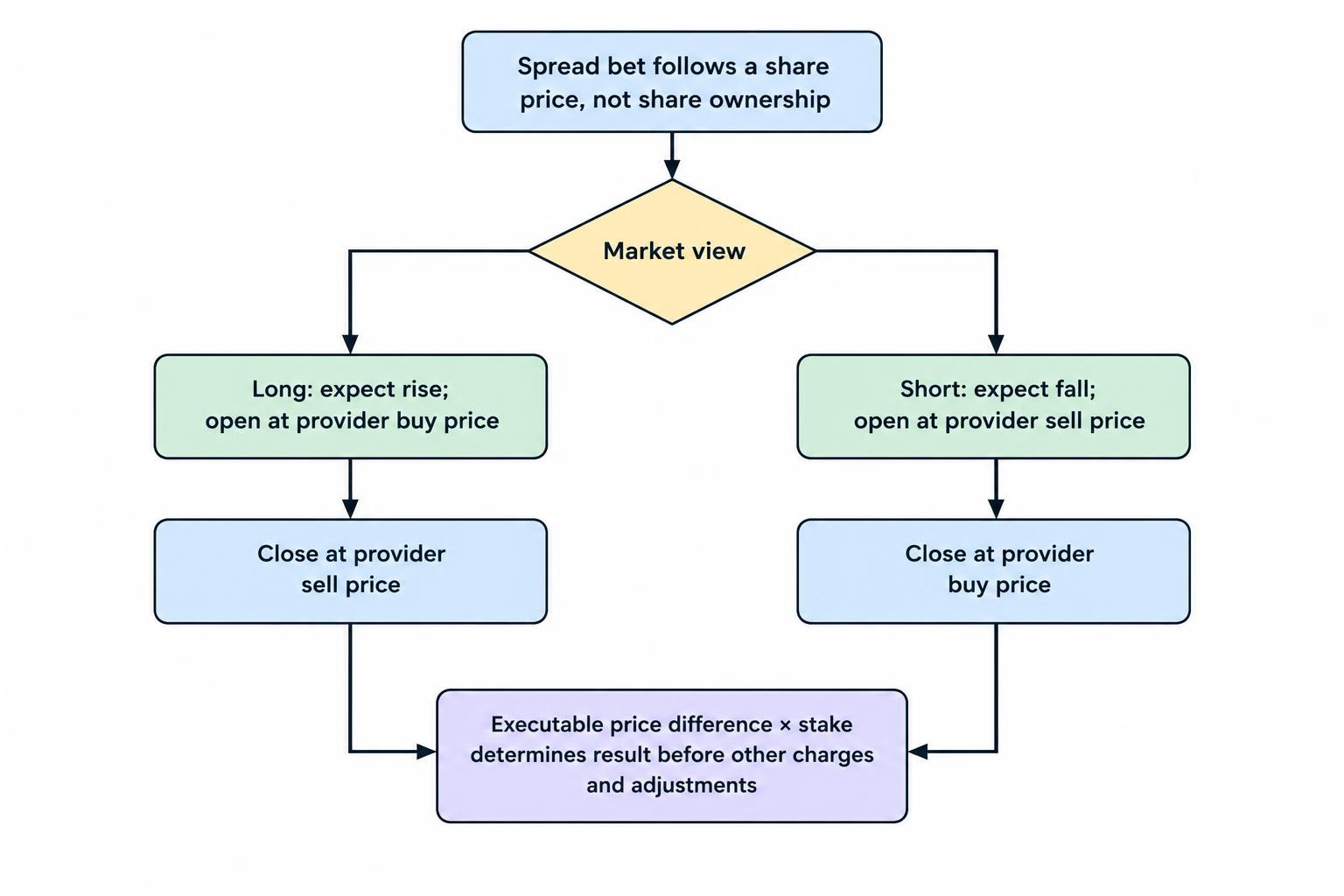
That distinction matters when checking a chart. A news service might display the last exchange trade, while your platform chart displays a midpoint or one side of its quote. None necessarily equals the price at which you can close your position. Use the relevant dealing price when calculating an exit.
Availability is also a contract question. Do not assume that every US listing is available, that every available share can be sold short, or that a provider quotes it throughout every exchange session. Check the individual market’s dealing terms rather than relying on the size of its company list.
US Share Prices, Points and Sterling Stakes
Check what one point means
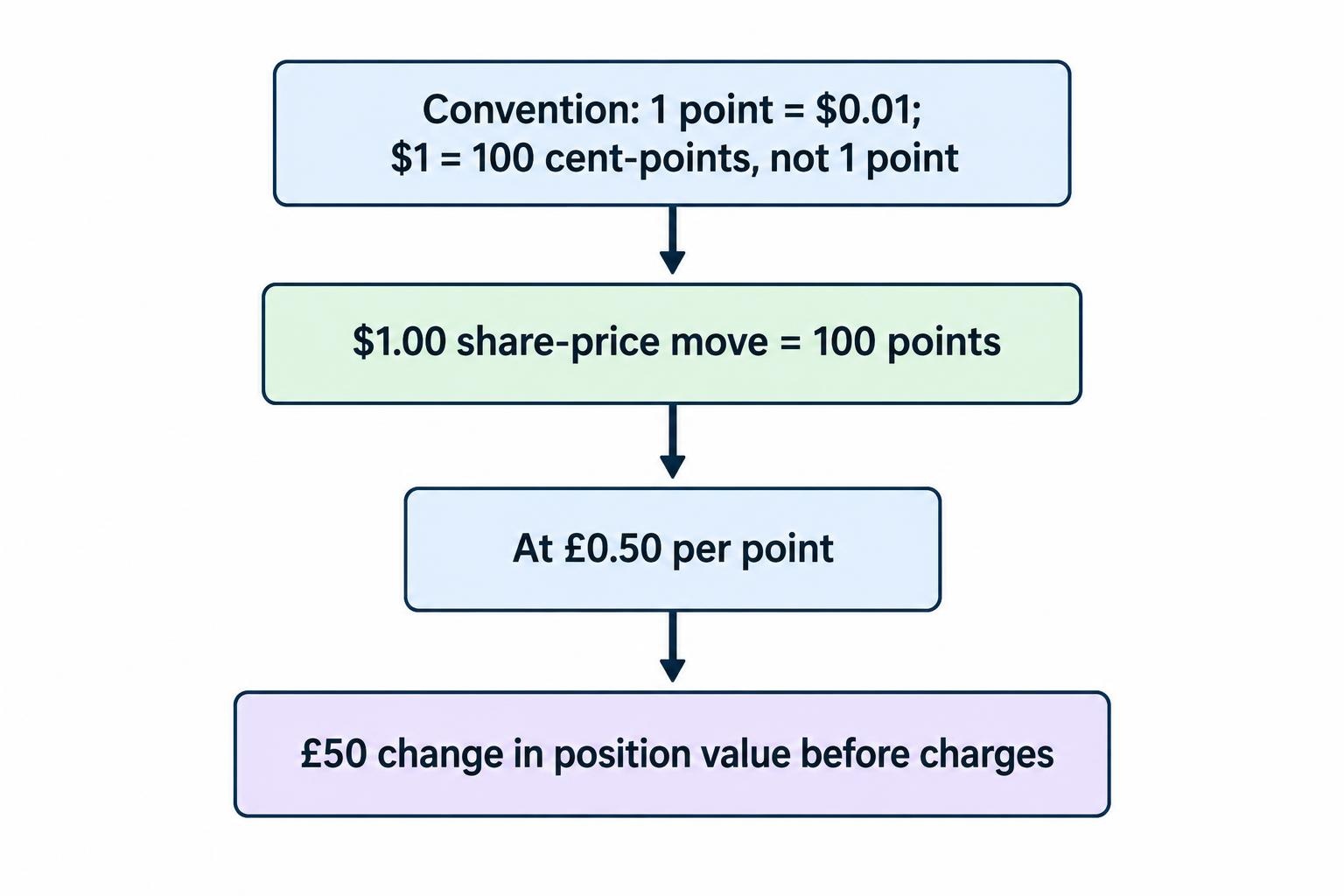
US shares are quoted in dollars, but a spread betting contract may define one point as one US cent. Under that convention, a share price of $180.00 corresponds to 18,000 points. A move from $180.00 to $181.00 is therefore 100 points, not one.
At £0.50 per point, that $1.00 move produces a £50 change in the position’s value. At £1 per point, it produces £100. Confusing a cent with a dollar creates a hundredfold sizing error. It is an expensive way to learn where the decimal point belongs.
Never assume that the screen’s decimal format tells you the point definition. Confirm the contract size, minimum stake and profit calculation on the dealing ticket. Our explanation of stake per point covers how these units translate into cash exposure.
A pound stake is not the same as owning dollar assets
Suppose your contract pays £0.50 for every one cent movement. A favourable 400 point movement produces £200 before charges. You do not automatically calculate a dollar trading profit and then convert it at the closing GBP/USD rate; the agreed sterling stake already determines the payout.
This differs from buying US shares with pounds. With directly owned stock, both the dollar share price and the exchange rate affect its sterling valuation. A fixed sterling stake spread bet instead pays for the share’s movement under its own contract terms.
That does not make currency irrelevant. Exchange rates can affect the underlying company’s business, and a provider may use currency conversions when calculating certain charges or adjustments. The stake currency, account currency and currency used for fees are separate details. Check them rather than assuming that a pound balance means every entry avoids currency conversion costs.
A Worked Example: Buying a US Share Spread Bet
Assume a hypothetical US technology share has a spread betting quote of 18,000–18,006, equivalent to $180.00–$180.06, with one point defined as one cent. You expect the price to rise and buy at 18,006 for £0.50 per point.
| Item | Calculation | Result |
|---|---|---|
| Opening buy price | $180.06 expressed in cent points | 18,006 points |
| Stake | Cash change for each point | £0.50 per point |
| Opening spread | 18,006 − 18,000 | 6 points, or £3 at this stake |
| Closing sell price | $184.06 expressed in cent points | 18,406 points |
| Trading profit before other charges | (18,406 − 18,006) × £0.50 | £200 |
| Alternative losing exit | (17,706 − 18,006) × £0.50 | £150 loss |
| Opening notional exposure | 18,006 × £0.50 | £9,003 |
The £200 result already reflects the opening buy price and closing sell price. Do not subtract the opening spread again. That would count the same cost twice. Financing, a separately charged fee or another account adjustment would still need to be included.
The £9,003 notional figure describes the price exposure created by this contract’s sterling stake. It is not a dollar stock purchase converted into pounds. A 1% change from the entry price changes the position’s value by approximately £90.03, before differences caused by the dealing spread and other costs.
For a short trade, subtract the closing buy price from the opening sell price, then multiply by the stake. A falling price benefits the position; a rising price hurts it. Shorting also brings contract availability and borrowing considerations covered in our guide to short selling shares through spread betting.
Margin Requirements and Position Size
UK retail rules require at least 20% initial margin for spread bets on individual shares, equivalent to maximum opening leverage of 5:1. Providers can require more. The same rules require account level close-out when net equity falls below 50% of the applicable margin requirement, as soon as market conditions allow, and restrict retail liability to funds in the relevant account. These protections sit within the FCA rules for retail speculative investments.
At a hypothetical 20% margin rate, the £9,003 position above requires £1,800.60 to open. That deposit is not its maximum possible loss. A 10% adverse share price movement would produce a trading loss of about £900.30 before spread changes and charges.
Negative balance protection is not a guarantee that the opening margin survives. It protects against liability beyond the funds in the relevant account under the applicable retail rules. It does not preserve an individual trade’s deposit or make an ordinary stop execute at its requested price.
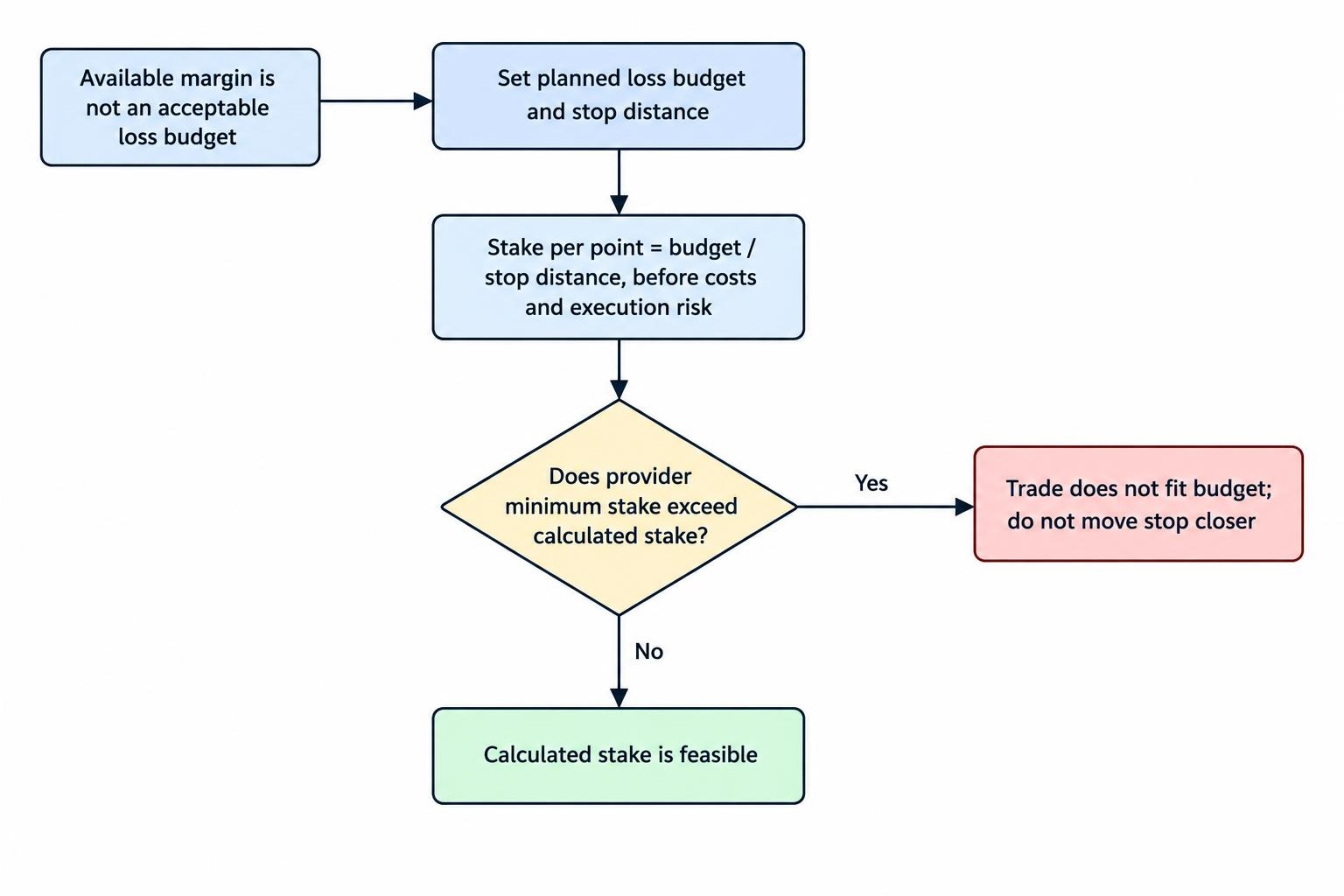
Size the position from the loss you are prepared to accept, not the margin the platform will let you use. If a trade has a £150 planned loss budget and the proposed stop is 300 points from entry, the arithmetic gives £0.50 per point before allowing for costs and execution risk.
That calculation also needs a feasibility check. If the provider’s minimum stake is higher, the trade does not fit that budget. Moving the stop closer solely to squeeze the position into the account changes the trade, rather than fixing the sizing problem.
Keep spare account equity separate from your planned stop loss. A position may face higher margin requirements, accumulating financing or losses elsewhere in the account. Our guide to position sizing for spread betting develops this process without treating available margin as permission to trade larger.
The Costs of Spread Betting on US Shares
Dealing spreads and other entry costs
Start with the actual executable spread for the share and session you intend to trade. A minimum advertised spread does not establish the cost of your proposed order. Compare quotes under similar conditions and at a stake representative of your planned trade.
Check whether the provider adds its charge through the spread, applies a separate commission, imposes a minimum transaction charge, or uses another arrangement. A small position can be disproportionately affected by a minimum charge. Our guide to share spread betting costs separates these charging methods.
Overnight financing and short borrowing
A daily funded position held beyond its funding cut-off can attract financing. Do not estimate that cost from the margin deposit alone. In its review of trading charges, the FCA identified overnight financing calculated on total notional exposure, rather than just the amount exceeding the client’s initial margin, in its findings on CFD and spread betting charges.
For illustration, assume an unchanged £9,003 exposure, a hypothetical annual financing rate of 8%, seven chargeable days and a 365 day calculation basis. The estimated charge is £9,003 × 8% × 7 ÷ 365, or £13.81. This is arithmetic, not a current rate quote or a promise about a provider’s formula.
The actual calculation may use a changing valuation, a different day count or a schedule that collects several days’ funding together. Short positions can also attract stock borrowing charges. Do not assume that selling a share spread bet automatically earns an overnight credit.
Compare the expected holding period with the likely price objective. Funding that looks small each night can absorb a substantial part of a modest move over several weeks. Check the applicable overnight financing terms before choosing a daily funded contract for a longer position.
US Share Trading Hours for UK Traders
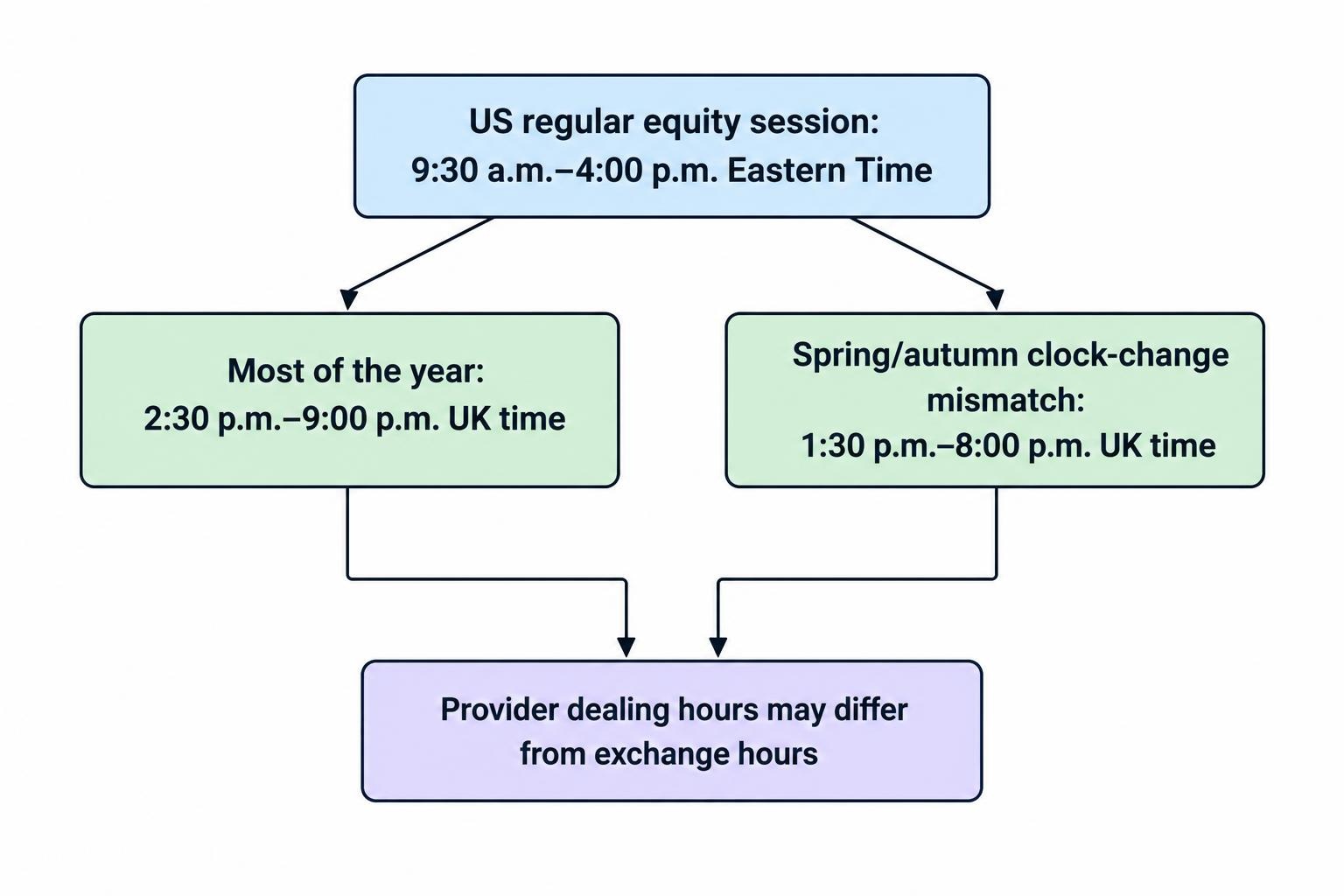
The regular US equity session runs from 9:30 a.m. to 4:00 p.m. Eastern Time. The NYSE trading calendar and session schedule also identifies exchange holidays and shortened sessions. Those dates matter even when the UK is having an ordinary working day.
For most of the year, the regular session translates to 2:30 p.m.–9:00 p.m. UK time. During the spring and autumn mismatch between the countries’ clock changes, it translates to 1:30 p.m.–8:00 p.m.
The UK changes its clocks on the last Sunday in March and October, as set out in the National Physical Laboratory’s UK clock timetable. Put the session in a calendar that recognises both London and New York time rather than keeping a fixed afternoon reminder.
The mismatch exists because the US uses a different seasonal timetable. Its clocks change on the second Sunday in March and first Sunday in November under the NIST daylight saving time rules.
Exchange hours and spread betting dealing hours are not interchangeable. Your provider may quote a share for a shorter or longer period, and its order rules can vary between sessions. Check whether pending orders and stops remain active outside the main session, including what happens at an early close.
Extended hours require a separate execution check
Trading outside regular hours can mean less liquidity, wider spreads and less certain prices. Company announcements can cause sharp price changes during those sessions. These are documented risks in the SEC investor bulletin on extended hours trading, although the terms governing your spread bet remain the provider’s own.
A price moving on a financial news screen does not prove that your contract is open for dealing. Confirm both access and executable quotes. Our guide to after-hours share trading covers the distinction between seeing a market and being able to trade it.
Earnings Announcements, Gaps and Stop Orders
Before opening a US share position, check the next earnings announcement and whether it falls inside your intended holding period. The announcement time matters as much as the date: a release after the regular close may arrive when your provider is no longer quoting that share.
Make the decision before entry. You might close beforehand, reduce the stake or accept the event exposure within a defined budget. None of those choices removes uncertainty, but deciding in advance is better than discovering the announcement while reviewing an unexpected loss.
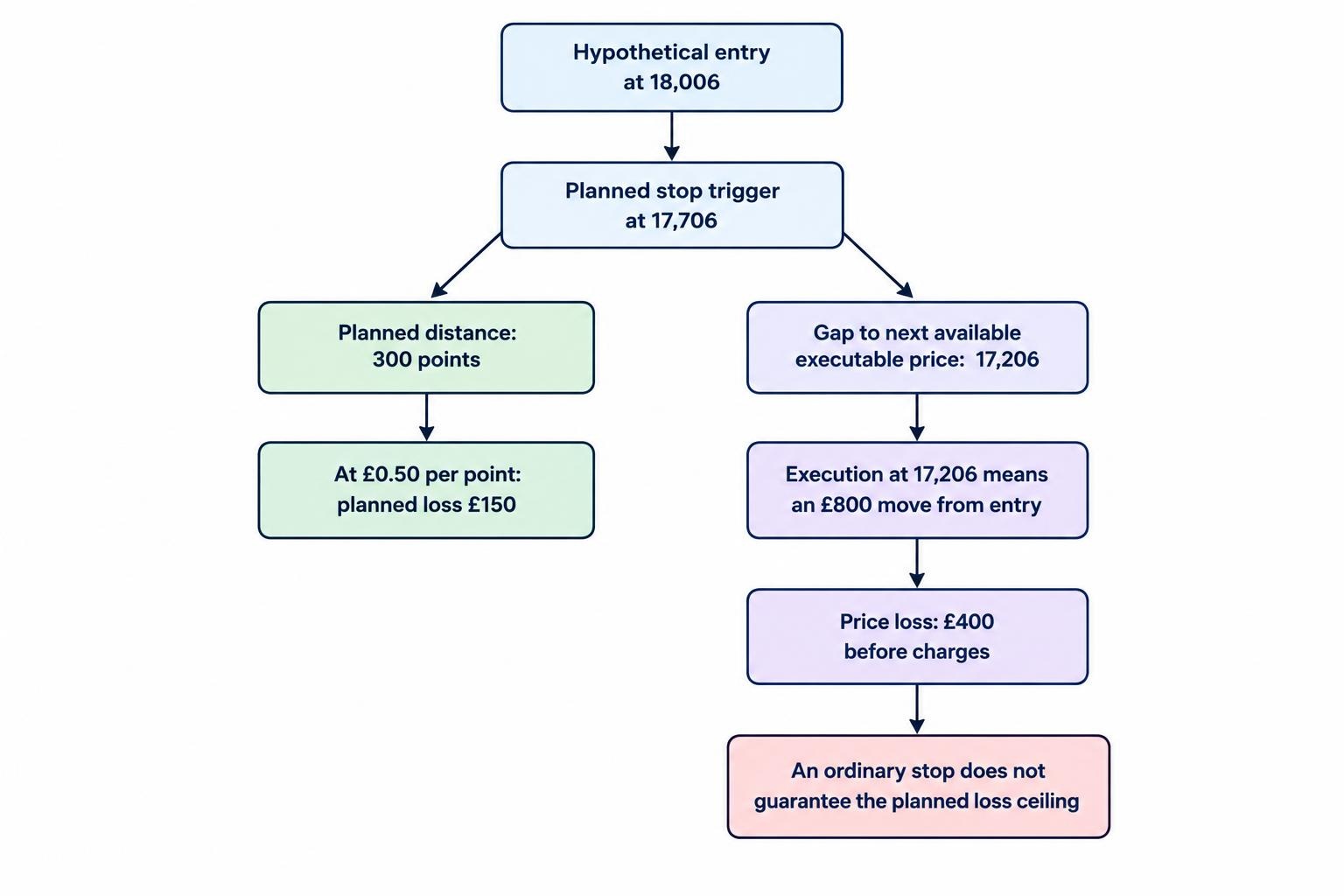
Consider the earlier long position at 18,006 with an ordinary stop at 17,706. The planned distance is 300 points, suggesting £150 of price risk at £0.50 per point. If the next available executable price is 17,206 and the position closes there, the price loss becomes £400 before charges.
The stop did not provide a guaranteed £150 ceiling. An ordinary stop becomes an instruction to close once its trigger conditions are met; a gap or rapid move can produce a worse execution price. The difference between a trigger and a guaranteed exit is particularly relevant around company news.
A guaranteed stop, where offered for the chosen share and position, can address that price gap risk under its contractual terms. Availability, premiums and minimum distances need checking before entry. Our guide to managing risk with guaranteed stops covers those trade-offs.
For an ordinary stop, calculate several possible gap losses rather than treating the requested exit as certain. If a plausible adverse opening would create an unacceptable loss, reduce the stake, change the holding period or leave the trade alone. A smaller position is not an admission that the analysis is wrong.
Dividends, US Withholding and Corporate Actions
A share spread bet does not pay you a shareholder’s dividend. Instead, the contract may apply an adjustment to reflect the underlying share going ex-dividend. Long positions generally receive a credit and short positions a debit, subject to the provider’s calculation and deductions.
Do not treat the credit as an isolated gain. The underlying share trades without the dividend entitlement from the ex-dividend date, and its price can reflect that change. Assess the position’s price movement and adjustment together. Our guide to dividends and share spread bets explains that relationship.
US withholding is a separate consideration. Certain dividend equivalent payments are treated as US source dividends and may face withholding, including payments connected with section 871(m) transactions. The relevant distinction appears in IRS Publication 515 on withholding and dividend equivalents. A spread betting label does not, by itself, establish that every US related adjustment arrives without deductions.
Ask the provider how it treats the particular contract, which documentation it requires and how any withholding appears on the statement. Do not assume that a form or treaty rate used for directly held US stock applies automatically to a spread bet.
Stock splits, takeovers, spin-offs and delistings can also require contract changes or closure. Check how the provider handles stake adjustments, opening prices, pending orders and stops. A split should not be read as a trading gain simply because the number displayed on a price chart changes.
Research the Company and the Combined Exposure
Read the company’s own announcements rather than trading solely from a results headline. Revenue growth, profit margins, cash generation and management’s expectations can point in different directions. A favourable historical quarter does not settle the question of what the current price already assumes.
For US domestic reporting companies, Form 10-K contains annual financial and business disclosures, Form 10-Q provides quarterly reporting, and Form 8-K reports material events. The SEC guide to researching companies through EDGAR identifies where to find these filings. Foreign issuers can use different forms.
Then assess the proposed position alongside trades already open. Several technology longs plus a long US technology index position may express much the same view. Different ticker symbols do not necessarily create different sources of risk.
Compare cash sensitivity, not just stake numbers. A £0.50 per point position in a high priced share can create more notional exposure than a larger stake in a lower priced share. Calculate what a common percentage decline would cost across the account, including positions that might fall together.
UK Tax Treatment of US Share Spread Bets
For individual UK bettors, financial spread betting generally produces no chargeable capital gains and no allowable capital losses. That means a loss ordinarily cannot offset a taxable gain on directly owned shares. This treatment is stated in HMRC’s capital gains guidance on financial spread betting.
That is not a blanket promise covering every arrangement or every taxpayer. Whether spread betting receipts are taxable can depend on the contract and economic substance, including their connection with carrying on a trade. Those qualifications appear in HMRC’s business income guidance on spread betting.
Keep this UK treatment separate from possible US dividend equivalent withholding. They concern different rules. Company accounts, business hedging and non-UK residence also need their own assessment rather than an assumption based on a retail account description.
The dedicated guide to whether spread betting is tax-free covers the broader qualifications. Keep transaction records and obtain advice where your circumstances fall outside straightforward personal betting.
What to Check Before Placing a US Share Trade
Compare providers at the contract level. A long list of American companies says little about whether the share you want has suitable dealing hours, an affordable minimum stake and acceptable holding costs. Use our guide to share spread betting brokers to structure that comparison, then verify the live terms.
Before submitting an order, confirm:
- The instrument: the correct company, ticker, share class and contract type.
- The units: what one point means, the stake currency and cash exposure to a $1 move.
- The costs: executable spread, separate charges, funding and any short borrowing fee.
- The timing: dealing hours, holidays and announcements within the planned holding period.
- The exit: stop type, activation rules and the loss if execution occurs beyond an ordinary stop.
- The account: opening margin, spare equity and exposure shared with existing positions.
US share spread betting becomes easier to assess once the dollar quote is translated into cash risk. Start with the point definition and stake, then add execution costs, holding costs and event exposure. The trade should fit that calculation before it reaches the order ticket.