EUR/USD spread betting lets you speculate on the euro’s value against the US dollar using a stake per point. Buy if you expect the exchange rate to rise; sell if you expect it to fall. Your profit or loss depends on the price movement, your stake and the costs of holding the position.
The pair combines the two most traded currencies in the BIS April 2025 foreign exchange survey. That trading activity does not make a spread bet safe. A small exchange rate movement can produce a large account loss if the stake is too high.
This guide focuses on UK financial spread betting: reading EUR/USD quotes, calculating results, assessing costs and controlling exposure. For the broader product mechanics across currency pairs, see our guide to forex spread betting. All prices, spreads and trade examples below are hypothetical, not live quotes.
How EUR/USD Spread Betting Works
EUR/USD expresses how many US dollars buy one euro. At 1.0850, one euro is worth $1.0850. The euro is the base currency and the dollar is the quote currency.
A rise from 1.0850 to 1.0900 means the euro has strengthened against the dollar. A fall to 1.0800 means the euro has weakened against it. This is a relative price: the pair can rise because the euro strengthens, the dollar weakens, or both happen together.
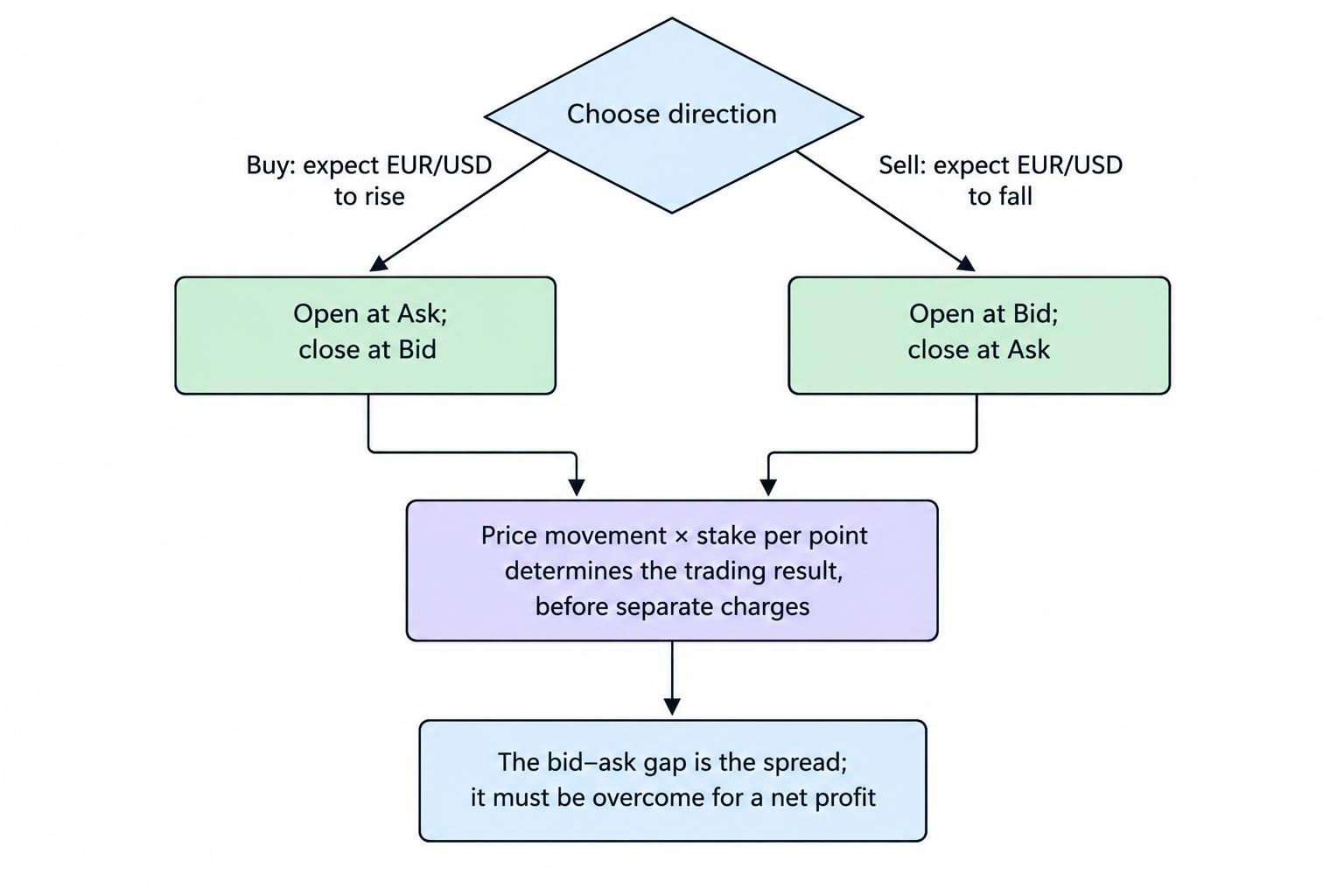
A spread bet does not put euros into your bank account. It creates a cash-settled position with your provider. You choose a direction and a monetary stake for each defined point of movement.
When buying, you open at the provider’s higher price, called the ask or offer, and close at its lower price, called the bid. When selling, you open at the bid and close at the ask. The difference between those prices is the spread.
You can therefore lose money even if the exchange rate moves slightly in your favour. The move must first cover the spread and any other charges before the position produces a net profit.
EUR/USD Pips, Points and Stake Size
For EUR/USD, one pip is conventionally 0.0001. A movement from 1.0850 to 1.0860 is 10 pips, not one. A fifth decimal place represents a fraction of a pip: 0.00001 is one tenth of a pip.
Spread betting platforms may display the exchange rate as 1.08504 or use a scaled price such as 10850.4. Check what the dealing ticket means by a “point” before entering a stake. Do not assume that the smallest displayed price change equals one full stake unit.
| Item | Value | Meaning |
|---|---|---|
| Bid | 1.08496 | Price for opening a sell or closing a buy |
| Ask | 1.08504 | Price for opening a buy or closing a sell |
| Spread | 0.00008 | 0.8 pip |
| One pip | 0.00010 | A full pip of EUR/USD movement |
| Stake | £2 per pip | A 10-pip movement changes the trade result by £20 |
If one platform point equals one pip, a £2-per-point stake produces a £2 gain or loss for each pip. At £10 per pip, the same movement produces five times the result. Our guide to stake per point covers how to check that relationship before submitting an order.
A sterling-denominated stake can produce sterling trading profits and losses even though EUR/USD contains neither side of a sterling exchange rate. You do not automatically need to convert a dollar profit into pounds. Check the contract and account terms for any separate currency conversion charges.
EUR/USD Spread Betting Examples
The following examples assume that one point equals one pip and the stake is £2 per pip. They use actual entry and exit sides of the quote, so the spread is already reflected in the calculations.
Buying EUR/USD
The quote is 1.08496–1.08504. You expect EUR/USD to rise and buy at the ask of 1.08504.
Later, the quote reaches 1.08804–1.08812. You close the buy at the bid of 1.08804:
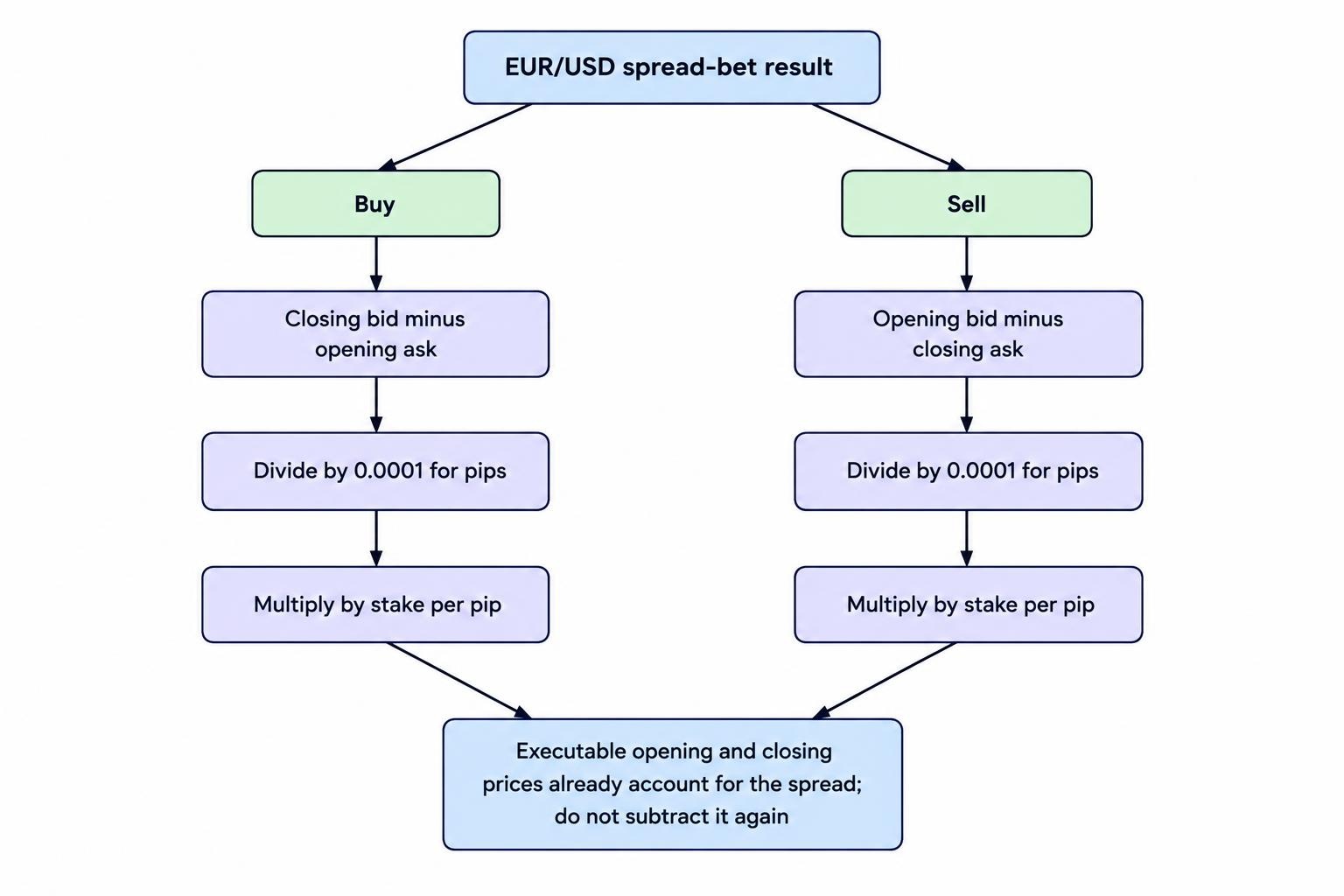
Price gain: (1.08804 − 1.08504) ÷ 0.0001 = 30 pips.
Trading profit: 30 × £2 = £60 before separate charges.
If the closing bid instead falls to 1.08304, the position loses 20 pips. At £2 per pip, that is a £40 loss before separate charges.
Immediately after opening, an unchanged quote would show a loss of approximately £1.60: the 0.8-pip spread multiplied by £2. That is the cost of crossing the spread, not evidence that the market has already moved against you.
Selling EUR/USD
Using the original quote, you sell at the bid of 1.08496 because you expect the pair to fall. You later buy back at an ask of 1.08246:
Price gain: (1.08496 − 1.08246) ÷ 0.0001 = 25 pips.
Trading profit: 25 × £2 = £50 before separate charges.
If the closing ask instead rises to 1.08746, the short position loses 25 pips, or £50.
For a buy, subtract the opening ask from the closing bid. For a sell, subtract the closing ask from the opening bid. Once you have used those executable prices, do not subtract the spread again. Doing so counts the same cost twice.
What Does EUR/USD Spread Betting Cost?
The spread is the most visible cost, but it is not always the largest. Your holding period, execution price and contract type can matter more than a small difference in an advertised minimum spread.
Spread and execution
A hypothetical 0.8-pip spread costs £1.60 at £2 per pip when the underlying price is unchanged. At £10 per pip, it costs £8. The quoted spread may vary with market conditions, so compare the price available during your intended trading hours rather than treating a minimum as a permanent offer.
Slippage is separate. If an order executes at a worse price than expected, that difference changes the result. A narrow spread does not compensate for every possible execution loss, especially around a fast announcement.
Overnight funding
A daily funded EUR/USD bet can receive a funding debit or credit when held through the provider’s adjustment time. The calculation depends on the contract’s funding method, the currencies’ interest rate relationship and the provider’s adjustment or administration charge.
Do not assume that selling automatically earns funding or that buying always costs the same amount. Check both directions and whether a booking covers several days around a weekend or holiday. Our guide to overnight financing costs explains how these adjustments affect longer holdings.
If a dated EUR/USD contract is available, compare its spread, pricing basis and expiry terms with the daily funded alternative. The absence of a separate daily funding entry does not mean the contract has no financing cost.
Guaranteed stop premiums and other account charges may also apply. Estimate costs over the intended holding period, not just at entry.
What Moves EUR/USD?
EUR/USD responds to changes in the relative outlook for the euro area and the United States. The useful question is not simply whether an announcement sounds positive. It is whether the announcement changes expectations enough to justify a different exchange rate.
ECB and Federal Reserve policy
Interest rate expectations are central to the pair. If markets begin expecting US rates to remain higher for longer relative to euro area rates, that can support the dollar and weigh on EUR/USD. A shift in the opposite direction can support the euro. Neither relationship is a mechanical trading rule.
Mark monetary policy decisions and the accompanying press conferences using the ECB Governing Council meeting schedule. A decision and the later discussion can deliver different messages, creating more than one period of event risk.
The US calendar also deserves attention beyond the rate announcement. The Federal Reserve’s FOMC calendar includes policy statements, minutes and, for designated meetings, economic projections. Treat these as separate releases rather than assuming the policy decision ends the event.
A rate increase can still coincide with a weaker currency if traders expected a larger increase or if the accompanying message points to future cuts. The surprise relative to expectations matters more than the headline alone.
Inflation, employment and growth
Inflation and labour market data can alter expectations for central bank policy. US consumer inflation, payroll growth, unemployment and wages therefore belong on a EUR/USD watchlist, alongside euro area inflation and measures of economic activity.
The Bureau of Labor Statistics release calendar lists US CPI and Employment Situation publication times in Eastern Time, commonly at 8:30 a.m. Check the date and time zone before trading rather than relying on a remembered UK release time.
Read beyond a single number. A strong payroll headline accompanied by weaker revisions or slower wage growth can send a different message from the headline viewed alone.
Politics, energy and broader market stress
Political uncertainty, trade measures, energy price shocks and changes in demand for dollar funding can also affect the pair. These influences can reinforce or oppose the interest rate story.
Use scenarios rather than fixed slogans. “Higher inflation means a stronger currency” is incomplete: the reaction depends on expected policy, growth concerns and what traders had already priced in.
EUR/USD Trading Hours and Session Choice
Forex trading generally runs from Sunday evening to Friday evening UK time, but your provider’s dealing hours and maintenance breaks determine when you can open or close its EUR/USD contract. Check the product schedule rather than assuming continuous access.
For a UK trader, useful observation periods include the London morning and the early afternoon as US participation builds. The London and New York session overlap gives both regions’ participants a shared trading window, but it does not guarantee a tight spread or an orderly move.
Match the session to the setup. A method based on small price targets is sensitive to spread changes. A trade around a US announcement faces a different execution problem from a position opened during a quieter period.
Daylight saving differences can shift the UK time of US events. Platform server time may differ from both. Our guide to forex trading hours covers session timing and the checks needed around clock changes.
Holding through the weekend adds another issue: news can arrive while the normal market is closed. The next available price may be beyond your intended exit level.
Margin, Stake Size and Risk Controls
Margin is the money required to support the exposure. It is not a forecast of the maximum loss, and a position does not become affordable just because the platform accepts the deposit.
For UK retail business within the rules’ scope, EUR/USD falls within the major currency pair category. FCA rules require at least 3.33% initial margin, commonly expressed as approximately 30:1 maximum leverage. They also require account-level close-out when net equity falls below 50% of the applicable margin requirement, with positions closed as soon as market conditions allow, and negative balance protection restricting liability to funds in the trading account. These protections appear in the FCA rules for retail spread bets and similar speculative investments.
A provider can require more margin than the regulatory minimum. Check the live ticket and account terms. Negative balance protection does not protect your deposit from trading losses, and account close-out is not a substitute for a planned exit.
Calculate the stake from the planned risk
Start with the cash amount you are prepared to lose, then consider the distance between entry and the point where the trade idea is invalidated.
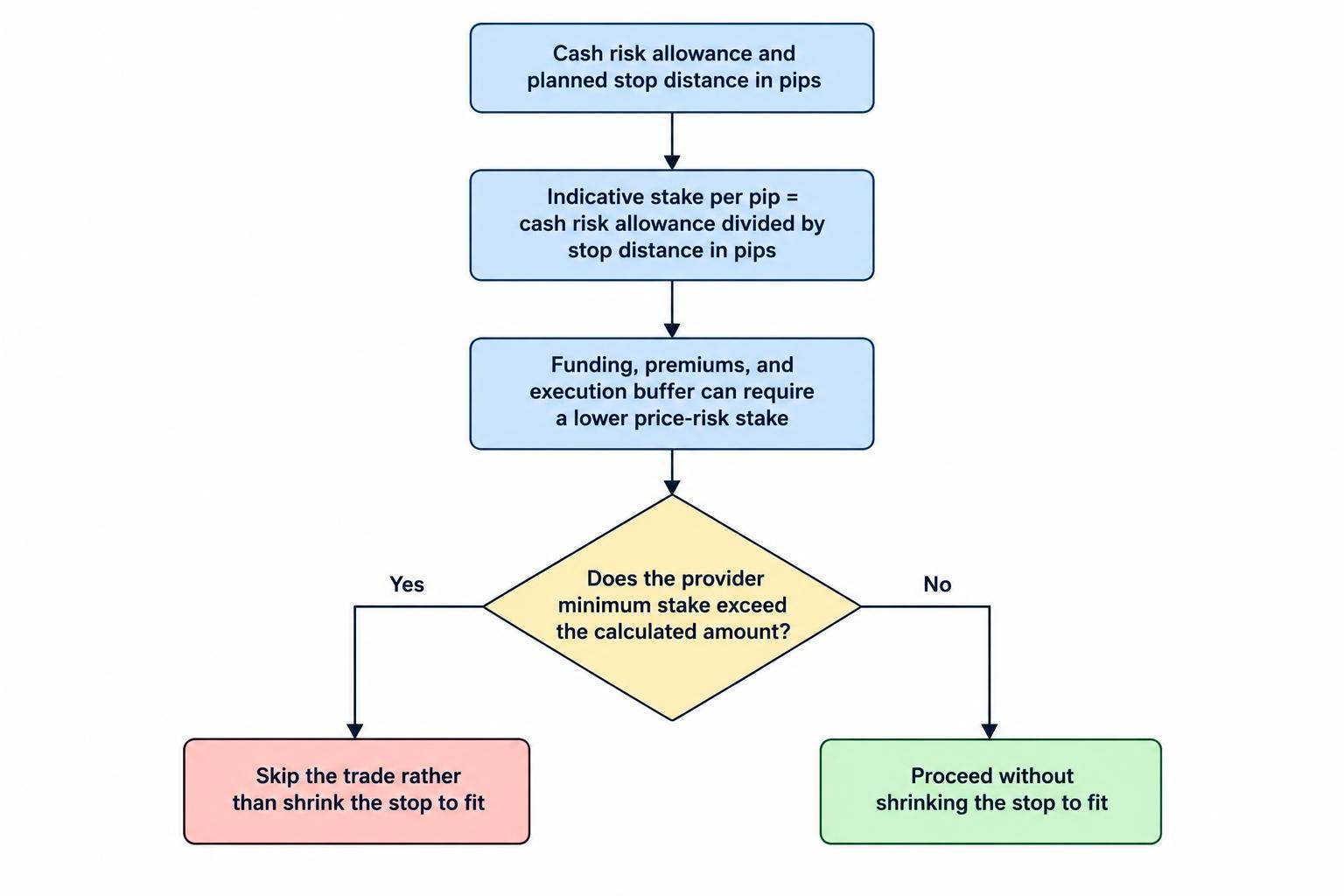
Indicative stake per pip = cash risk allowance ÷ stop distance in pips.
Suppose a hypothetical trader has a £5,000 account and sets a £25 allowance for a trade. With a 25-pip stop distance, the calculation gives £1 per pip before costs and any adverse execution. This is an illustration, not a recommended account percentage.
If the £25 allowance must include funding, premiums and an execution buffer, the price-risk stake needs to be lower. Where the provider’s minimum stake exceeds the calculated amount, skipping the trade is more consistent than shrinking the stop to make the ticket fit.
Our guide to position sizing for spread betting develops this calculation across different stop distances and account sizes.
Know what the stop does—and does not do
A standard stop-loss order triggers an exit process; it does not guarantee execution at the selected level. During a gap or fast move, the fill can be worse. A guaranteed stop, where offered, provides contractual protection at its agreed level subject to its terms and any premium.
Check which side of the quote triggers the stop. A long position closes through the bid, while a short closes through the ask. A chart displaying only one price can make a stop appear inconsistent with the visible candles.
Use stop-loss risk management to connect the exit level with position size. Moving a stop farther away after entry increases the cash exposure unless you reduce the stake.
Trading Approaches for EUR/USD
EUR/USD does not require a separate collection of indicators. It requires a method that matches the market conditions, the intended holding period and the costs of execution.
Trend and pullback trading
A trend approach looks for directional structure and then defines an entry, often after a pullback. The practical task is to distinguish a normal retracement from evidence that the trend assumption has failed.
Marking support and resistance can help organise that decision. A previous swing provides a reference for an invalidation level, but it does not guarantee that the price will hold.
Range and breakout trading
A range approach assumes that established boundaries continue to contain price. A breakout approach assumes that price can leave those boundaries and sustain the move. These are opposing assumptions, so define which one applies before entry.
A brief move outside a range is not proof of a lasting breakout. Decide in advance whether confirmation means a candle close, a retest or another observable condition. Test the rule with realistic bid and ask prices rather than a frictionless chart.
Trading around announcements
A correct economic forecast can still produce a losing trade if the entry is late, the spread widens or the initial move reverses. Decide whether your method permits positions immediately before a scheduled announcement or requires waiting until prices settle.
Our news trading guide covers that execution problem in more detail. No strategy becomes reliable simply because it trades a widely followed currency pair.
Check Combined Exposure and Contract Terms
A EUR/USD position should not be assessed in isolation. Buying EUR/USD and buying GBP/USD both include a position against the dollar. They are not identical trades, but a broad dollar rally can hurt both at once.
Check the combined loss if several positions move against you together. Our guide to portfolio correlation and spread betting risk explains why several tickets can still represent one concentrated market view.
Before choosing a EUR/USD contract, compare its point definition, minimum stake, spreads during your trading hours, funding method, stop facilities and order execution terms. Confirm the legal entity holding the account and the client classification attached to it. Do not assume that every account carrying the same brand receives identical protections.
A spread betting demo account can help check quote scaling, stake arithmetic and order handling without risking cash. It cannot establish how every live order will execute or how you will respond to real losses.
Before Placing a EUR/USD Spread Bet
- Confirm whether the ticket’s stake applies to a full pip or another price increment.
- Write down the entry, invalidation level, intended holding period and cash risk allowance.
- Calculate the stake, allowing for relevant costs and possible adverse execution.
- Check the next euro area and US announcements, plus existing dollar exposure.
- Review margin headroom and the rules for your chosen exit order.
The exchange rate forecast is only one part of the decision. A workable EUR/USD spread bet also needs a correctly sized stake, a clear exit and enough account headroom to avoid relying on the provider’s close-out process. If those conditions do not fit, leaving the trade alone is a valid outcome.