Qualifying for professional client status with a UK spread betting firm requires more than a large account or frequent trading. An individual applying as an elective professional client must meet the relevant eligibility criteria, pass the firm’s assessment of their knowledge and experience, and acknowledge the protections they may lose.
The practical question is not just whether you qualify. It is whether the resulting account terms suit the risks you intend to take. Start with the distinction between retail and professional client classification, then assess your evidence and the proposed agreement separately. A professional account is a regulatory category, not a certificate of trading ability.
The FCA eligibility criteria for individual applicants
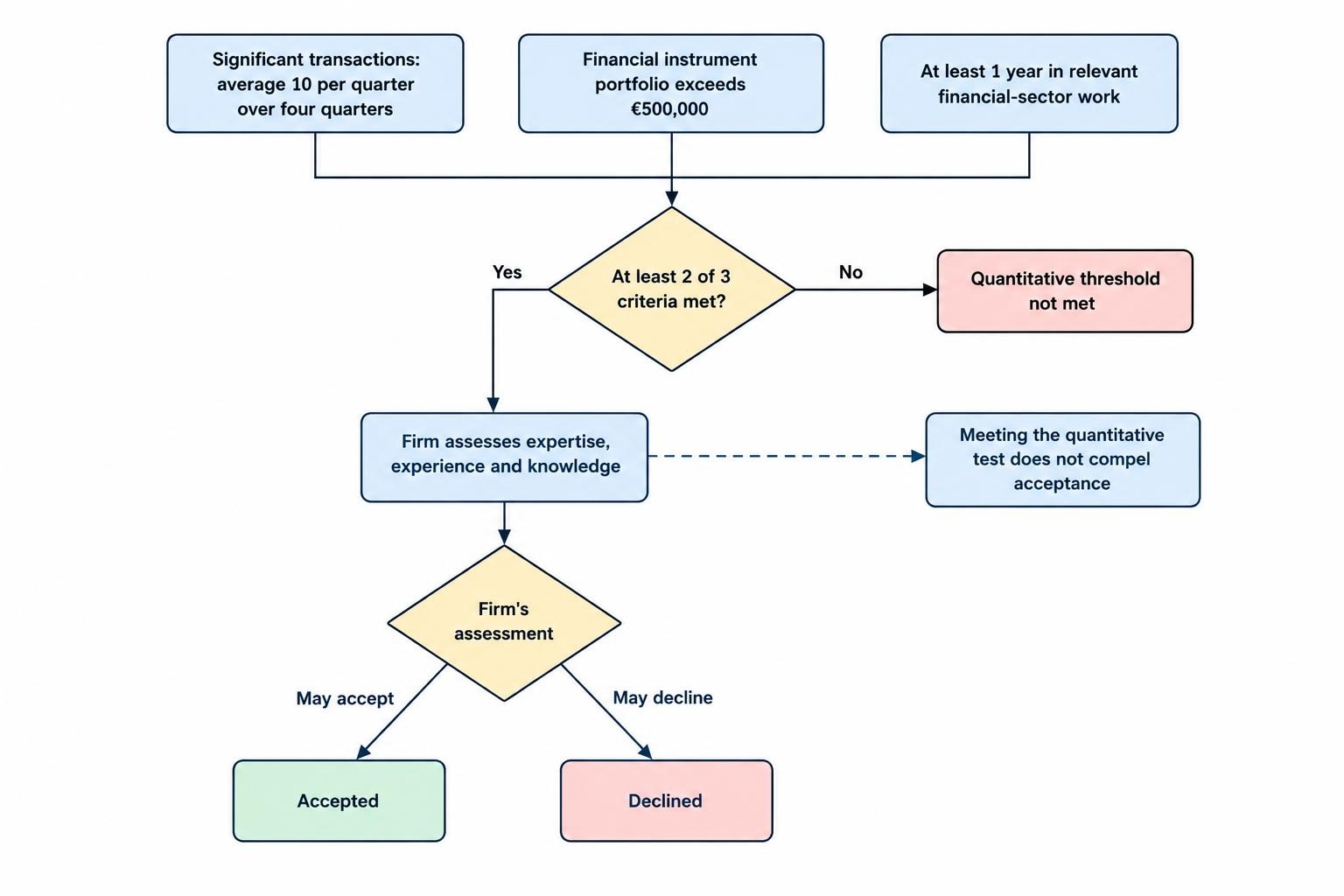
For the MiFID business relevant to financial spread betting, the quantitative test requires at least two of the following three criteria. The firm must also assess your expertise, experience and knowledge. Meeting two criteria does not compel it to accept your application. These requirements sit in the FCA’s professional client classification rules.
| Criterion | Requirement |
|---|---|
| Trading activity | Transactions of significant size on the relevant market, averaging 10 per quarter over the previous four quarters. |
| Financial portfolio | A financial instrument portfolio, including cash deposits and financial instruments, exceeding €500,000. |
| Relevant employment | At least one year working, or having worked, in a professional financial sector position requiring knowledge of the transactions or services envisaged. |
You do not necessarily need a €500,000 portfolio: trading activity and relevant employment can provide the two qualifying criteria. Equally, wealth alone is insufficient.
Use the table as an initial screening exercise, not an application strategy. Identify the two criteria you believe you meet, gather supporting records, then ask the firm how it will assess them. Do not stretch an answer simply because the form offers a convenient tick box.
How to assess your trading history
The activity criterion contains three separate considerations: frequency, transaction size and market relevance. Counting trades addresses only the first.
An average of 10 transactions per quarter across four quarters gives an arithmetic total of 40. That does not mean any collection of 40 orders qualifies. The transactions still need to satisfy the size and relevant-market requirements.
Transaction size should be assessed in its market context. Meaningful exposure matters, rather than whether a trade felt large relative to your account. For leveraged products, the exposure represented by a transaction also needs consideration; the margin deposit alone does not describe its size. The background to this market-based interpretation appears in ESMA’s client categorisation Q&A on significant transaction size.
Prepare statements showing the instruments traded, dates, transaction sizes and account ownership. Ask the firm which reporting period it uses, how it treats partial executions, and whether the markets you traded are relevant to the proposed spread betting service.
Do not place extra trades simply to improve an application. That introduces costs and market risk without establishing that professional classification is appropriate. If the application starts dictating your trading, pause and review the risks of overtrading.
What counts towards the €500,000 portfolio threshold?
The portfolio criterion concerns financial assets, not total personal wealth. A valuable home does not turn into a financial instrument because its valuation appears on a net worth statement.
There is another distinction for leveraged positions: their market exposure is not the same as their portfolio value. Net equity, rather than the full notional exposure, is the relevant valuation approach discussed in the Financial Ombudsman decision examining portfolio valuation and supporting evidence. That decision also addresses the problems with relying on an applicant’s declarations without adequate assessment.
As an illustration, a position with £100,000 of exposure does not necessarily add £100,000 to your qualifying portfolio. If its net equity is £8,000, substituting the larger exposure figure would confuse money you own with exposure created through margin.
The threshold is expressed in euros and requires a portfolio exceeding €500,000. Do not replace it with a fixed sterling figure. Ask which exchange rate and valuation date the firm will use, particularly if your assets sit close to the threshold.
Prepare a clear asset schedule supported by recent statements. Separate cash balances, investments and leveraged positions, and avoid counting the same money twice across linked accounts. Where ownership, pension arrangements or asset valuation are uncertain, ask for written clarification before including them.
Does your financial sector employment qualify?
The employment criterion concerns the work performed, not just the employer’s name. A role at a bank or investment business needs to be assessed against the knowledge required for the proposed transactions. Long service and an impressive title are not substitutes for relevant product knowledge; this issue receives detailed consideration in the Financial Ombudsman decision on relevant experience and professional client assessment.
A useful employment summary should identify your role, dates of employment, responsibilities and connection to the products you intend to trade. Explain what the work required you to know, rather than supplying a list of organisations where you have worked.
Consider the difference between administering a finance department and managing derivatives exposure. Both may involve financial work, but an application should establish the connection between your responsibilities and the proposed trading service.
Ask what supporting documents the firm accepts. An employment letter, role description or contract may help establish the facts, but avoid sending confidential employer information without checking what is necessary.
The qualitative assessment and application process
The firm must assess whether your expertise, experience and knowledge give reasonable assurance that you can make your own investment decisions and recognise the risks involved. The quantitative criteria do not replace that assessment.
For your own preparation, be ready to explain how a spread bet behaves under adverse conditions. Can you calculate the loss from a given price move? Can you distinguish the margin required to open a position from the amount you might lose? What happens if the market gaps through an ordinary stop?
These are useful questions to test yourself against, not a prescribed FCA examination paper. If your answers depend on the assumption that the platform will always close a position at the price you expect, revisit how spread betting margin works before applying.
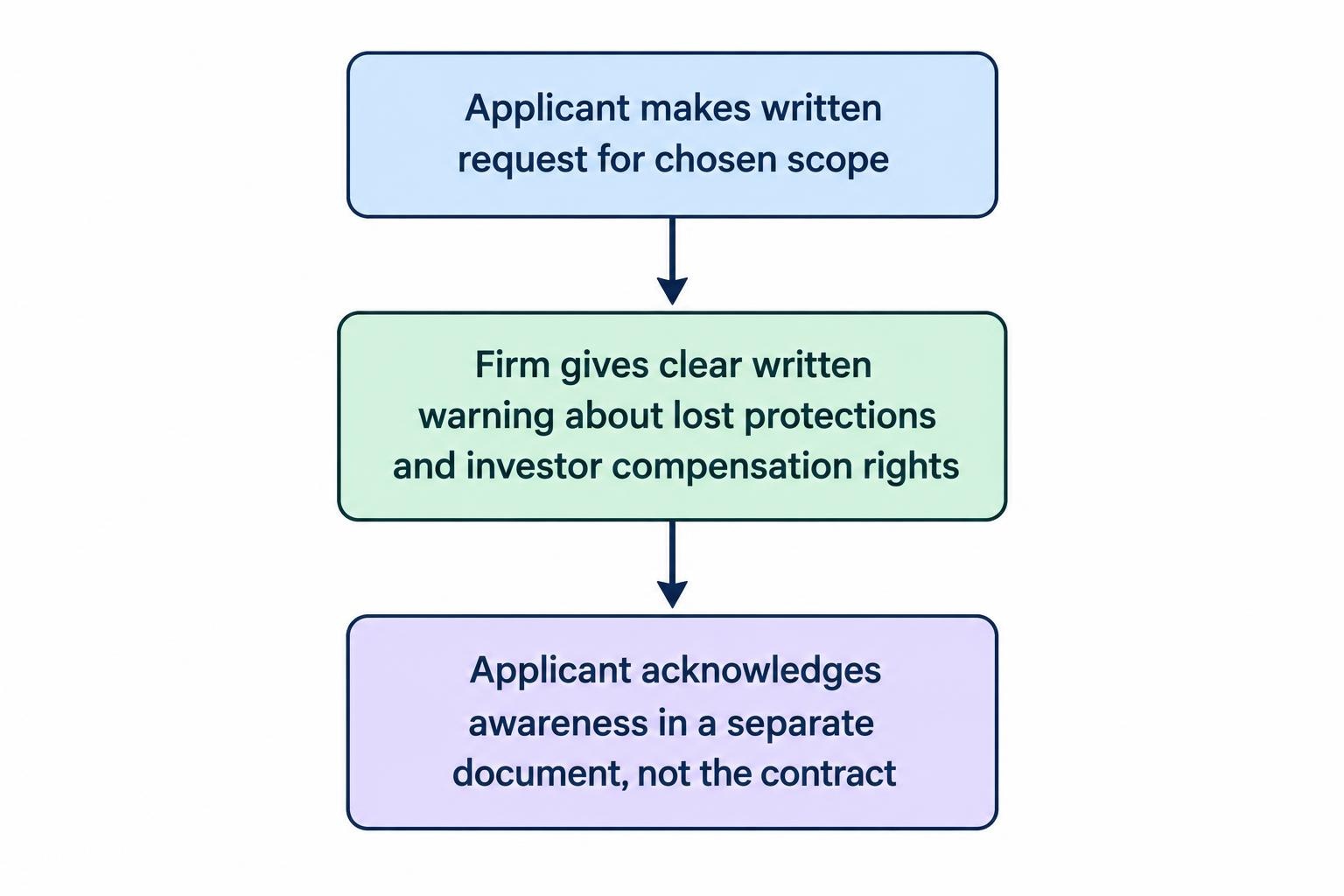
The written procedure has three parts, set out in the classification rules and reproduced in the Ombudsman decision above:
- Your request: you state in writing that you want professional treatment, either generally or for particular services, transactions or products.
- The firm’s warning: it gives you a clear written warning about protections and investor compensation rights you may lose.
- Your acknowledgement: you confirm awareness of those consequences in a document separate from the contract.
Keep copies of your submission, supporting records, warning and final classification notice. Check the scope carefully: ask which products and services it covers, which legal entity operates the account, and when the new terms take effect.
Do not confuse this process with the spread betting appropriateness test. Treat professional classification as a separate decision requiring a clear explanation of the evidence and consequences, not as another account-opening questionnaire to get through.
Which trading protections change?
The retail product intervention rules cover leveraged spread bets and include minimum margin requirements, account-level margin close-out requirements and negative balance protection. Those retail requirements do not apply to professional clients in the same way. The relevant obligations appear in the FCA rules for retail spread bets and similar speculative investments.
For a professional account, establish the contractual position rather than assuming the retail safeguards continue. Ask for the margin schedule, liquidation policy and treatment of any account deficit in writing. A firm may offer contractual protections, but check their conditions and exclusions.
The retail close-out requirement involves action when account net equity falls below 50% of the required margin, as soon as market conditions allow. It is not a promise of execution at a chosen price. Professional terms need their own review; do not assume the same threshold applies.
Pay particular attention to negative balance protection. Without an applicable protection, losses can leave an amount owed beyond the funds in the trading account. An ordinary stop order is not a substitute for account-level protection.
Before accepting the warning, turn each protection into a practical question: what happens to this account during a sharp market move, and who bears any resulting shortfall?
Lower margin does not reduce the loss per point
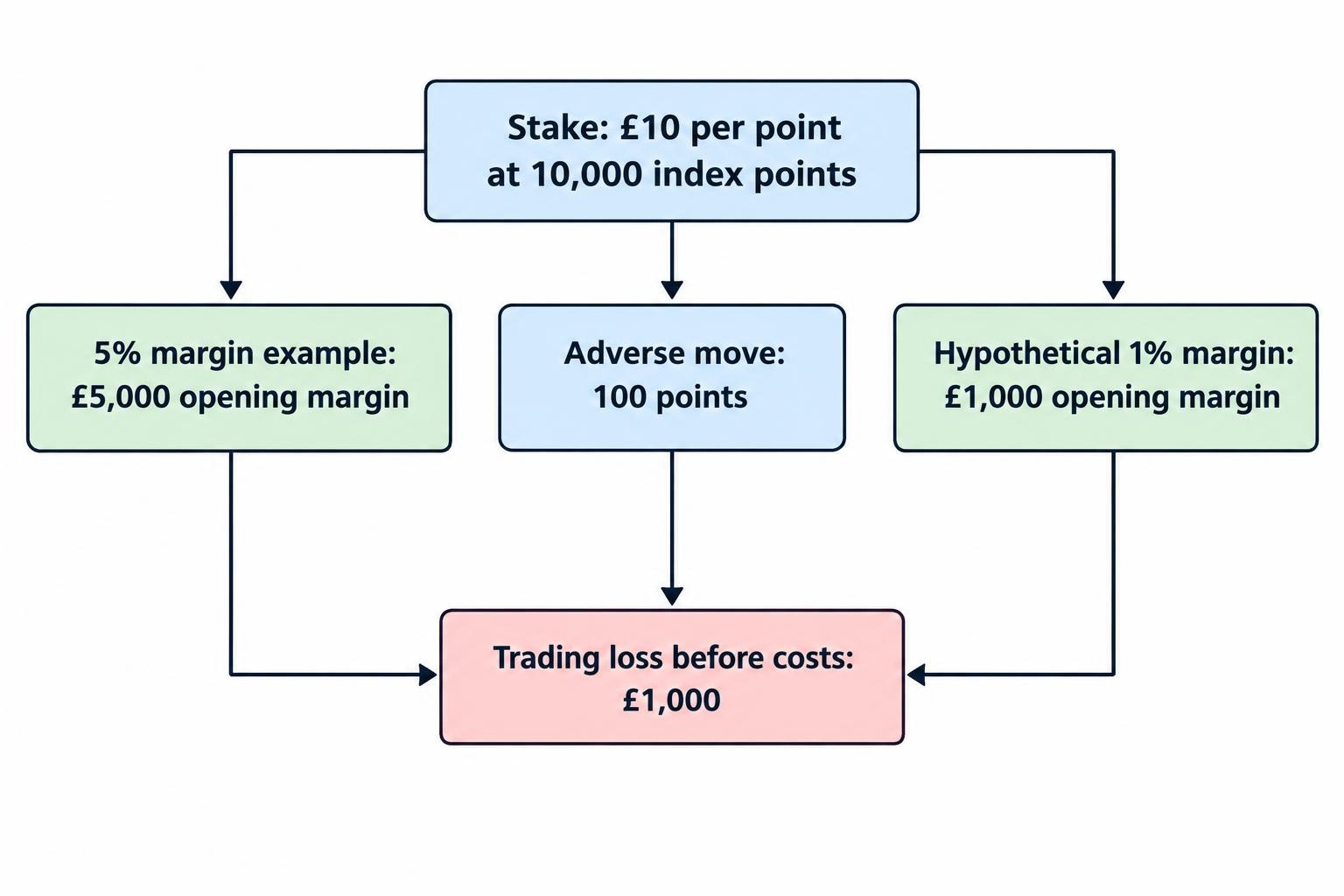
Consider an illustrative index spread bet at 10,000 points with a stake of £10 per point. Its approximate exposure is £100,000. A 100-point adverse move produces a £1,000 trading loss before costs.
Now compare a 5% margin requirement with a hypothetical professional requirement of 1%. The opening margin would fall from £5,000 to £1,000, but the same 100-point move still loses £1,000. These figures illustrate the mechanics; they are not a quoted professional account offer.
The smaller deposit changes the funding requirement, not the market movement needed to produce that loss. If you increase the stake because less margin is required, you increase the cash loss per point too.
Assess the proposed terms using your intended stake, adverse price moves and available cash. Keep position sizing separate from the maximum exposure the platform will allow. Available margin is capacity, not a spending target.
Do professional clients lose Ombudsman or FSCS access?
These questions require separate answers. Neither should be reduced to a blanket statement that every professional client loses all protection.
Financial Ombudsman Service
The FCA’s complaint eligibility rules contain an exclusion for professional clients, but also an exception where the complainant is a consumer in relation to the activity concerned. Professional classification therefore does not automatically remove every individual’s ability to complain. The distinction appears in DISP 2.7 on eligible complainants and the consumer exception.
Whether a complaint can be considered depends on the circumstances and the other jurisdiction requirements. Do not assume either guaranteed access or automatic exclusion from the account label alone.
Before changing status, ask the firm to explain its position on complaints and retain that response. If a dispute concerns the classification process itself, preserve the application evidence and communications rather than relying on your recollection of a sales call.
Financial Services Compensation Scheme
FSCS claimant eligibility follows separate rules. Becoming an elective professional client is not, by itself, a blanket exclusion for an individual. Eligibility still depends on the claimant, claim and applicable protection requirements; the FCA’s COMP rules identify eligible and excluded claimants.
Avoid treating a general assurance about compensation as an answer to every account risk. Ask which legal entity holds your account and what protection the firm considers applicable to you.
Also ask whether the proposed agreement changes how your cash is held. Review the client money rules separately from trading loss protection. Put questions about any title transfer collateral arrangement to the firm before signing, rather than assuming the professional label settles them.
Can you return to retail status?
A professional client must be allowed to request classification offering a higher degree of protection. The right to make that request appears in the FCA rules on providing clients with greater protection. Do not assume a request changes your account immediately or retrospectively.
Before applying for professional treatment, ask how a later return to retail classification would work. Establish the notice required, the effective date and the treatment of open positions. If the margin requirement would rise, work through the cash implications before requesting a change.
You should also keep the firm informed of changes affecting your classification. Under COBS 3.5, a firm that becomes aware you no longer meet the initial conditions must take appropriate action.
Keep your own review practical: revisit the account terms when your finances, trading activity or needs change. Approval should not become a reason to ignore circumstances that would have altered your original decision.
Deciding whether to apply
Separate eligibility from usefulness. You may have enough evidence to qualify and still prefer the retail account’s safeguards.
Write down the actual reason for applying. If it is lower margin, calculate whether your trading plan needs that extra funding flexibility or whether it simply makes larger positions easier to open. If it is access to different products or services, ask the firm to confirm what would genuinely change before accepting reduced protection.
Then stress-test the proposal. Consider a sharp overnight move, a delayed exit and several positions losing together. Use the same planned stakes when comparing the two account types; otherwise you are comparing different trading risks rather than different account terms.
A broader spread betting risk management plan should determine your exposure and cash reserve, regardless of classification. Apply only when the evidence is accurate, the contractual changes are clear, and you can explain why the trade-off serves your needs. If any of those answers remains vague, keep the retail protections while you resolve it.