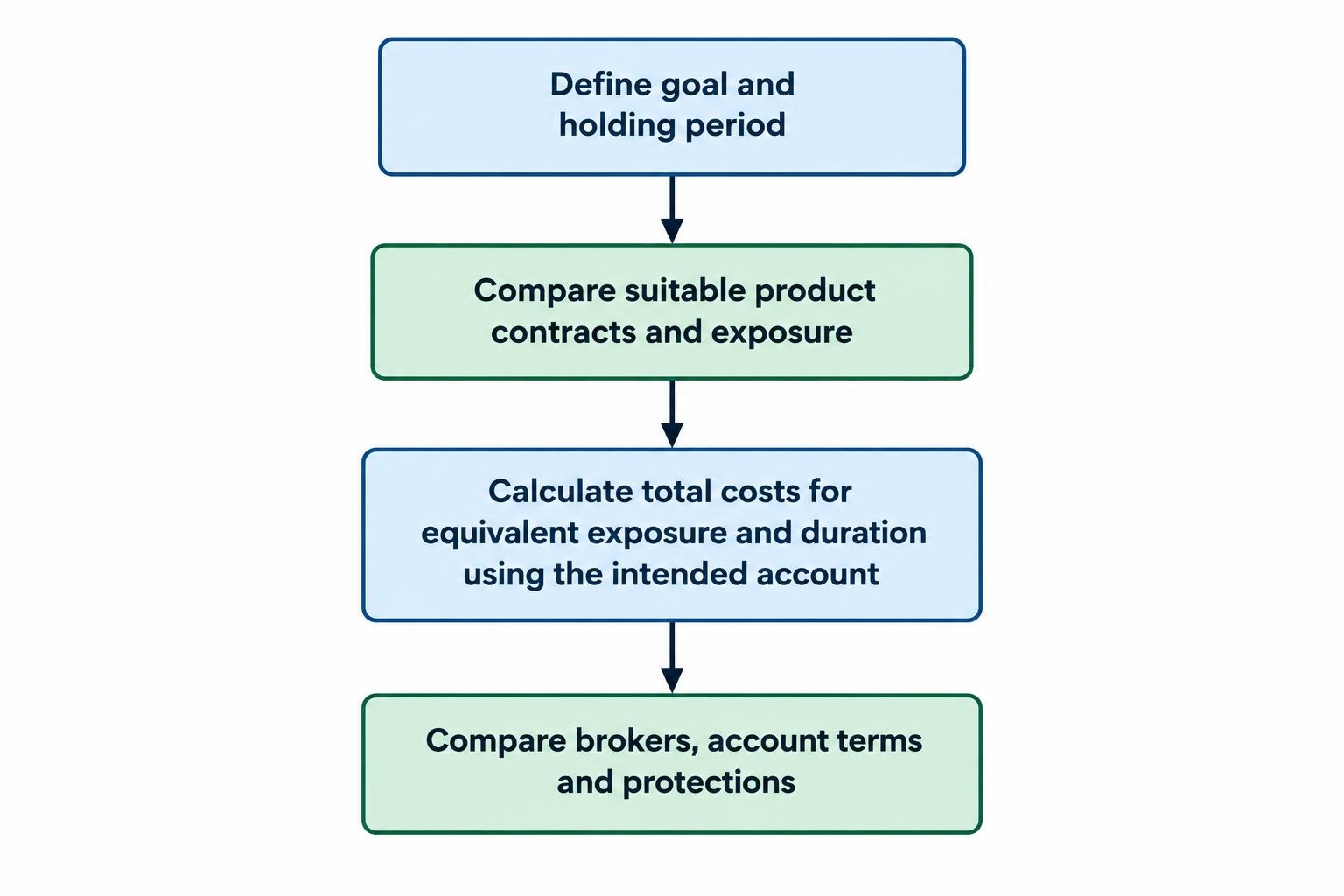
Spread betting comparisons should start with what you want to achieve: trade a short price move, hedge an existing position, or own an investment for years. These are different jobs, and the cheapest looking product is not necessarily the best fit.
This comparison hub covers spread betting against CFDs, share dealing, futures, options and other ways to access financial markets. It also separates product choice from broker choice. A suitable contract can still be expensive on the wrong account.
Which Spread Betting Comparison Do You Need?
| Comparison | Main difference to assess | Question to ask |
|---|---|---|
| Spread betting vs CFDs | Stake per point versus contracts or units | How do position size, costs and tax treatment differ? |
| Spread betting vs share dealing | Price exposure versus share ownership | Do you want a trade or an investment? |
| Spread betting vs futures | Provider contracts versus exchange traded contracts | How do contract size, expiry and trading costs compare? |
| Spread betting vs options | Directional exposure versus option rights and premiums | How does the payoff change with price, time and volatility? |
| Spread betting vs ETFs | A bet on price versus ownership of fund units | Are you trading a move or building portfolio exposure? |
Compare Ownership, Exposure and Holding Period
Spread bets and CFDs both provide exposure to price movements without ownership of the underlying asset. Neither becomes a conventional investment because you leave it open longer. The spread betting vs CFDs comparison examines the differences in position sizing, charging structures and UK tax considerations. Compare equivalent exposure, rather than assuming a £1 stake and one CFD represent the same trade.
Share dealing changes the starting point. Buying ordinary shares gives you an ownership interest, whereas a spread bet tracks price movements under a contract with the provider. Our spread betting vs share dealing comparison is the more useful route if you are deciding between trading and holding shares. For longer holding periods, assess recurring financing charges alongside dealing and account fees.
Futures and options need a separate comparison of contract terms. Futures have defined contract sizes and expiry arrangements. Options introduce a strike price, expiry and premium; buying an option and selling one create very different risks. Also distinguish an exchange traded future from a futures based spread bet. Similar market exposure does not mean an identical contract.
Keep Tax Benefits Separate From Trading Risk
For individuals placing ordinary financial spread bets, gains generally do not attract UK capital gains tax, and losses are not allowable for CGT. That second point matters when comparing potential outcomes, not just potential winnings. The treatment is set out in HMRC’s financial spread betting guidance.
“Tax free” is not a promise covering every arrangement. Whether a spread bet is taxable can depend on its contract terms and economic substance, including whether winnings arise from carrying on a taxable trade. HMRC’s guidance on spread betting and trading income addresses that distinction. Obtain advice where business activity or unusual arrangements complicate the position.
Tax treatment does not soften a market loss. UK retail protections for spread betting include leverage restrictions, margin closeout requirements and negative balance protection under the FCA’s framework for CFDs and spread bets. These protections do not prevent you losing all the money in the trading account.
Compare Total Costs Before Comparing Brokers
Use the same market, exposure and holding period for each comparison. Include the entry and exit spread, commissions where applicable, overnight financing, currency conversion and any stop premiums. A tight advertised spread tells you little about the cost of holding a position for several weeks.
Consider a hypothetical trade with £10 profit or loss per index point. A two point spread represents £20 at that exposure. A narrower spread may reduce that starting cost, but financing or other charges can reverse the apparent saving. Margin is a separate calculation: it is collateral, not the purchase price or a reliable measure of maximum loss.
Once you have chosen the product, use the spread betting broker comparisons to assess providers. Check the contracting legal entity, execution terms, market coverage, minimum stakes and account protections alongside costs. Compare the account you would actually use, rather than another client category’s headline offer.
Choose brokers
Broker overview
TestPoint
80.0 / 100
Fictional broker profile with populated data for exploring the theme.
- Clear sample cost breakdown
- Several example payment methods
- Desktop and mobile platform examples
Illustrative demo data. Not a factual broker assessment.
IG starter
Unpublished review starter. Add verified broker details and editorial text before publishing. Key facts Ratings Markets Banking
Illustrative demo data. Not a factual broker assessment.
Feature comparison
| Feature | TestPoint | IG starter |
|---|---|---|
| Legal entity | FCA regulated · Verified (demo) | FCA regulated · Verified (demo) |
| Minimum deposit | £100 (example) | Not supplied |
| Minimum stake | £0.50 per point (example) | Not supplied |
| Guaranteed stops | Selected markets (example) | Not supplied |
Category ratings
| Feature | TestPoint | IG starter |
|---|---|---|
| Trust and client protection | Not supplied | |
| Trading costs | Not supplied | |
| Platform and execution | Not supplied | |
| Banking and support | Not supplied | |
| Market coverage | Not supplied | |
| Overall | Not rated |
Trading costs
| Feature | TestPoint | IG starter |
|---|---|---|
| FTSE 100 | 1.0 point (example) | Not supplied |
| EUR/USD | 0.8 points (example) | Not supplied |
| Gold | 0.3 points (example) | Not supplied |
Market coverage
| Feature | TestPoint | IG starter |
|---|---|---|
| Forex | EUR/USD, GBP/USD, USD/JPY, EUR/GBP | |
| Indices | FTSE 100, S&P 500, Nasdaq 100, DAX | |
| Commodities | Gold, Silver, Brent crude, WTI crude | |
| Shares | UK shares, US shares, European shares |
Platforms
| Feature | TestPoint | IG starter |
|---|---|---|
| Platforms | Demo web platform, Demo mobile app |
Deposits and withdrawals
| Feature | TestPoint | IG starter |
|---|