Spread betting leverage lets you take a market position worth more than the money reserved to open it. A position with £16,000 of exposure might require £800 of margin, but its profit or loss still follows the full £16,000 exposure.
That difference matters. A small market move can produce a large percentage change in your trading funds, and the opening margin is not a maximum loss. The practical task is to measure the exposure you have chosen, rather than treat the broker’s available leverage as a target.
What leverage means in spread betting
Leverage is the relationship between a position’s market exposure and the capital supporting it. At 20:1 leverage, £1 of opening margin supports £20 of exposure. The market does not need to move far for the resulting gain or loss to become substantial relative to that margin.
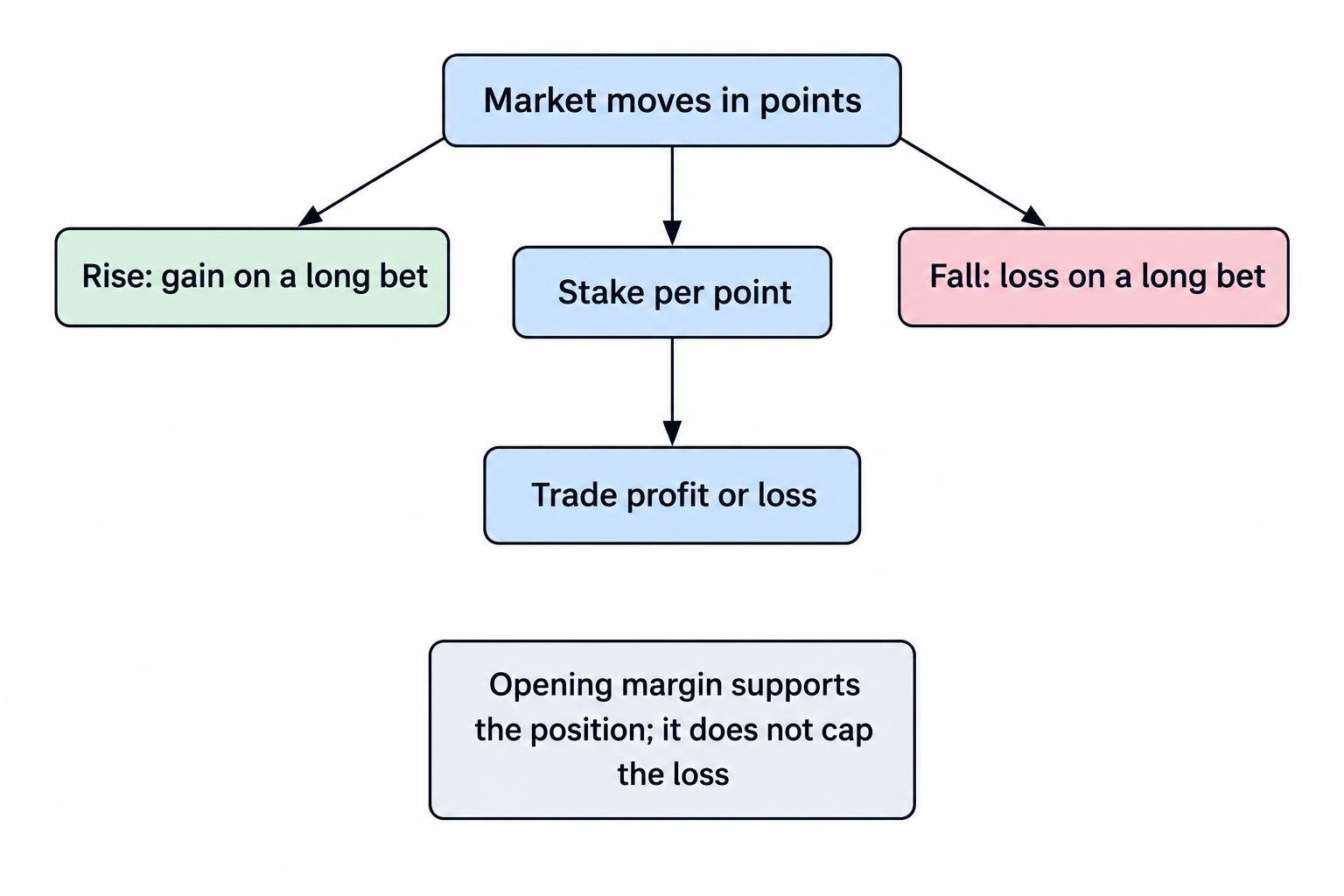
You do not buy the underlying shares, index or commodity. You enter a bet whose value changes by an agreed cash amount for each point of movement. The contract mechanics are covered in how spread betting works; leverage concerns how much exposure that contract creates relative to your funds.
It also works in both directions. A long bet loses when the quoted market falls, while a short bet loses when it rises. Leverage magnifies the financial effect of either move relative to your capital. It does not improve the odds of choosing the right direction.
Leverage and margin are related, but different
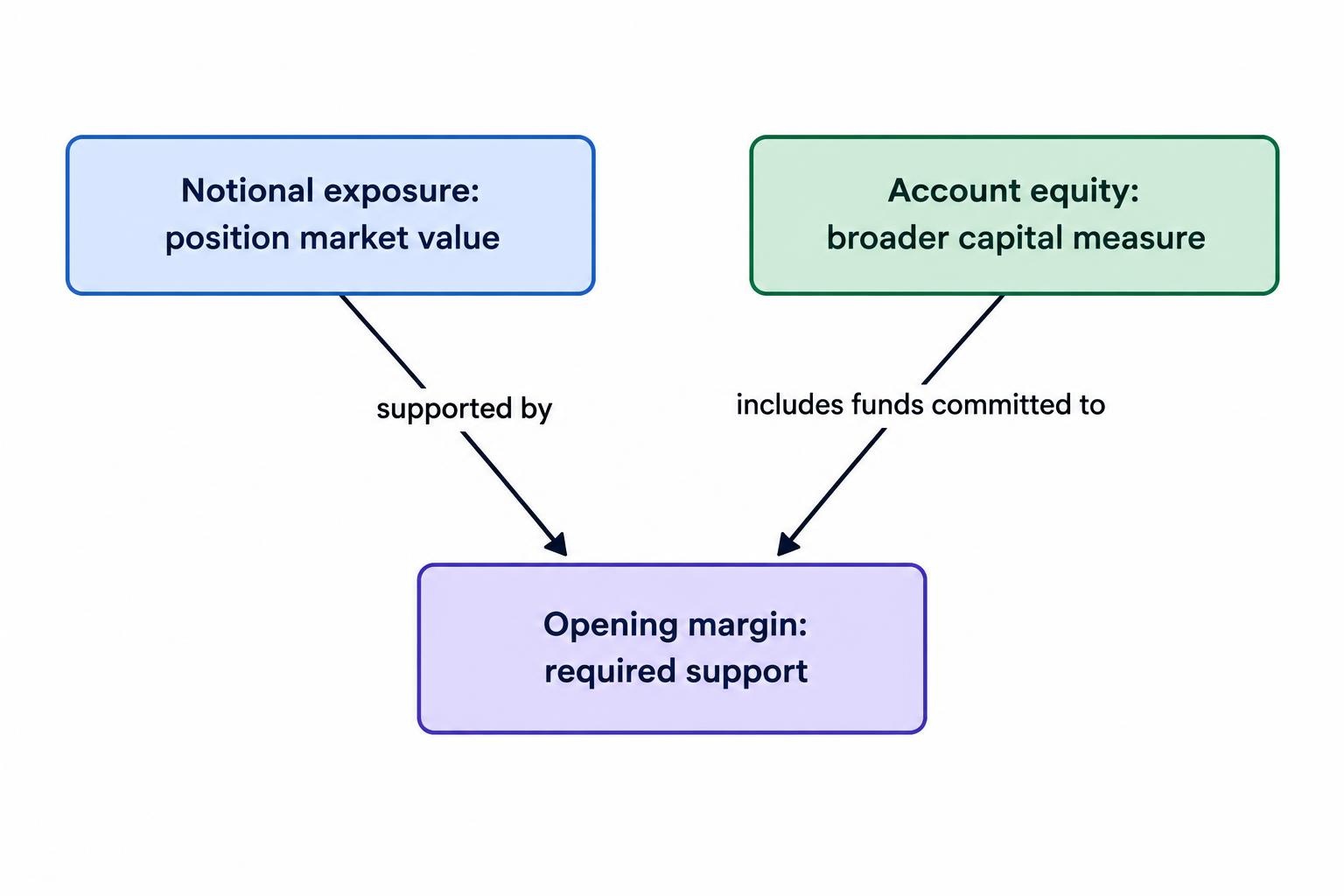
Margin is the money the provider requires to support an open position. Leverage describes the exposure that money supports.
Opening leverage = notional exposure ÷ required opening margin
Required opening margin = notional exposure × margin rate
A 5% margin rate corresponds to 20:1 opening leverage because 100 ÷ 5 = 20. A 10% rate corresponds to 10:1, and a 20% rate corresponds to 5:1.
The margin remains part of your account equity, but it is committed to supporting the position rather than freely available for other trades. It is not an entry fee or an insurance payment. The separate guide to spread betting margin covers the account calculations in more detail.
How to calculate your spread betting exposure
For a straightforward index bet quoted in whole index points, multiply the index level by your stake per point.
Notional exposure = index level × stake per whole index point
If an index stands at 8,000 and you bet £2 per point, the position has £16,000 of notional exposure. With a 5% margin requirement, the opening margin is £800.
Check the contract’s definition of a point before using this calculation elsewhere. An FX point, a commodity point and an index point need not represent the same price increment. Your stake and the quoted price must use compatible units. The guide to stake per point explains that distinction.
Measure leverage against account equity too
The opening margin ratio is only half the picture. Your account may contain considerably more cash than the trade requires.
Effective account leverage = total notional exposure ÷ account equity
Account equity means your account balance adjusted for open profits and losses. If the £16,000 index position is your only trade and your equity is £2,000, your effective leverage is 8:1, even though the contract’s opening margin ratio is 20:1.
For several positions, adding their absolute exposures gives a useful gross leverage measure. It is not a complete risk model, particularly where positions offset each other, but it prevents a busy account from looking smaller than it is.
A worked example: £800 margin, £16,000 exposure
Assume you open a long index spread bet at 8,000 with a £2 stake per whole index point. The margin rate is 5%, and your account equity before opening is £2,000.
The position creates £16,000 of exposure and requires £800 of margin. Ignoring the spread and other charges, £1,200 remains outside the opening margin requirement.
| Closing level | Index movement | Trade profit or loss | Change against £2,000 starting equity |
|---|---|---|---|
| 8,080 | +80 points, or +1% | £160 profit | +8% |
| 7,920 | −80 points, or −1% | £160 loss | −8% |
| 7,800 | −200 points, or −2.5% | £400 loss | −20% |
| 7,600 | −400 points, or −5% | £800 loss | −40% |
The £160 profit in the first row is also 20% of the £800 opening margin. Both percentages are mathematically correct, but they answer different questions. Return on margin measures the result against money reserved for the trade. Return on account equity measures the result against your trading capital.
The last row shows why margin can be misleading. A 5% adverse move produces a loss equal to the opening margin, yet it does not automatically end the trade or cap the loss. Continued trading depends on account equity, the applicable margin requirement and any exit orders.
These are simplified calculations, not executable quotes. Actual results must include the difference between opening and closing dealing prices, plus any applicable charges.
Available leverage is not the leverage you must use
A provider offering 20:1 opening leverage does not force your whole account to operate at 20:1. You choose the stake, subject to the contract’s minimum size.
Using the same index level of 8,000 and £2,000 account equity, a £1 stake creates £8,000 of exposure and 4:1 effective leverage. A £2 stake creates £16,000 and 8:1 effective leverage. The margin rate can remain 5% in both cases.
Reducing the stake directly reduces the cash gained or lost per point. Adding cash without changing the stake lowers effective account leverage, but it does not reduce the trade’s pounds-per-point loss. A 100-point adverse move still costs £200 on a £2 stake.
This distinction is useful when deciding whether to reduce a position or deposit more money. One changes the position’s sensitivity. The other gives the existing position more capital to consume.
UK retail spread betting leverage limits
The FCA minimum margin requirements in COBS 22.5.11 establish the following opening limits for standard UK retail positions:
| Underlying market category | Minimum margin | Maximum opening leverage |
|---|---|---|
| Major currency pairs and relevant sovereign debt | 3.33% | Approximately 30:1 |
| Major stock indices, minor currency pairs and gold | 5% | 20:1 |
| Minor stock indices and commodities other than gold | 10% | 10:1 |
| Individual shares and other assets covered by the remaining category | 20% | 5:1 |
These are minimum margin requirements, not promises that every provider will offer the corresponding maximum leverage. A provider can require more margin. Check the actual deal ticket, including any higher rates applying to larger positions.
Market classification also matters: not every index qualifies for the major-index rate. The dedicated guide to spread betting leverage limits covers the regulatory categories without confusing them with the lower effective leverage you may choose for your account.
What happens when losses reduce your equity?
Losses reduce the capital supporting a position. Required margin and available funds therefore need attention throughout the trade, not just when you open it.
With £16,000 of exposure and £2,000 equity, effective leverage starts at 8:1. After a £400 trading loss, equity falls to £1,600. Exposure may also change with the market price, but the capital cushion has plainly shrunk. Keeping the same stake means each further point still carries the same cash consequence.
The FCA retail account protection requirements require positions to be closed as soon as market conditions allow when net equity falls below 50% of the required margin. Negative balance protection caps liability for covered retail trades at the funds dedicated to that trading account. Professional reclassification means losing some retail protections, so do not assume the same safeguards apply after changing status.
A simplified account requiring £800 of margin would have a 50% regulatory close-out reference of £400 equity. That is not permission to wait until £400 remains. Requirements can change, providers may close positions earlier under their terms, and execution depends on available market prices.
The margin close-out rule is an account safeguard, not a substitute for choosing your own exit. Negative balance protection does not prevent you losing the funds in the account.
How leverage affects trading costs
Costs should be assessed against the exposure and stake you trade, not just the margin displayed beside the order.
Consider a hypothetical two-point spread. At £2 per point, that represents £4 between the buy and sell quotes. At £10 per point, it represents £20. The quoted spread has not changed, but the larger position makes the cash cost five times higher.
Daily funded positions can also attract overnight financing based on their notional exposure rather than only their opening margin. Rates, calculation methods and debit or credit treatment depend on the contract. The guide to overnight financing costs covers those mechanics.
As arithmetic rather than a rate quotation, an annualised 8% charge applied to £16,000 would equal £1,280 over a full year before compounding or changes in exposure. That is 64% of a £2,000 starting account. A modest-looking percentage can become expensive when applied to a much larger notional position.
Choose the stake from the loss budget
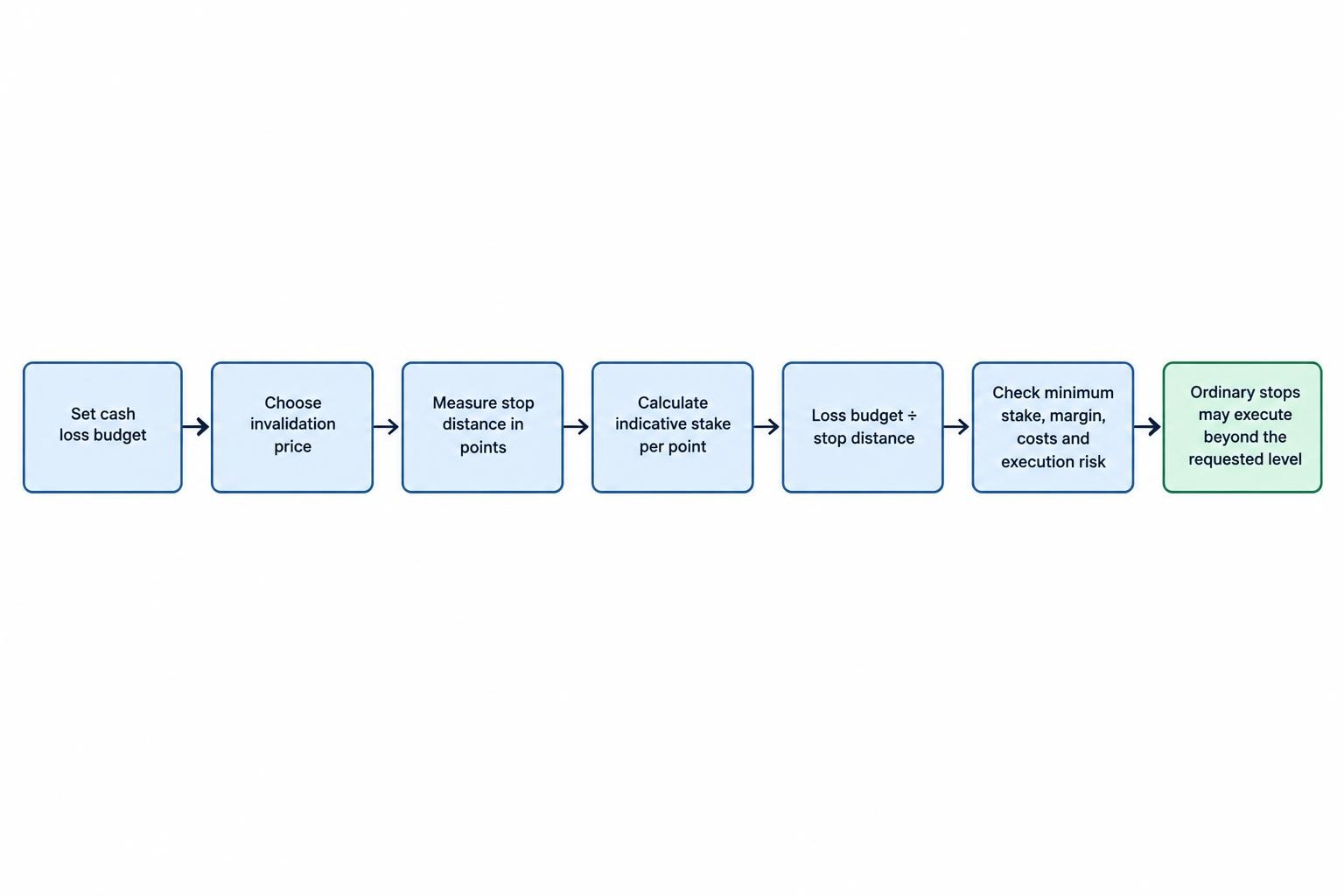
A practical sequence starts with the amount you are prepared to lose on the trade, then works back to the stake. Starting with the maximum available position reverses that process.
- Set a cash loss budget that fits your account and other open risks.
- Identify the price level at which the trade idea would no longer hold.
- Convert the distance to that level into the contract’s points.
- Calculate the stake, then check margin, costs and execution risk.
Indicative stake per point = cash loss budget ÷ stop distance in points
Suppose account equity is £2,000, your chosen loss budget is £20, and the planned stop is 50 points away. The calculation gives £0.40 per point before allowing for costs or adverse execution. This is an illustration, not a recommended risk percentage.
If the contract’s minimum stake is £1, it does not fit that plan. A 50-point loss would be £50 before costs. Moving the stop closer solely to make the arithmetic fit changes the trade rather than fixing the sizing problem. The position sizing guide develops this approach.
A stop order does not remove every risk
An ordinary stop can execute beyond its requested level when prices gap or move quickly. A planned £20 loss is therefore not necessarily a hard £20 ceiling.
Where available, a guaranteed stop-loss order provides an exit at the agreed level under the provider’s terms, with any premium and restrictions included in your calculations. Check availability, minimum distances and charges before relying on it.
Even with a guaranteed exit, you still need enough available funds to support the position under the account’s margin rules. A loss-control order and a margin requirement perform different jobs.
Count related positions as shared exposure
Leverage becomes harder to judge when several trades express much the same view. Buying three equity indices is not necessarily three independent bets. A broad equity sell-off could hurt all of them at once.
For example, three £8,000 long positions create £24,000 of gross exposure. Against £3,000 equity, that is 8:1 gross account leverage. Looking at each trade separately conceals how much of the account depends on favourable market conditions.
The pattern of shared gains and losses matters alongside the exposure total. Portfolio correlation and spread betting risk covers how related positions can concentrate losses.
Opposing trades also need care. A long and short position may reduce directional exposure without removing every spread, financing charge or margin obligation. Judge the account by its actual terms and combined outcomes, not by the number of tickets marked buy or sell.
Use leverage as a constraint, not a target
There is no leverage ratio that makes a trade safe. The same ratio can support very different risks depending on volatility, stop distance, holding period and the other positions in the account.
Before opening a bet, be able to state its pounds per point, notional exposure, required margin and loss under a plausible adverse move. If one of those figures is unclear, the position is not ready.
A spread betting demo account can help you practise those calculations without committing funds, although simulated execution does not establish how a live trade will fill. The useful habit is the same in either setting: choose the exposure you can support, rather than fill the account simply because margin is available.