Share spread betting brokers let you speculate on individual company share prices without buying the shares. You choose a stake per point, take a long or short position, and make or lose money as the broker’s quoted price changes. The account, trading costs and execution arrangements matter just as much as the companies you trade.
The right broker needs to offer your chosen shares at a workable stake, with clear financing charges and order controls that fit your strategy. A platform can advertise thousands of markets yet still be unsuitable for a trader who needs one particular AIM stock, a small position in a US company, or protection against an overnight price gap.
This guide focuses on choosing a provider for individual equities. For comparisons across currencies, indices and other markets, see the broader guide to spread betting brokers. Spread betting carries a high risk of rapid losses and is not a substitute for owning shares.
Which Share Spread Betting Brokers Should You Compare?
IG, CMC Markets and Spreadex provide useful starting points for a shortlist. They are not interchangeable, and naming them does not establish that any one is cheapest for your shares, stake or holding period.
IG and CMC Markets offer proprietary trading platforms within their spread betting services, including CMC’s Next Generation platform. These platform options appear in the spread betting broker and platform comparison. Treat platform availability as a starting point, then inspect the actual share contracts available through your intended account.
| Broker | Reason to investigate | What to check before choosing |
|---|---|---|
| IG | Broad spread betting market selection and its own trading platform. | Availability of your exact shares, minimum stakes, share pricing and the platform through which each contract can be traded. |
| CMC Markets | A proprietary platform option through Next Generation. | Share contract coverage, financing, quote units and whether your preferred platform supports the same instruments and orders. |
| Spreadex | AIM and smaller company share coverage alongside other equity markets. | Whether the required stock is tradable online, its minimum stake, margin requirement and any restrictions on opening short positions. |
This is a research shortlist, not a ranking based on original platform testing. There is no defensible universal winner without defining the shares being traded and the way the account will be used.
A trader holding large UK shares for several hours needs a different comparison from someone holding US growth stocks for three weeks. The former may care most about the spread and execution. The latter also needs to examine financing, earnings gaps and corporate action handling.
Before comparing providers, write down five to ten shares you genuinely intend to trade. Use that same watchlist throughout the assessment. It is a more useful filter than a broker’s total market count.
Check the Share Coverage Behind the Headline Number
UK Large Companies and Smaller Shares
Search by company name and ticker, then open the instrument details. Confirm that the result is an individual share spread bet rather than a CFD, an index contract or a share dealing instrument. A company appearing in a broker’s search results does not, by itself, answer that question.
For UK shares, compare the trading conditions across different types of company. A large bank, a mid-sized retailer and a thinly traded smaller business can present very different pricing and execution problems. The guide to spread betting on UK shares covers those market distinctions.
If smaller companies are central to your strategy, ask whether the broker supports online dealing in each stock and in both directions. Also ask what happens when liquidity deteriorates. Can the market become closing only? Can the maximum position size change? Is a telephone quote needed above a certain stake?
A broker that lists an obscure company but cannot support the position you need has not solved your access problem. Conversely, there is little reason to prioritise a vast smaller company catalogue if you only trade a handful of highly liquid shares.
US and Other Overseas Shares
For overseas equities, compare the contract rather than assuming it behaves like a UK share bet. Check the quote currency, point size, stake currency and trading session. A displayed price of 150.00 does not tell you what a one-point move means on that broker’s ticket.
The practical issues involved in spread betting on US shares include contract sizing and session differences. Test these with a sample order before placing a live trade.
Also check the exact listing. A company may have several share classes, overseas listings or depositary receipts. Similar names do not guarantee identical price behaviour or contract terms. Record the exchange and instrument identifier beside each company on your comparison sheet.
Keep availability separate from affordability. A broker may offer the stock but impose a minimum stake or margin requirement that makes a sensible position impractical for your account.
Compare the Full Cost of Trading Shares
A “commission free” label does not establish that a share spread betting account is cheap. Your comparison should cover the quoted spread, overnight financing, borrowing charges on shorts where applicable, paid market data and any other relevant account charges.
Start with the costs of share spread betting, then calculate an example using your own stake and expected holding period. Avoid comparing one broker’s share spread with another broker’s share CFD commission: those are different pricing arrangements.
Measure the Spread on the Same Basis
Compare executable buy and sell quotes for the same share at approximately the same time. Record the session and intended stake. A quote observed during busy trading is not directly comparable with one captured outside the main session.
Check how the broker describes its charge. A percentage markup, a fixed number of points and a minimum monetary charge need converting into the same cash measure. Where a charge applies on each side, include both sides. Where you use the complete quoted bid–ask spread, do not automatically double it again.
Suppose a hypothetical UK share is quoted at 499p to sell and 500p to buy. If one point equals 1p and your stake is £2 per point, buying and immediately selling at unchanged quotes would lose £2. That is the cash effect of the one-point spread, before any other charges.
Record this cash amount for every share on your watchlist. A small difference becomes more relevant when repeated across many trades, but it still needs weighing against execution and other costs.
Financing Can Change the Cheaper Broker
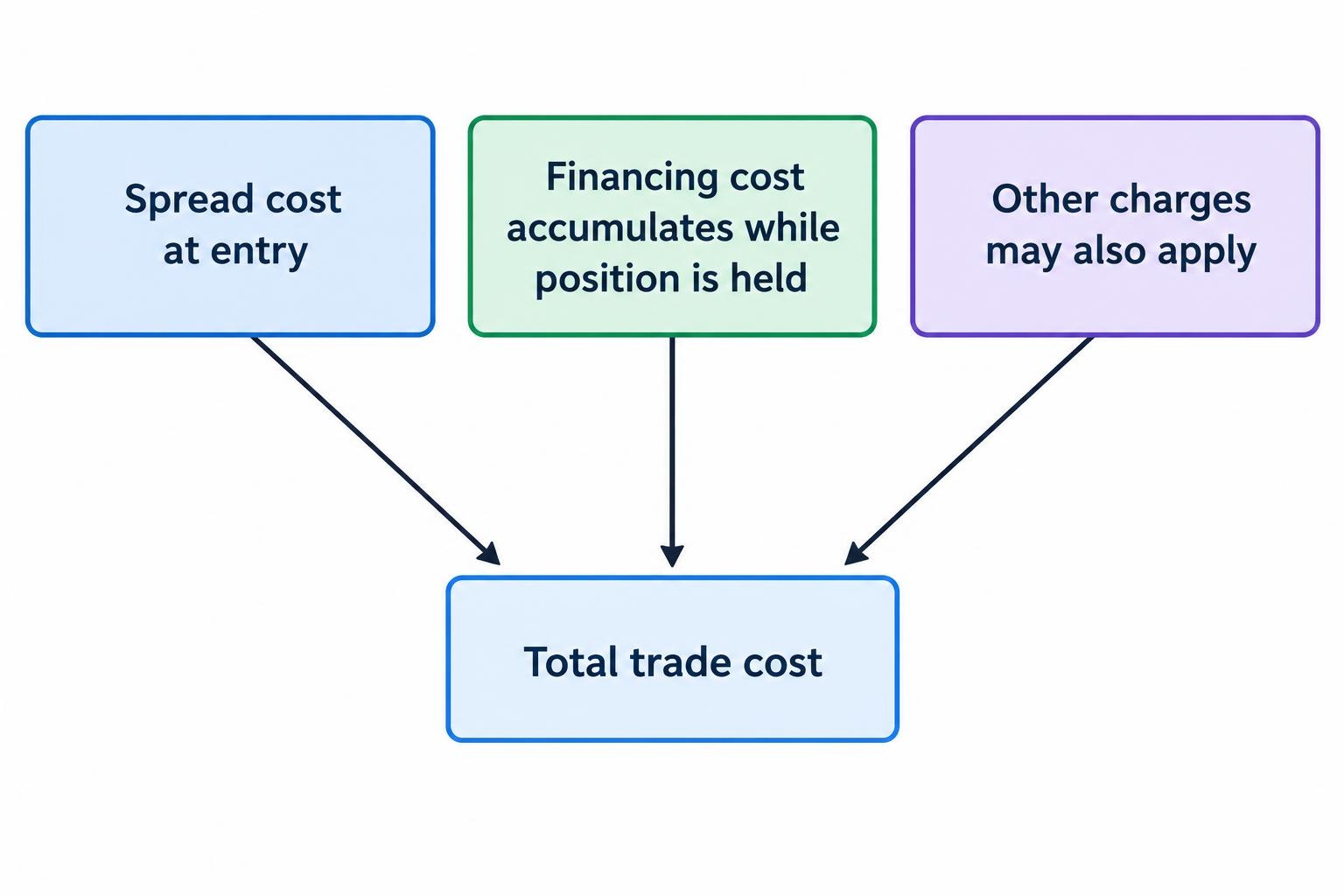
For positions held beyond the financing cutoff, compare the full annual funding rate and the calculation method. Establish the reference rate, broker adjustment, day-count basis and treatment of weekends. Do not compare a total rate at one provider with only the broker’s markup at another.
Financing is generally linked to the position’s exposure, not just the opening margin. The separate guide to overnight financing costs explains the calculation in more detail.
The following illustration shows why holding period matters. Assume a share price of 500 points, a £2 stake per point and £1,000 of exposure. Prices stay unchanged. Both hypothetical providers use a 365-day calculation, and the stated annual financing rates include all funding components.
| Cost measure | Provider A | Provider B |
|---|---|---|
| Quoted spread | 1 point | 2 points |
| Cash effect of spread | £2 | £4 |
| Total annual financing rate | 10% | 5% |
| Financing for 30 charged days | £8.22 | £4.11 |
| Spread plus 30 days’ financing | £10.22 | £8.11 |
Provider A has the narrower spread. Provider B costs less over the illustrated holding period. Neither result establishes the better account outside those assumptions.
Real prices and funding rates can change, and other charges may apply. The useful habit is to compare the whole proposed trade. The advertising banner does not pay the trading bill.
Check Charges Outside the Trade Ticket
Ask whether live exchange data requires a subscription and whether any rebate depends on trading activity. Check inactivity charges, withdrawal conditions and currency conversion arrangements where relevant. Only include charges you expect to incur, but do not leave them out because they appear on a different page.
For an occasional trader, a recurring data charge can outweigh a modest spread saving. For a frequent trader, the recurring cost may be less important than pricing across hundreds of transactions.
Margin and Minimum Stakes Can Rule Out a Broker
UK retail rules require opening margin of at least 20% of exposure for individual shares, equivalent to maximum exposure of five times that margin. The rules also require account-level closeout when net equity falls below 50% of the applicable regulatory margin requirement, as soon as market conditions allow, and restrict retail liability to funds dedicated to the relevant trading account. These requirements appear in FCA COBS 22.5 margin and retail protection rules.
The 20% figure is a regulatory minimum, not a promise that every share will be offered at that rate. Read the broker’s instrument schedule for higher requirements, position-size tiers and circumstances in which margin can change.
For a hypothetical share at 500 points and a £2 stake per point, exposure is approximately £1,000. A 20% opening margin would be £200. A 50-point adverse move would produce a £100 trading loss before costs. The £200 opening requirement is not the trade’s maximum loss.
Minimum stakes deserve equal attention. If the smallest permitted stake makes the loss at your planned exit too large, the account is unsuitable for that trade. A lower deposit requirement does not repair the sizing problem.
Use position sizing for spread betting to work backwards from the amount you are prepared to risk. Then check whether the broker supports that stake. Do not start with the largest position the margin calculator permits.
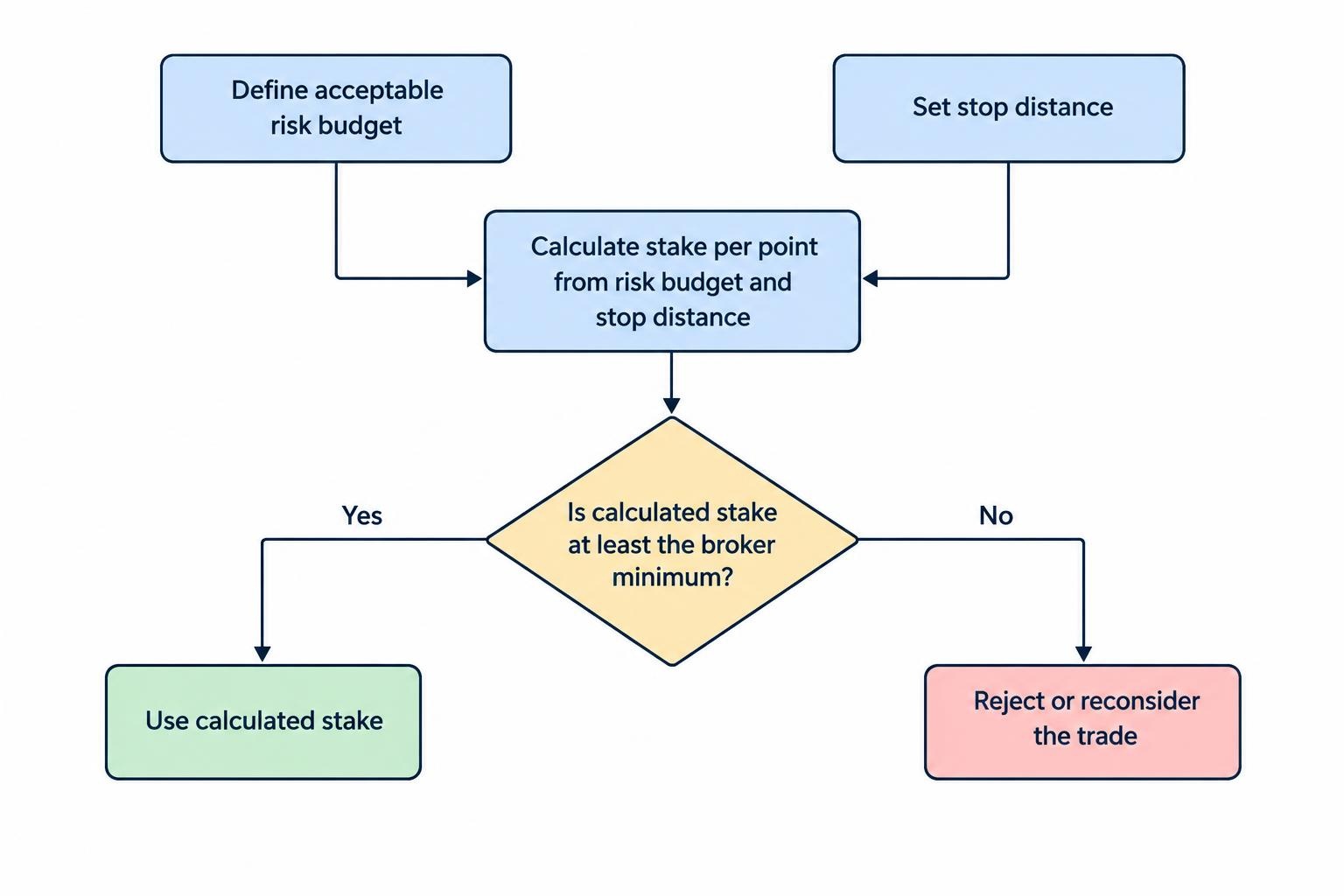
For example, a £40 planned risk budget and a 20-point stop distance imply a £2 stake per point before costs and possible slippage. If the minimum stake is £5, the planned price loss becomes £100. Moving the stop closer just to accommodate the broker changes the trade rather than making it cheaper.
Keep spare account equity in the comparison too. Several positions can draw on the same available funds, and a rising margin requirement can reduce that buffer without a new trade being opened. Ask how the broker communicates changes and which positions it may close when funds are insufficient.
Assess Execution, Stops and Trading Sessions
Judge the Order Process, Not Just the Chart
A useful share trading platform should make the instrument, direction, stake, opening margin and attached orders easy to verify before submission. Test whether you can amend a stop, partially close a position and distinguish an order confirmation from an order rejection.
Read the execution policy for how orders are priced and handled. Ask how the broker treats market orders during sharp moves, whether orders can be partially filled and what happens when the underlying share is suspended. Obtain answers before relying on a particular order type.
Do not use a smooth chart as evidence of dependable execution. A chart displays price information; it does not prove that your intended stake can be dealt at the displayed level.
Check Guaranteed Stops Share by Share
An ordinary stop sets a trigger for closing a position but does not guarantee the final execution price. A share can gap beyond the trigger following company news, leaving the eventual loss larger than the amount calculated from the stop distance.
Where offered, guaranteed stop-loss orders can provide a different form of price protection, subject to the contract’s conditions. Verify availability on the exact share rather than relying on a platform-wide feature list.
Compare the premium, minimum distance, maximum stake and rules for moving or removing the order. Check when the premium becomes payable and how the guarantee interacts with margin. A feature that exists elsewhere on the platform may not be available on a smaller or more volatile company.
Separate Main-Session and Extended-Hours Trading
If you need access outside the underlying exchange’s main session, verify each share’s schedule and the permitted order types. Ask whether existing stops remain active, whether new positions can be opened and how prices are formed while the exchange is closed.
The guide to after-hours share trading covers the wider trading considerations. For broker selection, the immediate question is whether the available session and contract terms match your intended use.
Also check the time zone shown by the platform and its treatment of daylight saving changes. Keep a record of the broker’s dealing hours rather than relying on a remembered UK opening time.
Extended access is not automatically an advantage. It is useful when it supports a defined trading plan and the pricing is acceptable. Extra hours are less useful if they encourage positions that would not otherwise pass your risk checks.
Check Short-Selling Terms and Corporate Action Handling
If your strategy includes falling share prices, confirm that the sell button opens a new short position on the required company. A broker may display a sell quote for closing an existing long without permitting a new short trade.
Ask about borrowing availability, additional borrowing charges and circumstances in which a short position can be closed. The guide to short selling shares through spread betting covers the mechanics; your broker comparison should establish the practical restrictions.
Do not assume that a short position earns a financing credit. Request the actual funding calculation and any separate borrowing charge. For a longer holding period, these terms may matter more than a small difference in the opening spread.
Corporate actions also deserve a place in the assessment. Read how the provider handles stock splits, rights issues, takeovers and suspensions. Check whether it adjusts the contract, closes it, or offers a choice under the relevant terms.
For positions held around an ex-dividend date, inspect the provider’s dividend adjustment arrangements. You hold a derivative contract, not the underlying shares, so do not treat account adjustments as shareholder dividends or assume that every provider calculates them identically.
Clear statements are valuable here. You should be able to distinguish trading profit or loss, financing, borrowing costs and adjustments without reconstructing the account from scattered notifications.
Verify the Legal Entity Before Funding
Check the legal company named in the application and customer agreement, not just the trading brand. Match its permissions and contact details against the official record. The FCA guidance on checking an authorised firm also warns that clone firms can copy genuine businesses’ names and regulatory details.
Do this before transferring money or submitting sensitive documents. A familiar logo, a search advertisement or a reference number copied into a footer does not complete the check.
Next, establish how client money is held, what the agreement says about account funds and which complaints process applies. Keep copies of the agreement and relevant schedules. These documents matter more than a broad statement that a brand operates in several countries.
FSCS investment protection can cover eligible claims up to £85,000 per person, per firm where the relevant conditions are met. It does not compensate for poor investment performance. The distinction is set out in the FSCS investment protection and eligibility guidance.
Do not treat compensation arrangements as trading insurance or assume that several accounts create several separate allowances. Verify the authorised firm behind each account and the protection applicable to the service you are using.
Account security deserves a practical check too. Look for suitable authentication controls, a clear withdrawal process and a dependable way to contact the dealing desk if the platform becomes unavailable.
Test the Account Against a Realistic Share Watchlist
Where available, use a spread betting demo account to learn the interface and check order entry. Confirm that the practice environment includes the shares and contract type you intend to use.
A demo helps reveal confusing quote units, awkward stop controls and missing instruments. It does not establish how a live order will execute during an earnings announcement or a disorderly market. Keep those two purposes separate.
A focused assessment can use the following sequence:
- Build a representative watchlist. Include the types of company and listing you expect to trade, not just the most familiar names.
- Record matching quotes. Compare the same instrument, session, stake and direction across providers.
- Inspect the contract. Note point value, minimum stake, margin, financing and any borrowing charge.
- Check order controls. Practise attaching, amending and cancelling orders, including partial position closures.
- Ask a difficult support question. Request a written answer about a suspension, margin change or corporate action affecting one of your chosen shares.
Keep the comparison sheet short enough to use. Ten well-chosen shares with complete contract information are more useful than a spreadsheet containing hundreds of unexplained headline spreads.
Pay attention to answers that require qualification. “Guaranteed stops available” should lead to a share-by-share check. “No commission” should lead to the spread schedule. “Global equities” should lead to an instrument search. The qualification is often where the account’s suitability becomes clear.
Do not fund an account simply to complete a comparison if the available information already exposes a mismatch. An excessive minimum stake, missing market or unclear charge is a valid reason to remove a provider from the shortlist.
Choose the Broker That Fits the Holding Period
For intraday share trading, give more weight to executable spreads, order handling and access during the session you trade. For positions held over several days or weeks, move financing, borrowing costs, margin changes and corporate action administration higher up the list.
For smaller company strategies, prioritise genuine access and workable position sizes. For overseas equities, prioritise contract units, session coverage and clear treatment of charges. No amount of chart customisation compensates for an instrument that cannot be traded on suitable terms.
If the aim is to own a company for years, receive shareholder rights and avoid ongoing derivative funding, revisit the comparison between spread betting and share dealing before choosing a broker.
The strongest share spread betting broker for your needs is the one that passes the checks on your actual watchlist: correct account, suitable contracts, manageable stakes, transparent costs and usable risk controls. Choose on that evidence rather than a headline market count or an unsupported “best broker” label.