Financial spread betting lets you speculate on whether a market price will rise or fall without buying the underlying asset. You choose a stake for each point of movement, such as £1 or £2 per point. Your profit or loss depends on how far the price moves between opening and closing the bet, multiplied by that stake.
The attraction is straightforward: you can trade rising or falling markets through one account. The risk deserves equal attention. Spread betting uses leverage, so a relatively small deposit can support a much larger position. Losses can therefore build quickly. This guide covers financial spread betting in a UK context, rather than sports betting.
A Bet on Price Movement, Not Asset Ownership
A spread bet is a derivative: its value depends on an underlying market. You enter a contract with a spread betting provider, and the difference between your opening and closing prices determines the trading result.
Buying a spread bet on a company does not make you a shareholder. You do not acquire shares or voting rights. A bet on gold does not involve taking delivery of metal either. You are taking exposure to a price, not purchasing the thing being priced.
Common financial spread betting markets include stock indices, individual shares, currency pairs, commodities and government bonds. The available contracts, trading hours and point values depend on the provider and market.
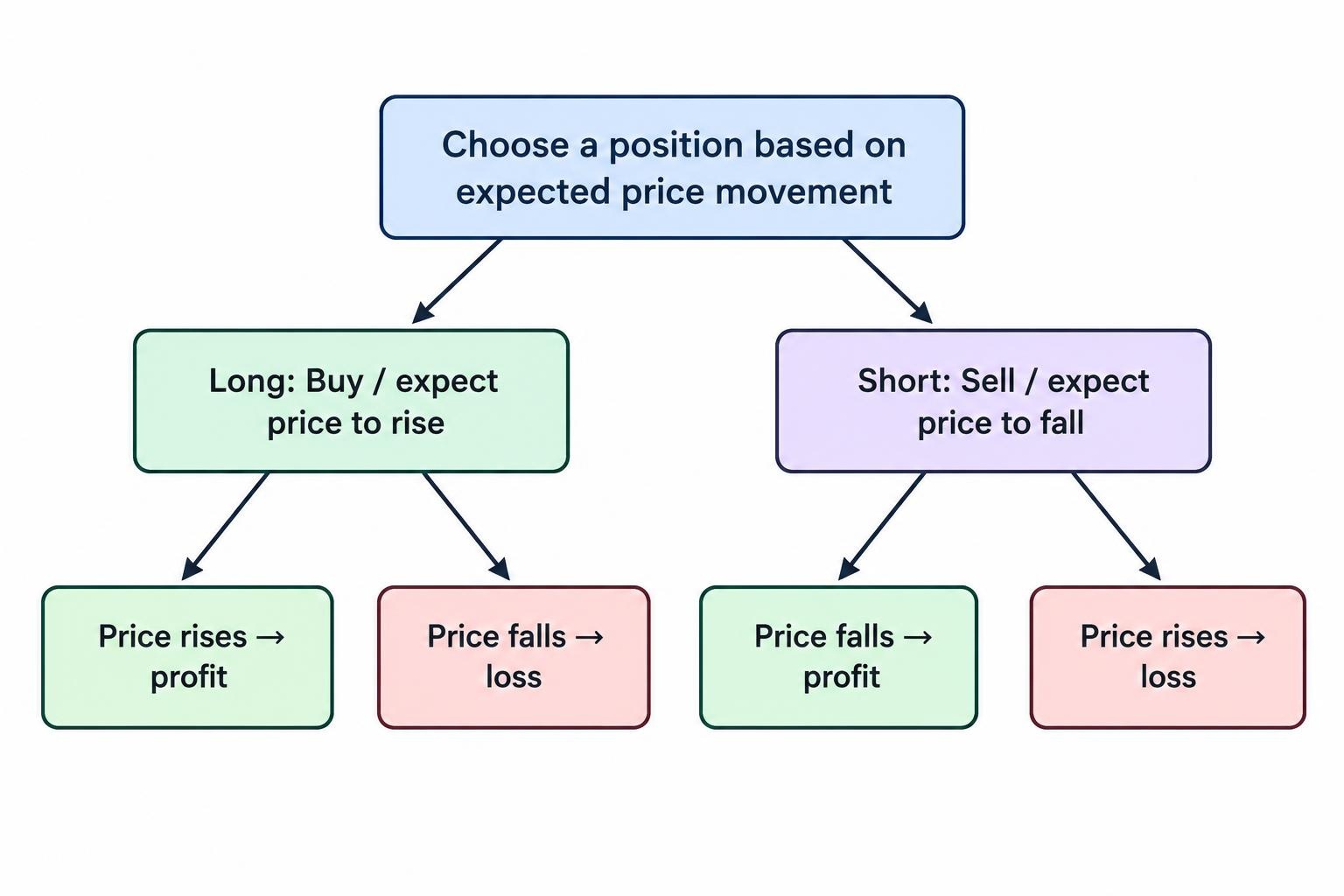
You can open a long position by buying if you expect the price to rise, or a short position by selling if you expect it to fall. Either direction can produce a profit or a loss. Shorting changes which price movement helps you; it does not make the trade safer.
Why Is It Called Spread Betting?
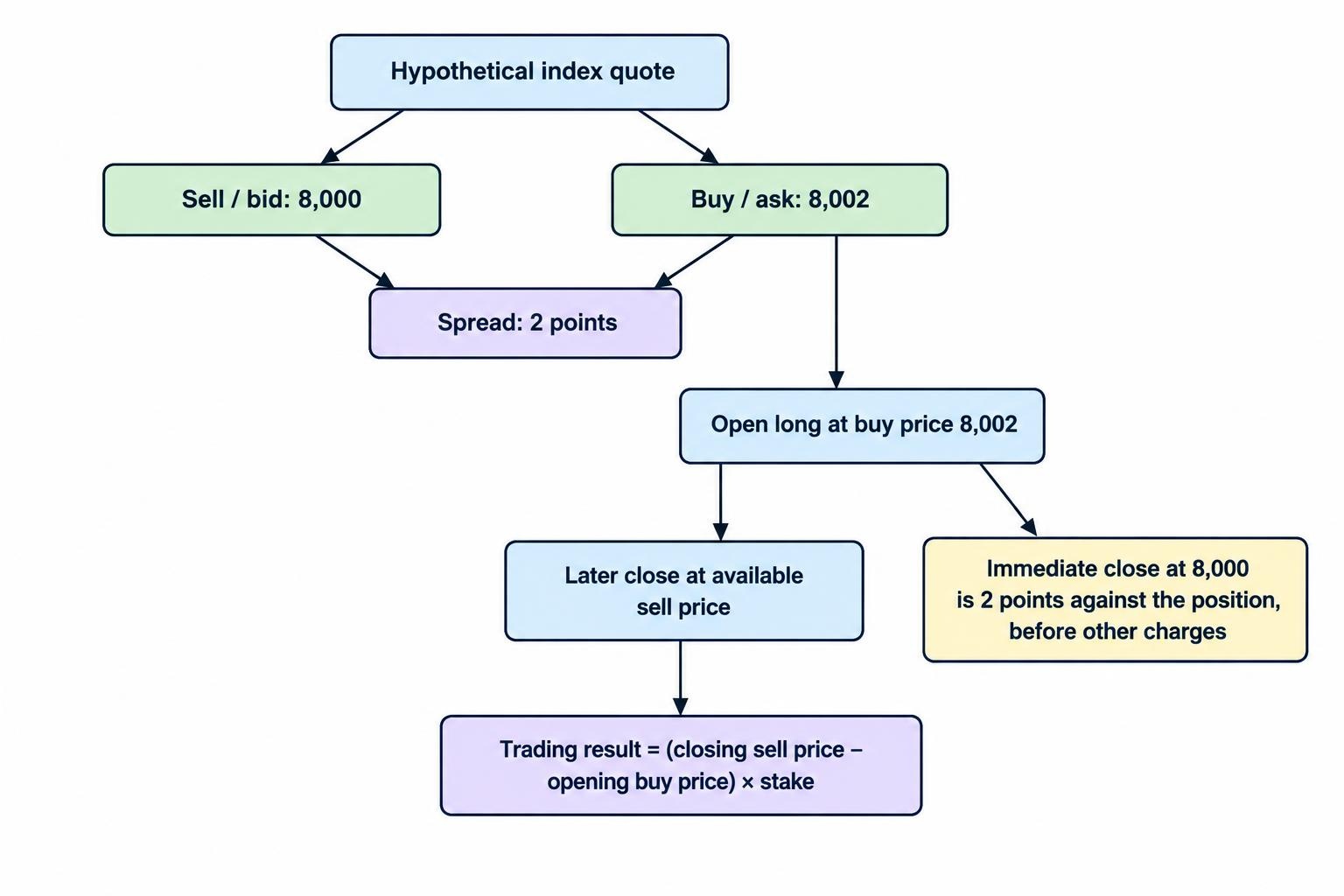
The provider quotes two prices: a sell price, also called the bid, and a buy price, also called the ask or offer. The difference between them is the spread.
Suppose an index quote is 8,000 to sell and 8,002 to buy. The spread is two points. You open a long bet at 8,002 and close it using the sell price available at that time. For a short bet, you open at the sell price and close at the buy price.
This means a new position normally starts with a small unrealised loss. If you bought at 8,002 and immediately sold at 8,000, you would lose two points multiplied by your stake. The market must move far enough in your favour to cover that gap before the trade reaches break even, ignoring other charges.
The spread is a trading cost, not a separate prediction about where the market will go. Its width may change with market conditions. The guide to spread betting spreads covers how these quotes affect entry prices, exit prices and trading costs.
A Simple Spread Betting Example
Assume the hypothetical index quote above is available and you expect the market to rise. You buy at 8,002 with a stake of £2 per point.
For a long bet, the calculation is:
Trading profit or loss = (closing sell price − opening buy price) × stake per point.
| Closing sell price | Movement from entry | Trading result before other charges |
|---|---|---|
| 8,052 | 50 points in your favour | £100 profit |
| 7,952 | 50 points against you | £100 loss |
| 8,000 | 2 points against you | £4 loss |
These calculations already reflect the spread because they use the actual buy and sell prices. You should not subtract the same spread again. Financing and any other applicable charges would still affect the final account result.
For a short bet, reverse the price calculation: subtract the closing buy price from the opening sell price, then multiply by the stake. A lower closing price produces a profit; a higher one produces a loss.
The stake is not the maximum amount you can lose. At £2 per point, every 100 points of adverse movement between entry and exit costs £200 before other charges. A longer spread betting worked example follows the calculation through a complete trade.
Margin and Leverage: The Deposit Is Not the Position
Margin is the money required to open and maintain a position. Leverage describes the relationship between that deposit and the larger market exposure it supports.
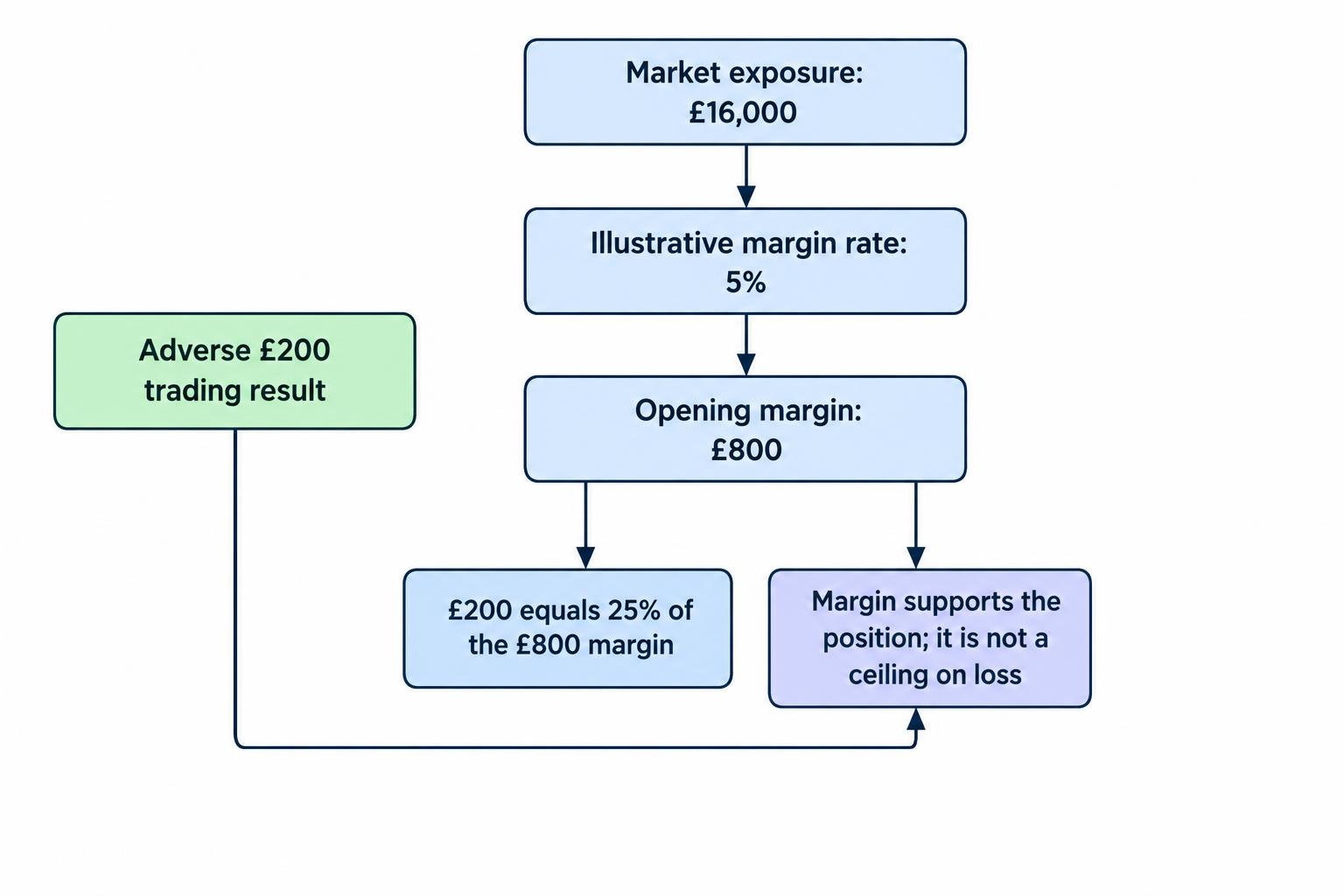
For illustration, a position with £16,000 of exposure would require £800 if its margin rate were 5%. You would not have paid £16,000 upfront, but your trading result would still depend on the full position. The £800 is a deposit supporting the trade, not a ceiling on its loss.
If an adverse movement produced a £200 loss, that would equal 25% of the £800 margin. A £200 profit would have the same percentage relationship. Leverage magnifies the effect of both outcomes relative to the money initially committed.
This distinction matters when deciding whether a trade is affordable. Having enough available funds to meet the opening margin does not establish that the position is sensible for your account. It only establishes that you can meet that opening requirement.
Account equity changes as open profits and losses change. If funds become insufficient, the provider may close positions under its rules and applicable retail protections. Our explanation of spread betting margin separates the deposit requirement from the money actually at risk.
What Does Spread Betting Cost?
The spread is the most visible charge, but it is not necessarily the only one. The contract type and the time you hold it both matter.
Daily funded bets generally apply financing adjustments when positions remain open beyond the provider’s daily cut-off. These can accumulate over a longer holding period. A futures or forward style bet normally reflects financing in its quoted price rather than using the same daily charging structure, and it has an expiry date.
Financing deserves close attention. The FCA has identified concerns about both the level of overnight charges and how firms disclose them in its findings on CFD and spread betting charges.
Other possible costs include guaranteed stop premiums, currency conversion, market data or account administration charges. Not every provider applies every fee, and some depend on how you use the account.
Compare costs against your intended holding period. A narrow opening spread may offer little comfort if financing absorbs the expected profit over several weeks. The guide to spread betting costs and fees explains the charges to check before opening a position.
How Does It Differ From Investing or CFD Trading?
Traditional share investing involves owning shares. You may receive dividends and hold the investment without the daily financing structure of a funded spread bet. Spread betting instead creates a contract linked to price movement. Any dividend related adjustment on that contract is not a dividend received as a shareholder.
That makes spread betting a different tool from buying assets for a long term portfolio. It can express a short term market view, but keeping a leveraged bet open for months introduces costs and account management demands that ownership does not reproduce in the same form.
CFDs are much closer in economic behaviour. Both products can provide leveraged exposure to rising or falling prices without asset ownership. Spread bets usually express position size as money per point, whereas CFDs generally use units or contracts.
The two products can also receive different tax treatment. Neither is automatically cheaper or safer simply because its trade ticket uses different terminology. The comparison of spread betting and CFDs covers those distinctions without treating either product as a shortcut to profitable trading.
Is Spread Betting Tax-Free in the UK?
For individuals placing financial spread bets, the UK Capital Gains Tax position is favourable: spread betting does not create chargeable gains. The other side of that treatment is that losses are not allowable capital losses. Both points appear in HMRC’s guidance on financial spread betting.
That is not a promise that every arrangement is free of every tax. Income Tax treatment depends on the contract and the economic substance of the activity. Spread betting winnings can be taxable where they arise from carrying on a trade, rather than simply from an opportunity connected with one. This distinction is set out in HMRC’s spread betting income guidance.
Do not apply the treatment of an individual’s wager automatically to a company, a business arrangement or another country’s tax system. Get advice where your circumstances are uncertain. A tax advantage also cannot repair a losing strategy: keeping all of a profit is useful only if there is a profit to keep.
UK Regulation and Retail Protections
UK retail rules impose minimum margin requirements according to the underlying market. Examples include 5% for major stock indices and 20% for individual shares. Providers may require more than these minimums.
The rules also require account level margin close-out when net equity falls below 50% of the required margin, with positions closed as soon as market conditions allow. Negative balance protection caps a retail client’s liability for the relevant products at the funds dedicated to trading them in the account. These requirements sit within the FCA rules for retail speculative investments.
Those safeguards do not protect your account from ordinary trading losses. You can still lose the money committed to the account, and a loss on one position can exceed its opening margin.
Check the legal entity providing the account, its regulatory status and your client classification. Do not assume that an offshore account or a professional classification carries the same protections as a UK retail account.
What Makes Spread Betting Risky?
The arithmetic is simple; controlling the exposure is harder. A stake that looks small can produce a large loss if the market travels far enough. Several positions can also move against you together, especially when they depend on the same economic news or market trend.
Execution adds another risk. A standard stop-loss order does not guarantee its requested exit price. A market gap or rapid movement can cause it to execute at a worse level. Guaranteed stops, where offered, have separate terms and may carry a premium.
Start with the loss you could afford, rather than the largest stake the platform permits. If your planned exit is 40 points away and your stake is £2 per point, the planned price loss is £80. That estimate is not a guaranteed maximum unless the exit is guaranteed under the contract’s terms.
Our guide to position sizing for spread betting explains how stake size, stop distance and account capital fit together. Increasing the stake after a loss does not improve the next trade’s prospects; it increases its financial consequences.
Before Placing a First Bet
Spread betting is a speculative trading product, not a savings account or a dependable source of income. It is a poor fit for money needed for bills, emergencies or near term commitments.
Before committing money, be able to identify what one point means for the contract, calculate the loss from an adverse move and explain the costs of holding it. Know which price closes your position and what happens if your available funds fall.
A spread betting demo account can help you practise those mechanics without risking cash. It does not establish that a strategy will be profitable or reproduce every pressure of live trading. The aim is to make the contract and its risks familiar before real money makes mistakes expensive.