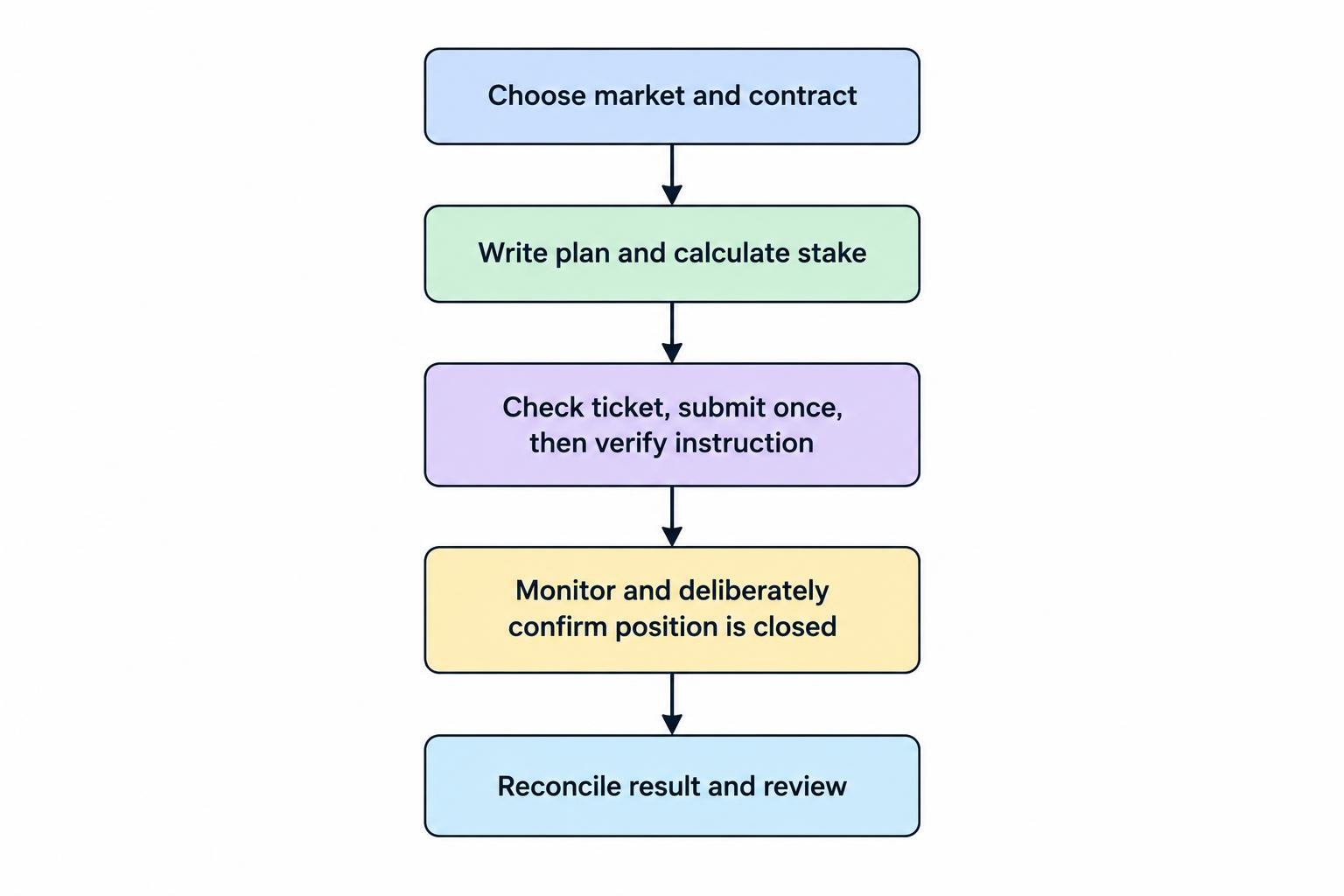
To spread bet, choose a market, decide whether to buy or sell, set your stake per point and place the trade through a spread betting account. Your profit or loss depends on how far the price moves between opening and closing the position, multiplied by your stake.
The practical challenge is deciding how much money is exposed before you press the button. An affordable margin deposit does not make a trade affordable to lose. Stops, trading costs and the way orders execute all affect the result.
This guide follows the process from choosing an account to reviewing a closed trade. It uses one hypothetical index position throughout, rather than switching between unrelated examples. If you need the mechanics before placing an order, start with how spread betting works.
Risk warning: Spread betting can produce rapid losses. Only use money you can afford to lose, and do not treat an ordinary stop order as a guaranteed limit on the loss.
1. Choose an account and practise the dealing process
Start by checking the firm, not its promotional headline. Establish which legal entity would hold your account, whether it accepts residents of your country and whether it offers the financial spread betting product you intend to use. This guide describes a UK account context; do not assume the same access or protections apply elsewhere.
Check authorisation and permission for the service through the FCA’s firm verification guidance. Match the contact details against the official record too. Fraudsters can copy the name and reference number of a genuine business, so finding a familiar name is not enough.
Once those checks are complete, compare the practical terms: minimum stakes, market coverage, spreads, financing charges, stop facilities and how the platform handles closing positions. Our spread betting broker section provides a starting point for that comparison.
Use a demo to learn the controls
Practise opening, amending and closing positions before using real money. Check where the platform displays your stake, margin, running profit or loss and attached orders. Learn how to cancel a pending order without accidentally opening another trade.
A spread betting demo account is useful for learning these operations. Treat its balance as if it were your intended trading balance, rather than using an oversized virtual account to place trades you could never afford in practice.
Do not assume a demo result proves that a method will work with real money. Use it first to establish that you can operate the platform consistently and explain every field on the dealing ticket.
Complete the application honestly
Read the account terms and answer questions about your finances, knowledge and trading history accurately. If you cannot explain how a position could lose money, pause rather than searching for answers that will get an application accepted.
The spread betting appropriateness assessment concerns whether you understand the product and its risks. Passing it is not evidence that a proposed trade is sensible or that you can afford its loss.
2. Select the market and the correct contract
Choose one market you can follow and whose price units you understand. Knowing a company’s name or recognising an index does not tell you how its spread betting contract is quoted.
Open the market information panel before the dealing ticket. Confirm what counts as one point, the minimum stake and the hours during which the contract can be traded. A small decimal movement on one market can represent a different number of betting points on another.
For the example in this guide, assume a hypothetical UK 100 index contract where a move from 8,000 to 8,001 is one point. A £1 per point stake therefore gains or loses £1 for each point of favourable or adverse movement.
Check whether the contract is daily funded or dated
A market search may show several contracts referencing the same underlying asset. One may be a daily funded bet, while another has a stated expiry date. Do not choose between them simply because one displays a lower price.
Daily funded positions can incur financing adjustments when held past the provider’s funding cutoff. Dated contracts have an expiry and a different pricing structure. Compare the proposed holding period with the contract’s costs using our guide to daily funded bets versus futures and forward bets.
For this example, assume you select a daily funded UK 100 contract and intend to close it during the same trading day. That is an illustration, not a claim that this contract or holding period is best.
3. Write the trade plan before choosing the stake
Decide what would justify entering, what would invalidate the trade and what would make you close it. These decisions should come before calculating how large a position the account can support.
A usable plan might read: “I will buy only if my entry condition occurs, close if the quoted selling price reaches my protective stop, and take profit at my planned target. I will close any remaining position before my chosen time cutoff.”
The entry condition needs to be observable. “It looks ready to rise” leaves too much room for changing the story after the trade is open. A price level, a defined chart condition or a scheduled review time gives you something you can check.
Choose buy or sell
Buy if your plan requires a rising price. You open at the buying price and close at the selling price. Sell if your plan requires a falling price. You open at the selling price and close at the buying price.
Suppose the hypothetical quote is 8,000 sell / 8,002 buy. Buying opens the position at 8,002, assuming that price is still available when the order executes. Closing immediately at an unchanged selling price of 8,000 would produce a two point loss.
That difference is the spread. It is already reflected when profit or loss is calculated from the actual entry and exit prices; do not subtract it again as a separate charge.
For the running example, assume your plan calls for buying, with a protective stop at 7,952 and a profit target at 8,102. Those levels are arbitrary teaching figures, not a market forecast.
4. Calculate the stake from the planned loss
Work backwards from an amount you can afford to lose. Do not start with the largest stake permitted by the available margin.
For a simple calculation before separate charges and execution differences:
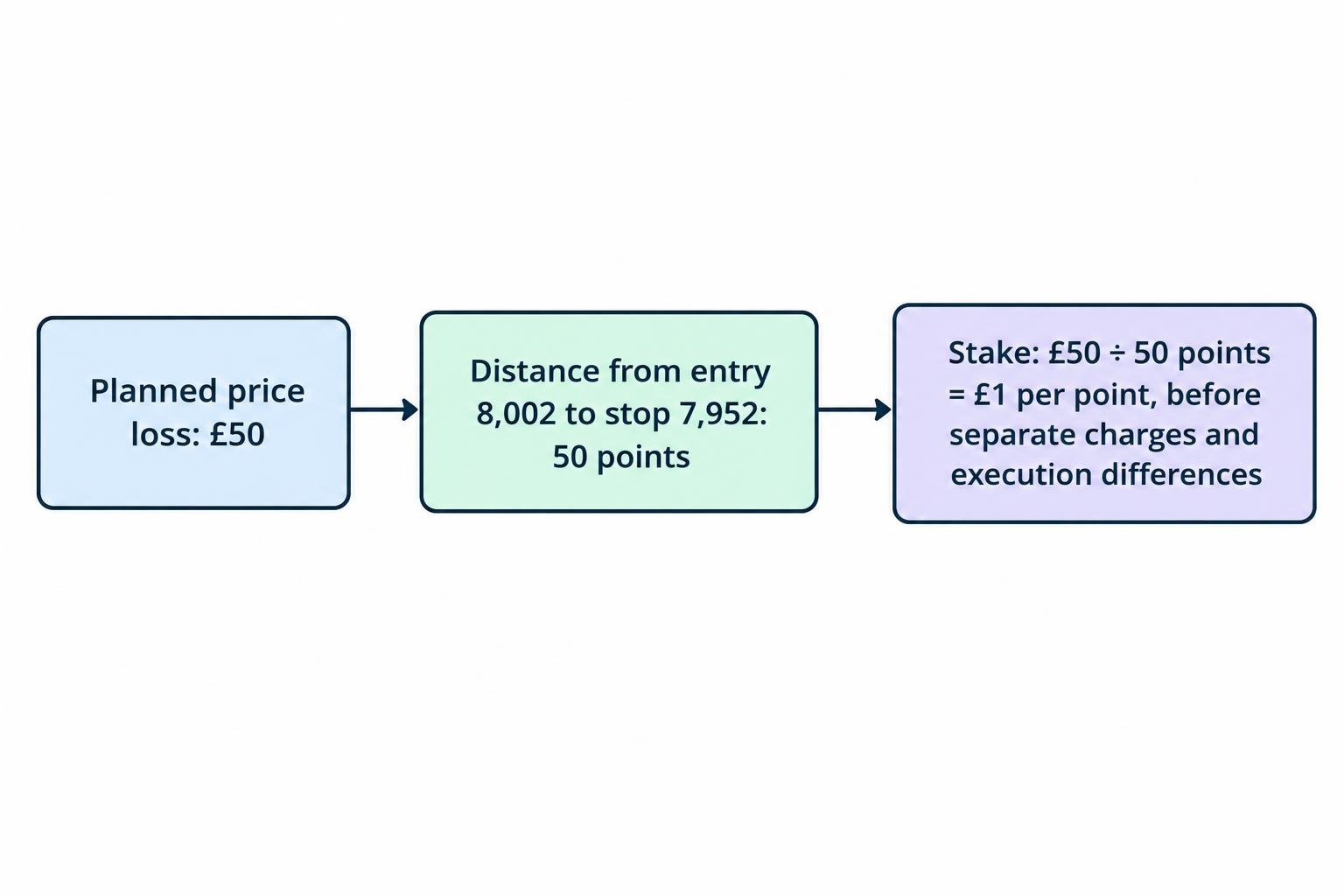
Stake per point = planned price loss ÷ distance from entry to stop.
Suppose the account balance is £5,000 and you allocate £50 to the planned price movement on this trade. That is 1% of the example balance, not a universal recommendation. Your chosen amount should reflect your circumstances and the possibility of several losses.
The assumed buying price is 8,002 and the stop is 7,952. The distance is 50 points, giving:
£50 ÷ 50 points = £1 per point.
If the position closes exactly at 7,952, the price loss is £50. If it closes below that level, the loss is larger. Any separate financing charges or other applicable fees also affect the final result.
Allow room for costs and execution uncertainty
If £50 is meant to cover the entire loss, rather than just the price movement, reserve an allowance for relevant charges before calculating the stake. That produces a smaller stake. It still cannot turn an ordinary stop into a guaranteed cash limit.
Check whether the platform accepts the calculated amount. If your calculation produces £0.80 per point but the minimum is £1, rounding up increases the risk. The minimum stake is a trading condition, not a risk budget.
You can skip the trade, use a suitable contract with a smaller permitted stake or reconsider whether the account is large enough for the proposed approach. Do not move the stop closer solely to make the arithmetic fit.
The position sizing guide covers these calculations in more detail, including how existing positions affect the amount available for another trade.
5. Set the entry order, stop and profit exit
The next decision is how the position should open. A market order requests execution at the available price. A pending order waits for a price condition, subject to its terms and the market remaining tradable.
Use a limit entry when you only want to trade at your chosen price or better. Use a stop entry when the plan requires the market to reach a trigger beyond its current level. Neither guarantees that a trade will produce the expected result.
Check the selected order type carefully. A limit order and a stop order can have very different purposes even when the entry field looks almost identical. Our spread betting order types guide separates the main choices.
Attach the protective stop
For the example long position, the protective stop sits below entry at 7,952. Check whether the platform asks for an absolute price, a distance in points or a cash amount. Entering “50” into the wrong field is not a small clerical error.
Read which quoted price triggers the stop. A long position is closed by selling, but the chart may display a midpoint or another price series. A visible chart level and the relevant execution quote are not always the same thing.
An ordinary stop triggers an instruction to close; it does not promise execution at the stop level. A fast move or market gap can produce a worse fill. Where offered, a guaranteed stop-loss order provides a guaranteed exit level under its contractual terms, with a premium and restrictions to check before use.
Define the profit exit
A take-profit limit can close the example long position when the selling price reaches 8,102, subject to the order terms. From an entry of 8,002, that represents a 100 point gain, or £100 at £1 per point before separate charges.
You can also specify a time exit. If the trade was planned for one session, an unfinished position should not become an overnight holding simply because closing it would realise a loss.
6. Check margin and the cost of holding the trade
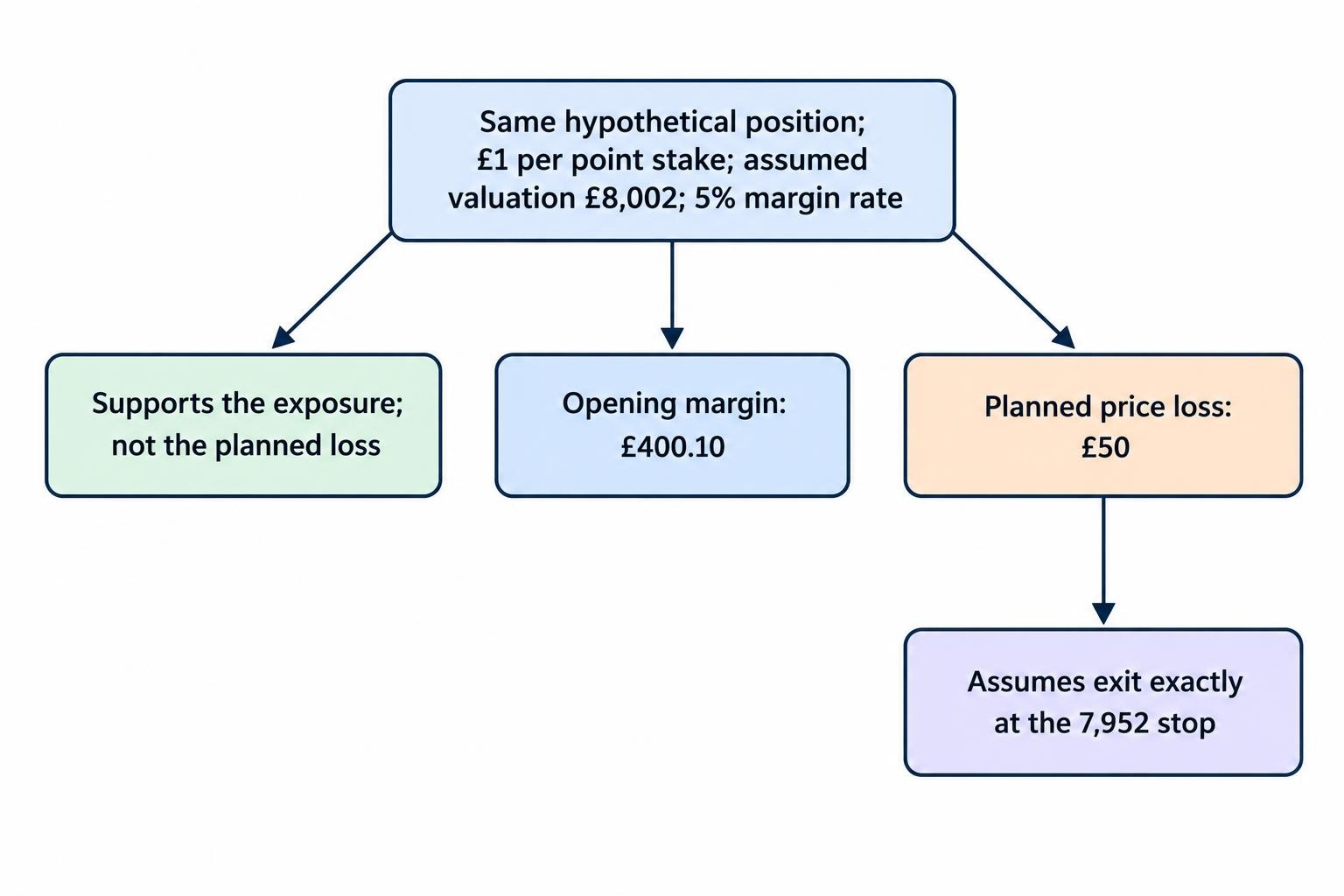
The platform will calculate the margin needed to open the position. Margin is money required to support the exposure; it is not the purchase price of an asset and it is not the planned loss.
For an illustrative index position valued at 8,002 with a £1 per point stake, assume exposure of £8,002. At an assumed 5% margin rate, the opening requirement would be £400.10. Use the live ticket’s actual calculation, since the contract terms and valuation basis determine the amount required.
UK retail rules set a 5% minimum opening margin for major stock market indices. They also require account-level close-out when net equity falls below 50% of the required margin, as soon as market conditions allow, and provide negative balance protection for covered trading accounts. These requirements appear in FCA Handbook COBS 22.5. Negative balance protection does not protect the account balance from trading losses.
The distinction matters: the example’s £400.10 margin requirement and £50 planned price loss answer different questions. The first concerns opening the position. The second concerns an assumed exit at the selected stop.
Leave a cash buffer rather than committing the account’s available funds to margin. Check how the platform calculates equity, used margin and available funds, especially if other positions are open. The spread betting margin guide explains those account figures.
Estimate costs for the intended holding period
Before submitting the order, check the spread, any stop premium and any funding or other contract charges that could apply. If you might hold overnight, identify the funding cutoff and how the adjustment is calculated.
Do not estimate financing by applying a rate only to the margin deposit. Check the contract’s stated calculation basis and the applicable charge or credit for your direction. Our guide to overnight financing costs covers the practical calculation questions.
If the expected cost makes the trade unattractive, change the plan or leave it alone. A position does not become cheaper because you ignore the charge until it appears on the statement.
7. Review the dealing ticket and submit once
Pause before confirming. Check the market name, contract, direction, stake, order type and attached exits against the written plan. Treat this as a short operational check, not a last opportunity to improvise.
| Field | Example setting |
|---|---|
| Market | Hypothetical UK 100 daily funded contract |
| Direction | Buy |
| Assumed execution price | 8,002 |
| Stake | £1 per point |
| Protective stop | 7,952 |
| Take-profit level | 8,102 |
| Planned price loss at the stop | £50, assuming execution exactly at 7,952 |
| Illustrative opening margin | £400.10 at the assumed valuation and 5% rate |
Submit the instruction once, then check its status. An order marked as received or pending is not necessarily an open position. Confirm the executed price, actual stake and whether both protective and profit orders are attached.
If the screen stalls, check the order history and open positions before clicking again. Repeated submissions can create an unintended duplicate position.
If the fill differs from the planned entry, reassess the distance to the stop and the resulting exposure. Do not assume that the figures calculated before execution remain unchanged.
8. Monitor the position and close it deliberately
Once the position is open, monitor the plan rather than every change in the running profit figure. Check that the stop remains active, that available funds are sufficient and that no relevant holding cutoff has been overlooked.
Review upcoming events that could affect the position, particularly if the plan would leave it open through a scheduled announcement or a market closure. Check the contract’s trading hours; do not assume you can close whenever a related market appears on a news screen.
Avoid widening the stop simply to postpone a loss. That increases the amount at risk after entry. Adding another position also increases exposure, even if its purpose is to improve the average entry price.
Use the position’s close control
To exit manually, use the platform’s close function for the position and confirm the quantity. Do not assume that placing a new trade in the opposite direction will always close the original one. Depending on the account settings, it may create a separate position.
For the example buy at 8,002, a close at a selling price of 8,062 produces a 60 point gain:
(8,062 − 8,002) × £1 = £60 before separate charges.
A close at 7,942 instead produces a £60 price loss. That also shows why a stop level and an actual exit price must not be confused. The profit and loss calculation guide covers both buying and selling positions.
After closing, verify that the position no longer appears as open. Check for any remaining pending orders and cancel those that no longer belong to the plan. Do not assume every associated instruction has disappeared automatically.
9. Reconcile the result and review the decision
Record the actual entry and exit prices, stake, charges and final profit or loss. Compare the dealing confirmation with the account history. If a figure differs from your calculation, establish why before placing another trade.
Keep the original plan alongside the outcome. A profitable trade can still involve an execution mistake or an unjustified increase in risk. A losing trade can follow the plan exactly. Judging the process only by whether the balance went up makes those differences easy to miss.
A short review should answer four questions:
- Did the entry meet the condition written before the trade?
- Was the stake consistent with the planned loss?
- Were the exits handled as intended?
- Did charges or execution differences change the result?
Use your spread betting account statements to reconcile the cash movements, not just the trade’s headline profit figure. This is especially useful when funding adjustments or other charges appear separately.
Before returning to the market, identify whether anything needs changing: the platform procedure, the cost estimate, the position size or the trading rule itself. Avoid changing all four after one result, because you will lose track of what you are evaluating.
The practical standard is straightforward: know what you are trading, calculate the exposure before entry, verify the instruction after execution and confirm that the position is closed. If any part of that process is unclear, return to the demo rather than paying to find out.