IG and City Index are worth comparing on three things: the markets you actually trade, the platform you want to use and the cost of holding your positions. IG deserves a closer look if ProRealTime forms part of your trading process. City Index deserves the same attention if you want its Web Trader platform or a spread betting account connected to TradingView. Neither earns an automatic win on price.
There is also a naming change to clear up. City Index’s UK business relaunched as StoneX Trading in September 2026. The announcement was issued on 9 September, with the City Index UK brand retiring on 12 September. Existing accounts, platforms and support services continued through the transition. The StoneX Trading rebranding announcement sets out those arrangements. This comparison uses “City Index” where it helps identify the business readers are searching for.
The assessment below compares published services and practical account requirements. It does not claim that either platform has been personally tested, or that one broker delivers faster execution or better fills without a matched execution study. Spread betting involves substantial risk, and choosing between two established providers does not remove that risk.
IG vs City Index: The Practical Differences
| Comparison point | IG | City Index, now StoneX Trading |
|---|---|---|
| Main reason to investigate | ProRealTime access alongside its own trading interface and other platform connections | Web Trader, mobile trading and direct TradingView spread betting access |
| Advertised market breadth | Its UK trading app description advertises spread betting and CFD access across more than 15,000 markets | The TradingView announcement confirming the StoneX Trading name describes more than 13,500 markets across the wider service |
| What market totals do not establish | Availability of every instrument on every account and platform | Availability of every instrument on every account and platform |
| Intraday cost comparison | Check executable spreads during your trading session | Check executable spreads during the same session |
| Overnight cost comparison | Use the spread betting funding terms for the chosen contract | Use the spread betting funding terms for the equivalent contract |
| Execution winner | Not established by this comparison | Not established by this comparison |
The market totals above describe advertised ranges, not a verified count of spread betting instruments available through every interface. Treat them as a starting point. A provider with thousands of additional contracts offers little extra value if both accounts already cover your five regular markets.
The more useful question is whether your preferred contract is available at an appropriate stake, with the orders you need, during the hours you trade. That is a much narrower comparison than “which broker has more markets?” It is also the one that affects your account.
Which Broker Is Cheaper?
There is no defensible blanket answer without choosing a market, stake, trading session and holding period. An index day trader and a share trader holding positions for several weeks can reach different answers using the same two brokers.
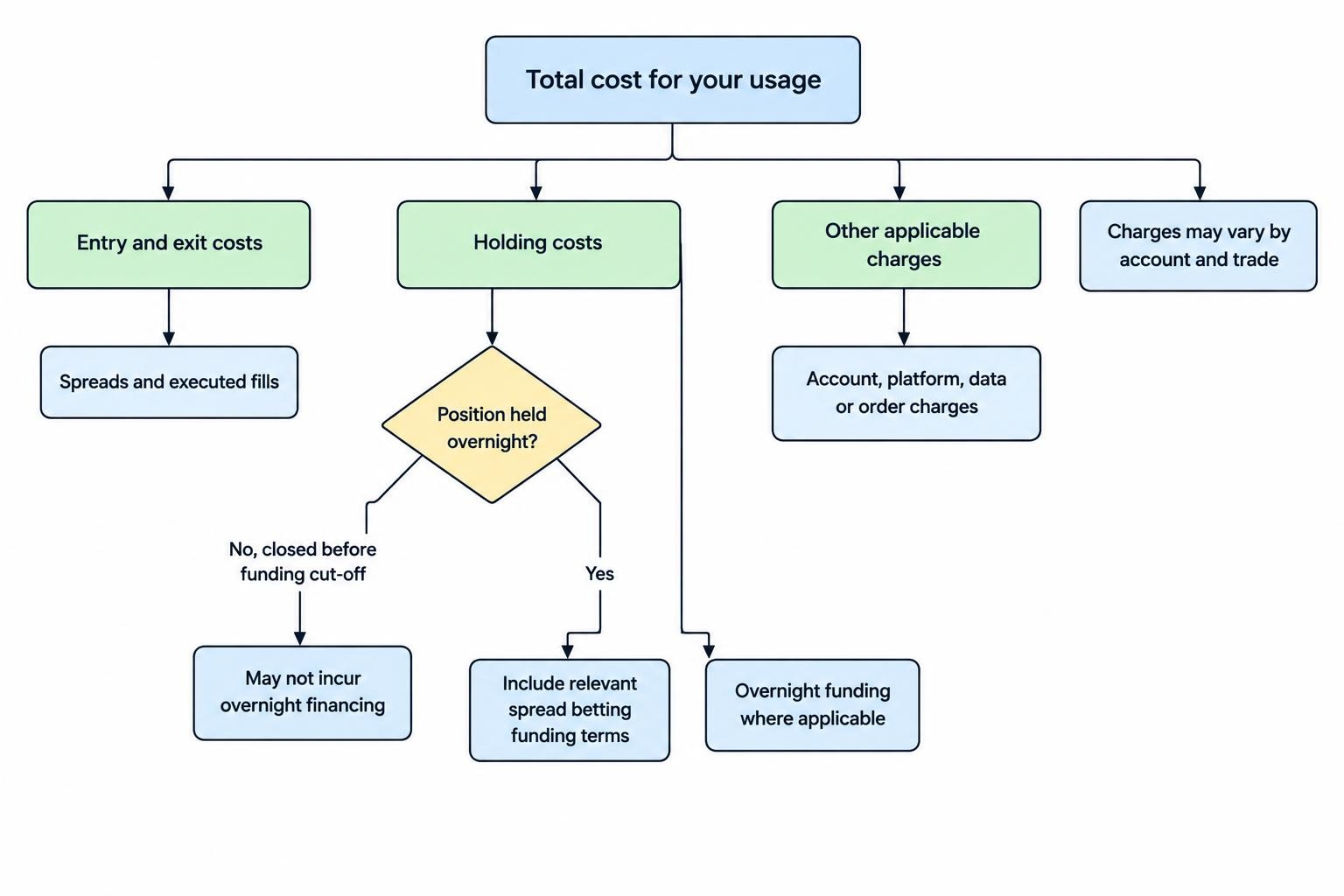
A proper comparison separates entry and exit costs from holding costs. It then adds any account, platform, data or order charges that apply to your usage. Our guide to comparing total spread betting costs covers that process across providers.
Compare Spreads at the Same Time
Record the buy and sell prices for the same underlying market on both platforms. Match the contract type as well: a cash index bet and a dated index bet are not interchangeable price samples. Repeat the check during the hours you expect to trade, rather than whenever you happen to open the comparison.
A published minimum spread describes a pricing floor under stated conditions. It does not establish your average transaction cost. A historical average also needs a measurement period and trading window before it becomes useful. Comparing one broker’s minimum with another broker’s average gives a neat table and an untidy answer.
Consider an illustrative comparison, not current IG or City Index prices. At a £2 per point stake, a one point spread represents £2 of spread cost under unchanged pricing. A 1.2 point spread represents £2.40. Across 40 otherwise identical round trips, that difference amounts to £16.
The saving is real within those assumptions, but so are the assumptions. Spreads can differ at entry and exit, and the fill can move away from the price you expected. Compare the complete trade, not just the number displayed before you click.
Execution Can Outweigh a Small Spread Difference
A broker quoting a fractionally tighter spread is not necessarily cheaper if your orders regularly receive worse fills. Equally, one disappointing trade does not establish poor execution. You need a record of requested prices, executed prices, order types and market conditions before drawing that conclusion.
For IG and City Index, this means avoiding unsupported claims that one is “best for scalping” simply because a headline spread looks attractive. Short holding periods make execution quality more important, not less. The mechanics of slippage in spread betting explain why the final fill belongs in the cost calculation.
Do not count the full spread twice automatically when estimating a round trip. With an unchanged market and unchanged spread, buying at the offer and selling at the bid produces one full spread of cost. Actual entry and exit conditions may differ, which is why completed trade records are preferable to a shortcut.
Overnight Funding: The Comparison That Changes the Result
If you close every position before its funding cut-off, overnight financing may not enter your normal cost calculation. If you hold daily funded bets for days or weeks, it can become more important than a small difference in the opening spread.
Compare the terms attached to the spread betting account itself. Do not copy a CFD funding figure into a spread betting calculation, or use an overseas account schedule for a UK account. Similar product names do not guarantee identical charges.
The useful inputs are the position’s economic exposure, the applicable benchmark or funding adjustment, the provider’s charge, the day-count basis and the number of funding days. Our explanation of overnight financing costs covers these inputs without treating one formula as suitable for every market.
Calculate Funding on Exposure, Not the Deposit
Take a hypothetical cash index at 8,000 with a £2 per point stake. The economic exposure is £16,000. If the position required 5% margin, the opening margin would be £800, but that does not make £800 the basis for the funding calculation.
At an illustrative annual financing rate of 7% and a 365-day basis, £16,000 of exposure costs about £3.07 per funding day. Thirty funding days would cost approximately £92.05. These are scenario figures, not an IG or City Index quote.
Now compare that amount with a few pence saved on the spread. For a longer holding period, getting the financing terms right can matter far more than winning the headline spread comparison. Before opening either account, calculate a representative position over your expected holding period.
Compare Cash Bets With Dated Contracts
A dated contract may provide a more suitable cost structure for some longer trades, but the absence of a separate daily financing debit does not mean financing has disappeared. Pricing, spreads, expiry and rollover arrangements still need checking.
Use equivalent contracts when comparing IG with City Index. If you also want to compare contract structures, assess that as a separate decision through our guide to daily funded bets versus futures spread bets. Otherwise, you risk attributing a contract difference to the broker.
Short positions need their own calculation. Do not assume that selling automatically earns an overnight credit. The applicable benchmark, provider adjustment and any borrowing cost can change the result.
Trading Platforms: Where IG and City Index Differ
Platform choice is one of the more useful reasons to favour one broker over another. The right interface should let you place and manage your normal trades without unnecessary steps. More indicators are not much help if changing a stop requires a small administrative expedition.
IG and ProRealTime
IG is worth investigating if ProRealTime is central to your analysis or trading process. The connection between the two services is established, but access and subscription conditions deserve attention. A Financial Ombudsman decision concerning IG’s ProRealTime subscription examined charges and qualifying trading conditions in 2024. That decision is historical evidence, not a current fee schedule.
Check the present subscription terms before enabling paid charting. Find out whether a refund depends on trade count, trade value or other conditions. “Available without a net subscription cost if conditions are met” is not the same promise as “free regardless of usage.”
There is no sense placing unnecessary trades to avoid a platform charge. Those trades introduce spreads, possible financing and market risk. If ProRealTime improves a process you already follow, include its expected net cost in the comparison. If it only looks impressive, start with the ordinary interface.
TradingView Connections
IG also has a TradingView connection, documented in TradingView’s announcement of its IG integration. That establishes the relationship, but an integration announcement should not be treated as a permanent promise that every account, instrument and order type is supported.
StoneX Trading’s current TradingView material expressly includes spread betting. For either provider, confirm that you can connect the intended spread betting account and trade the exact contracts you need. A CFD connection does not automatically answer a spread betting question.
Our guide to TradingView spread betting brokers examines this distinction. It matters because charting access, embedded TradingView charts and direct order execution from a TradingView account are three different arrangements.
Also check how you will manage the account if the connection fails. Know where to view open positions, amend orders and contact the broker outside TradingView. A third-party interface should not leave you dependent on one route into the account.
City Index Web Trader and Account Tools
City Index’s successor service provides Web Trader and Performance Analytics alongside its other interfaces. Those tools are worth examining if you prefer analysis, order entry and account review within the broker’s own platform.
Test the parts that affect actual decisions. Can you see your total exposure without opening several windows? Can you distinguish an entry order from an order attached to an existing position? Can you review trading results after charges rather than focusing only on gross winning trades?
Do not choose analytics because the charts look persuasive. Choose them if they help identify a repeatable problem, such as increasing stakes after losses or holding unsuccessful trades longer than planned. A useful account review changes behaviour; a colourful dashboard only changes the screen.
Do Not Assume MetaTrader Means Spread Betting
If MetaTrader is a requirement, ask an account-level question: “Can this UK spread betting account trade through this version of MetaTrader?” Asking whether a broker “offers MT4” is not enough. A separate MetaTrader account may have different products, credentials and instrument coverage.
Make the same distinction for automated trading. Establish where the strategy runs, what happens during a disconnection and whether its orders appear correctly in the broker’s own interface. Do not transfer assumptions from an existing CFD setup into a new spread betting account.
Mobile Trading: Compare the Jobs You Need to Complete
A mobile comparison should focus on order management rather than screenshots or app store scores. Check whether you can open a position, amend its stop, reduce its size and identify the remaining stake without ambiguity.
IG’s UK app description includes watchlists, price alerts, charting and risk management orders. City Index’s successor service also provides mobile access. That establishes available routes, not which app you will find easier to use.
Run the same task on each: locate a market, enter a proposed stake, inspect margin, add an exit order and review the confirmation. Then cancel an unfilled order and check that it has actually disappeared from the working order list.
Our comparison of mobile spread betting apps covers the wider selection. Between IG and City Index, the deciding factor should be whether the app supports your normal workflow clearly, especially when you are managing rather than opening a trade.
Separate an app alert from an order held by the broker. An alert asks you to act; an accepted stop order is an instruction to the provider. Treating the two as interchangeable can leave a position exposed when your phone has no connection.
Market Coverage: Check Your Watchlist, Not the Headline Total
Both services advertise broad market ranges. However, a large total can combine shares, indices, currency pairs, commodities and several contracts referencing the same underlying market. It does not tell you whether your preferred instrument is available at a suitable stake.
For an index trader, check the cash and dated contracts separately. For a share trader, check the actual company, short availability, minimum position size and relevant trading hours. For a currency trader, confirm what the provider counts as one point before comparing stakes.
Build a short list of the markets you expect to trade over the next few months. Against each provider, record availability, minimum stake, normal spread, funding treatment and supported exit orders. That small worksheet is more useful than comparing two large marketing totals.
Our broker market coverage guide provides a broader framework. For this decision, an absent contract can rule a broker out immediately; an extra thousand unused contracts should not automatically rule it in.
Trading hours deserve the same care. Access outside an underlying exchange’s main session does not establish that liquidity, spreads or available order sizes will match the main session. Compare the periods you intend to use.
Stops, Guaranteed Stops and Position Size
Risk controls belong near the top of this comparison, particularly if you hold positions through company announcements or market closures. Both services publish guaranteed stop offerings, but that does not establish universal availability across every market and platform.
Check the instrument’s order ticket. Establish whether a guaranteed stop is offered, the minimum distance, the premium and the conditions for changing it. Then confirm that the same arrangement works through your intended interface, not just through a different platform offered by the broker.
The financial effect of those charges is covered in our guide to guaranteed stop premiums. Include the premium in the trade assessment where applicable rather than treating protection as an incidental extra.
A Standard Stop Is Not a Guaranteed Exit Price
A standard stop can execute beyond its trigger during a gap or fast move. A guaranteed stop is intended to protect the agreed exit level under the provider’s contractual terms. Neither should be confused with a guarantee that the trade will be profitable or suitable.
When comparing IG and City Index, inspect the complete order arrangement: entry price, stop distance, stake, potential premium and any restrictions on amendments. A tighter minimum stop distance is not automatically better if it encourages a position size that is too large.
Minimum Stake Can Decide the Account Choice
Suppose your planned price risk is £100 and the stop needs to sit 50 points from entry. The corresponding stake is £2 per point before other costs. If a contract’s minimum stake were £5 per point, that same stop distance would imply £250 of price risk.
Adding more money does not repair that mismatch. Neither does moving the stop closer simply to make the arithmetic fit. You need an appropriate contract, an appropriate stake or no trade.
Our guide to position sizing for spread betting covers the calculation. For IG versus City Index, check minimum stakes on the actual instruments you need rather than assuming an advertised account minimum settles the question.
Regulation and Protection: Compare the Legal Account
A broker’s brand and the company holding your account are related, but they are not the same identifier. IG’s UK spread betting business is associated with IG Index Limited. The group’s 2025 base prospectus filed in the FCA’s National Storage Mechanism identifies IG Index Limited among its authorised UK entities.
City Index’s UK business operates through StoneX Financial Ltd. The company’s use of the City Index trading name also appears in a Financial Ombudsman decision concerning StoneX Financial Ltd trading as City Index. The subsequent StoneX Trading branding does not remove the need to check the contracting company.
Before funding either account, match the legal name in the agreement with the regulatory record, contact details and permissions. Our guide to checking a broker on the FCA Register explains the process. Do not rely on a logo or a registration number copied into an unsolicited message.
Retail Protections Are Not a Brand Advantage
The FCA’s retail restrictions cover financial spread bets and include asset-dependent leverage caps, account-level margin close-out protection and negative balance protection. The rules require close-out when account funds fall to 50% of the required margin and protect clients from losing more than the funds in the relevant account. These requirements are set out in the FCA’s permanent restrictions on retail CFD products, including financial spread bets.
Those protections do not prevent you from losing the money in the account. They also do not make the margin deposit a sensible measure of trade risk. A position can satisfy an opening margin requirement and still be much too large for your finances.
Keep client classification consistent when comparing providers. A professional account and a retail account are not equivalent offers. More borrowing capacity should not be scored as an improvement without assessing the protections and obligations attached to it.
FSCS Protection Does Not Cover Unsuccessful Trading
Eligible investment claims can qualify for compensation of up to £85,000 per person, per firm, subject to the scheme’s conditions. Protection can apply where an authorised provider fails and there is a qualifying shortfall; it does not reimburse poor investment performance. The FSCS investment protection rules explain that distinction.
Do not describe an IG or City Index balance as automatically insured against every possible loss. Our guide to FSCS protection and spread betting separates firm failure from ordinary trading losses. The legal entity and claim circumstances matter more than the brand name.
Deposits, Withdrawals and Demo Accounts
Distinguish the amount needed to open an account, the minimum payment accepted by a funding method and the capital needed to trade responsibly. Those are three different figures. A low account-opening threshold does not establish that your intended strategy is practical at that balance.
Before transferring money, check the current payment terms for the exact account. Confirm accepted funding methods, payment ownership requirements, withdrawal procedures and any charges. Do not assume that an offer attached to an investing account also applies to spread betting.
Withdrawal speed should not be ranked from an unsupported promise or a single customer comment. Processing can involve broker checks, banking schedules and the payment method. This comparison does not claim a measured withdrawal-speed winner.
Use a demo to assess the interface before judging either provider. Our guide to spread betting demo accounts explains what simulated trading can and cannot establish.
A demo can show whether you understand stake entry, margin displays, working orders and position closure. It cannot prove future live fills, withdrawal reliability or how you will react when money is at risk. Treat it as an operational rehearsal, not a certificate of trading ability.
Does Tax Treatment Favour IG or City Index?
For an individual placing genuine financial spread bets within the ordinary UK treatment, tax is generally not a reason to prefer one provider over the other. HMRC states that financial spread betting does not give rise to chargeable gains or allowable capital losses in its guidance on financial spread betting and Capital Gains Tax.
The absence of allowable capital losses matters alongside the treatment of winnings. Do not compare a profitable spread bet with another product while ignoring what happens if the position loses.
Our guide to whether spread betting is tax-free covers circumstances requiring closer attention. Account eligibility and tax residence also need checking; a UK-focused comparison should not be read as confirming access or tax treatment for a US resident or someone living elsewhere.
Which Broker Fits Your Trading Style?
For Intraday Index Trading
Start with executable spreads during your session, suitable minimum stakes and clear order management. Compare the same index contract on IG and City Index while the relevant underlying market is active.
If your method involves frequent entries and exits, small cost differences accumulate. However, do not promote a minimum spread into an execution-quality verdict. Traders following an intraday spread betting approach should assess completed trade costs and platform behaviour together.
For Positions Held Several Days
Put financing, contract choice and gap exposure ahead of minor interface preferences. Calculate a representative holding period, including the relevant funding calendar, before deciding which account is cheaper.
For a swing trading approach, also check whether the exit orders you need remain available on the chosen contract. A small spread advantage at entry can be overwhelmed by holding costs or an unsuitable order arrangement.
For Platform-Led Traders
IG is a logical candidate if ProRealTime is a firm requirement, provided the current access conditions and costs suit your usage. City Index’s successor service is a logical candidate if you prefer its Web Trader workflow or want its explicitly supported TradingView spread betting connection.
Neither preference establishes an exclusive advantage across every platform. Make the decision around the account and tools you will actually use. Paying for extra capability that never enters your process is still paying for extra capability.
How to Make the Final Choice
Reduce the comparison to a representative trade rather than an abstract broker score. Before funding either account, complete these checks:
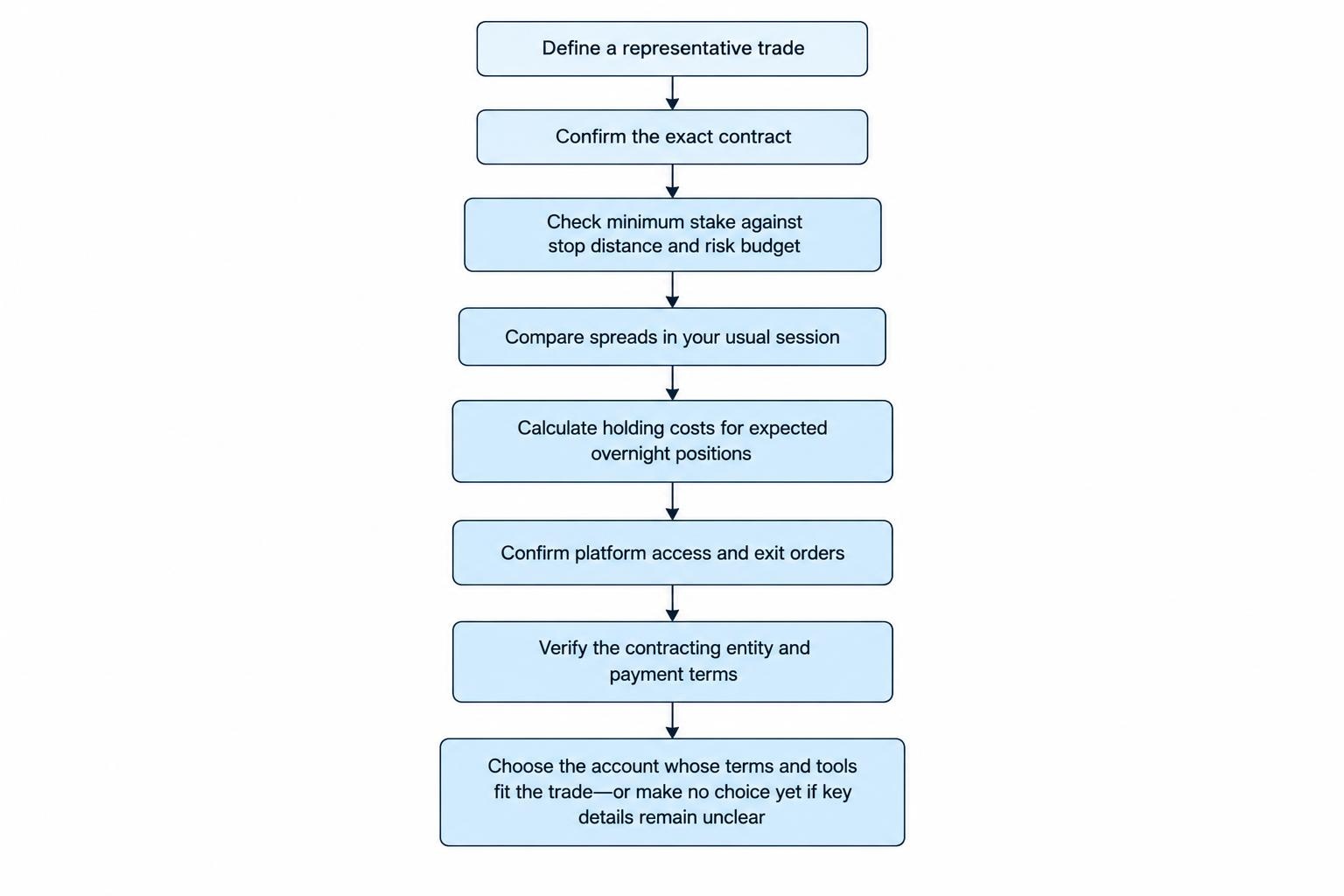
- Find your regular markets and confirm the exact spread betting contracts available.
- Check that the minimum stakes fit your planned stop distances and risk budget.
- Record equivalent spreads during your normal trading session.
- Calculate holding costs for the positions you expect to keep overnight.
- Confirm platform access, exit orders and any subscription conditions.
- Verify the contracting entity and current payment arrangements.
Choose IG if its platform options solve a clear requirement and the costs work for your trades. Choose City Index, now StoneX Trading, if its interface, account tools and contract terms fit better. If the answers remain close, there is no need to manufacture a winner: clarity of use and a sensible position size are better tie-breakers than an extra badge on a comparison table.
For alternatives, use our wider spread betting broker comparisons. Keep the same test across every provider: the right contract, at the right stake, with costs and account terms you understand before placing the trade.