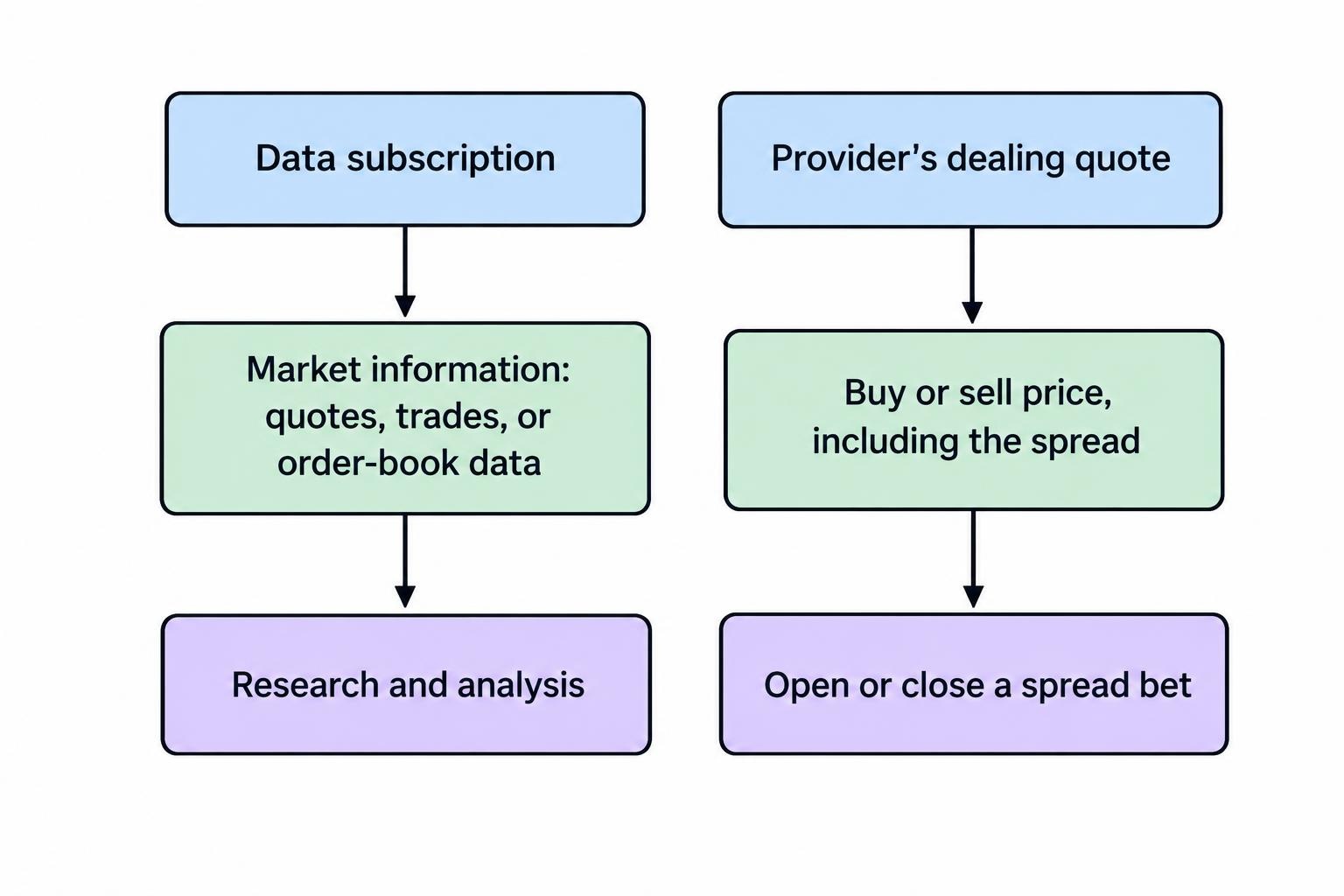
Market data fees are charges for access to price information, such as live exchange quotes or order book data. In spread betting, distinguish between the provider’s dealing price, which you use to place a bet, and any separate data package you subscribe to for research or analysis.
There is no single market data charge that applies to every spread betting account. Before activating a feed, check what it includes, how billing works and whether you actually need it. Treat subscriptions as part of your spread betting costs, rather than an incidental platform expense.
What Do Market Data Fees Pay For?
A data subscription buys access to information, not a better execution price or a narrower spread. Depending on the package, that information might include current bids and offers, completed trades, trading volumes or orders resting at different prices.
Exchange licensing costs can apply even where the customer trades a derivative rather than the underlying shares or futures. Deutsche Börse’s market data licensing terms expressly cover the use of real-time data to calculate and provide spread betting prices. These are contractual charges for the licensed business; they do not establish what an individual spread bettor must pay.
Your own bill depends on the account’s fee schedule. Check whether the provider includes the information you need, charges separately for it or requires an additional subscription through your charting service.
Also separate the underlying market price from the provider’s quote. A last traded share price is not necessarily a price at which you can open or close a spread bet. The provider’s buy and sell prices, including the spread on the bet, remain relevant to the transaction.
Live Prices, Delayed Data and Market Depth
Delayed Data
Delayed data shows earlier market activity rather than current prices. London Stock Exchange’s delayed data terms specify publication 15 minutes after the information was initially released. Do not assume every feed uses the same delay: read its label and check the timestamp.
Earlier prices can support background research, but they are not a substitute for checking the current dealing quote before submitting an order. A chart can look perfectly orderly while showing a market that has already moved.
Level 1 and Level 2 Data
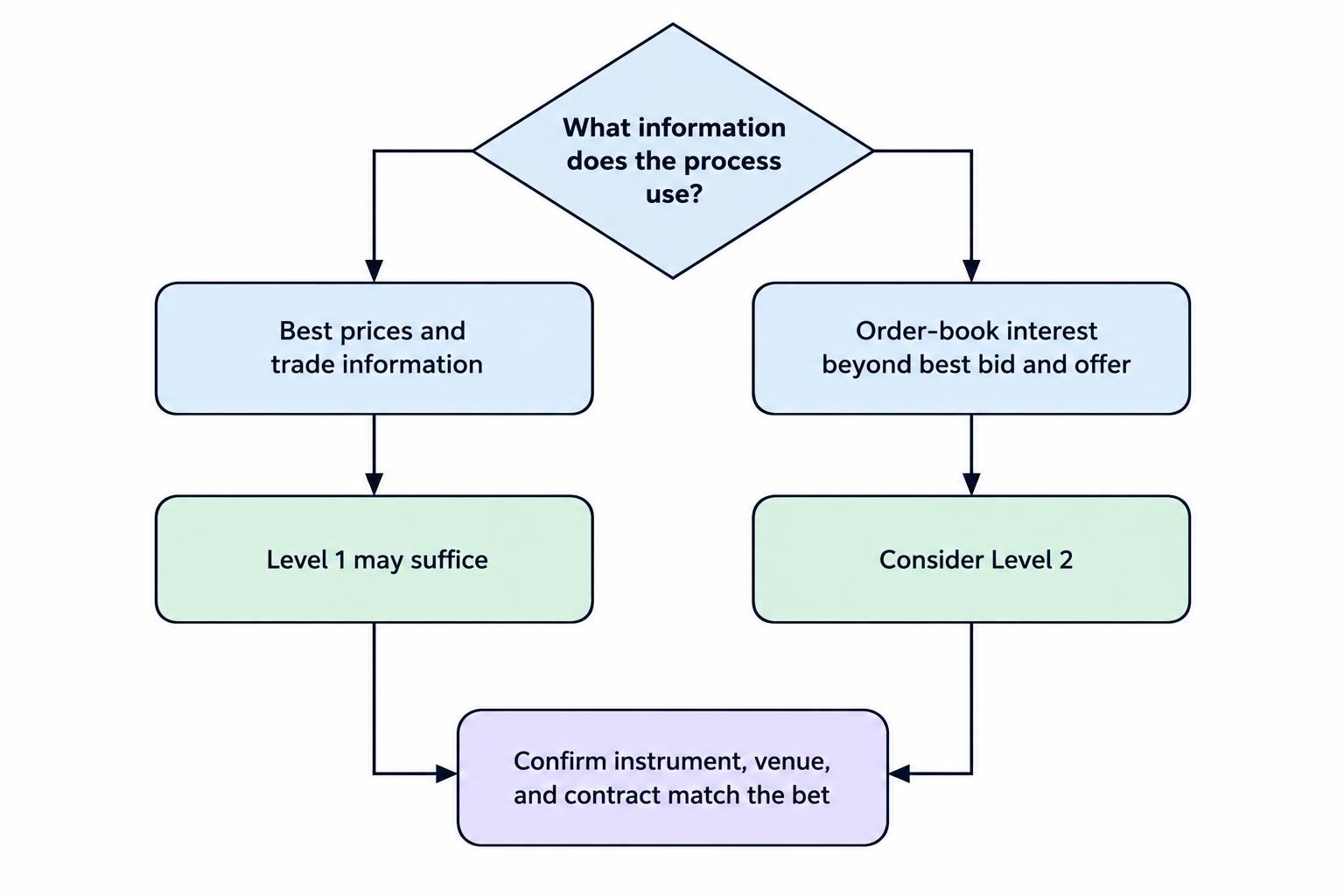
Level 1 generally focuses on the best available prices and trade information. Level 2 adds order book depth, showing interest at prices beyond the best bid and offer. The London Stock Exchange data service descriptions distinguish Level 1 best prices and trade reporting from Level 2 full order book depth.
Choose between them by asking what the extra information changes in your process. If your strategy does not use order book depth, a Level 2 subscription needs another justification. More numbers on the screen do not automatically mean better decisions.
Check coverage too. A live share feed, an index value and a futures quote are different products. Confirm the instrument, trading venue and contract before using one feed to analyse a bet priced from another.
How Market Data Charges Are Calculated
Data pricing can depend on the information product, subscriber category and method of access. Deutsche Börse’s market data price list effective from 1 August 2026 includes monthly access-based charges and individual price quote charging arrangements. Again, an exchange tariff is not a quote for your spread betting account.
Read the provider’s subscription terms rather than applying an exchange price directly. Establish whether the charge covers a calendar month or a rolling billing period, and whether activating a package partway through a month triggers the full fee.
Ask what starts the charge: enabling access, requesting quotes or another event. Do not assume that making no trades means paying no data fees. Also check whether mobile access, desktop software and a separate charting platform fall under the same subscription.
For equity trading, put the required feeds alongside other share spread betting costs. Comparing spreads alone leaves out a recurring charge that may matter more when you trade infrequently.
Professional and Nonprofessional Data Status
An exchange’s subscriber classification deserves attention. It is not simply a question of whether you describe yourself as an amateur or earn your living from trading.
The NYSE nonprofessional subscriber policy requires personal, non-business use by a natural person who does not meet its securities professional criteria. It also requires the distributor to verify eligibility. Trading your own money is therefore not, by itself, a complete eligibility test.
Do not confuse a market data declaration with your broker’s retail or professional client classification. They answer different questions. Complete the relevant declaration accurately and ask the provider to confirm the applicable category if your employment, account ownership or use of the data creates uncertainty.
A Worked Example of the Cost
Suppose you subscribe to two data packages costing £12 and £8 per month. These are hypothetical charges, not advertised rates. Assume both subscriptions remain active throughout the month, with no rebates or other charges.
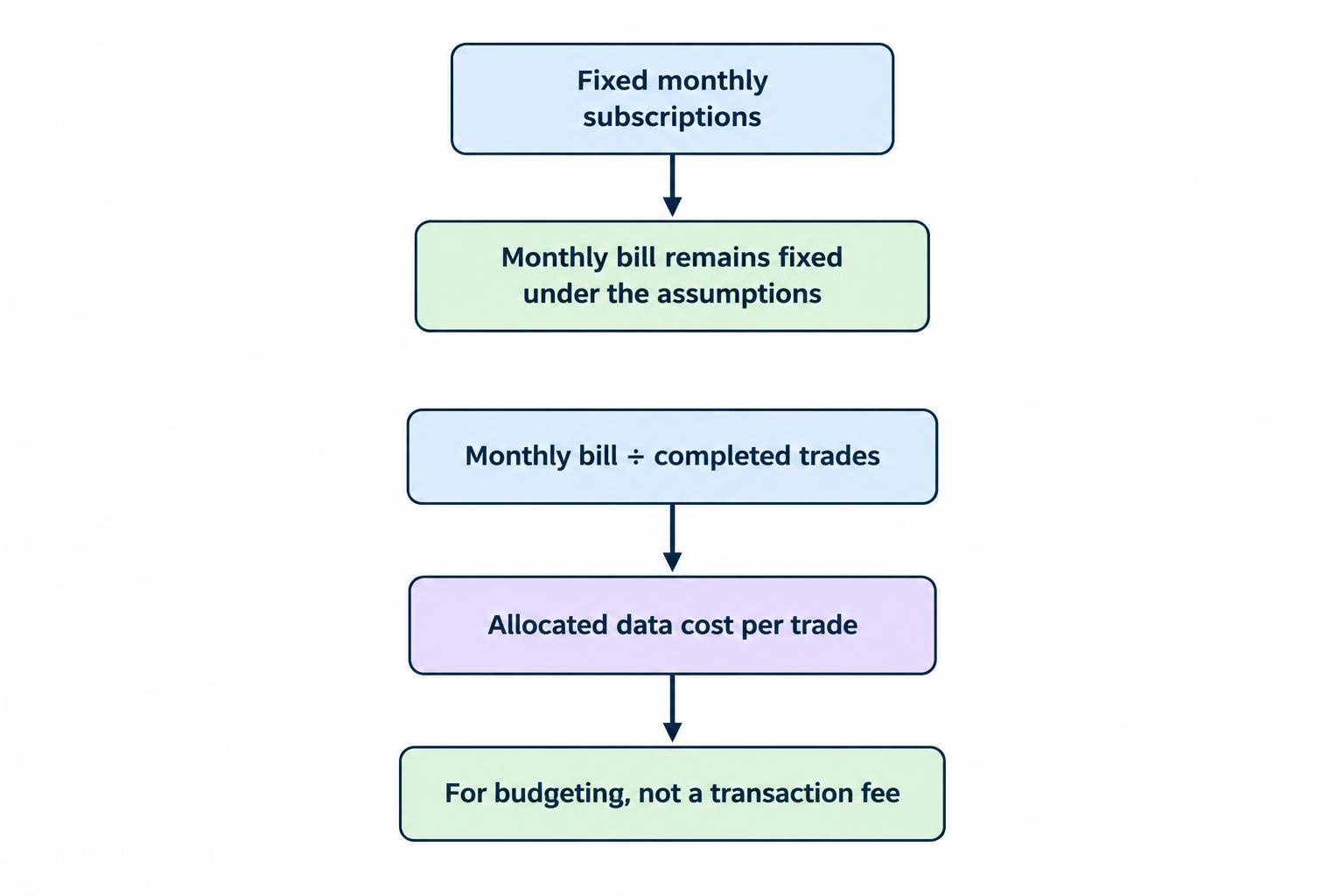
The combined subscription costs £20 each month, or £240 over 12 months. Dividing that fixed expense by completed trades shows its accounting impact:
| Completed trades per month | Monthly data cost | Allocated data cost per trade |
|---|---|---|
| 4 | £20 | £5 |
| 10 | £20 | £2 |
| 20 | £20 | £1 |
Here, a completed trade means an opening and closing transaction counted together. The allocation does not turn a subscription into a transaction fee: the monthly bill remains £20 under the assumptions above.
This is a budgeting calculation, not a reason to increase trading frequency. Account for subscriptions separately when reviewing net results, rather than assuming that a position’s displayed profit or loss includes them.
Fee Waivers and Rebates
If a provider offers a data fee waiver, read the qualifying conditions before treating the subscription as free. Check which transactions qualify, whether the threshold applies separately to each feed and whether the benefit is an upfront waiver or a later credit.
Base the calculation on activity you already intend to undertake. Suppose one unnecessary trade would cost £9 in spreads and other charges, while securing an £8 data rebate. Even before any trading loss, that leaves you £1 worse off.
A rebate should reduce the cost of planned activity, not become a trading target.
What to Check Before Subscribing
Use the subscription screen and current fee schedule to answer these questions:
- Coverage: Does the package include the instruments and venues you need?
- Timing: Is the information live, delayed or supplied only when requested?
- Billing: What starts the charge, when does it renew, and are partial months charged in full?
- Final price: What currency is billed, and are any applicable taxes or conversion charges included?
- Cancellation: How do you stop renewal, and when does cancellation take effect?
Check for duplicate subscriptions before adding another feed. If you already pay for data through a separate analysis platform, establish whether the proposed package supplies anything you lack. Do not assume a paid software plan includes every exchange entitlement.
Retain the activation terms and cancellation confirmation, then review the charges on your account statement. Include the feeds you actually need when comparing total spread betting costs. The sensible choice is sufficient data for your process at a justified cost, not the largest package available.