A professional spread bettor does not automatically pay UK tax on personal betting profits. For an individual placing genuine spread bets on their own account, the normal position is no tax on winnings and no relief for losses. That starting point appears in HMRC’s guidance on betting and gambling.
The word “professional” causes much of the confusion. It can describe someone who trades full time, a broker’s client classification, or an activity that constitutes a trade for tax purposes. These are different questions.
This article covers UK tax considerations for individuals who spread bet professionally or intend to stop working and trade for themselves. It does not assume that a company, a funded trading arrangement or a business hedge receives the same treatment. For the wider subject, see our UK spread betting tax guide. Personal circumstances and contractual terms can change the answer, so obtain advice before relying on a tax treatment for substantial sums.
What Does “Professional Trader” Mean for Tax?
Start by separating the description of your working life from the legal character of your receipts. Calling yourself a professional trader tells an accountant something about how you spend your time. It does not tell them what contracts you enter into, whose money you use or why someone pays you.
| Meaning of professional | What it describes | Tax question to investigate |
|---|---|---|
| Full-time spread bettor | Someone who devotes their working time to personal spread betting. | Are the receipts personal betting winnings, or do they arise from another activity? |
| Professional client | A regulatory classification applied by a financial services firm. | What is the tax treatment of the underlying transactions, regardless of the account label? |
| Person carrying on a taxable trade | An activity assessed under tax law and the relevant facts. | Do the spread betting receipts arise from carrying on that trade? |
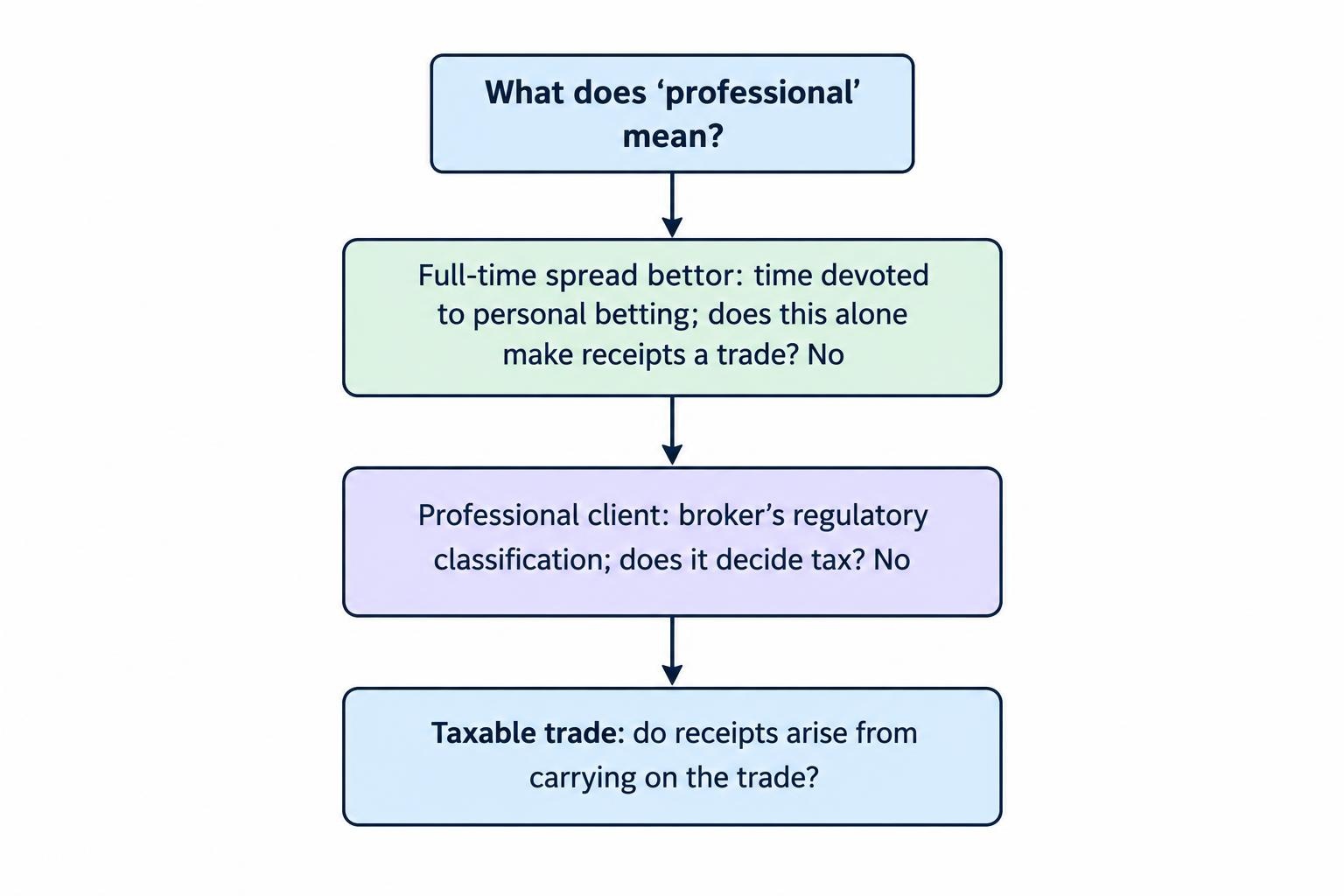
A broker’s classification follows regulatory rules. The FCA professional client rules in COBS 3.5 cover assessments of expertise, experience and knowledge, alongside applicable eligibility tests and written procedures. They also require warnings about protections and compensation rights a client may lose.
That process is not an HMRC ruling. Being accepted as a professional client does not, by itself, establish that your winnings are taxable. Remaining a retail client does not settle the tax question either.
Keep the decisions separate: assess the regulatory consequences through our guide to retail versus professional client classification, then assess tax by examining the transactions and the activity producing the receipts.
Does Spread Betting Become Taxable If It Is Your Only Income?
Earning your living from betting does not, on its own, turn the activity into a trade. Having expertise or a systematic method is not enough either. These distinctions are explicit in HMRC’s guidance on the professional gambler.
This matters because “main income” is often used as an informal dividing line. It is not a substitute for examining the activity. Someone who leaves employment needs a tax assessment of what they actually do, not an assumption that their first Monday without a salary changes every subsequent bet.
Consider a hypothetical individual who uses personal savings to place spread bets, has no customers and receives no payment for services. They spend several hours a day researching markets and withdraw money to meet household bills. Those facts describe a serious personal betting activity; the time commitment and dependence on the proceeds do not, by themselves, establish a taxable trade.
For a review of that situation, bring the account agreement and transaction statements rather than just an annual profit figure. A £60,000 balance increase tells an adviser how much money was made. It does not establish the legal reason the money was received.
Likewise, do not treat a monthly transfer from the betting account as proof that you receive a salary. Describe it accurately as a withdrawal, then investigate the underlying receipts. Our guide to spread betting and Income Tax covers that distinction in more detail.
The Tax Test: What Produced the Winnings?
The central exception concerns the relationship between a bet and a trade. Taxable winnings must arise from carrying on the trade, rather than simply from an opportunity that the trade presented. The contract terms and the economic substance of the arrangement determine the assessment. This is the test set out in HMRC’s spread betting guidance in BIM22020.
In practical terms, look beyond the trading screen. Identify the parties to the contract, who bears the loss, who receives the settlement and whether the position serves another commercial activity. A familiar market name does not answer any of those questions.
Prepare a short description of the arrangement before asking for advice. “I trade the FTSE” is too vague. “I place spread bets in my own name using personal capital, and the broker settles the bets with me” is much more useful. If a company funds the account, a customer pays you or the position offsets a business liability, include that too.
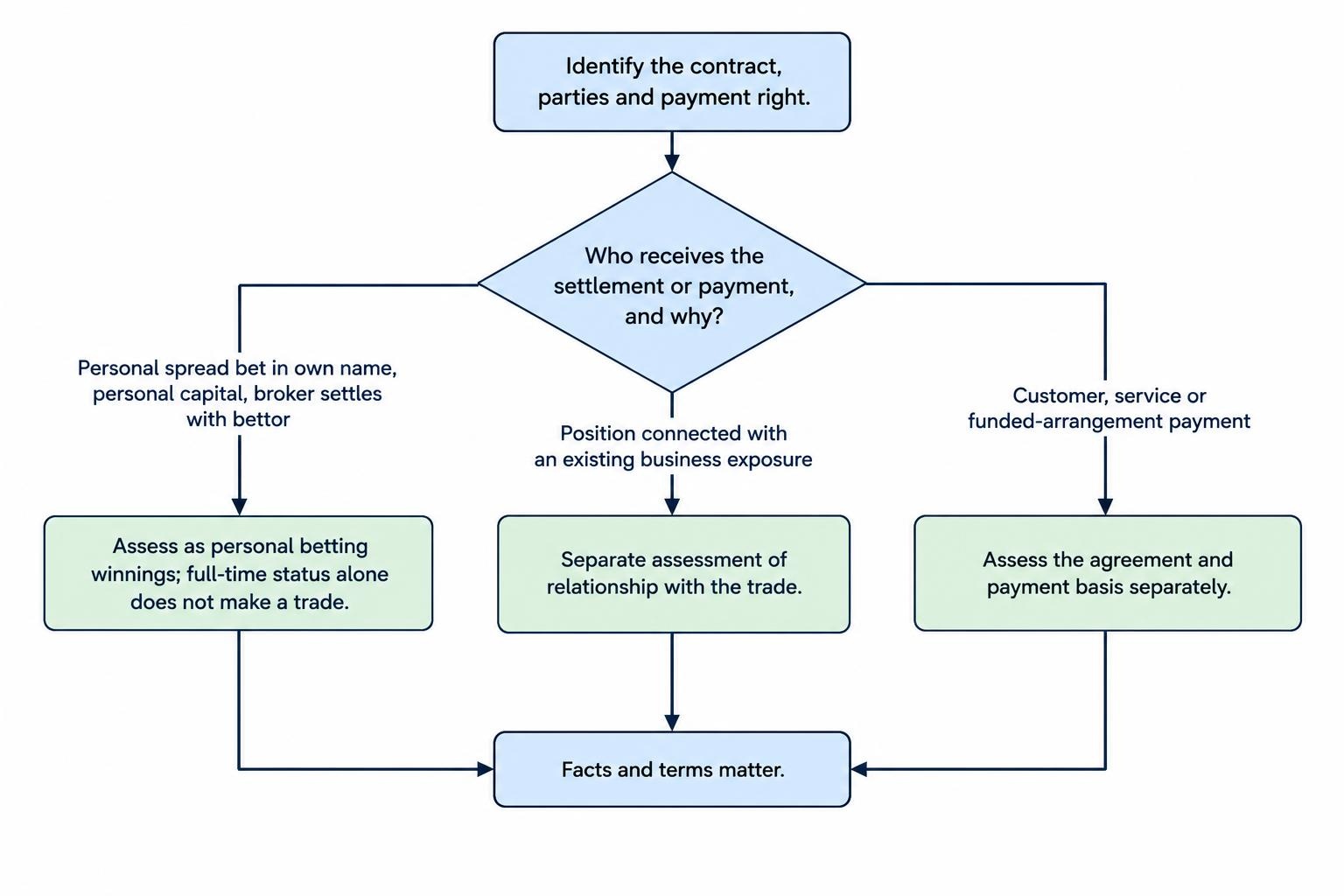
Do not try to resolve the issue by counting monitors, trading hours or spreadsheet tabs. Organisation helps explain your process, but it cannot replace analysis of the contracts and receipts. The wider boundary is covered in our guide to spread betting as a business.
Business Hedging Needs a Separate Assessment
A bet can form part of an existing trade. One example is a position used to hedge interest on a business loan, which appears in HMRC’s guidance on betting within an existing trade. That is a different setting from an individual betting on market direction for personal gain.
If a position is intended to offset a commercial exposure, give your adviser the documents for both sides: the spread bet and the loan, transaction or liability it relates to. Explain why the position was opened, how its size was chosen and what business risk it was intended to address.
A label such as “hedge” is not enough on its own. Avoid assuming that every protective position has the same tax consequences, particularly where personal investments and business exposures overlap. See our separate guide to hedging with spread bets and tax.
Capital Gains Tax and Losses Are Separate Questions
Betting winnings are excluded from chargeable gains by section 51 of the Taxation of Chargeable Gains Act 1992. This is not simply an exemption for people whose profits fall below an annual allowance.
However, a Capital Gains Tax answer does not dispose of every possible Income Tax question. Keep the two analyses separate: establish whether the receipt is a betting winning, then consider whether the connection with a trade changes its treatment.
For ordinary personal spread betting, the absence of tax on profits comes with the absence of loss relief. You cannot treat losing personal bets as deductible trading losses simply because you describe yourself as professional. Nor can you elect to treat the activity as a taxable business only in a losing year.
Suppose personal spread bets produce a £12,000 loss. Do not enter that amount as a deduction against salary or other income without a proper basis. The fact that the loss consumed money previously earned from employment does not make it an employment expense.
The same discipline applies to data subscriptions, charting packages and equipment. Paying for a professional setup is not evidence, by itself, that the underlying betting constitutes a trade or that the expenditure is deductible.
Keep a distinction between the cash cost of your activity and any tax relief available. Our guide to the tax treatment of spread betting losses examines the loss side without assuming that every trading expense belongs on a tax return.
Separate Personal Bets from Other Trading-Related Receipts
A professional market participant may receive money under several arrangements. Do not put everything into one “trading income” category before checking what each payment represents.
Training, Subscriptions and Other Services
HMRC’s professional gambler guidance distinguishes gambling from providing services to a customer for payment, using television appearance fees as an example. The wider relationship between service income and gambling winnings depends on the facts.
Apply that distinction when preparing information about a trading education business, research subscription or paid speaking work. A customer’s payment for a lesson is not the settlement of your personal spread bet. Keep the customer contract, invoice and receipt separate from your broker statements.
If you demonstrate live trades during paid sessions, explain that arrangement fully to your adviser. Include who owns the account, what customers purchase and whether any payment depends on the trading result. Do not assume that either the fees or the bets automatically determine the treatment of the other.
Funded Trading and Profit-Sharing Arrangements
For a funded account or proprietary trading arrangement, inspect the agreement rather than relying on the phrase “profit split”. Ask who contracts with whom, who owns any account and what gives you a right to payment.
Provide the adviser with the evaluation terms, payout agreement and any later amendments. Identify whether the arrangement involves actual positions, simulated results or payment for an activity you perform. Those are questions to resolve, not details to leave until after a large payout.
Do not describe a payment as personal spread betting winnings unless the contractual facts support that description. The word “trader” on a dashboard is not a tax analysis.
CFDs, Shares and Other Accounts
Check the legal product held in each account. Two screens may display the same index and offer similar exposure while the account agreements describe different instruments.
For an annual review, separate spread betting statements from CFD, share dealing, futures and options records. Ask for each category to be assessed rather than applying one conclusion to the combined result.
This is particularly useful after changing brokers or opening another account with an existing provider. Verify the account type before moving figures into a spreadsheet. Our guide to spread betting versus CFD tax treatment covers the product distinction.
Does Trading Through a Company Change the Position?
A company needs its own tax analysis. A financial spread bet entered into by a company is also a contract for differences for the corporate rules, and its character as a wager does not, by itself, prevent the corporate derivative contracts regime from applying. This distinction appears in HMRC’s guidance on companies and financial spread bets.
Do not therefore assume that incorporating preserves the personal tax treatment. Equally, do not confuse owning a company with the company being the party to a spread bet.
Before opening or funding a corporate account, establish whose name appears on the agreement and who holds the contractual rights and liabilities. Give the accountant the proposed funding arrangements as well as the product documents.
If you already have a company for consulting or education work, avoid moving money between it and a personal betting account without documenting the reason and obtaining advice. Keep the assessment of company activity separate from the assessment of personal bets.
Our guide to spread betting through a company addresses that structure. Incorporation should follow a reasoned review, not a decision that a successful trader ought to have a company.
What Records Should a Professional Spread Bettor Keep?
Maintain a file that lets someone reconstruct the arrangement without relying on your memory. The aim is not to make personal betting look more commercial. It is to show what happened and support the classification you have adopted.
Start with the account opening documents and the terms governing the product. Save the versions relevant to the period being reviewed, particularly if the provider changes its agreement or moves your account to another legal entity.
Next, retain transaction statements and a reconciliation of money moving into and out of the account. Separate deposits, withdrawals, trading results and account charges. A bank statement alone does not explain the activity inside the account.
- Account evidence: the named account holder, product agreement and relevant terms.
- Transaction evidence: statements showing positions, settlements, adjustments and charges.
- Funding evidence: records identifying deposits, withdrawals and the origin of funds.
- Related arrangements: customer agreements, funded trading contracts or business exposures connected with positions.
- Advice and decisions: written tax advice, the facts supplied and any changes requiring another review.
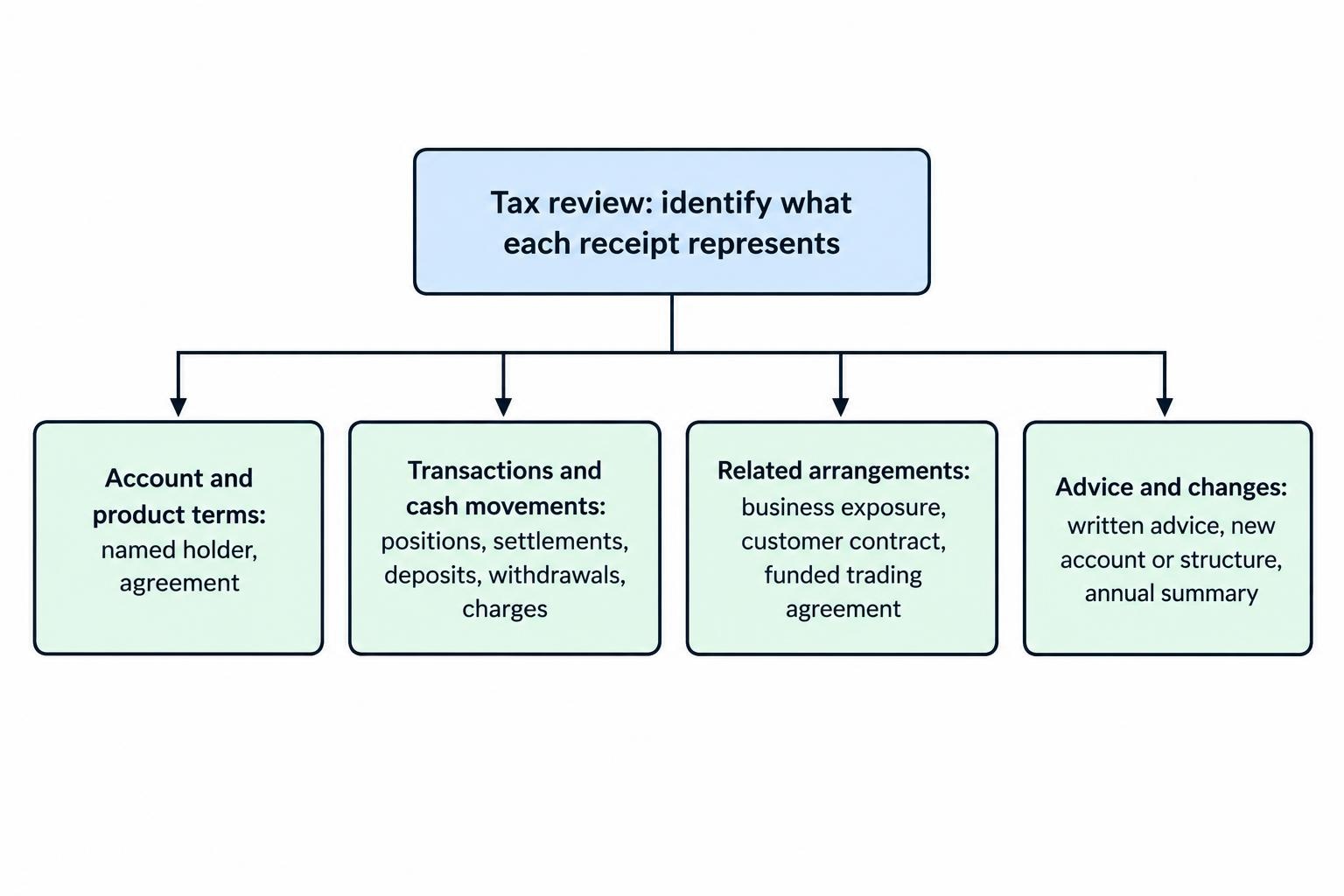
Keep the records proportionate but complete. A lengthy trading diary is no substitute for a missing contract. Conversely, a contract does not explain an undocumented transfer from a business account.
Create a short annual summary of changes: a new account, a move abroad, a paid subscription service, a corporate structure or a new funding arrangement. Give that summary to the adviser alongside the figures, rather than assuming last year’s answer still covers everything.
Our spread betting record keeping guide develops the practical record system. For tax review purposes, favour documents that identify legal rights and actual cash movements over screenshots of headline returns.
How to Review Your Position Before Filing
Ask for advice about the activity first and the tax return entries second. Beginning with “Which box should this profit go in?” risks skipping the question that determines whether it belongs there at all.
Prepare a one-page factual summary. State where you live, which person or entity owns each account, what products you use, how the accounts are funded and whether you receive money from customers or other trading firms. Attach the relevant agreements.
Then ask the adviser to address the issues separately: personal betting winnings, any relationship with an existing trade, other payments received and any company activity. Request an explanation of the assumptions behind the answer, not just a sentence saying that spread betting is tax-free.
If you already file Self Assessment, ask whether the circumstances warrant an explanatory note and how any other receipts should be presented. Do not automatically insert personal betting results into business accounts because you spend your working day trading. Equally, do not omit a payment for services because it came from a trading-related activity.
Review previous treatment if your records were prepared on a different assumption. Give the adviser the earlier returns and the facts that applied at the time. Avoid trying to repair a classification problem by renaming transactions in the current spreadsheet.
Written advice is most useful when it identifies what would change the answer. Ask whether you should return for another review before introducing company money, accepting customer payments, entering a funded arrangement or connecting bets with business exposures.
Before Relying on Spread Betting for Your Living
Resolve the tax classification before building a household budget around it. Present the proposed arrangement, not just a description of the lifestyle you want it to support.
Also separate the tax decision from the financial decision. A favourable tax treatment does not establish that your results can support regular withdrawals. Test your budget against periods with no withdrawals, losses and additional cash demands, rather than treating a good run as a replacement payslip.
Do not change regulatory status simply because the word “professional” seems to match your occupation. Read the broker’s warnings and assess the account terms independently of tax.
The practical approach is straightforward: identify the contract, establish who earns each receipt, document any connection with a business and keep other paid activities separate for assessment. Treat “professional trader” as the beginning of that discussion, not the answer.