You can hold many spread bets overnight, but keeping a position open changes both its cost and its risk. Daily funded bets usually attract a financing adjustment when they cross the provider’s daily funding cutoff. You also remain exposed to news, price gaps and changes in available trading conditions while you are away from the screen.
The practical question is not simply whether a trade can stay open. It is whether the contract, funding cost and possible loss still fit your plan. A position that made sense for an afternoon does not automatically make sense for the following morning.
What Counts as Holding a Spread Bet Overnight?
For charging purposes, “overnight” normally means crossing a contract’s funding cutoff, rather than holding it for 24 hours. A trade opened shortly before that cutoff can attract an adjustment even if you close it soon afterwards. The rollover arrangements for daily funded bets determine how the position continues into another day.
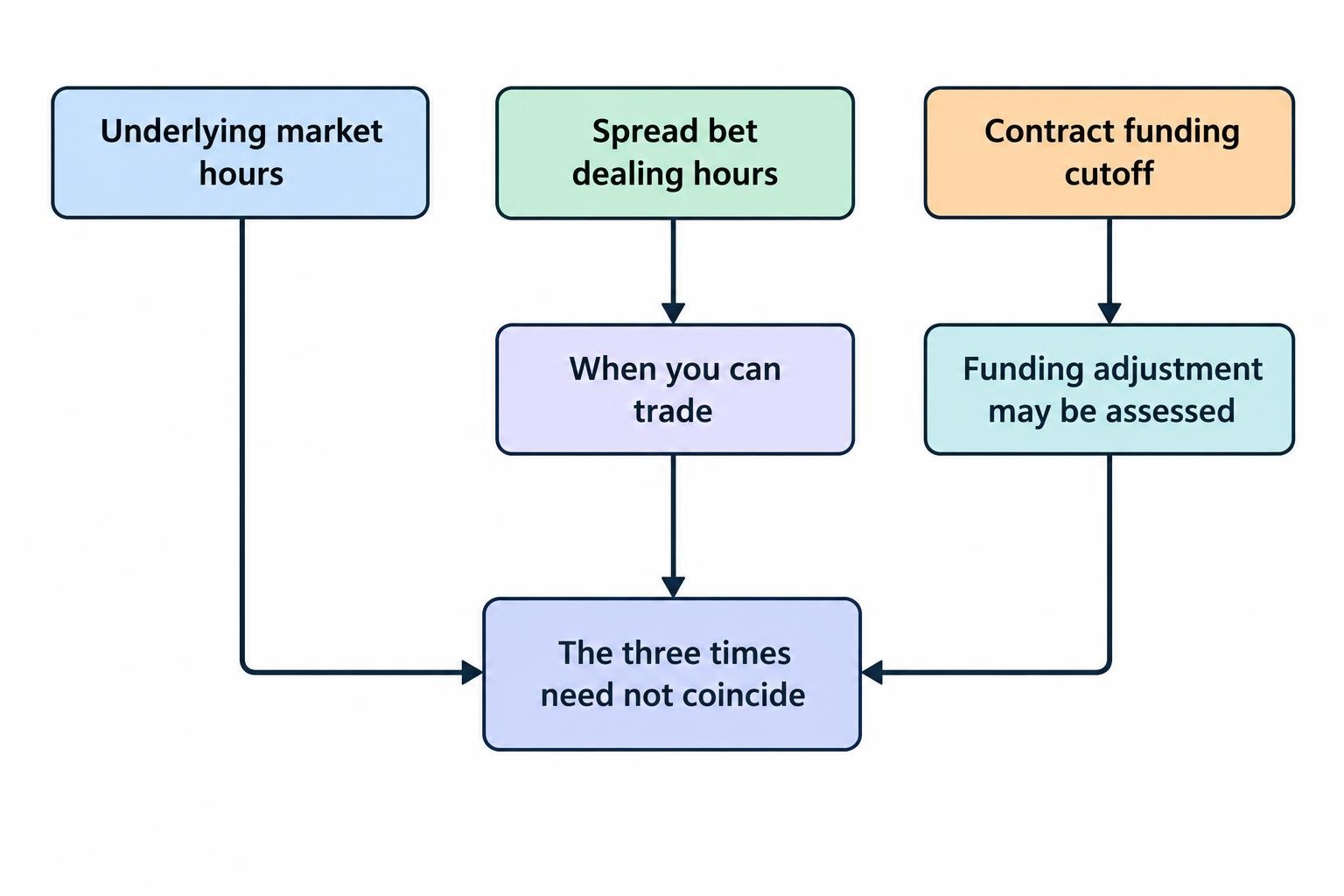
Keep three different times separate: the underlying market’s closing time, your spread betting contract’s dealing hours, and its funding cutoff. They need not coincide. An index contract might remain available after the cash stock market closes, while an individual share contract may have a much shorter dealing session.
Check the published time zone too, including how daylight saving changes affect it. Do not assume every market on the same platform follows one timetable. The relevant spread betting trading hours tell you when you can trade; the funding terms tell you when a charge or credit is assessed.
An undated contract has no scheduled expiry, but that does not promise uninterrupted trading or an indefinite right to keep it open. Margin requirements, contract terms and market availability still apply.
How Overnight Funding Affects the Position
Funding is commonly calculated using the position’s full notional exposure, not just the margin deposited to open it. Rates vary between providers and markets, and a short position may produce either a funding charge or a credit. These differences form part of the FCA’s findings on overnight funding charges, which cover spread bets alongside CFDs and rolling spot forex.
That distinction matters. Depositing enough cash to cover a larger share of the exposure does not automatically reduce the charge. Check whether the provider makes any allowance for account cash, rather than treating the deposit as a repayment of financing.
For a contract using an annual percentage rate, a simplified estimate is:
Funding charge = notional exposure × annual funding rate × chargeable days ÷ annual day-count basis.
Use the contract’s actual calculation method. Currency funding may be quoted through swap points, while other products can use different adjustments. A percentage formula is not universal, and the long and short rates are not necessarily mirror images.
Worked Example: Seven Chargeable Days
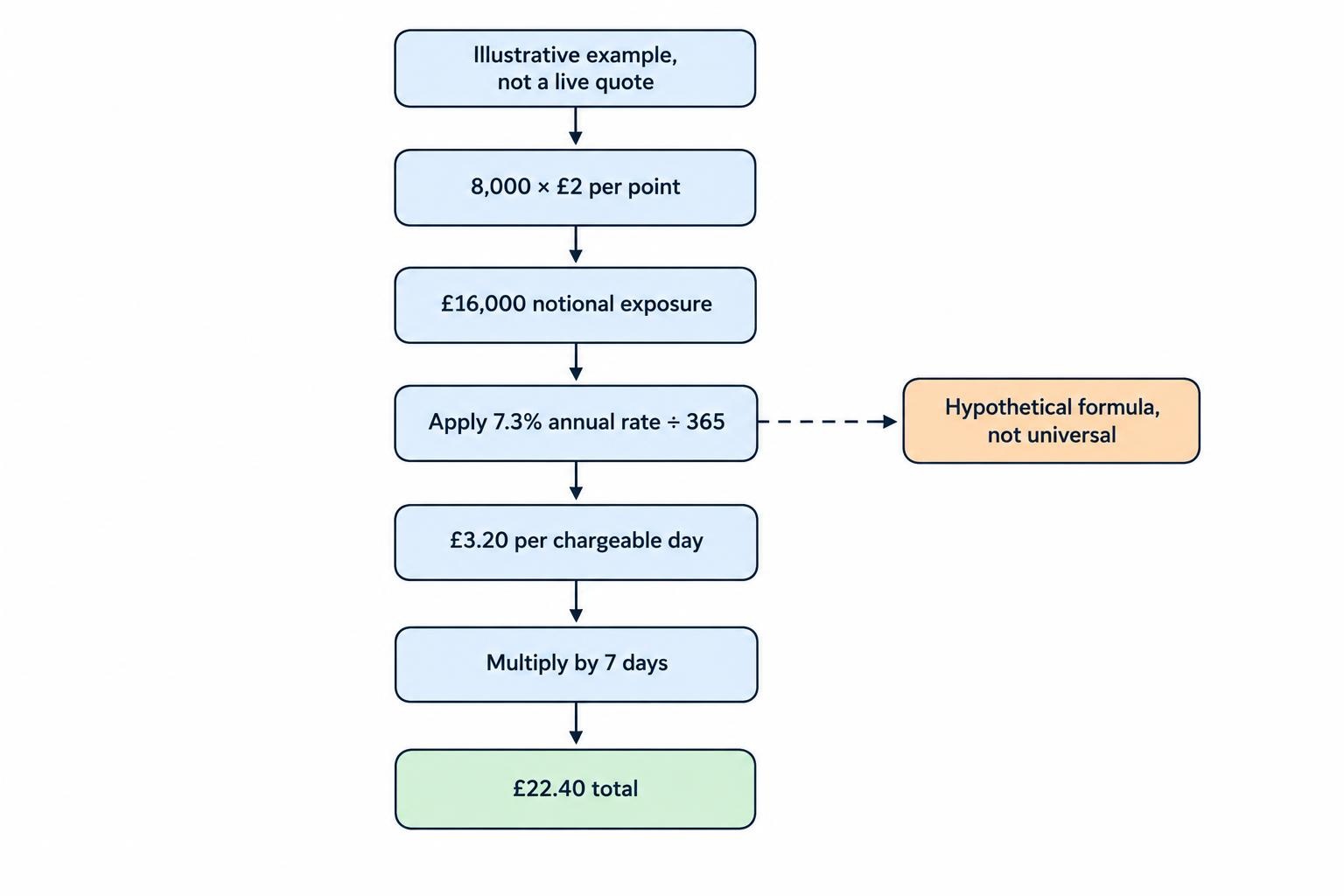
Suppose you buy a hypothetical cash index spread bet at 8,000 for £2 per point. Assume an all-in annual funding rate of 7.3%, a 365-day calculation basis, and an unchanged reference price for the funding calculation. These are illustrative figures, not a live quote or a provider’s current terms.
| Calculation | Illustrative amount |
|---|---|
| Notional exposure: 8,000 × £2 | £16,000 |
| Funding for one chargeable day: £16,000 × 7.3% ÷ 365 | £3.20 |
| Funding for three chargeable days | £9.60 |
| Funding for seven chargeable days | £22.40 |
If you later sell to close at 8,060, the execution-price profit is 60 points × £2, or £120. After £22.40 of funding, £97.60 remains before any other applicable charges or adjustments. Because the calculation uses your actual opening buy price and closing sell price, do not subtract the spread again.
At £2 per point, the seven-day funding bill equals 11.2 points. The trade therefore needs another 11.2 favourable points just to cover that funding assumption. In practice, changing prices, rates or position size can change each daily amount.
Weekend and Bank Holiday Funding
A closed market does not necessarily mean a pause in financing. Check whether the charging schedule includes calendar days when trading is unavailable, and whether several days are collected through one adjustment. The booking date and the period being funded are not always the same.
Do not assume that every product receives a three-day charge on Friday. The relevant weekday can depend on the market, settlement convention and provider’s terms. Holidays may alter the schedule too. The separate guide to overnight financing costs covers the charging mechanics in more detail.
Before a weekend, calculate the cost through your intended exit date rather than counting only the nights you expect to be asleep. Then assess reopening risk separately. A modest funding bill says nothing about how far the market might move before you can close the trade.
Would a Futures or Forward Bet Be More Suitable?
Dated futures and forward spread bets commonly avoid a separate daily financing debit, although the exact terms still need checking. They have an expiry date and may involve different spreads, pricing and rollover arrangements. The comparison of daily funded bets and futures bets sets out those contract differences.
No separate overnight debit does not mean no financing cost. Equity index futures prices reflect interest rates, expected dividends and time to expiry, rather than simply matching the cash index. Those components appear in CME Group’s equity index futures fair-value calculation.
Compare the expected total cost over the period you intend to hold. A daily funded contract might suit a brief position, while a dated contract could become worth considering over a longer period. There is no universal number of days at which one becomes cheaper.
Include the cost of switching contracts if the position is already open. Closing one bet and opening another creates fresh transactions; it does not erase costs already paid.
The Main Risks of Holding Overnight
A Stop Price May Not Be Your Exit Price
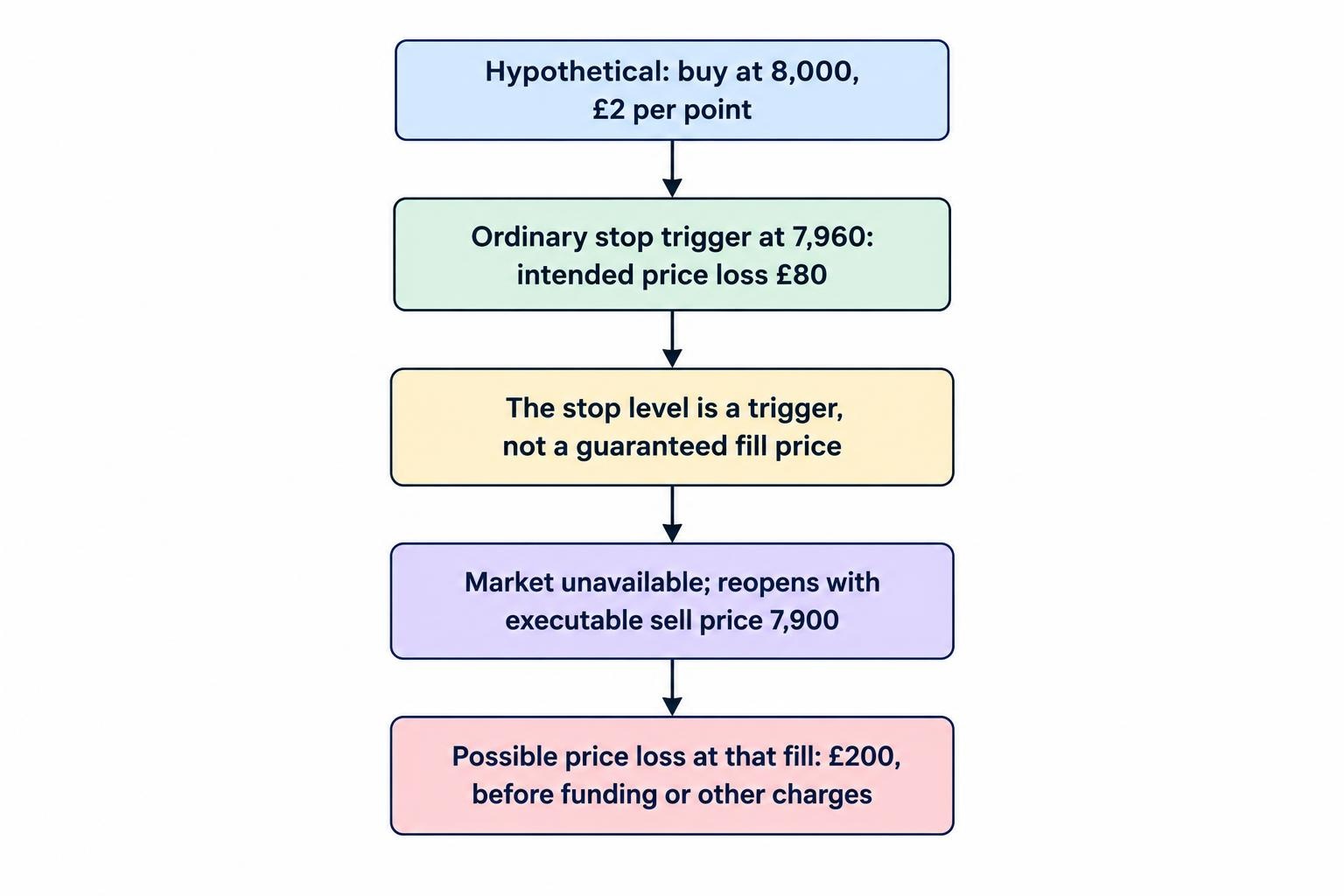
An ordinary stop loss is a trigger, not a guaranteed execution price. If the market gaps beyond it, the eventual exit can be worse than the level you selected. Thin trading can also affect execution. These mechanics are addressed in ASIC’s report on CFD stop losses and price gaps.
Suppose you buy at 8,000 for £2 per point and place an ordinary stop at 7,960. The intended price loss is £80. If your contract becomes unavailable and reopens with an executable sell price of 7,900, a fill there would produce a £200 price loss, before funding or other charges. The 40-point stop distance did not prevent a 100-point loss.
A guaranteed stop-loss order addresses execution beyond the agreed stop level, subject to the provider’s terms. Check availability, premiums, minimum distances and any restrictions on changing the order. It does not remove funding costs or make the trade profitable.
Margin Pressure Can Develop While You Are Away
An adverse move can reduce account equity while several positions draw on the same account balance. For UK retail accounts within the relevant rules, the provider must close positions as soon as market conditions allow when net equity falls below 50% of the applicable margin requirement. That is an account-level threshold, not a promise to close each trade at half its original deposit. The requirements sit in FCA COBS 22.5 on retail speculative investments.
Do not build an overnight plan around receiving a warning and then transferring money in time. Leave room for adverse moves, funding deductions and other open positions. More cash provides a buffer; it does not turn a poor trade into a sound one.
Choose the stake from an acceptable cash loss and a defensible exit level, with an allowance for execution uncertainty. The principles of position sizing for spread betting matter more here than how small the opening deposit appears.
Trading Conditions and Adjustments Can Change
A position may remain tradable outside the underlying market’s main session, but that does not guarantee the same spread or execution conditions. Before leaving it unattended, check how your provider triggers stops and whether your chart displays the bid, ask or another price. The displayed chart and the price relevant to your exit order may differ.
Share and cash index positions can also cross dividend adjustment dates. Check the direction, amount and timing of any spread betting dividend adjustment. A cash credit should not be treated as free profit without considering the related price movement and the rest of the trade.
Deciding Whether to Keep the Trade Open
Separate a planned overnight hold from an improvised extension of a day trade. A position opened for a move lasting several sessions should already have an expected holding period, exit conditions and cost allowance. A losing intraday trade kept open because “it should come back” has acquired more exposure, not a better reason to exist.
Ask whether you would open the same position now, at its current size, knowing the next funding charge and the events ahead. If the answer is no, the original entry price is not a strong argument for keeping it.
Entry methods and session selection belong in an overnight spread betting strategy. The holding decision is narrower: does this position still meet its exit rules, cost budget and acceptable risk while you cannot actively manage it?
Checks Before Leaving a Position Open
- Confirm the contract: Identify whether it is daily funded or dated, and check any expiry or rollover instruction.
- Price the holding period: Use the correct directional funding rate and include weekend or holiday charging days.
- Review scheduled events: Check company announcements, economic releases and other events relevant to the market.
- Check exit orders: Confirm the stop type, trigger basis, expiry setting and any guaranteed-stop conditions.
- Assess the whole account: Allow for losses across related positions rather than reviewing each bet in isolation.
- Plan for being unavailable: Decide what should happen without relying on an alert waking you or a last-minute deposit arriving.
Afterwards, reconcile the funding entries and adjustments against the contract terms. Record the net result, not just the points gained or lost. Repeated small deductions can change whether a holding period is worthwhile, even when the market direction was correct.
Holding a spread bet overnight should be a deliberate extension of the trade plan. Keep it open only while the reason for holding, the cost and the possible loss remain acceptable—not because closing it would make the loss feel more real.