Futures and forward spread bets let you trade a market through a contract with a stated expiry date. You still choose a stake per point, buy or sell the broker’s quote, and make or lose money as that quote changes. The difference from a rolling daily bet is the dated contract and the way its price accounts for the period before settlement.
These contracts can suit positions held for several weeks or months, but “no separate overnight funding charge” does not mean free financing. Before opening one, check the reference market, expiry, point size and total cost. A familiar market name with a different contract month is a different trade.
What are futures and forward spread bets?
A futures spread bet is a cash-settled bet whose quote references a dated futures market. A forward spread bet is also a dated bet, but its price may be calculated from the underlying cash market with adjustments for the period to expiry. Product names vary between providers, so the contract specification matters more than the label on the trading screen.
Neither label means that you have bought the underlying asset. Financial spread betting gives you exposure to price movements without acquiring or disposing of those assets, a distinction set out in HMRC’s guidance on financial spread betting. An oil spread bet does not leave you arranging delivery of barrels at expiry.
The basic trade mechanics remain the same as those covered in how spread betting works. You buy if you expect the quoted market to rise, or sell if you expect it to fall. Your stake determines the cash effect of each point moved.
How the names differ from conventional futures and forwards
In the underlying derivatives markets, futures are standardised exchange-traded contracts. Forwards are generally privately negotiated contracts between counterparties. Exchange futures also use daily settlement of gains and losses. These structural differences are covered in CME Group’s comparison of futures and forward contracts.
A spread betting provider can use those markets or pricing methods to construct its own quote. Your agreement remains with the spread betting provider; the word “futures” does not turn your account into an exchange futures account. Do not assume exchange contract sizes, clearing arrangements or delivery rules apply to your bet.
The practical distinction is between the market used to price your exposure and the contract you actually hold. The separate comparison of spread betting versus direct futures trading covers that choice in more detail.
Why a dated price differs from the cash price
A cash index, its nearest futures contract and a later contract can show different prices at the same moment. That does not, by itself, indicate a bad quote. They refer to different settlement dates, and the value of carrying exposure between those dates can affect their prices.
Index financing and expected dividends
For a conventional equity index future, theoretical fair value reflects the cash index, financing, expected dividends before expiry and time remaining. A simplified relationship is:
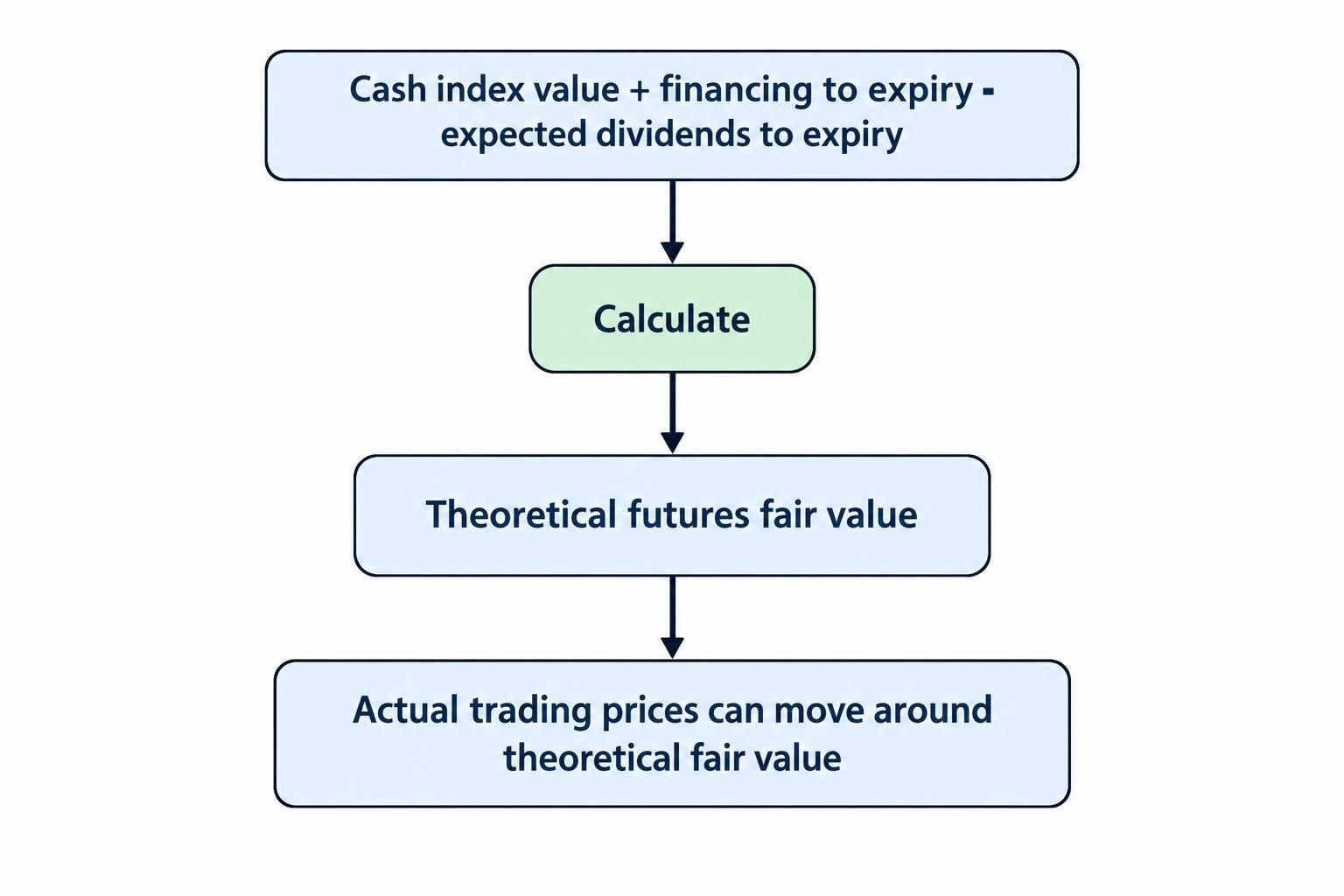
Futures fair value ≈ cash index + financing to expiry − expected dividends to expiry.
Actual trading prices can move around that theoretical value as buying and selling pressure changes. CME Group’s equity index fair value calculation sets out the relationship between these inputs.
Suppose, purely for illustration, an index stands at 8,000. Financing to expiry represents 70 points and expected dividends represent 45 points. The simplified fair value is 8,025, before the provider’s spread or other pricing adjustments. Those extra 25 points are not a forecast that the index must rise by 25 points.
Check dividend treatment separately. Where expected dividends are already reflected in a dated price, do not assume the same cash adjustments used on a daily product will also apply. The guide to spread betting dividend adjustments explains why cash and dated positions need different treatment.
Commodity contract months
Commodity prices can differ between delivery months because of storage, financing and supply conditions. A curve with later contracts priced above nearer contracts is called contango; the reverse shape is backwardation. Oil inventory and storage conditions can influence both, as covered in ICE’s analysis of oil futures curves and storage constraints.
The trading consequence is straightforward: a rise in the nearest oil contract does not promise an identical rise in the contract your bet references. Match your analysis to the same contract month, or recognise that you are comparing different exposures.
How financing and trading costs work
Dated spread bets commonly account for financing through their quoted price and dealing terms rather than a separate daily funding debit. Providers may also apply a wider dealing spread than on the corresponding daily product. Check the actual specification: “forward” is not a universal promise that every holding charge disappears.
Keep two different numbers separate. The bid-ask spread is the gap between the price at which you can sell and the price at which you can buy the same contract. The basis is the difference between a dated market price and its corresponding cash price. They are not interchangeable costs.
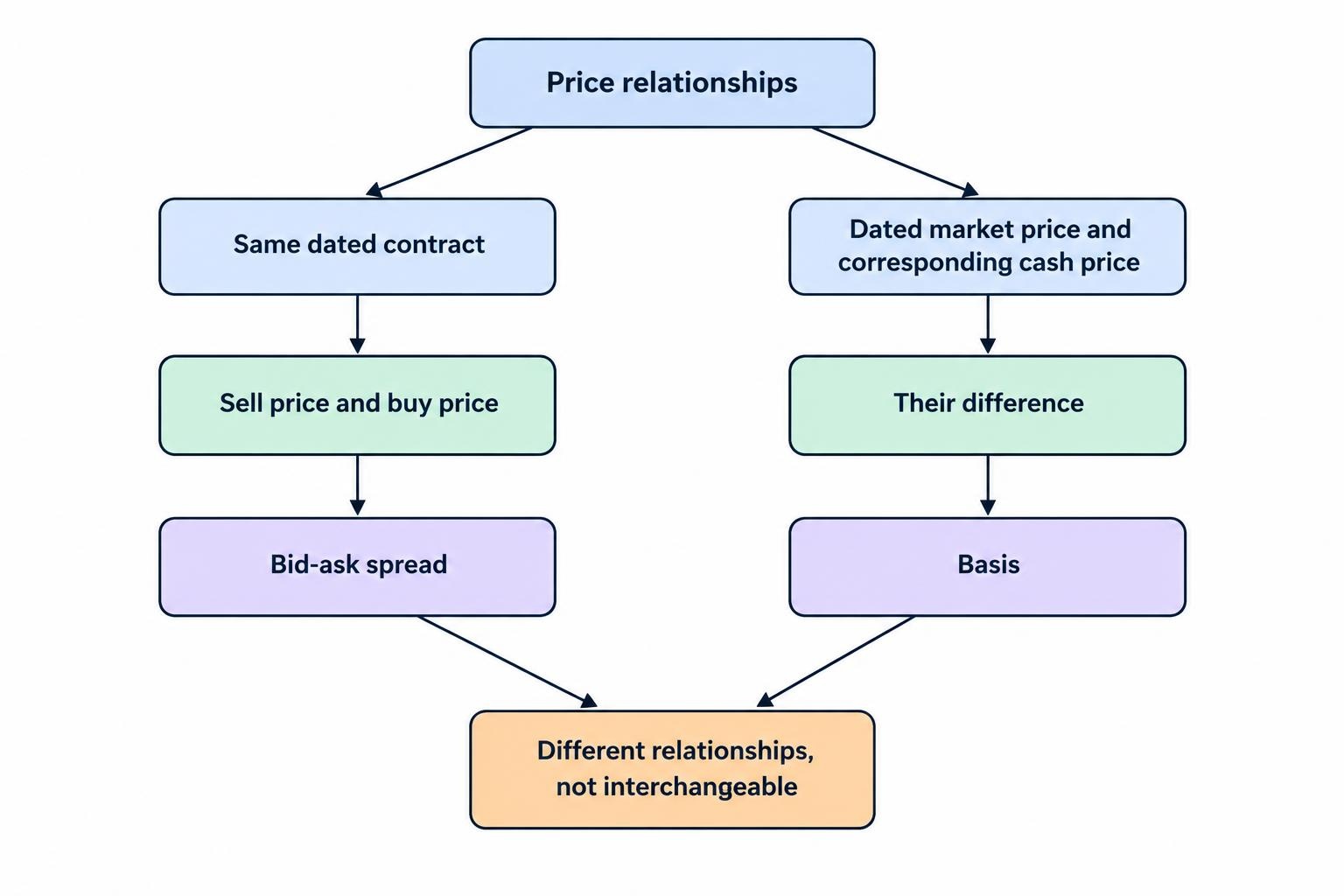
Suppose a dated index quote is 8,020–8,028 while the cash index is 8,000. The dealing spread is eight points, not 28. The dated price’s relationship with cash has a separate explanation. Calling the entire difference a broker fee would misread the quote.
At £2 per point, an eight-point spread produces a £16 loss if you buy and immediately sell at an unchanged quote. That calculation describes the dealing spread, not every economic effect of holding the contract.
For a fair cost comparison, consider the same exposure over the same intended holding period. Include dealing spreads, financing treatment, any rollover charges and other applicable fees. The guide to overnight financing costs covers the separate daily charges that can apply to rolling positions.
Be careful with a shortcut that divides a dated contract’s extra spread by a daily funding charge to produce a supposed break-even holding period. It can miss differences in pricing basis, dividend treatment and exit dates. A tidy answer is not much use if the calculation compares different things.
Worked example: a long futures spread bet
Assume a provider quotes a dated equity index market at 8,200–8,208, with one index point equal to one spread betting point. You expect the contract to rise and buy at 8,208 for £2 per point. These are illustrative figures, not live quotes.
For this long position:
Profit or loss = (closing sell price − opening buy price) × stake per point.
| Exit scenario | Closing quote | Profit or loss before other charges |
|---|---|---|
| Immediate exit at an unchanged quote | 8,200–8,208 | (8,200 − 8,208) × £2 = −£16 |
| The contract rises | 8,326–8,334 | (8,326 − 8,208) × £2 = £236 |
| The contract falls | 8,086–8,094 | (8,086 − 8,208) × £2 = −£244 |
The calculation uses the provider’s executable sell price, not a chart midpoint or the cash index level. Because the entry and exit prices already include the spread, do not deduct the same spread again.
A short position reverses the calculation. If you sell at 8,200 and later buy back at 8,094, the profit is 106 points × £2, or £212 before other charges. You close a short at the buy price, not the sell price displayed beside it.
Check what “one point” means before applying either formula. Commodity quotes, share prices and index levels do not necessarily use the same increments. The guide to stake per point covers the link between the quoted price movement and your cash exposure.
What happens at expiry?
A dated bet has a contractual endpoint. If you have not closed or rolled it, the provider settles it under the product’s published terms. The settlement reference may differ from the last tradable quote you happened to see.
Three details deserve separate checks: the last time you can trade, the final settlement reference, and the deadline for rollover instructions. They need not be the same. A contract month alone does not tell you the exact closing date or time.
You do not normally have to hold the bet until expiry. You can close beforehand when the provider offers trading, subject to its execution terms. However, a market closure or suspension can prevent an exit at your preferred time. A fixed expiry date is a settlement boundary, not a promise of uninterrupted dealing.
Read the contract specification rather than borrowing a date from another platform or the underlying exchange calendar. The guide to spread betting expiry dates covers settlement references and dealing deadlines in more detail.
Rolling into a later contract
A rollover continues your market exposure through a later dated contract. Economically, that means closing the expiring position and opening another one. A platform may combine the process operationally, but the new position still has a new entry level, expiry and set of applicable terms.
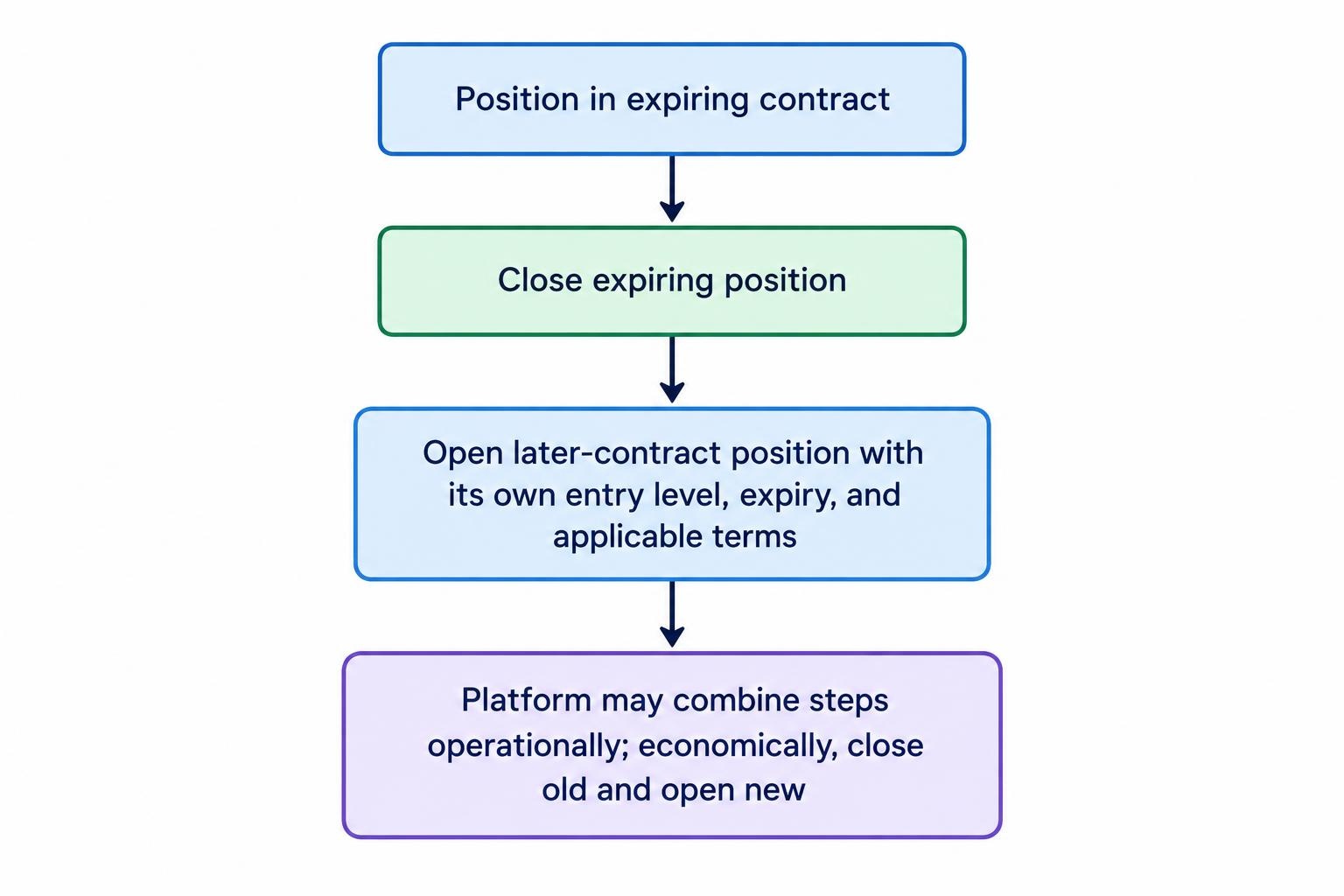
Suppose your existing long can be closed at 8,300 and the later contract can be bought at 8,360. The 60-point difference does not, by itself, mean the provider has charged you a 60-point fee. You are moving between contracts with different maturities and potentially different pricing bases.
Your result on the old trade is calculated against its original entry. The new trade starts from its own entry price. Its later performance depends on that contract’s movement, including changes in its relationship with the cash market. Dealing spreads and any rollover fees still matter.
Check how the provider handles attached orders during the roll. A stop level copied unchanged from one contract may sit at an unintended distance from the new entry. Do not assume every stop, limit or guarantee transfers automatically.
Automatic rollover also needs active supervision. Review the new contract month, stake, margin requirement and orders after the process. “Automatic” describes the administration, not the risk management.
Margin and risk on dated spread bets
A later expiry gives a trade more calendar time, not more protection. Your account must support the position throughout its life. A profitable view at final settlement is irrelevant if losses force the trade to close before then.
At an entry level of 8,208 and £2 per point, the example position has approximate notional exposure of £16,416. If its opening margin requirement is 5%, the deposit requirement is £820.80. A 100-point adverse move still costs £200; the smaller deposit does not shrink the position’s price sensitivity.
The distinction between deposit and exposure is covered in spread betting margin. Treat margin as collateral needed to maintain the trade, not as a maximum loss figure.
For retail spread bets within scope, FCA rules require account-level close-out when net equity falls below 50% of the required margin, as soon as market conditions allow. They also provide negative balance protection for funds dedicated to the relevant trading account. These are account protections, not a guarantee that an individual bet cannot lose more than its opening deposit; see the FCA’s margin close-out and negative balance protection rules.
Choose the stake from the loss you can accept and a defensible exit distance, rather than from the maximum position the available margin permits. If your planned price risk is £150 and the stop distance is 75 points, £2 per point uses that budget before costs or slippage. The method is covered in position sizing for spread betting.
An ordinary stop can execute beyond its trigger during a gap. A dated contract does not remove that possibility. Where offered, a guaranteed stop has separate eligibility, distance and premium conditions; the guide to guaranteed stop-loss orders covers that distinction.
Keep spare account equity for adverse movements and other open positions. Several dated bets can draw on the same account balance at once, even if their expiry dates are months apart.
When a futures or forward bet may fit the trade
A dated contract may be worth comparing when your intended holding period runs for weeks or months and an available expiry extends beyond it. It can make the contract’s time horizon clearer and avoid a stream of separate daily funding entries where those charges are embedded instead.
It can also fit analysis aimed at a particular contract month. A view on a winter energy contract, for example, is not necessarily the same view as a forecast for the nearest available month. Match the instrument to the event or period you are analysing.
A daily funded bet may be simpler for a short holding period, especially where its dealing spread is narrower and you expect to exit before funding applies. It also avoids choosing a fixed maturity, although its own funding and trading terms still need checking.
There is no universal number of days after which a dated bet becomes cheaper. Compare the live terms for the same market and intended exposure. The dedicated comparison of daily funded bets versus futures spread bets covers that decision without treating one format as the default winner.
If you plan to close early, assess an early exit rather than assuming a hold to settlement. You will exit at the contract’s then-current quote, so changes in its basis and dealing spread can affect the outcome alongside the underlying market move.
Checks before opening a dated spread bet
Read the market information panel and contract terms before submitting the order. At minimum, confirm:
- Reference market and month: the instrument being priced and the maturity you intend to trade.
- Point size and stake: the price increment that produces each pound of profit or loss.
- Trading and settlement deadlines: the final dealing time, settlement method and rollover instruction cutoff.
- Costs and margin: the spread, financing treatment, other charges and collateral requirement.
- Exit arrangements: stop availability, gap exposure and how attached orders are treated during rollover.
Futures and forward spread bets change how the exposure is dated and priced. They do not change the basic discipline: know what each point costs, compare the correct contract, and fund the position for the path it might take—not just the outcome you hope to reach.