Commodity spread betting lets you speculate on movements in gold, oil, natural gas, agricultural products and other raw materials without buying the physical goods. You choose a stake per point, then make or lose money according to how far the quoted price moves between opening and closing your position.
The calculation is straightforward. The product selection needs more care. Two bets labelled “oil” can follow different benchmarks, expire on different dates and charge for holding positions in different ways. Even the meaning of one point can change between markets.
This guide covers commodity spread betting through a UK retail account, including contract selection, costs and risk. Commodities are one part of the wider choice of spread betting markets; they should not be treated as a single trade with interchangeable labels.
What Are You Trading With a Commodity Spread Bet?
A commodity spread bet is a cash-settled position with a provider. Your return depends on changes in its quoted market price, not on taking ownership of bullion, barrels or grain. You can buy to benefit from a rise or sell to benefit from a fall.
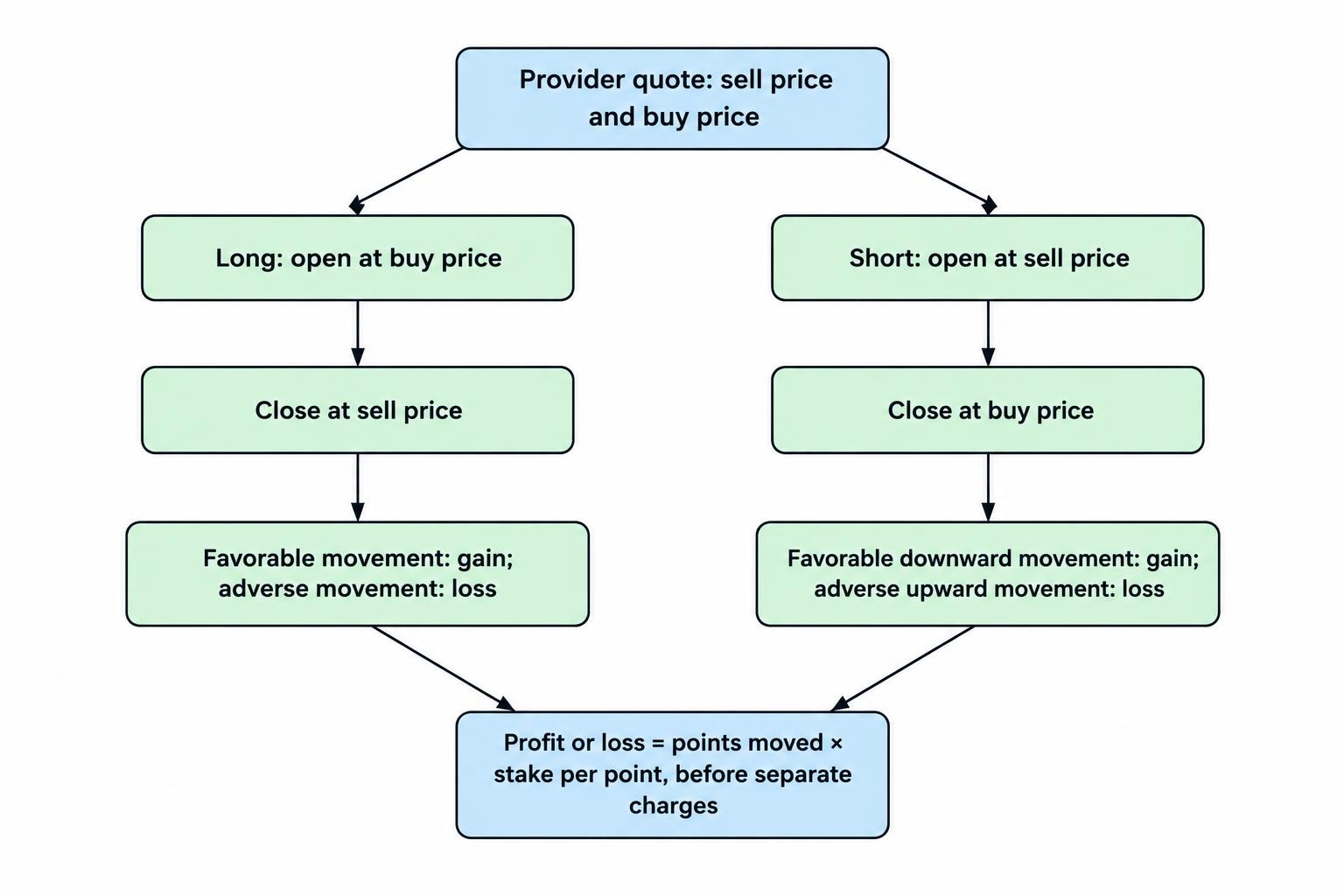
The provider quotes a selling price and a buying price. You open a long position at the buying price and close it at the selling price. For a short position, the sequence reverses. The difference between those prices is the spread.
Your stake determines the financial effect of each point of movement. At £2 per point, a favourable move of 80 points produces £160 before separate charges. An adverse move of 80 points loses £160. There is no fixed payout simply for getting the direction right.
The mechanics of spread betting apply across asset classes, but commodity contracts demand particular attention to the benchmark, quotation units and expiry arrangements. Getting those details wrong can spoil an otherwise sensible trade.
Which Commodity Markets Can You Spread Bet On?
Available markets vary by provider. Start with the exact product offered rather than assuming that every commodity, delivery month or regional benchmark will be accessible.
Precious and Industrial Metals
Gold, silver, platinum, palladium and copper provide different types of exposure. Investment demand and industrial consumption can pull metals in different directions. Copper is closely tied to manufacturing and construction demand, while gold and silver also attract investment flows. These distinctions are covered in CME Group’s analysis of metals supply and demand.
With gold spread betting, check whether the product follows a cash metal price or a dated contract. Do not assume that every product with “gold” in its name has the same holding costs.
The same check matters for silver spread betting. A smaller headline price does not establish that a position is cheaper or safer: the quotation scale, stake and distance to your exit determine its monetary risk.
Energy Markets
Energy products may include crude oil, natural gas and refined fuels. For crude oil spread betting, establish whether the quote references Brent or West Texas Intermediate, then identify the contract month. A generic “US crude” label is not enough information to size a trade.
Natural gas requires attention to location as well as contract date. In the US market, production, storage, imports, exports and weather all affect the supply and demand balance. Cold weather can raise heating demand, while hot weather can increase gas consumption for electricity generation, as set out in the EIA’s natural gas price factors.
Before opening a natural gas spread bet, identify the referenced regional market. A view about British household energy bills is not automatically a trading view about a US gas benchmark.
Agricultural Commodities
Providers may offer products such as wheat, corn, soybeans, coffee, cocoa, sugar or cotton. Availability, minimum stakes and contract choices need checking individually.
For crop markets, the USDA’s monthly agricultural supply and demand estimates provide forecasts for major crops, including wheat, coarse grains, oilseeds and cotton. Check whether a report concerns the crop, country and marketing year relevant to your position rather than trading from its headline alone.
Read the Quotation Before Choosing a Stake
A commodity’s headline price and its spread betting point scale are not necessarily the same thing. A platform might display oil at 7,500, representing $75.00 per barrel, with each one-point change representing one cent. Another product can use a different scale.
Under that hypothetical convention, a move from $75.00 to $76.00 is 100 spread betting points. At £2 per point, it changes the position’s value by £200 before costs. It is not a one-point move simply because the dollar price increased by one.
Exchange specifications help identify the underlying quotation, but they do not define your spread betting stake. The ICE Brent crude futures specification, for example, sets a contract size of 1,000 barrels and a minimum price fluctuation of $0.01 per barrel. A provider’s pounds-per-point bet is a separate contract; do not copy the exchange contract’s monetary tick value into your calculations.
Before placing an order, establish what one point means, how the platform displays it and what one point will gain or lose at your chosen stake. The order ticket’s profit and loss preview can help confirm the arithmetic.
A sterling stake also does not mean the commodity is quoted in sterling. Read the account terms for settlement and conversion arrangements. The practical distinction between price units and monetary exposure is covered in stake per point explained.
Cash Commodity Bets Versus Dated Contracts
Cash or Rolling Products
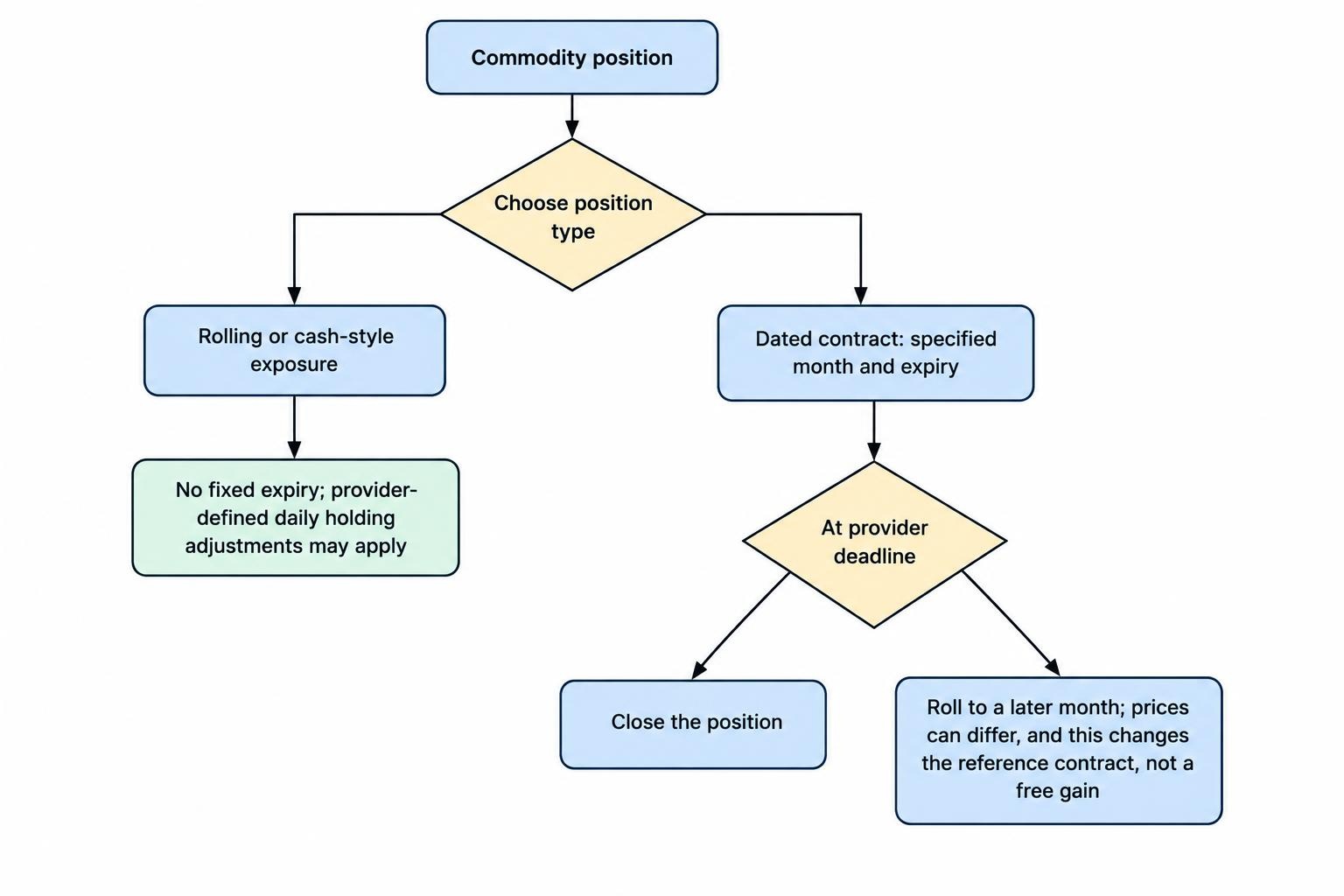
A cash or rolling commodity bet generally lets you maintain exposure without selecting a fixed expiry month. That convenience does not remove the cost of holding it.
Check how the provider constructs the quote. A product labelled “cash oil” may use futures prices to create a continuing price series rather than track a directly tradable physical spot price. Its daily adjustments can therefore involve the futures curve as well as an administration charge.
Look for the funding cutoff, calculation method and treatment of non-trading days. Ask whether a displayed adjustment is a fee, a credit or a price adjustment designed to keep the position economically consistent.
Futures or Forward Spread Bets
A dated spread bet references a contract with a stated expiry. Its quoted price reflects that delivery period rather than necessarily matching the nearest cash price.
Such products may place more of the carrying cost within the price and spread instead of charging the same daily funding used on a rolling product. “No separate overnight funding” does not mean “no holding cost”. The comparison of daily funded bets and futures examines that choice in more detail.
Check the provider’s last dealing date and settlement method. Its deadline may differ from the underlying exchange contract’s expiry, and continuing the position may require a rollover into another month.
Why Different Contract Months Have Different Prices
Contango describes a futures price above the spot price; backwardation describes a futures price below it. Financing, storage and the value of having material available now can affect these relationships. The curve is not simply a forecast of where the cash price will go. CME Group’s explanation of futures pricing and carrying costs covers the relationship.
Suppose the expiring contract is quoted at 7,500 and the following month at 7,600. Moving into the later contract does not create a free 100-point gain. You are changing the reference contract. Read how the provider handles closing prices, opening prices and any rollover adjustment before comparing the two positions.
Commodity Spread Betting Worked Example
The following oil trade uses fictional prices and a hypothetical contract in which one point represents $0.01 per barrel. The stake is £2 per point. There are no separate charges in the initial calculation.
| Item | Calculation or value |
|---|---|
| Opening sell/buy quote | 7,498 / 7,502 |
| Opening transaction | Buy at 7,502 for £2 per point |
| Immediate close at unchanged quote | (7,498 − 7,502) × £2 = £8 loss |
| Profitable closing sell price | 7,582 |
| Trading profit | (7,582 − 7,502) × £2 = £160 |
| Losing closing sell price | 7,442 |
| Trading loss | (7,442 − 7,502) × £2 = £120 loss |
The £160 profit uses the actual buying and selling prices, so it already reflects the spread. Subtracting another spread charge would count it twice. Separate funding, premiums or account charges would still need to be included.
A short trade reverses the calculation. Selling at 7,498 and later buying back at 7,418 earns 80 points, or £160 at the same stake. Buying back above 7,498 would produce a loss.
Now consider an ordinary stop on the long position at 7,442. The planned price loss is £120, but that is not a guaranteed maximum. If the available selling price jumps straight to 7,400, execution there would lose 102 points, or £204, before separate charges.
This example separates three figures that should never be confused: the stake per point, the intended loss at the stop and the margin needed to open the position. Each answers a different question.
Margin Requirements and Retail Account Protections
Under UK retail rules, gold requires initial margin of at least 5% of exposure, equivalent to maximum leverage of 20:1. Commodities other than gold require at least 10%, equivalent to 10:1. These requirements appear in the FCA rules for retail speculative investments. Providers can require more margin than these minimums.
Using the fictional oil contract above, an opening level of 7,502 at £2 per point represents approximately £15,004 of exposure. At a 10% margin rate, the illustrative initial requirement is £1,500.40. The provider’s own valuation method and margin schedule determine the amount actually shown on the ticket.
That deposit is not the trade’s maximum loss. It is the amount required to support the exposure. A position can lose more than its initial margin, drawing on other funds in the account.
UK retail protections also include account-level margin close-out and negative balance protection. Positions must be closed as soon as market conditions allow when net equity falls below 50% of the required margin, while liability is capped at the funds in the relevant account. The FCA’s retail CFD and spread betting information sets out these protections.
Neither protection replaces a trading exit. Account-level close-out may happen far beyond your intended loss on one position, and negative balance protection does not stop you losing the funds you have committed to the account.
Keep spare equity separate from the minimum opening requirement. A trade that only just fits the margin available leaves little room for adverse movement or other account demands.
The Costs That Matter Beyond the Spread
The spread is the most visible cost, but compare products over your expected holding period. A narrow opening spread can be poor value if the position then attracts substantial daily charges.
For rolling commodity bets, examine the funding formula rather than relying on a headline rate. Check the reference price, administration component, charging time and whether several days are booked together around weekends or holidays. The guide to overnight financing costs covers the wider calculation.
For dated contracts, examine the spread, expiry arrangements and likely cost of rolling into another month. A rollover can involve closing one position and opening another, each at executable prices. Any adjustment should be read alongside those transactions, not treated as an isolated profit or fee.
Execution also matters. An ordinary stop may fill beyond its trigger during a fast move. A wider spread can make closing more expensive even when the underlying market has moved little. These effects belong in the trading result, although they may not appear as separate statement charges.
Read the conditions attached to guaranteed stop premiums, currency conversion, market data and account administration where they apply. Avoid assuming that a charge used for one commodity also applies to another.
A useful comparison starts with one proposed trade: the same benchmark, comparable exposure and the same holding period. Estimate the spread and other known charges for that trade. Comparing only advertised minimum spreads leaves too much out.
Trading Hours and Commodity Announcements
Use the provider’s dealing schedule for the exact product. An underlying exchange being open does not by itself establish that your spread bet is available on identical terms.
Check daily breaks, weekend closures, holiday sessions and the final dealing time for dated contracts. Also check whether placing or amending orders remains possible while dealing is closed. The commodity trading hours guide covers these scheduling issues without assuming one timetable applies to every market.
For oil, a recurring diary entry is the US Energy Information Administration’s Weekly Petroleum Status Report. Its standard release is Wednesday at 10:30 a.m. Eastern Time, with holiday exceptions listed in the official petroleum report schedule. Check the date rather than carrying last week’s reminder forward.
Convert announcement times for the trading date. UK and US clock changes do not always occur on the same weekend, so a familiar London release time can shift temporarily.
Before an announcement, decide whether the position was intended to include that event. Leaving it open by accident is not the same decision as accepting the event risk deliberately.
Size the Position Around the Exit, Not the Available Margin
Choose the monetary loss you are prepared to accept before selecting the stake. Then identify a defensible exit level and measure its distance from the proposed entry in the product’s actual points.
For an ordinary stop, the basic sizing calculation is:
Stake per point = planned price risk ÷ stop distance in points
A £100 price-risk budget with a stop 50 points away gives £2 per point. If the trade needs a 100-point stop, the same budget supports £1 per point. Separate charges and possible slippage still need consideration.
The position sizing guide develops this calculation. Its purpose is to make the stake fit the trade, not to squeeze the stop closer until a larger stake appears affordable.
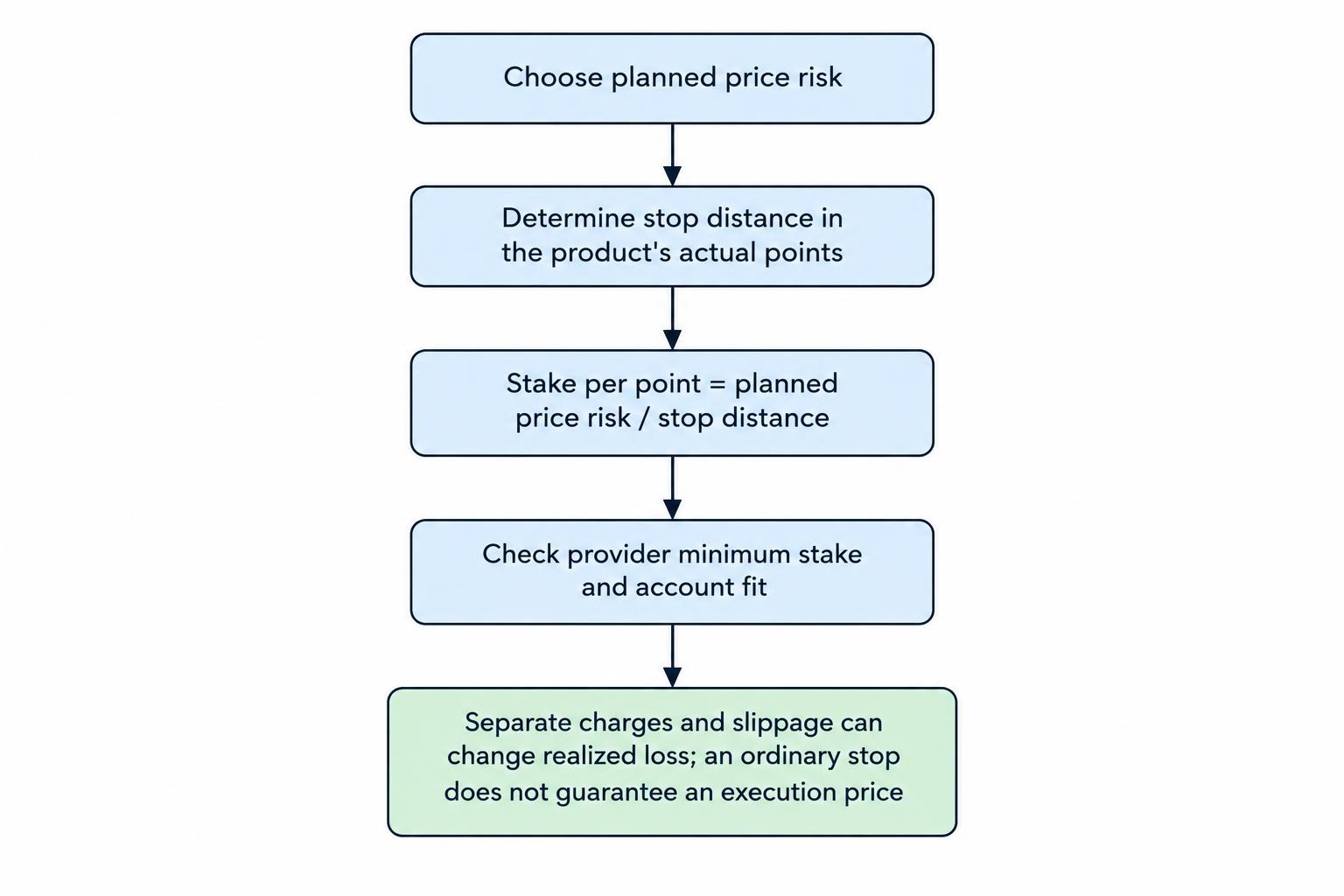
If the provider’s minimum stake creates too much risk at a sensible stop distance, the product does not fit that trade. More available margin does not fix the mismatch.
Allow for Gaps and Execution Risk
An ordinary stop triggers an exit instruction; it does not guarantee an execution price. A market can move past the trigger during a closure or jump between available quotes. Consider what a worse exit would do to the account, particularly when several positions are open.
Where offered, guaranteed stops for risk control can fix the exit level under the provider’s terms. Check availability, minimum distance, premium conditions and any restrictions on amendments before relying on one.
Review Combined Exposure
Do not assume that several commodity tickets create several independent risks. Long Brent and long WTI positions both express an oil view. Gold and silver positions may also share part of the same investment thesis.
Review a common adverse scenario: what happens if all positions move against you together? Add the planned losses, then consider gaps and account margin demands. Counting tickets is easier than measuring risk, but much less useful.
A commodity described as a defensive asset does not make a geared position defensive. The stake and exit arrangements still decide how much damage a price move can do.
How to Assess a Commodity Product Before Trading
Assess the contract before judging the platform. A clear interface cannot compensate for an unsuitable point scale, minimum stake or funding method.
Use a short contract check:
- Reference market: the commodity, benchmark, region and contract month.
- Monetary exposure: point definition, minimum stake and profit or loss from a realistic move.
- Holding arrangements: funding, expiry, settlement and rollover treatment.
- Exit conditions: dealing hours, stop availability and execution rules.
- Account fit: margin required, spare equity and exposure already open.
Read the product information and account terms together. If a material detail remains unclear, obtain an answer before entering the position. “It probably works like the other oil contract” is an expensive assumption to leave untested.
A spread betting demo account can help check quotation scales, order entry and statement presentation without risking trading funds. Use it to verify the process, not as proof that live orders will receive identical fills.
Commodity spread betting provides directional exposure without physical ownership, but it still requires precise contract selection. Know what price you are trading, what each point is worth and how the position will be closed. If those three answers are uncertain, the trade is not ready.