Silver spread betting lets you take a position on silver’s price without buying coins, storing bars or arranging delivery. You choose a stake per point, buy if you expect the price to rise, or sell if you expect it to fall. Your profit or loss depends on the price movement, your stake and trading costs.
The practical challenge is translating the quote into pounds at risk. A £1 stake can mean very different exposure depending on how the provider defines one point. Silver also responds to both industrial demand and financial market conditions, so a convincing long term argument does not automatically make a good short term trade.
Within commodity spread betting, silver deserves its own checks on point value, financing, expiry and execution. Those details matter more than whether its headline price looks inexpensive.
How Silver Spread Betting Prices Work
Silver is commonly quoted in US dollars per troy ounce. The LBMA Silver Price benchmark is set once daily at 12 noon London time in dollars per troy ounce. That benchmark is not a continuously tradable spread betting quote.
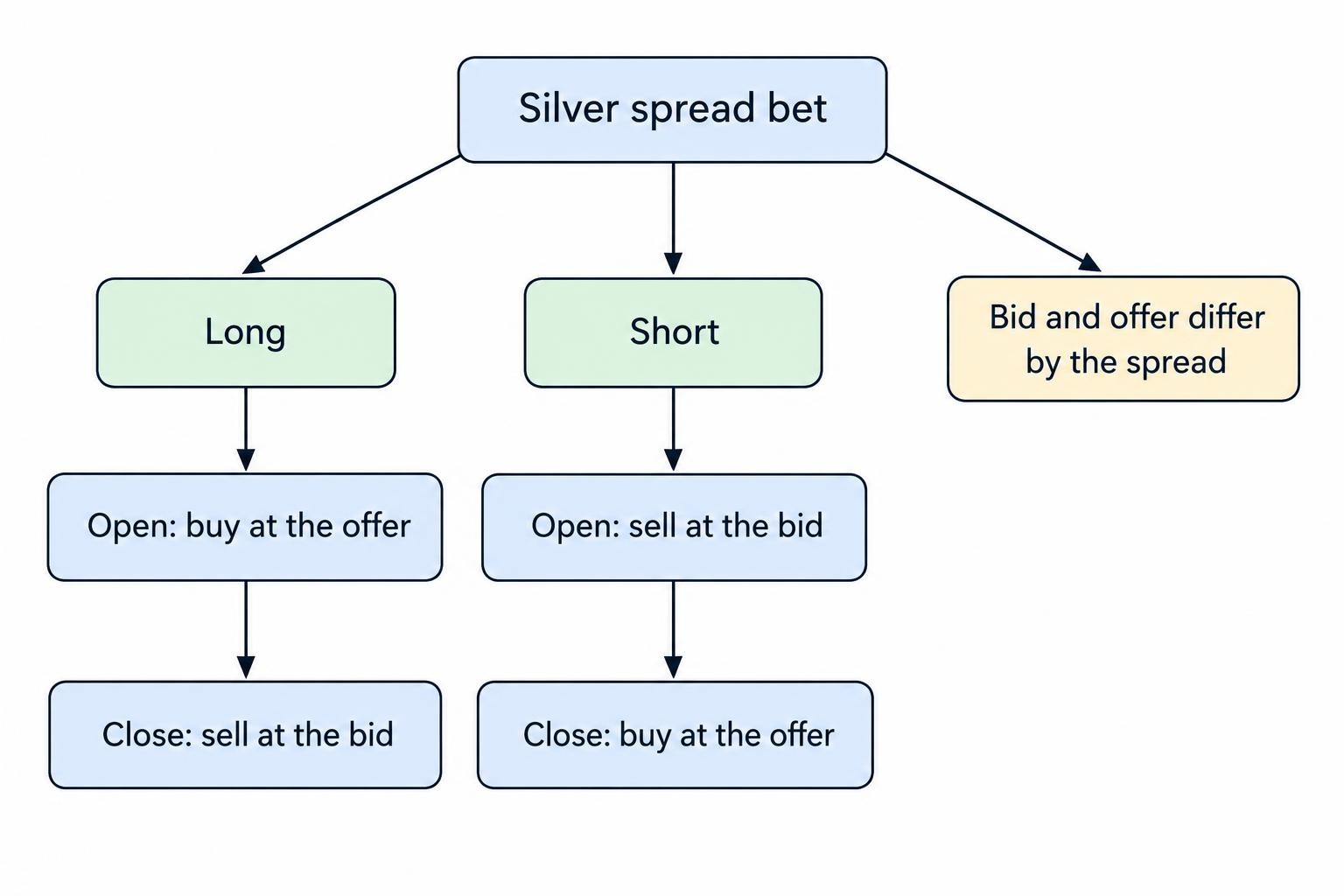
Your provider supplies a separate selling price, called the bid, and buying price, called the offer. A hypothetical quote of $30.00/$30.04 means you can sell at $30.00 or buy at $30.04. The difference is the spread.
A long position opens at the offer and closes at the bid. A short position opens at the bid and closes at the offer. Comparing your entry with a chart’s midpoint can therefore give the wrong profit figure, particularly when the spread changes.
Check What One Point Means
Do not assume that one point means a $1 movement. The provider’s contract details define the price increment attached to your stake. A display with three decimal places does not, by itself, tell you the value of one betting point.
Suppose the contract defines one point as $0.01 per ounce. A move from $30.00 to $30.50 is then 50 points. At £2 per point, that movement represents £100 of profit or loss before costs.
Always translate the ticket into a cash amount before submitting it. The calculation in stake per point explained applies directly here: price movement divided by point size, multiplied by stake.
A sterling stake can produce a sterling profit or loss even though silver’s reference price is in dollars. That does not remove the dollar’s influence on silver prices; it describes how the bet pays out. Check the account terms for any separate currency conversion charges.
Cash Silver or a Dated Silver Bet?
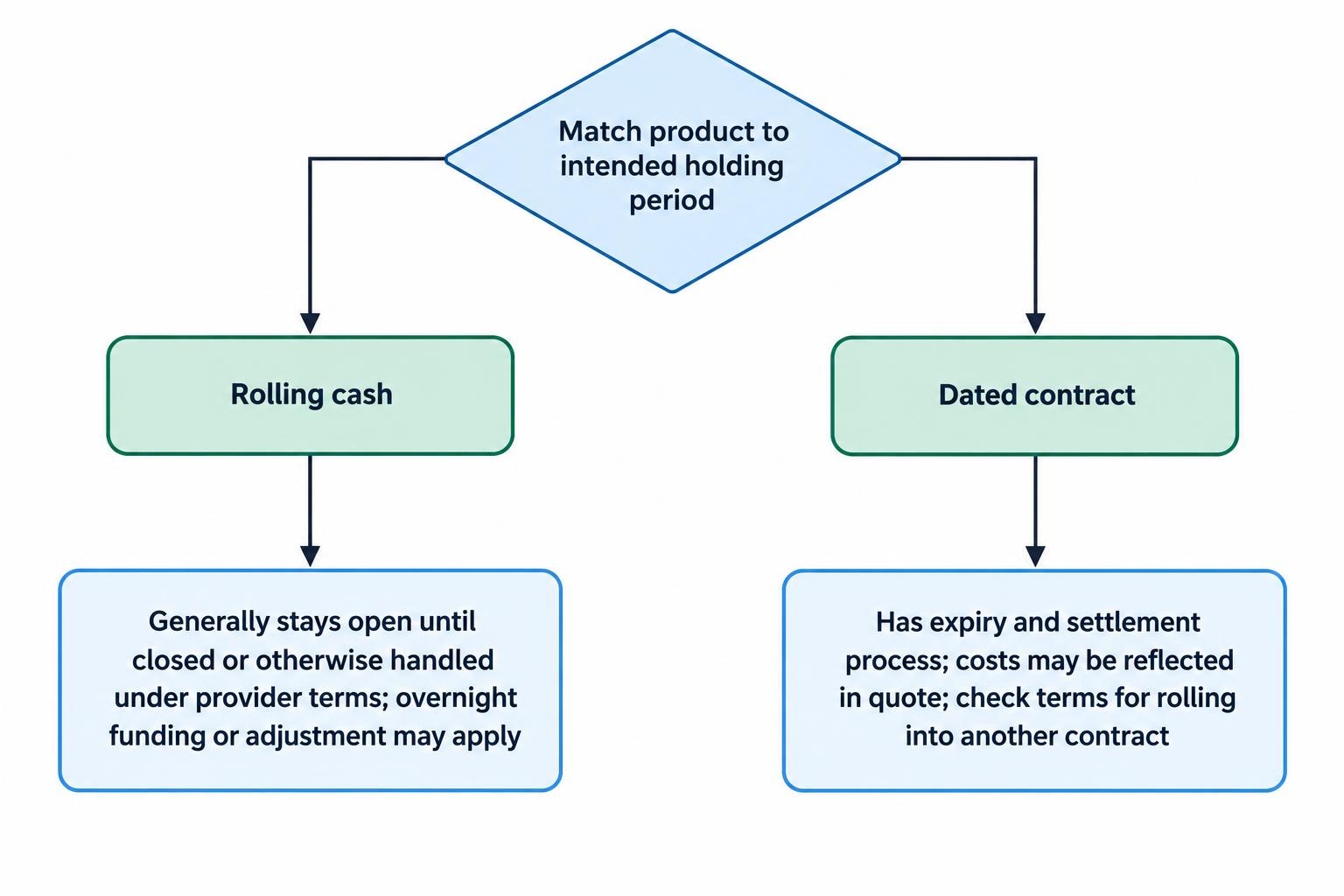
The choice between a rolling cash product and a dated contract affects both costs and trade management. Match the product to the intended holding period rather than choosing whichever appears first in the market list.
Rolling Cash Silver
A rolling cash bet generally stays open until you close it, a stop executes or the provider closes it under the account terms. Holding it beyond the funding cut off can create an overnight financing charge or adjustment.
This structure can suit an intraday plan because you can close before overnight funding applies. For a position held over several weeks, however, repeated funding adjustments become part of the trade’s economics. Check the applicable rate and charging schedule, not just the opening spread.
Dated Silver Contracts
A dated silver spread bet has an expiry and settlement process. Its price can differ from cash silver because it references a different delivery period or uses a pricing method that reflects financing and carrying costs.
Do not confuse a futures based spread bet with buying an exchange futures contract. The standard COMEX silver futures contract has a trading unit of 5,000 troy ounces under CME Group’s silver futures contract rules. Your spread bet instead uses the stake and settlement terms agreed with the provider; you are not arranging delivery of that metal.
A dated bet may have no separately debited daily funding charge, but that does not make financing free. Costs can sit within the quote. Compare the expected holding period using the distinctions in daily funded bets versus futures bets, including what happens if you roll into another contract.
Silver Spread Betting Worked Example
The following figures are hypothetical, not current silver prices or advertised provider terms. Assume one point equals $0.01 per ounce, the opening quote is $30.00/$30.04, and the stake is £5 per point.
Buying Silver
You expect silver to rise and buy at the offer of $30.04. The four point opening spread creates an immediate £20 unrealised loss if you could close at the unchanged bid of $30.00.
Later, the quote moves to $30.84/$30.88. You sell to close at $30.84. The movement between your actual execution prices is $0.80, or 80 points.
Gross profit: 80 points × £5 = £400.
| Closing bid | Movement from $30.04 entry | Gross profit or loss |
|---|---|---|
| $30.84 | 80 points higher | £400 profit |
| $30.04 | No change | £0 |
| $30.00 | 4 points lower | £20 loss |
| $29.74 | 30 points lower | £150 loss |
These figures already include the effect of entering at the offer and exiting at the bid. Do not subtract the spread again. Deduct any separate financing, premiums or other applicable charges to calculate the net result.
Selling Silver
For a short trade, reverse the execution sides. Suppose you sell at $30.00 with a £5 stake and later buy back at an offer of $29.40. The 60 point favourable movement produces £300 gross profit.
If the closing offer instead rises to $30.60, the same trade loses £300 before separate charges. Being correct about the general direction is not enough if your position closes before that move occurs.
What Moves the Silver Price?
Silver combines industrial demand with sensitivity to investment flows, interest rate expectations and currencies. Its response to an economic announcement can therefore differ from a purely industrial commodity or a metal held mainly for investment.
Industrial Demand and Substitution
Electrical equipment, vehicles, power infrastructure and solar manufacturing all contribute to silver demand. But growth in an end market does not guarantee that its silver consumption rises at the same pace.
Industrial silver demand fell 3% to 657.4 million ounces in 2025. Gains from automotive uses, power grids and artificial intelligence infrastructure were offset by weaker photovoltaic demand, including manufacturers using less silver and substituting other materials. Those findings appear in the Silver Institute’s April 2026 survey release.
The trading lesson is to examine the amount of silver used, not just the number of products manufactured. A strong solar installation forecast, taken alone, is an incomplete reason to buy.
The Dollar and Interest Rate Expectations
A stronger dollar can put pressure on dollar priced silver, while changing interest rate expectations can alter the appeal of holding a metal that pays no income. These forces interact with industrial demand rather than replacing it, a relationship covered in CME Group’s analysis of silver’s industrial and monetary roles.
For a trade around an economic release, ask what the result changes relative to expectations. A high inflation number is not automatically bullish for silver if traders interpret it as a reason for tighter monetary policy.
Separate the economic story from the execution plan. Even a reasonable interpretation can produce a losing trade if the entry is poor, the spread widens or the market initially moves the other way.
Gold and Relative Performance
The gold to silver ratio divides the gold price by the silver price, using the same currency and ounce basis. If hypothetical gold is $3,000 and silver is $30, the ratio is 100.
A falling ratio means silver is outperforming gold in proportional terms; it does not necessarily mean silver is rising. Both metals could be falling, with gold falling faster.
Use the ratio as context, not as a promise that an earlier level must return. Traders comparing the two markets should also review gold spread betting rather than assuming the contracts carry identical costs or risk.
Supply Headlines and Trading Horizons
A bullish supply argument still needs a time horizon. A forecast shortage does not tell you where a spread bet will trade this afternoon, or whether your account can withstand a move against the position first.
Define what would invalidate the trade. “Silver should rise eventually” gives you no usable exit rule and leaves financing costs running while you wait.
Silver Margin Requirements for UK Retail Clients
For UK retail accounts covered by the rules, silver falls within commodities other than gold. The minimum opening margin is 10% of exposure, equivalent to a maximum 10:1 leverage at that minimum. The same FCA retail margin and account protection rules require position closure as soon as market conditions allow when account net equity falls below 50% of the required margin. Negative balance protection restricts liability for the covered investments to funds in the account. Providers can require more opening margin than the regulatory minimum.
These protections do not cap a trade’s loss at its opening deposit. Margin is collateral, not a loss budget, and negative balance protection does not prevent the loss of trading account funds.
Using the earlier example, a £5 stake for each $0.01 movement gives an illustrative exposure of £15,020 at a price of $30.04:
Exposure: $30.04 ÷ $0.01 × £5 = £15,020.
At a 10% margin rate, the opening requirement would be approximately £1,502. Confirm the actual amount on the dealing ticket because the provider’s valuation method and applicable margin rate determine the requirement.
A $1 adverse movement would represent 100 points, or £500 at this stake, before separate costs. The stake looks small, the exposure is not. Keep the distinction clear when assessing retail client protections and deciding how much account capital to commit.
The Costs That Matter on a Silver Bet
The spread is the most visible cost, but its importance depends on the trade. A four point spread is a substantial hurdle for a strategy targeting ten points; it matters less proportionally when the planned movement is several hundred points.
For rolling positions, estimate funding against the full exposure rather than the margin deposit. As an arithmetic illustration only, an assumed annual charge of 7% on £15,020, using a 365 day basis, would cost about £2.88 per day. This is not a current provider rate or a universal charging formula.
Check the reference rate, provider adjustment, funding cut off and treatment of weekends and holidays. A short position should not be assumed to earn a credit. The calculation and timing issues are covered in overnight financing costs.
Execution also changes the result. A stop that fills worse than requested increases the loss; a wider closing spread can reduce the profit. Where guaranteed stops are offered, include any applicable premium in the planned cost.
Compare cash and dated products over your expected holding period. A narrower opening spread does not necessarily produce the cheaper completed trade.
Silver Trading Hours and Execution
Your silver spread bet follows the provider’s published dealing schedule for that product. Do not infer its availability from an exchange contract, a different silver instrument or a chart that continues updating.
Check daily breaks, holiday hours and whether opening new trades is possible throughout the quoted session. Also distinguish a market’s trading hours from customer support hours. A staffed telephone line does not mean every order can be executed.
For UK traders, clock changes need attention because UK and US daylight saving transitions do not always occur on the same dates. Verify the time zone shown on the product schedule rather than relying on a familiar clock time.
The checks in commodity trading hours help separate the underlying market schedule from the provider’s dealing terms. Before leaving a position open through a break, decide whether you can accept a reopening price beyond your intended exit.
Set the Stake From the Risk, Not the Available Margin
Start with an exit level that makes sense for the trade, then calculate the stake. Working backwards from the largest position the account permits is a poor substitute for a risk plan.
Suppose your planned price loss is £150 and the distance between entry and stop execution is 60 points. The corresponding stake is £2.50 per point. If the required distance becomes 100 points, the same price loss budget implies £1.50 per point.
Stake per point = planned price loss ÷ stop distance in points.
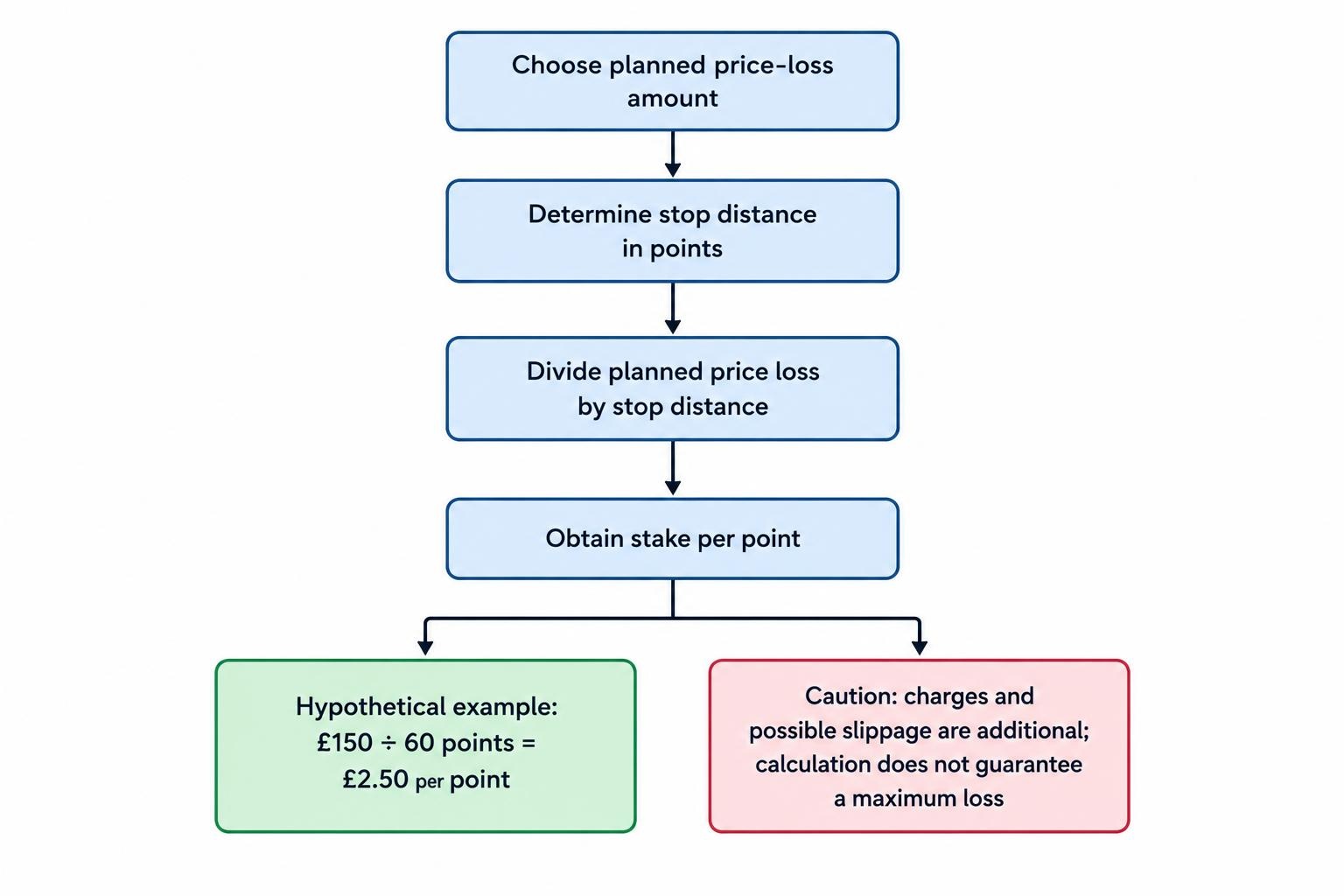
Allow separately for charges and possible slippage. These calculations describe a planned outcome, not a guaranteed maximum loss. The broader method in position sizing for spread betting helps keep the cash risk consistent when the stop distance changes.
Use the Correct Side of the Quote
A long position closes by selling, so its exit depends on the bid. A short position closes by buying, so its exit depends on the offer. Check which price the platform displays on its default chart and which price triggers the order.
An ordinary stop can execute beyond its requested level if the market gaps or moves quickly. A stop limit order creates a different problem: the price restriction can leave the position open if no acceptable execution is available.
If you require a defined stop execution level, check whether the product supports a guaranteed stop and read its conditions. Minimum distances, premiums and amendment rules matter. The distinction is covered in guaranteed stop loss orders.
Count Related Positions Together
Two trades are not independent simply because they have different market names. Before adding silver to an existing gold or metals position, consider whether both trades depend on the same dollar or interest rate view.
Write down the combined planned loss and a worse execution scenario. If that total is unacceptable, reduce exposure rather than relying on every stop filling neatly.
What to Check Before Placing a Silver Spread Bet
A provider’s silver contract needs to fit the trade you intend to place. Check the product details before comparing promotional headlines or minimum deposits.
- Point definition and minimum stake: Can you express the position at an acceptable cash risk?
- Pricing basis: Is the bet rolling cash or dated, and what happens at expiry?
- Total holding cost: What spread, financing and other charges apply to your planned duration?
- Order terms: Which stops are available, and how do their triggers and execution rules work?
- Account terms: Which legal entity holds the account, and what client classification applies?
Use a practice account to verify the arithmetic: open a small hypothetical position, observe the quoted sides and calculate its profit or loss independently. A spread betting demo account is useful for learning the ticket and order controls, but simulated fills do not establish how a live order will execute.
Before committing money, you should be able to state the cash effect of a $0.10 move, the planned exit, the expected holding cost and the consequence of worse execution. If any of those answers is unclear, the silver price forecast can wait.