Firms must not market, distribute or sell binary options to retail clients in or from the UK. The permanent prohibition took effect on 2 April 2019 and remains set out in the FCA Handbook rules on retail binary options. An offer advertised as “regulated binary trading” does not override that restriction.
The distinction matters because binary options and financial spread betting can appear beside each other in trading adverts, despite having different payout structures and regulatory treatment. This guide covers the UK position, the claims that deserve scrutiny and the practical steps to take if you have already paid a platform. For the wider framework, see our guide to spread betting regulation.
What Counts as a Binary Option?
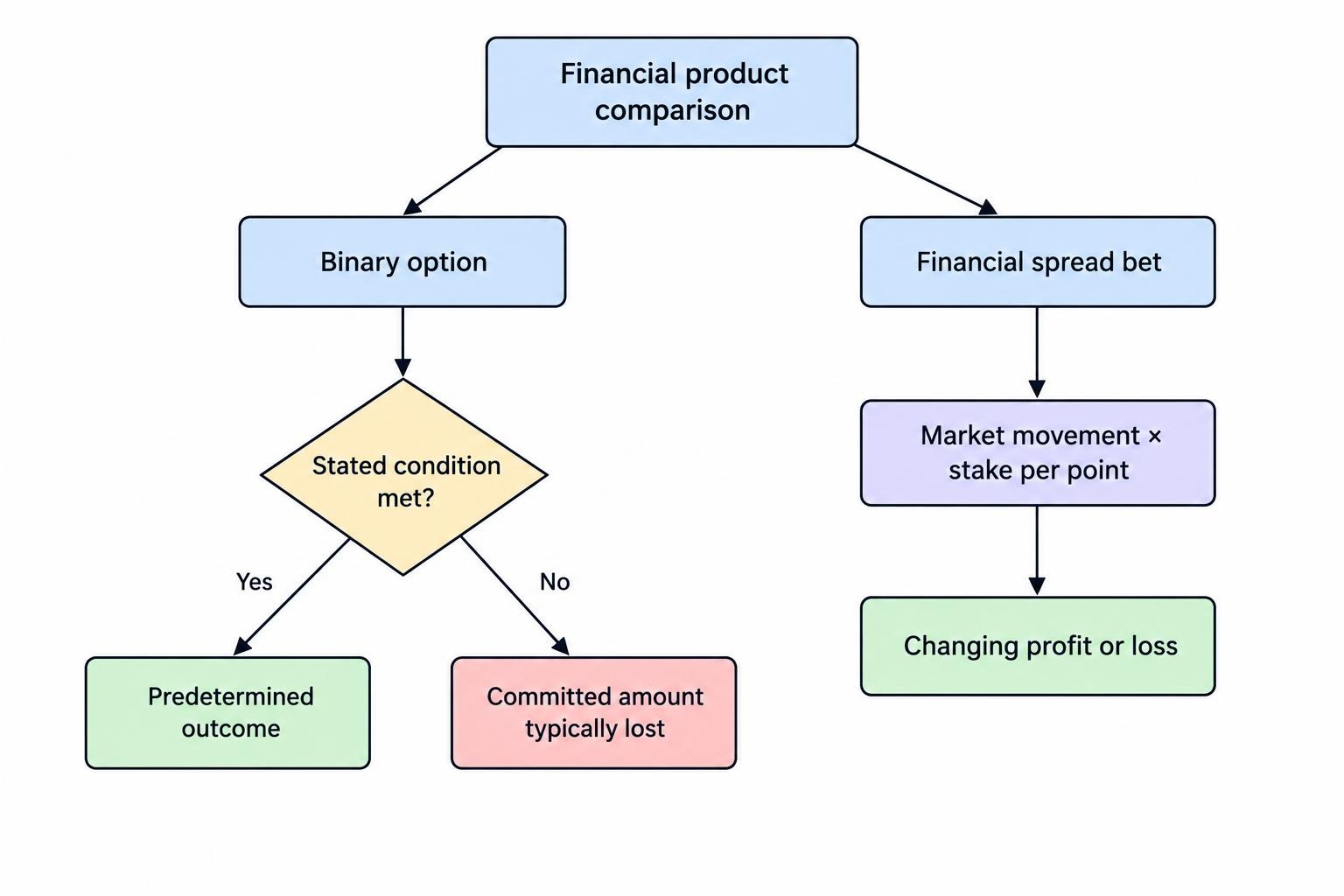
A binary option has a predetermined payout linked to whether a stated condition is met. A common example is a contract that pays out if an index finishes above a chosen level at a set time. If the condition is not met, the customer usually loses the amount committed.
Consider a hypothetical contract costing £100 that returns the £100 stake plus £80 profit if a currency pair finishes above its starting price after five minutes. A correct prediction earns £80; an incorrect prediction loses £100. The size of the market move does not determine the profit. Finishing one fraction above the threshold can produce the same payout as a much larger rise.
That differs from a spread bet, where profit or loss normally changes with the number of points the market moves and the stake per point. Our comparison of spread betting and binary options covers those mechanics in more detail.
Look at the contract rather than its label. Names such as “digital”, “fixed return” or “up/down” do not, by themselves, establish its regulatory classification. Equally, not every product containing the word “option” is a binary option.
What the UK Prohibition Covers
The restriction is not just a ban on opening a trade. It also covers distributing the relevant products and marketing them to retail clients. The marketing rule includes financial promotions addressed to retail clients, or circulated in a way that makes retail clients likely to receive them.
This means the compliance question begins before the deposit screen. A promotional message can matter even if the customer never completes an application or places a bet.
The rule is directed at firms and their activities. It is more accurate to describe it as a prohibition on retail marketing, distribution and sale than to suggest that this rule makes every individual customer a criminal. That distinction does not make an offshore offer legitimate or give a customer a safe route around the restriction.
Nor does a risk acknowledgement change the product’s status. Accepting a warning, choosing a small stake or agreeing that the entire stake could be lost does not create a retail exemption.
How UK Binary Options Regulation Changed
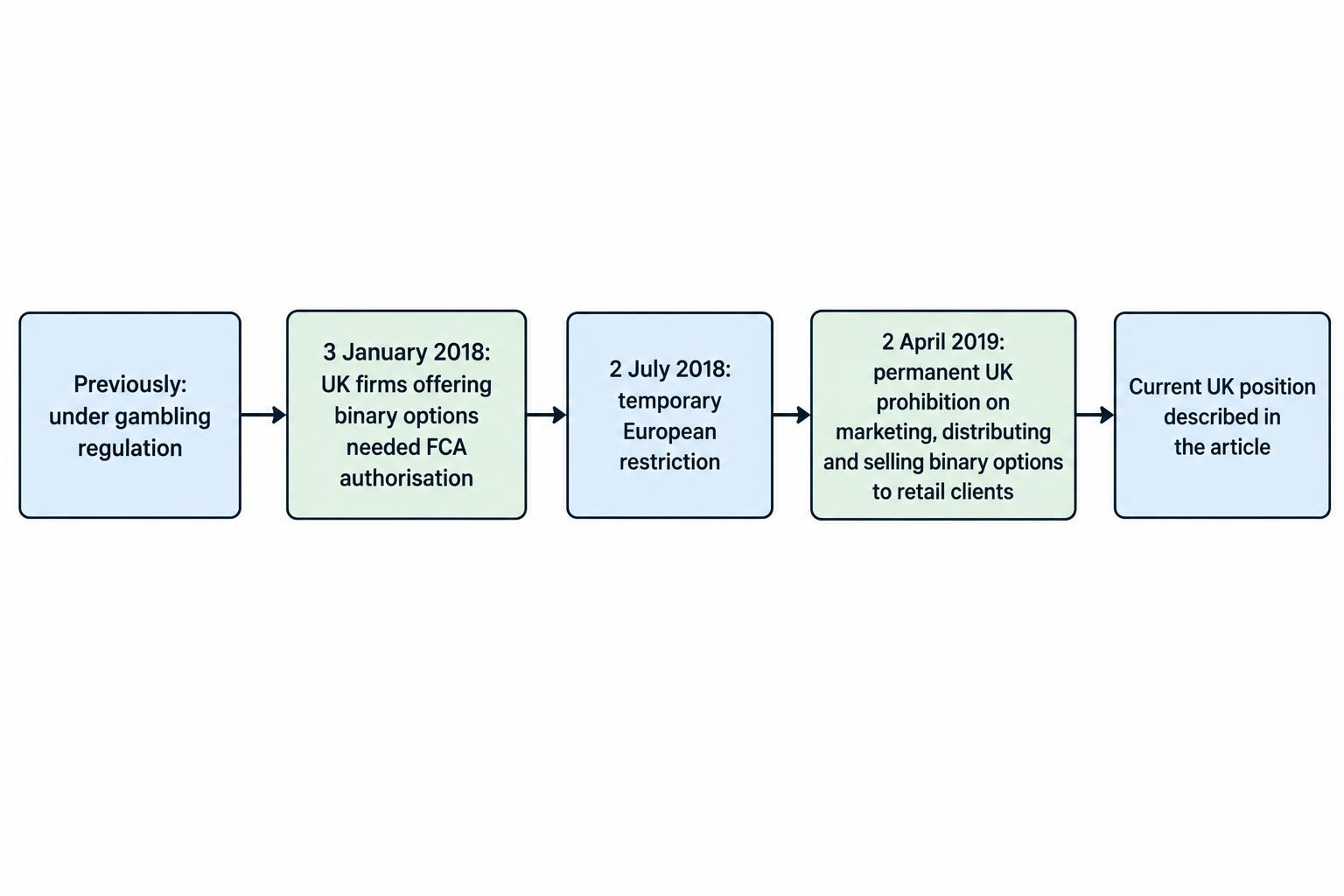
Older articles can be misleading because the regulatory position changed in stages. Binary options previously fell under gambling regulation. From 3 January 2018, UK firms offering them needed FCA authorisation, a transition recorded in the Gambling Commission’s guidance on scams and fraud.
A temporary European restriction followed on 2 July 2018. The FCA then introduced its permanent UK prohibition from 2 April 2019. The UK measure also captured securitised binary options that were excluded from the European measure, as set out in FCA policy statement PS19/11 on retail binary options.
The dates explain why an old page might discuss authorised retail binary options firms without mentioning a ban. It may describe an earlier regulatory period, not a service that firms can offer retail clients now.
For an old dispute, keep the original transaction dates and the provider’s legal name. Do not assess a historical complaint solely by looking at the platform’s current branding or its present account terms.
Why the FCA Chose a Ban
The intervention addressed both the products’ risks and poor conduct by firms selling them. The FCA also identified difficulties for retail consumers in valuing binary payouts. Including securitised versions reflected the view that changing the packaging did not remove those concerns.
The payout arithmetic shows why a simple interface does not necessarily mean a favourable proposition. Return to the hypothetical £100 contract offering £80 profit on a win and a £100 loss otherwise. Across ten trades, five wins generate £400 profit while five losses cost £500. The result is a £100 loss despite getting half the predictions right.
With those assumed terms, the break-even win rate is approximately 55.6%, before any other charges. That is an illustration, not a claim about a platform’s actual payout or a trader’s chance of success.
Knowing the maximum loss on one contract answers only one question. It does not establish that the price is fair, that the provider will honour withdrawals or that repeated trades have a positive expected return.
Do Overseas Licences or Professional Accounts Change the Position?
An overseas licence is not a UK retail exemption
Permission from a foreign regulator is not permission to disregard the UK restriction. A claim that a platform is “internationally regulated” leaves several questions unanswered: which legal entity holds the licence, what activities it covers and which customers it permits the firm to serve.
A foreign licence and permission to serve UK retail customers are separate matters. Do not treat an overseas address, a selectable UK country code or an accepted payment as proof that the service is authorised for you.
Before considering any cross-border trading service, establish the contracting entity and the rules governing the account. Our guide to offshore spread betting brokers covers the broader risks of moving outside the UK regulatory framework.
Professional status requires a genuine assessment
The binary options prohibition applies to retail clients. That does not mean any customer can avoid it by clicking a “professional trader” box. Elective professional classification involves an assessment and formal procedures under the FCA rules on professional client categorisation.
A firm must assess the customer’s expertise, experience and knowledge, with further requirements applying where relevant. A large deposit alone is not a substitute for that process.
Professional status also does not establish that a particular provider has the necessary permissions or that its contracts are suitable. Treat pressure to change classification simply to obtain a banned retail product as a reason to stop and investigate. Our comparison of retail and professional client status explains the wider consequences without treating professional classification as an account upgrade.
How to Assess a Binary Options Platform’s Claims
A binary options offer aimed at a UK retail customer is already a warning sign. The FCA’s binary options scam warning identifies social media advertising, false claims of a UK presence, manipulated prices and refused withdrawals among the methods used by fraudsters.
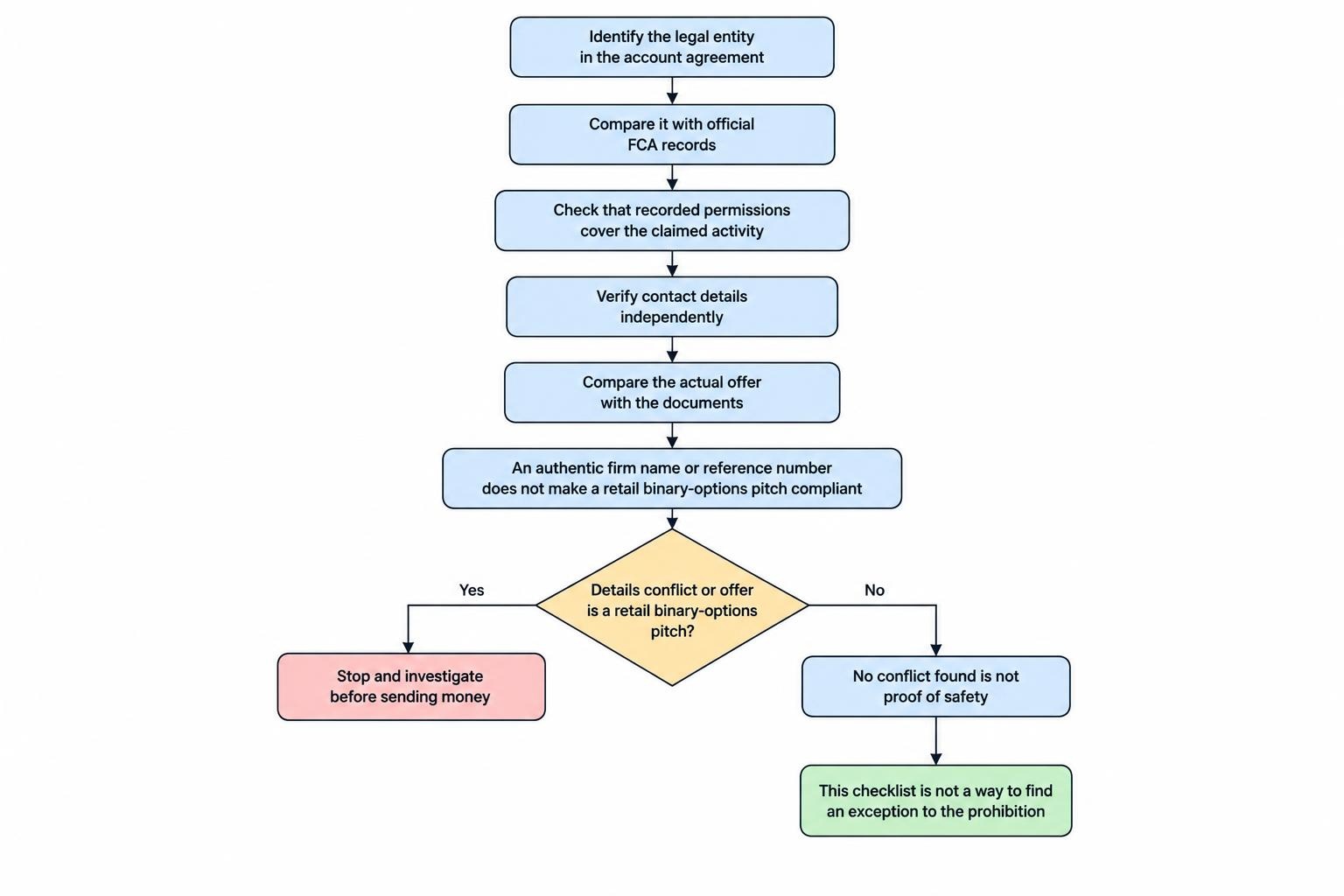
Do not let the quality of the presentation settle the question. A polished dashboard is not a regulatory permission. Before sending money, check the identity behind the trading name:
- Match the legal entity. Compare the company named in the account agreement with the firm shown in official FCA records.
- Check the permissions. Authorisation for one service does not establish permission to provide every investment product.
- Verify contact details independently. Use official records rather than a telephone number or verification link supplied by the salesperson.
- Examine the actual offer. An authentic firm’s name or reference number does not make a retail binary options pitch compliant.
Our guide to checking a broker on the FCA Register explains how to separate the trading brand from the authorised entity. This is an identity check, not a way to find an exception to the ban.
Save the advert and account terms before asking questions. A written record is more useful than a salesperson’s assurance that “compliance has approved it”. If the answers do not match the documents, do not make a test deposit to see what happens.
Does the Ban Also Cover Financial Spread Betting?
No. The binary options prohibition is not a general ban on financial spread betting. Retail spread bets fall within a separate framework of restrictions for CFDs and related products. The FCA’s permanent retail CFD restrictions expressly include financial spread bets and require measures such as leverage caps, account-level margin close-out and negative balance protection.
The difference follows the contract’s operation, not whether the customer is predicting a rise or a fall. Both products can involve a directional view, but a spread bet normally produces a changing profit or loss based on price movement. A binary contract instead links its settlement to a predefined outcome.
That does not make spread betting a low-risk replacement. Borrowed exposure can turn a relatively small market move into a large change in account equity. Read our guide to retail client protections before assuming that regulatory safeguards prevent trading losses.
A standard call or put option should not automatically be treated as a binary option either. Contract terms and the applicable rules need to be assessed separately; the shared word “option” does not settle the matter.
Are Binary Options Losses Covered by the FSCS?
Do not assume that money paid to a binary options platform carries compensation protection. FSCS eligibility depends on the firm, the regulated activity and the circumstances of the claim. It is not insurance against losing a market bet. The FSCS investment protection requirements distinguish eligible claims from losses caused by poor investment performance.
A platform displaying an FSCS logo has not demonstrated that your account or transaction qualifies. Check the underlying entity and service rather than relying on an assurance in its footer.
Also separate two possible disputes: a complaint about the platform itself and a complaint about how a bank or payment provider handled a suspected scam payment. They concern different businesses and different conduct. The absence of an obvious claim against the platform does not answer every question about the payment.
What to Do if You Have Already Sent Money
Stop further payments and contact your bank or payment provider immediately. Explain what was offered, when you paid and why you now suspect fraud. Ask what payment recovery or dispute options are available; do not assume either that reimbursement is guaranteed or that nothing can be done.
Preserve the advert, account agreement, payment receipts, messages, transaction identifiers and screenshots of withdrawal requests. Record the platform’s web address and the names used by anyone who contacted you. Report the suspected fraud to the police and notify the FCA.
If you are unhappy with your bank or payment provider’s handling of the matter, complain to that business first. Depending on the circumstances, the Financial Ombudsman Service may be able to consider the dispute through its process for complaints about payments made after being deceived by scammers. That is not a promise that a binary options loss will be refunded.
Be cautious about follow-up offers to recover the money for an advance fee. The FCA’s warning also identifies recovery approaches aimed at previous victims. Do not send another payment just because someone claims that a tax, release charge or recovery fee is the final obstacle to getting your balance back.