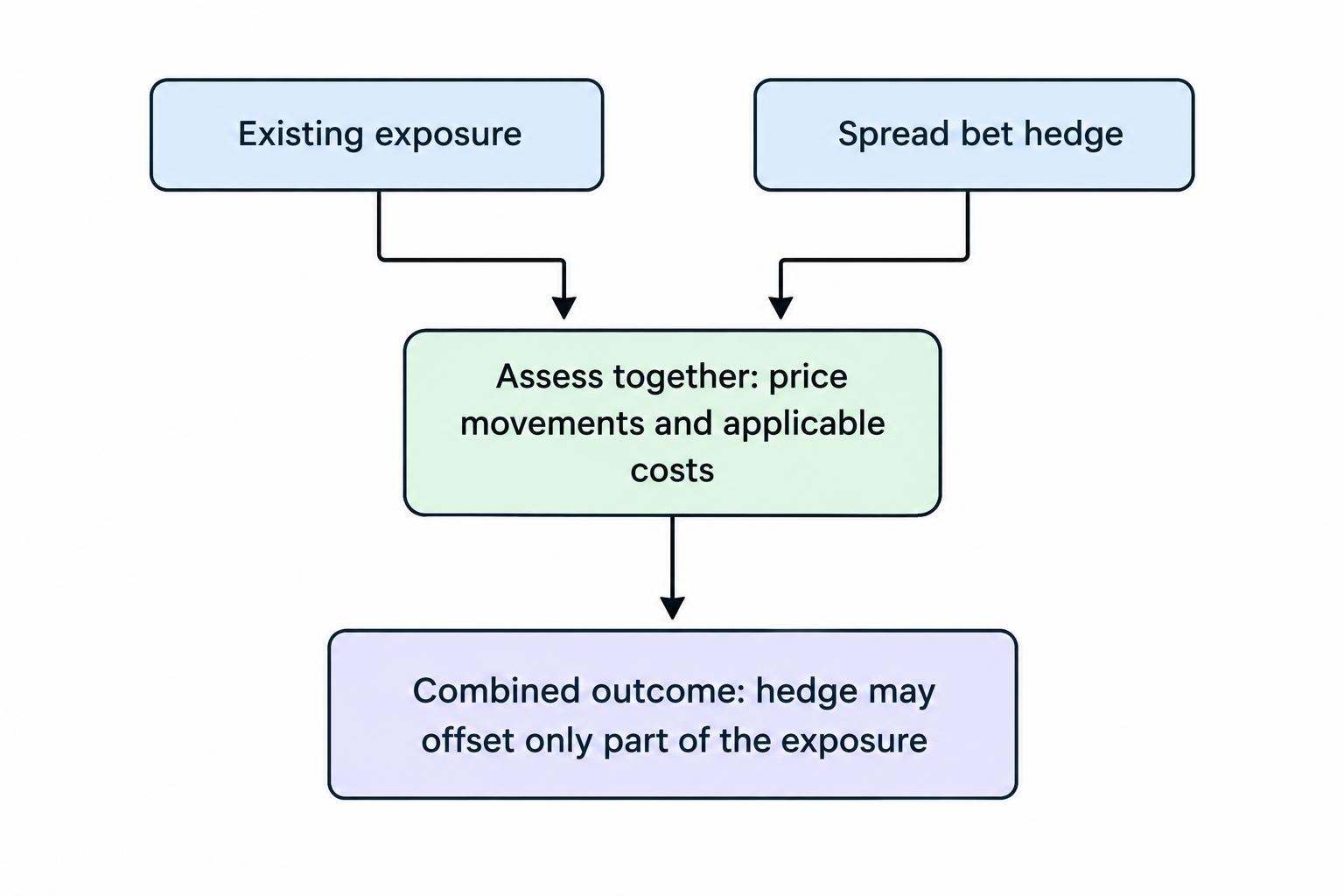
Hedging with financial spread betting means opening a position intended to offset some of the risk in an existing investment, portfolio or financial exposure. An investor holding shares might sell an index spread bet so that a market fall generates a gain on the hedge while reducing the value of the shares. The purpose is to change the combined outcome, rather than judge the spread bet as an isolated trade. Protection is rarely exact: the investments and hedge may move differently, costs accumulate, and the spread betting account needs sufficient funding. This guide explains how to structure a hedge, calculate its size, assess its limitations and decide whether a simpler reduction in exposure would meet the same objective.
Using a leveraged product for protection does not remove the risks of that product. The Financial Conduct Authority includes spread betting within its CFD product supervision and describes these products as high risk and unsuitable for some retail consumers. A hedge can lose money while the investment it protects rises, and that loss may require cash in a separate account before the investment gain is realised. The examples below are hypothetical educational illustrations, not recommendations or forecasts. Their prices, charges and relationships are assumptions. Before using a real contract, establish its point value, dealing hours, financing terms and margin arrangements, and consider the result across the entire position being protected.
What Is Hedging in Spread Betting?
A hedge is a position designed to respond favourably to a specified adverse movement elsewhere. If the exposure being protected loses value when an equity market falls, a short position in a suitably related market may provide an offset. If the original exposure instead suffers when a price rises, a long hedge may be relevant. Direction alone is insufficient: the amount, timing and relationship between the positions must also fit. Buying gold because it sometimes rises during uncertainty, for example, does not establish a dependable hedge for every share portfolio. The starting point is to identify the particular loss mechanism, then assess whether the proposed spread bet addresses it under realistic scenarios.
Financial spread bets express exposure through a monetary stake per point. A short spread bet gains when its closing buy price is below its opening sell price, while a long spread bet gains when its closing sell price is above its opening buy price. The spread, funding and other adjustments affect the final result. When hedging, that result must then be combined with the change in the original asset or liability. A profitable short hedge accompanying a larger portfolio loss has provided only partial protection. Conversely, a losing hedge accompanying a larger investment gain may have worked exactly as intended by reducing the combined sensitivity to market direction.
Hedging, Speculation and Diversification
The distinction between hedging and speculation depends on the relationship to an existing exposure. Selling an index without holding anything that benefits from its rise is ordinarily a directional short trade. Selling the same index against a related share portfolio may reduce market exposure. However, the label does not guarantee that the size is appropriate. A hedge larger than the exposure it offsets can turn the combined position into a net bet on a decline. The same problem arises when the investments are sold but their short hedge remains open. A hedging plan therefore needs to track both sides, with clear rules for reducing or closing protection when the original exposure changes.
Diversification spreads capital across different assets or sources of return, while hedging adds an exposure intended to counter a particular risk. Both approaches depend on relationships that can change, but their objectives and costs differ. A diversified portfolio may still fall when broad markets decline. A short index hedge can reduce part of that market sensitivity, while leaving company-specific risks untouched. Pairs trading introduces another distinction: a long and short pair often seeks to profit from relative performance, rather than protect an investment already held. These approaches can overlap, but the trader should be able to state which risk is being reduced and which risks remain deliberately or accidentally in place.
Who Might Hedging With Spread Bets Suit?
Hedging may be relevant to an experienced investor or trader who has an identifiable exposure, a defined reason for retaining it, and enough liquid capital to support a separate derivative position. For example, someone may want to reduce broad market sensitivity temporarily while continuing to hold a portfolio for a longer investment objective. That does not establish spread betting as the best instrument, but it creates a question that can be assessed. The person also needs to understand the relationship between the holdings and the hedge, monitor changing exposure, and accept that reducing downside participation normally reduces upside participation as well. A hedge is a trade-off that requires ongoing decisions.
It is generally a poor fit when the original portfolio is already too risky, cash is tight, or the trader expects protection without sacrificing gains. Adding a leveraged short can make an unsuitable investment arrangement more complicated without resolving its underlying problem. Small portfolios may also be difficult to hedge accurately if the contract’s minimum stake is too large. Beginners face the additional challenge of managing two related positions and reconciling their combined performance. Demonstration practice can help explain the mechanics, but it cannot make an unreliable relationship dependable. If simply selling part of the investment would achieve the desired risk reduction at lower cost and with fewer moving parts, that alternative deserves serious consideration.
Advantages and Disadvantages of Spread Betting Hedges
The main potential advantage is flexibility. A spread bet can alter exposure without requiring the immediate sale of every holding, and an index position can address part of the market risk in several investments at once. Subject to the available stake increments, the hedge can also be sized to reduce rather than eliminate exposure. This may be useful when the objective is temporary or when selling the underlying holdings would involve separate practical considerations. However, retaining ownership does not mean retaining all of its economic upside: a short hedge can offset gains as prices rise. The benefit should be evaluated as a change in the portfolio’s risk profile, not as an additional source of guaranteed profit.
| Potential advantage | Corresponding limitation |
|---|---|
| Reduce exposure without immediately selling holdings | The hedge can offset investment gains as well as losses |
| Hedge several holdings through one index | The portfolio may behave differently from that index |
| Choose a partial hedge | Minimum stakes and imperfect relationships limit precision |
| Adjust protection as circumstances change | Adjustments create costs and opportunities for timing errors |
| Retain the underlying investment | A separate spread betting account still needs cash |
| Use a position for a defined period | Funding, expiry and exit arrangements must match that period |
The disadvantages are most visible when the two sides stop moving as expected or cannot be managed together. An index can rise while a concentrated share portfolio falls, creating losses on both the investments and the short hedge. Even a close economic match can produce cash-flow pressure if the hedge loses in one account while gains remain unrealised elsewhere. Costs can also make a prolonged hedge expensive, especially when the intended protection period repeatedly extends. These limitations mean that effectiveness should be measured against a stated objective, such as reducing exposure to a broad market fall over a particular period. “Make the portfolio safe” is too vague to support a workable calculation or review process.
Choosing the Exposure and Market to Hedge
Begin by separating the risks in the original position. A portfolio of overseas shares can contain company risk, broad equity market risk and currency risk. A short equity index addresses a different component from a currency spread bet. Similarly, a domestic index hedge may be a weak match for a portfolio concentrated in a small sector or a few companies. The fact that both positions are described as equities does not ensure that their returns will align. Write down the exposure in monetary terms and identify what would cause it to lose value. Then select a possible hedging market based on that mechanism, rather than choosing whichever contract currently has the tightest spread.
| Existing exposure | Possible spread betting hedge | What may remain unprotected |
|---|---|---|
| Diversified share portfolio | Short a suitably related equity index | Company-specific returns, composition differences and changing sensitivity |
| Holding in one listed share | Short a spread bet on the same share, if available | Contract costs, execution differences and corporate action mismatches |
| Foreign-currency assets valued in sterling | Currency position in the direction that offsets sterling translation losses | Changes in the assets’ foreign-currency value and imperfect hedge sizing |
| Existing short market exposure | Long the same or a sufficiently related market | Differences in instrument behaviour, timing and costs |
| Sector-heavy portfolio | Short a relevant sector or broader index | Differences between individual holdings and the hedge constituents |
How to Calculate an Index Hedge
For a simple sterling portfolio assumed to move proportionately with a sterling-per-point index contract, the approximate full hedge stake is portfolio value divided by the index level. A £40,000 portfolio and an index at 8,000 imply £5 per whole index point: £40,000 divided by 8,000. A 1% index move is 80 points, producing £400 of price profit or loss on that stake, which matches 1% of the portfolio’s starting value. This calculation assumes a suitable relationship, consistent price units and no separate currency mismatch. It estimates market exposure rather than a guaranteed loss offset, and it excludes spread, funding, dividends and changes in the portfolio’s composition or value.
For portfolios with different market sensitivity, beta can refine the estimate. CME Group’s explanation of equity portfolio hedging describes using portfolio beta to size index futures hedges. Applying the same exposure principle to a compatible spread bet gives an approximate stake of portfolio value multiplied by beta and the desired hedged fraction, divided by the index level. This is an adaptation of the sizing principle, not a claim that spread bets and exchange futures have identical terms. With £40,000, beta of 1.2, a 50% hedge and an index at 8,000, the stake is £3 per point. Under the model, it removes half the estimated market sensitivity while leaving other risks.
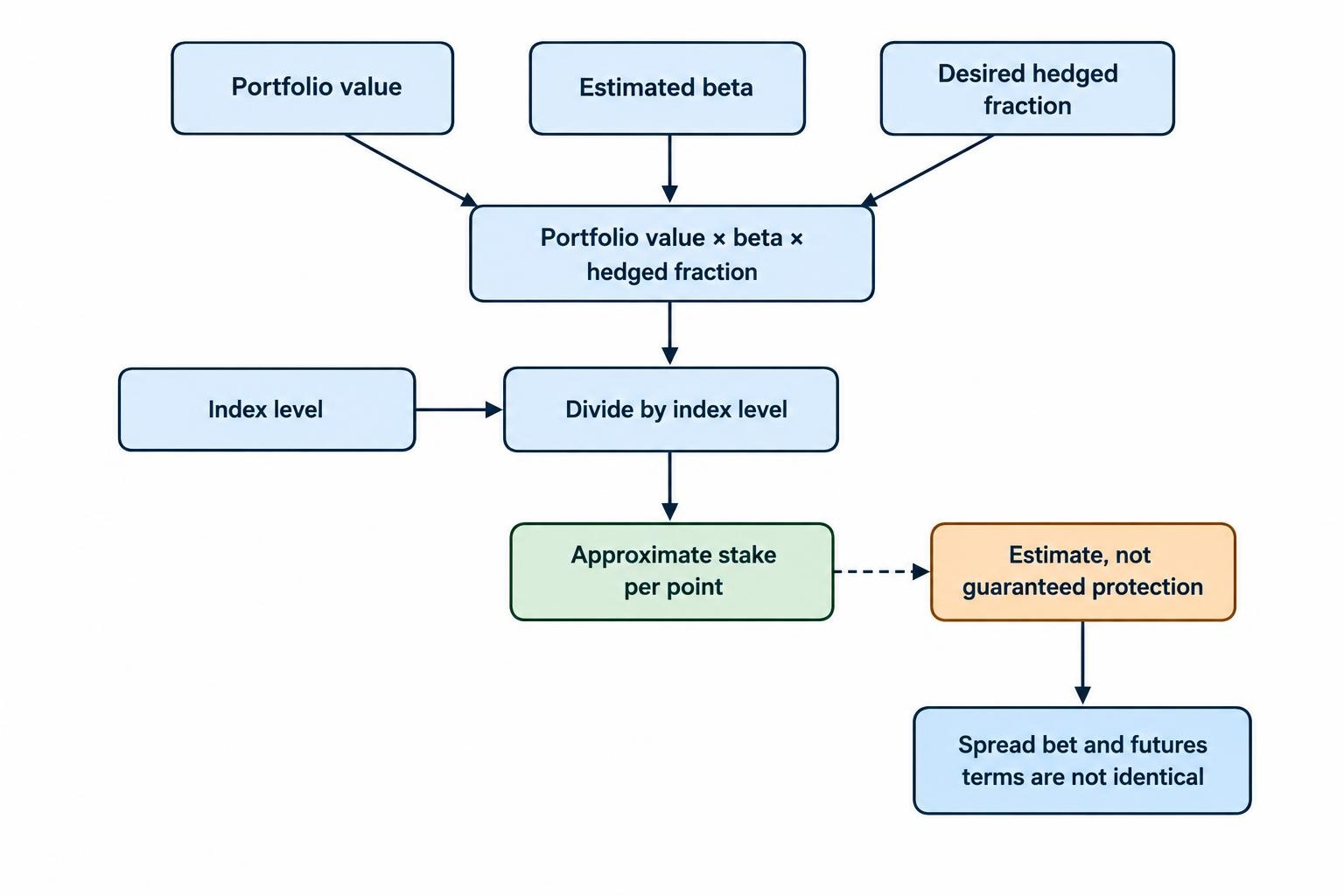
Beta is an estimated sensitivity, not a promised relationship. It depends on the chosen benchmark, observation period and return data, and it can change as the holdings or market environment change. A portfolio with a historical beta of 1.2 does not necessarily fall 12% whenever the index falls 10%. Company news, sector concentration and valuation changes can produce very different outcomes. Correlation also matters: a noisy relationship can leave substantial risk even where a beta estimate is available. Avoid treating a precise-looking number as evidence of precise protection. The portfolio correlation guide provides the wider context for assessing whether several positions share risks and how those relationships can behave under stress.
Practical Example: Hedging a Share Portfolio With an Index Spread Bet
Assume a hypothetical £40,000 portfolio is expected to track a chosen index closely over a short period. The index spread bet is quoted at 8,000/8,002, with the first number being the sell price and the second the buy price. The investor sells at 8,000 for £5 per whole index point. If the market falls approximately 5%, the portfolio is assumed to lose £2,000 and the closing spread betting quote is 7,600/7,602. Buying back at 7,602 produces 398 points of profit, or £1,990. Assume £30 of net holding costs and no dividends during the period. The hedge gains £1,960 after costs, leaving a combined loss of £40.
| Hypothetical outcome | Change in portfolio | Closing buy price of hedge | Hedge result after £30 holding costs | Combined result |
|---|---|---|---|---|
| Portfolio and index fall 5% | −£2,000 | 7,602 | +£1,960 | −£40 |
| Portfolio and index rise 5% | +£2,000 | 8,402 | −£2,040 | −£40 |
| Portfolio and index remain unchanged | £0 | 8,002 | −£40 | −£40 |
| Portfolio falls 8%; index falls 5% | −£3,200 | 7,602 | +£1,960 | −£1,240 |
| Portfolio falls 3%; index rises 2% | −£1,200 | 8,162 | −£840 | −£2,040 |
The first three rows show the intended trade-off under a close relationship: much of the market movement is offset, leaving dealing and holding costs. The final two rows show why an index hedge cannot guarantee the portfolio’s value. In the last scenario, weak holdings lose money while the index rises, causing a simultaneous loss on the hedge. The spread is already included through the actual sell and buy prices and should not be deducted again. These simplified calculations also exclude tax and assume that the position remains open throughout the period. A forced closeout, an early discretionary exit or different financing and dividend adjustments would change the combined result.
What Changes With a Partial Hedge?
A partial hedge retains more participation in both directions. Using the same £40,000 portfolio and assumed one-for-one relationship, a £2.50-per-point short would offset roughly half the initial index exposure. If the portfolio falls £2,000 and the hedge closes at 7,602, the gross hedge gain is £995. Assuming £15 of holding costs for this smaller position, the net hedge gain is £980 and the combined loss is £1,020. If the portfolio instead gains £2,000 and the hedge closes at 8,402, the hedge loses £1,005 before costs and £1,020 afterwards, leaving a £980 combined gain. Partial protection therefore reduces both downside and upside; it does not preserve the full upside while selectively removing losses.
Practical Example: Hedging an Individual Shareholding
Suppose an investor owns 1,000 shares valued at 500p each, giving a £5,000 holding. Every penny of share price movement changes that holding’s value by £10, so a matching price hedge would use a short stake of £10 per penny, assuming the contract permits it. The hypothetical spread bet is quoted at 500p/502p, and the investor sells at 500p. Later, the share valuation falls to 450p and the spread bet is quoted at 450p/452p. The shares have lost £500, while buying back the hedge at 452p generates £480. With £15 of assumed funding and borrowing costs, the combined result is a £35 loss, excluding dividends and tax.
If the share valuation instead rises to 550p and the hedge closes at the buy quote of 552p, the shares gain £500 while the short loses £520 before the same assumed £15 costs. The combined result is again a £35 loss. This close match illustrates how a full price hedge can largely suspend exposure while ownership continues. It also raises a practical question: why retain both sides instead of reducing the holding? There may be an investment or administrative reason, but the arrangement still requires financing and management. Check short availability, borrowing terms, corporate action treatment and dealing hours rather than assuming that a spread bet on the same name reproduces every feature of owning the shares.
Hedging Currency Exposure With Spread Bets
Currency hedging requires particular care with direction and quotation. A sterling-based investor holding a fixed US dollar amount loses sterling value when the pound strengthens against the dollar. A long GBP/USD spread bet can provide an offset because that currency pair rises when one pound buys more dollars. Selling GBP/USD would increase this particular exposure rather than hedge it. A foreign share portfolio creates an additional complication because the dollar value of the holdings can change at the same time. A currency hedge addresses the translation component, not the shares’ own investment performance. Check whether an existing fund or instrument already hedges its currency exposure before adding another position that could duplicate or reverse its intended effect.
For a simplified sensitivity example, assume $10,000 remains unchanged and GBP/USD is 1.2500. Its sterling value is £8,000. Near that rate, an approximate matching long stake is £0.64 per 0.0001 pip, calculated as $10,000 divided by 1.25 squared, multiplied by 0.0001. If GBP/USD rises to 1.3000, the dollar holding becomes approximately £7,692.31, a £307.69 decline. A 500-pip rise earns £320 on the unchanged £0.64 stake. This illustration excludes spreads and funding to isolate sensitivity. The £12.31 difference shows that a fixed sterling-per-pip bet does not exactly reproduce the curved conversion relationship over a larger move. Changing exchange rates or asset values may require reassessment rather than a permanent fixed stake.
Margin: Why an Effective Hedge Can Still Run Out of Cash
The hedge needs financing in its own account even when the combined investment position appears stable. In the index example, £5 per point at 8,000 represents approximately £40,000 of exposure. At an assumed 5% opening margin requirement, £2,000 would be needed to open the position. The FCA’s retail rules set a minimum 5% opening margin for major equity indices, while firms may require more. That opening amount is not the total cash commitment needed to maintain the hedge. If the market rises, the short accumulates losses, and unrealised gains on shares held elsewhere do not automatically transfer into the spread betting account or become available as collateral.
Suppose £3,000 is placed in the spread betting account supporting the £5-per-point short. A rise from the opening sell price of 8,000 to a buy quote of 8,402 produces a £2,010 unrealised loss before funding, leaving approximately £990 of account equity. Although the matching portfolio may have gained £2,000, the hedge account now has very little capacity relative to its margin requirement and could face forced closure under the applicable arrangements. If the market then reverses after the hedge is closed, the portfolio remains exposed without its intended protection. Stress testing must therefore examine the path of cash requirements, not merely compare the combined values at the intended end date.
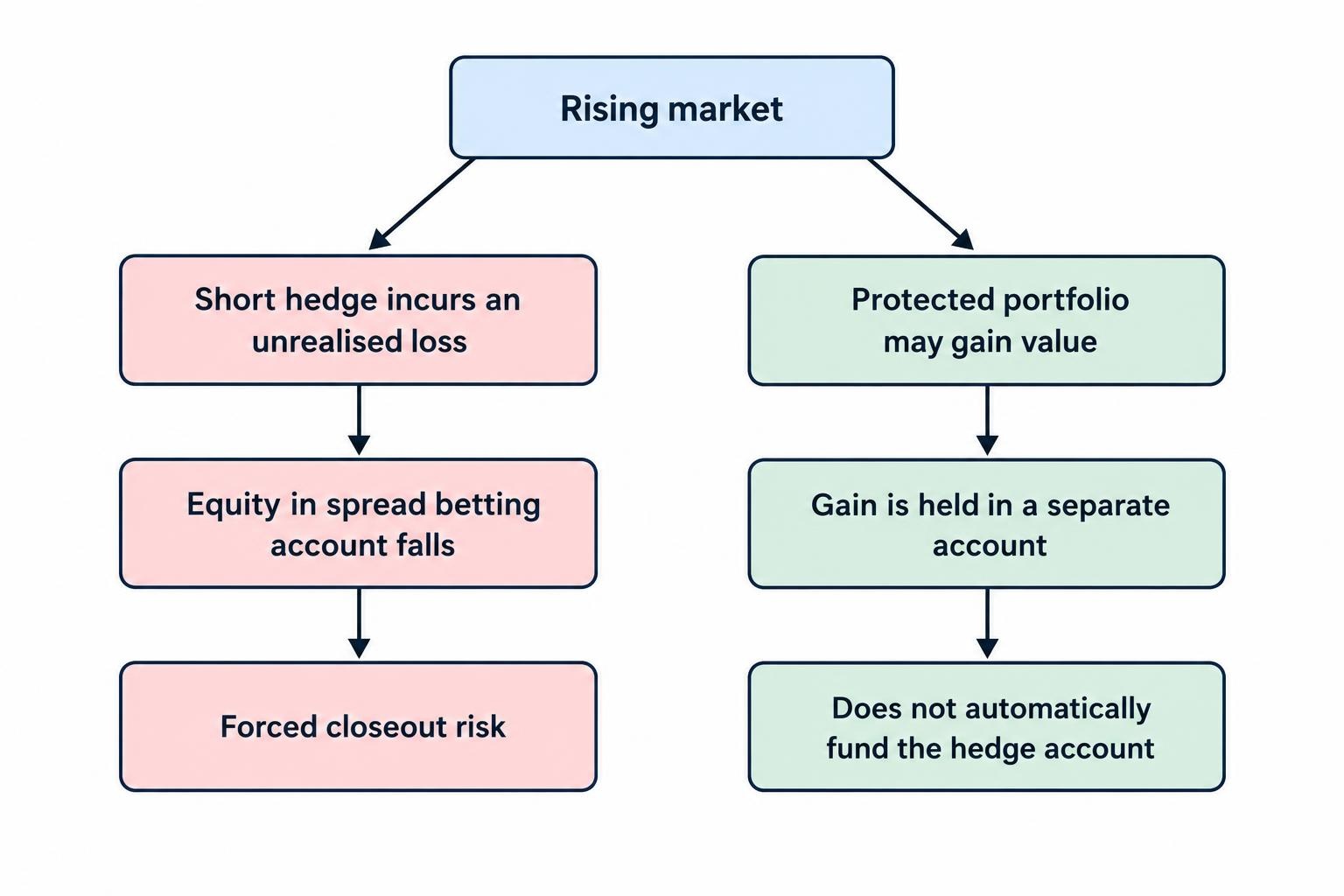
The FCA’s retail rules require margin closeout as soon as market conditions allow when account net equity falls below 50% of the required margin, and limit liability for covered investments to funds in the relevant account. These protections do not guarantee that a hedge remains open or that invested cash is preserved. Other positions and charges in the account also affect the available equity. Understand the provider’s calculation, its contractual rights and any higher requirements before relying on a hedge. A plan based on transferring money only after an alert arrives can fail when markets move rapidly, payment access is delayed or the trader is unavailable to respond.
Funding, Borrowing Costs and Dividend Adjustments
Daily funded hedges can accumulate costs throughout the protection period. A short position should not be assumed to earn interest: the FCA’s review of CFD pricing and value found differences in whether comparable short positions attracted a charge or credit, and highlighted funding applied to full underlying exposure. Share shorts can also involve borrowing charges under the contract terms. For an arithmetic illustration, £20,000 of unchanged exposure charged at an assumed net annual rate of 6% on a 365-day basis costs approximately £98.63 over 30 funding days. This is not a current rate or universal formula. Estimate the actual product’s costs, including what happens if the intended hedge period doubles.
Dividends need to be considered on both sides of an equity hedge. The physical holding may receive a dividend, while a related short spread bet may incur a dividend adjustment under its terms. The price movement associated with going ex-dividend must also be included, so the cash receipt should not be counted as an independent windfall. An index hedge introduces further differences because its adjustments reflect the index constituents rather than necessarily matching the investor’s holdings. Timing, deductions and contract methodology can leave a residual difference. Reconcile the investment’s price change and income with the hedge’s dealing result and adjustments, using the dividends guide to understand the mechanics before holding across relevant dates.
Daily Funded or Dated Contracts for Hedging?
A daily funded contract makes ongoing financing visible through account adjustments, while a dated contract may incorporate financing and other factors into its quoted price. A dated hedge therefore should not be treated as free to hold merely because no separate nightly debit appears. Its spread, price basis, expiry and rollover arrangements can change the total cost. Compare alternatives over the intended protection period and under a longer-than-expected holding scenario. If a hedge must continue beyond expiry, specify how it will be replaced and what additional dealing costs or temporary exposure may arise. A price difference between expiries is not automatically a gain or loss; the full settlement and adjustment process determines the economic result.
Why Opposite Spread Bets Are Not a Loss-Recovery Strategy
Opening an equal and opposite spread bet against an existing spread bet is different from hedging an investment held elsewhere. Depending on the platform settings, the new order may reduce the original position or create a separate opposing position. Where two matched contracts remain open, their directional effects may largely cancel while charges continue. The FCA’s pricing review specifically identified costs associated with keeping matched long and short CFD positions open, including funding on both sides. Such an arrangement should be compared with closing or reducing the original trade. Calling it a hedge does not establish a financial advantage or remove the need to recognise the combined loss and costs.
For example, imagine a trader bought an index at 8,000 for £1 per point and it later falls to 7,800. Ignoring spreads and charges solely to illustrate the directional arithmetic, opening a £1-per-point short at 7,800 leaves the combined position approximately £200 down. If the index falls to 7,700, the long loses £300 and the short gains £100. If it rises to 7,900, the long loses £100 and the short loses £100. The combined loss remains £200 before costs. Closing one side later reintroduces directional exposure and requires another timing decision. The offset has not repaired the earlier trade; it has temporarily neutralised its subsequent price sensitivity.
Stops, Gaps and the Risk of Losing Protection
A stop on a hedge limits the hedge’s intended standalone loss but can also remove the protection the wider portfolio depends on. A short index hedge might be stopped during a rally just before the market reverses and the underlying shares fall. That does not mean stops are inappropriate; it means the stop must be designed as part of the combined plan. An ordinary stop also does not guarantee its execution price when a market gaps. A guaranteed stop, where available and valid under the terms, can address the hedge’s stop execution risk for an additional cost, but cannot guarantee the value of a separate investment portfolio. See stop-losses and guaranteed stops for their different functions.
Dealing hours can prevent the two sides from being adjusted together. An index spread bet might remain available when the underlying shares cannot be traded, or a share contract could be unavailable during an important announcement. Different quotes and execution times can create an unprotected interval when establishing or removing a hedge. Corporate actions, trading suspensions and changes in short availability introduce further practical risks. The investment and hedge may also involve different financial institutions, so economic offset does not eliminate counterparty or operational risk. Map out which position can be dealt at each stage and how orders work during market breaks. The overnight trading guide explores these issues when protection must remain in place across sessions.
How to Get Started With a Hedging Plan
Start with a written objective that is specific enough to test: for example, reduce an estimated portion of a portfolio’s broad market sensitivity for a defined period. Record the holdings’ current value, the chosen reference market, the sizing assumptions and the risks deliberately left uncovered. Compare the proposed hedge with selling part of the exposure before choosing the instrument. If opening a spread betting account, follow the FCA’s guidance on checking authorisation, including permissions and contact details. Regulatory status does not establish that a hedge is effective. The actual contract and account terms must still fit the planned market, duration, stake and available capital before the arrangement can be assessed properly.
Next, calculate outcomes for a rise, a fall, a flat market and a breakdown in the expected relationship. Include the underlying investment, the hedge’s actual dealing sides, funding, borrowing, dividends and the cash needed to keep the hedge open. Practise the process in a demonstration account and a separate record of the combined position. Check whether the contract’s minimum stake and increments allow sensible sizing, and whether the trading platform nets opposite orders or keeps them separate. A demonstration account can reveal mechanical mistakes, but it cannot establish live execution quality or the future stability of the relationship. The proposed arrangement should remain understandable when one side loses heavily, not only in the scenario it was designed to offset.
Rebalancing and Removing a Hedge
A hedge should be reviewed when portfolio value, holdings, market sensitivity or the original objective changes. Selling part of the underlying portfolio without reducing its short hedge can leave too much protection and create net short exposure. Rebalancing after every small movement, however, can produce excessive dealing costs and turn risk management into constant market timing. A practical plan specifies review dates or meaningful exposure thresholds in advance. The review should consider whether the original relationship still holds, whether the expected duration has changed and whether costs remain acceptable. It should also ask whether reducing the original investment has become a clearer solution than continuing to maintain a separate leveraged position.
Removal needs a plan just as much as entry. A hedge established for an event might be reviewed after that event, while one created for a temporary allocation decision might end when the allocation changes. Waiting until the short hedge shows a profit can defeat the objective by keeping protection in place through a rising market for much longer than intended. When the hedge closes, the underlying exposure returns immediately unless the holdings are also reduced. Record that decision explicitly and check for leftover orders that could reopen or alter exposure later. If the underlying asset is sold first, the remaining hedge becomes a standalone directional position until it is closed or otherwise matched.
Tax Treatment: Assess Both Sides Separately
Do not assume that a hedge’s tax treatment automatically matches the investment it protects. HMRC’s general guidance on betting and gambling explains that betting profits are not normally taxable and losses are not normally relieved. Its specific spread betting guidance says that the terms and economic substance matter, including whether the activity arises from carrying on a trade. This is especially relevant when considering a hedge linked to commercial activity rather than a straightforward personal investment. Companies have separate considerations. The tax position should therefore be checked for the actual circumstances, rather than treating the word “spread bet” as a complete tax analysis.
Even where the ordinary treatment applies to a personal spread bet, the underlying investment may have a different tax position. An economic gain on one side and loss on the other should not be assumed to cancel for tax purposes. Likewise, retaining an asset while hedging it does not by itself answer every question about the wider arrangement. Compare the combined result after any relevant taxes, charges and restrictions, and obtain suitable advice where those issues are material. Tax treatment can affect instrument choice, but it cannot make an unreliable hedge effective or fund a losing spread betting account. The investment rationale, cash requirements and quality of the offset still need to stand on their own.
How to Judge Whether a Hedge Has Worked
Judge the hedge against its original risk objective, using the combined investment and derivative result. Relevant measures include how much the targeted exposure changed, the size of losses under adverse scenarios, the cash required during the holding period and the total cost of protection. A losing hedge can have served its purpose during a rising market, while a profitable hedge can still leave an unacceptable portfolio loss. Compare the outcome with remaining unhedged and with the practical alternative of reducing the holding. Hedging belongs within a wider spread betting strategy only when the trader understands the exposure being offset, the potential gains being given up, and the conditions under which the arrangement should be adjusted or ended.