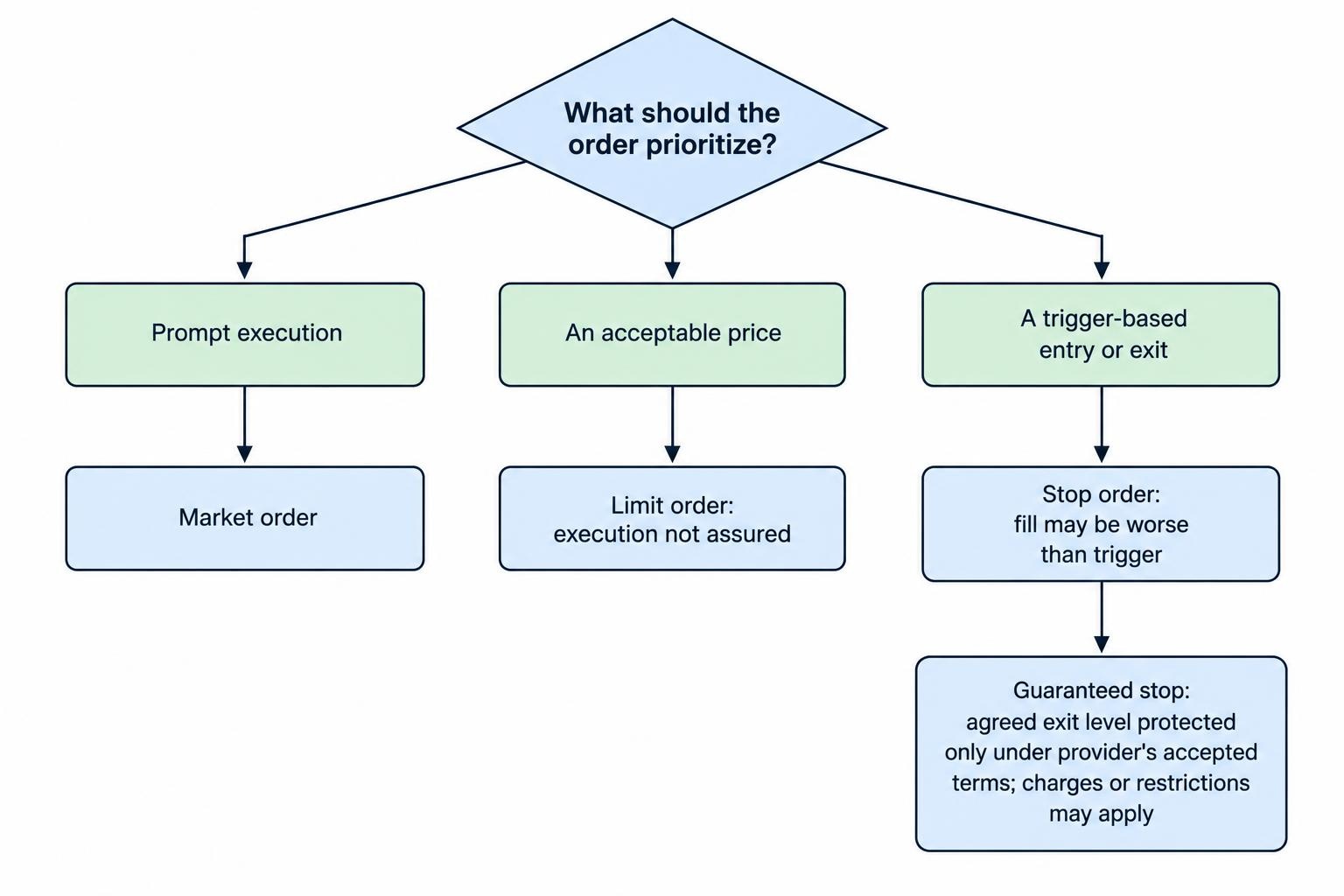
Spread betting order types determine when a trade opens or closes, what price conditions apply, and how an exit responds when the market moves. Market orders request execution now. Limit orders set an acceptable price or better. Stop orders activate after a trigger level is reached, either to enter a trade or close an existing position.
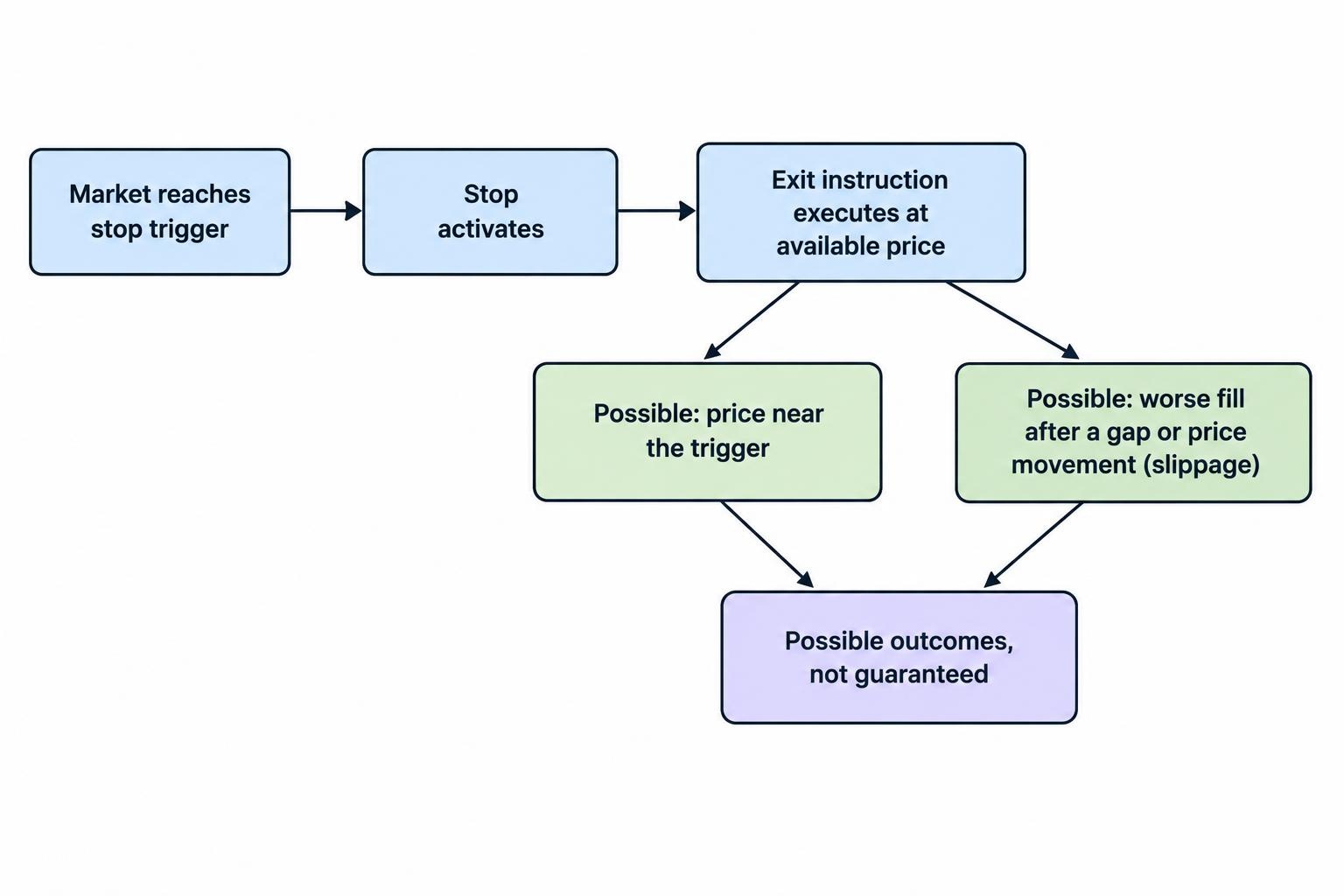
The distinction matters because a trigger price is not always an execution price. An ordinary stop can suffer slippage, while a limit order can remain unfilled. Choosing an order means deciding which matters more: getting the trade done, controlling the price, or protecting an exit level.
The main spread betting order types
Opening and closing orders describe an instruction’s purpose. Market, limit and stop describe its execution conditions. A sell order could open a short bet or close a long bet; the direction alone does not tell you which.
| Order type | Typical purpose | Main limitation |
|---|---|---|
| Market order | Open or close at the available dealing price | The displayed price may change before execution |
| Limit order | Buy at a maximum price or sell at a minimum price | Execution is not assured |
| Stop-entry order | Open after the market reaches a trigger level | The fill can be worse than the trigger |
| Stop-loss order | Close an existing position after an adverse move | An ordinary stop does not guarantee the exit price |
| Guaranteed stop | Close at an agreed level under the guarantee’s terms | Charges and placement restrictions may apply |
| Trailing stop | Move an exit level as the market moves favourably | Ordinary trailing stops remain exposed to slippage |
These labels provide a starting point, not a substitute for the order ticket. Check whether the instruction opens a new bet, closes a named position, or applies to your net exposure. Available features and execution conditions depend on the provider’s contract.
Market orders: requesting a trade now
A market order requests an immediate purchase or sale at the available dealing price. It suits an instruction where entering or exiting promptly matters more than specifying an exact level.
Suppose a hypothetical index is quoted at 8,000–8,002. The lower price is the sell price and the higher price is the buy price. You submit a market order to buy at £2 per point. If the quote remains available, the opening level would be 8,002. If prices move before acceptance, the execution level may differ.
A market instruction prioritises execution rather than price certainty, the central distinction in FINRA’s comparison of common order types. That general principle does not mean every spread betting request must be accepted. Check the confirmation rather than treating a button press as proof of a completed trade.
Limit orders: setting an acceptable price
A limit order sets the worst price you will accept: a maximum purchase price or a minimum sale price. For a pending entry below or above the current quote, it lets you wait rather than chase the market.
Using the same 8,000–8,002 quote, a buy limit at 7,980 seeks entry after the buying price falls. A sell limit at 8,030 seeks a higher selling price. A limit can also close an existing bet at a profit target. After buying at 8,002, you might attach a closing sell limit at 8,052.
Limits control price if execution occurs; they do not promise execution. That distinction is reflected in the SEC’s definitions of market and limit orders. A level appearing on a chart does not, by itself, establish that your spread betting order qualified for a fill under the provider’s pricing and execution terms.
Stop orders: separate entries from exits
Stop-entry orders
A stop-entry order waits for the market to reach a trigger before opening a bet. A buy stop normally sits above the current buying price; a sell stop normally sits below the current selling price.
A trader waiting for an upward breakout might place a buy stop at 8,020 rather than buy immediately at 8,002. The instruction says to enter once that threshold is reached. It does not say to buy only at 8,020 or less.
The difference can be costly at an opening gap. A Financial Ombudsman decision concerning a spread betting stop-entry order examined a buy stop set at 900 that executed at 968.8 after the market opened higher. The order record identified a stop, not the limit order the customer believed they had submitted.
Stop-loss orders
A stop-loss order uses a trigger to close an existing position. A long bet needs a selling exit below the current selling price. A short bet needs a buying exit above the current buying price.
Despite the name, a stop loss can protect an unrealised profit. A long position opened at 8,002 could later have its stop moved to 8,030 after a rise. What matters is its relationship to the current market, not whether the exit would show a loss against the original entry.
Guaranteed stops: protecting the agreed exit level
A guaranteed stop-loss order changes the exit commitment. Once accepted under the provider’s terms, it protects the agreed stop level rather than leaving that exit exposed to ordinary stop slippage.
Consider a long bet opened at 8,002 with a guaranteed stop at 7,972. If the market gaps below that level, the accepted guarantee protects the 7,972 exit. The protection against gaps is distinct from account-level margin controls, addressed in ESMA’s guidance on guaranteed stops and margin close-out.
Before submitting the trade, check the premium, when it becomes payable, the minimum permitted distance, and whether the stop can be amended. Do not assume a standard stop becomes guaranteed because you have placed it far from the market. The confirmation should identify the guarantee expressly.
A protected exit price also does not remove financing charges or other applicable costs. Calculate the cash exposure using the accepted entry, guaranteed stop and any charges.
Trailing stops: moving an exit with the market
A trailing stop adjusts as price moves in your favour but does not move back when price reverses. For a long position, the stop rises; for a short position, it falls.
Suppose a hypothetical long position uses a 30-point trailing distance. If the relevant selling price rises from 8,000 to 8,050, the stop could advance from 7,970 to 8,020. A subsequent fall would leave the stop at 8,020, subject to the platform’s trailing rules.
Trailing does not itself guarantee execution at the stop. The SEC bulletin on stop, stop-limit and trailing stop orders distinguishes an adjusting trigger from a guaranteed fill. Check whether your platform uses a continuous distance, a step size, or another adjustment method before relying on the displayed stop.
Stop-limit orders and linked exits
A stop-limit combines two instructions: a trigger and an acceptable execution boundary. Once triggered, it becomes a limit order rather than an unrestricted market instruction. Availability varies, so do not assume every spread betting platform supports it.
The trade-off is non-execution. A selling stop-limit might trigger at 7,970 but prohibit selling below 7,965. If the market gaps to 7,940, the position could remain open. It is not a guaranteed stop.
Linked orders solve a different problem. Where a platform offers one-cancels-the-other instructions, a completed stop exit can cancel its paired profit-taking limit, or vice versa. A bracket generally combines an entry with associated exit instructions.
Check what happens after a partial close or manual exit. Two independent orders are not necessarily a linked pair. Leaving a standalone order active after its intended position has closed can create an unwanted later trade.
Which price triggers the order?
Spread betting quotes have a buying side and a selling side. Generally, a long position closes by selling at the bid, while a short position closes by buying at the offer. Use the provider’s stated trigger basis rather than assuming a chart’s default line is the relevant price.
Suppose the quote is 8,000–8,002 and your short position has a buying stop at 8,003. If the offer rises to 8,003, the stop may trigger even though a chart displaying only the selling price remains below it. A widening spread can therefore matter as well as a directional move.
After activation, a price difference between the intended level and the actual fill is slippage. Keep trigger conditions and execution outcomes separate when reviewing a trade.
A worked example: entry, stop and profit target
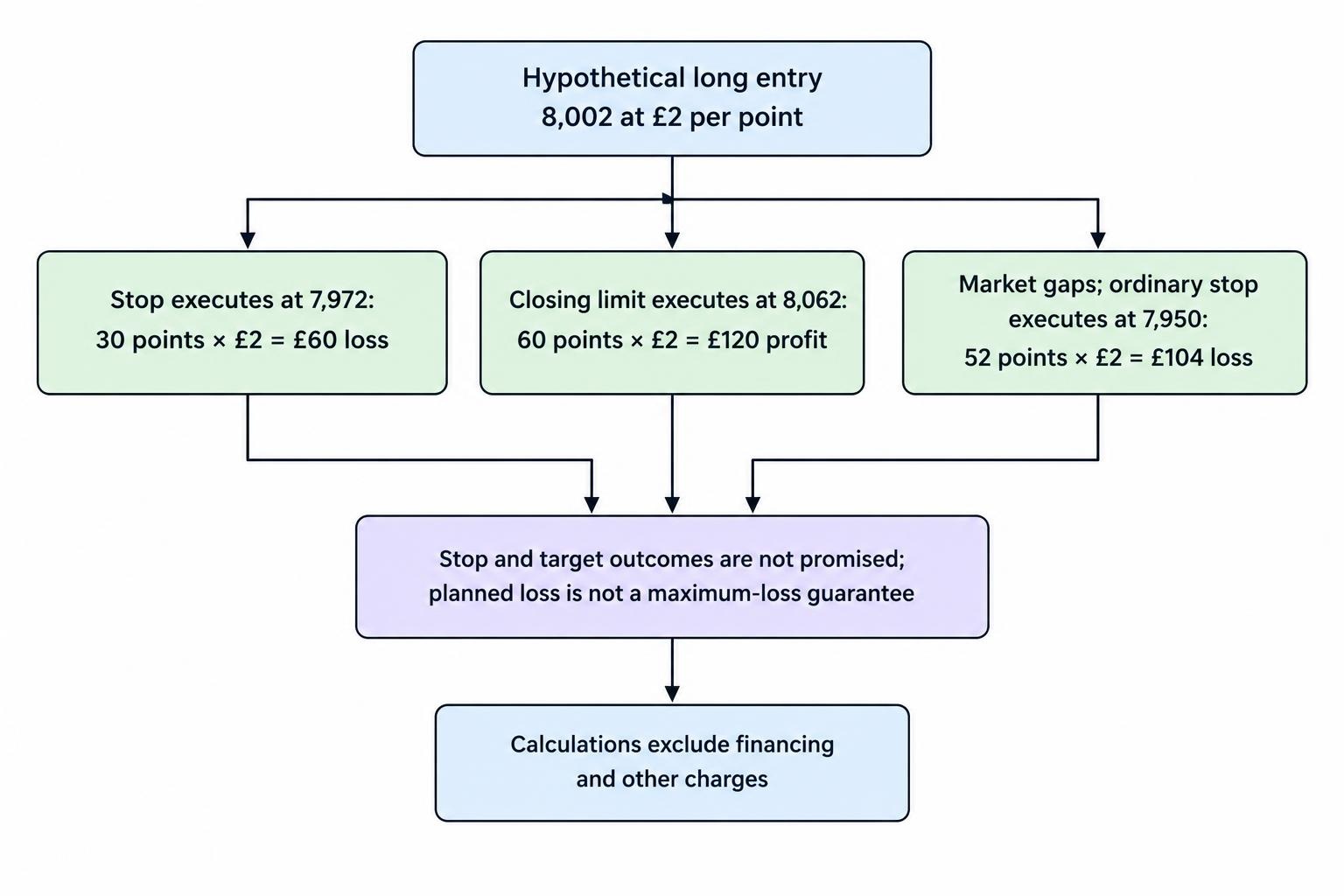
Assume a hypothetical index has a one-point dealing unit. You buy at 8,002 for £2 per point, attach an ordinary stop at 7,972 and set a closing limit at 8,062. The following calculations exclude financing and other charges.
If the stop executes exactly at 7,972, the loss is 30 points × £2, or £60. If the closing limit executes at 8,062, the profit is 60 points × £2, or £120. The planned reward is twice the planned loss, but neither outcome is promised.
Now suppose the market gaps down and the ordinary stop executes at 7,950. The loss becomes 52 points × £2, or £104. The stop triggered an exit; it did not cap the loss at £60.
Use position sizing to connect the stake with the stop distance. A £60 planned loss allowance over 30 points gives £2 per point before costs and slippage. Treat that figure as a planning calculation, not a maximum-loss guarantee. Also verify that the trade fits the account’s margin requirements.
Order duration and the final ticket check
An order’s duration determines how long an unfilled instruction remains active. A day order expires at the provider’s defined session end. Good till cancelled generally remains active until filled or cancelled, subject to the provider’s expiry and contract rules. A dated order uses a chosen expiry time.
Order expiry and bet expiry are different. One concerns an unfilled instruction; the other concerns an open contract. Check the time zone and treatment of orders attached to expiring markets.
- Purpose: Does the order open a bet or close the intended position?
- Size: Is the stake expressed in the correct currency and amount per point?
- Price: Have you entered a trigger, a limit, or a distance from the market?
- Status: Has the provider accepted the instruction, amendment or cancellation?
Account controls can also close positions independently of your chosen stop. For UK retail accounts within scope, FCA COBS 22.5 margin close-out rules require firms to close open positions as soon as market conditions allow when net equity falls below 50% of the required margin. A stop is not permission to ignore the account balance.
Choose the order that matches the instruction you actually want to give. Use a market order for prompt execution, a limit for an acceptable price, and a stop for a conditional entry or exit. Where a firm offers guaranteed protection, assess its terms and cost separately. Then check the accepted order record: the platform follows the submitted instruction, not the trade you meant to place.