A market order instructs your spread betting provider to open or close a position at the available market price, without waiting for a price level you choose. It prioritises prompt execution over control of the exact dealing price.
That makes it straightforward, but not price certain. The quote visible when you click can differ from the price confirmed on your trade. Among the available spread betting order types, market orders suit decisions to trade now rather than wait for a better entry or exit.
How Market Orders Work in Spread Betting
You select the market, choose buy or sell, enter your stake per point and submit the instruction. A buy opens a long position; a sell opens a short position. To close an existing bet, you trade in the opposite direction using the platform’s position closing function.
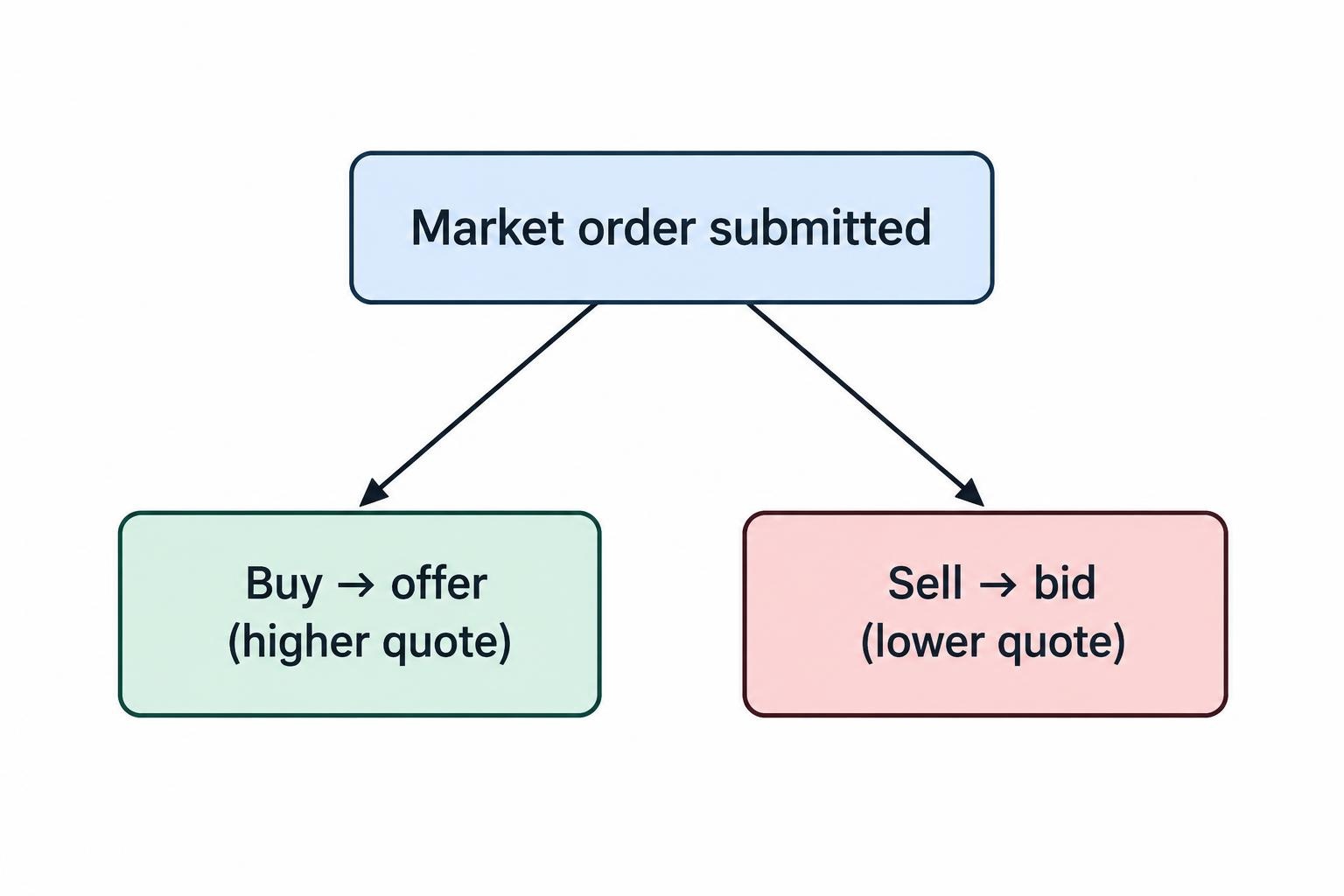
Execution uses the available buy or sell quote. A buy deals at the offer, the higher price in the quoted spread; a sell deals at the bid, the lower price. This use of the current bid and offer is covered in ESMA’s guidance on execution of speculative products.
Your spread bet is a contract with the provider, not a purchase of the underlying shares, currency or index constituents. Do not assume your instruction enters an exchange order book in the same way as a share dealing order.
A market order requests immediate execution, but that does not mean unconditional execution. Market availability, account checks and the provider’s dealing terms still matter. Treat the trade as completed only after you receive confirmation.
A Worked Market Order Example
Suppose a hypothetical index market has a sell price of 7,999 and a buy price of 8,001. You expect it to rise and submit a market buy at £5 per point. Assume the provider fills your instruction at 8,001.
| Stage | Illustrative details |
|---|---|
| Opening quote | Sell 7,999 / Buy 8,001 |
| Market buy confirmed | £5 per point at 8,001 |
| Later quote | Sell 8,011 / Buy 8,013 |
| Market close confirmed | Sell at 8,011 |
| Trading profit | (8,011 − 8,001) × £5 = £50 |
The £50 result excludes financing and any other applicable adjustments. The spread is already reflected in the opening buy and closing sell prices, so you should not subtract it again.
If you had closed immediately at the unchanged sell price of 7,999, the result would instead have been a £10 loss: two points multiplied by £5. That opening loss comes from the spread, not from the market moving against you.
A short bet reverses the sequence. You open by selling at the bid and close by buying at the offer. Your profit or loss depends on the difference between those confirmed prices, multiplied by your stake.
Why the Execution Price Can Change
The displayed quote is not necessarily the final dealing price. Prices can move between the moment you see them, the submission of your instruction and its execution. The difference between the expected and executed price is called slippage.
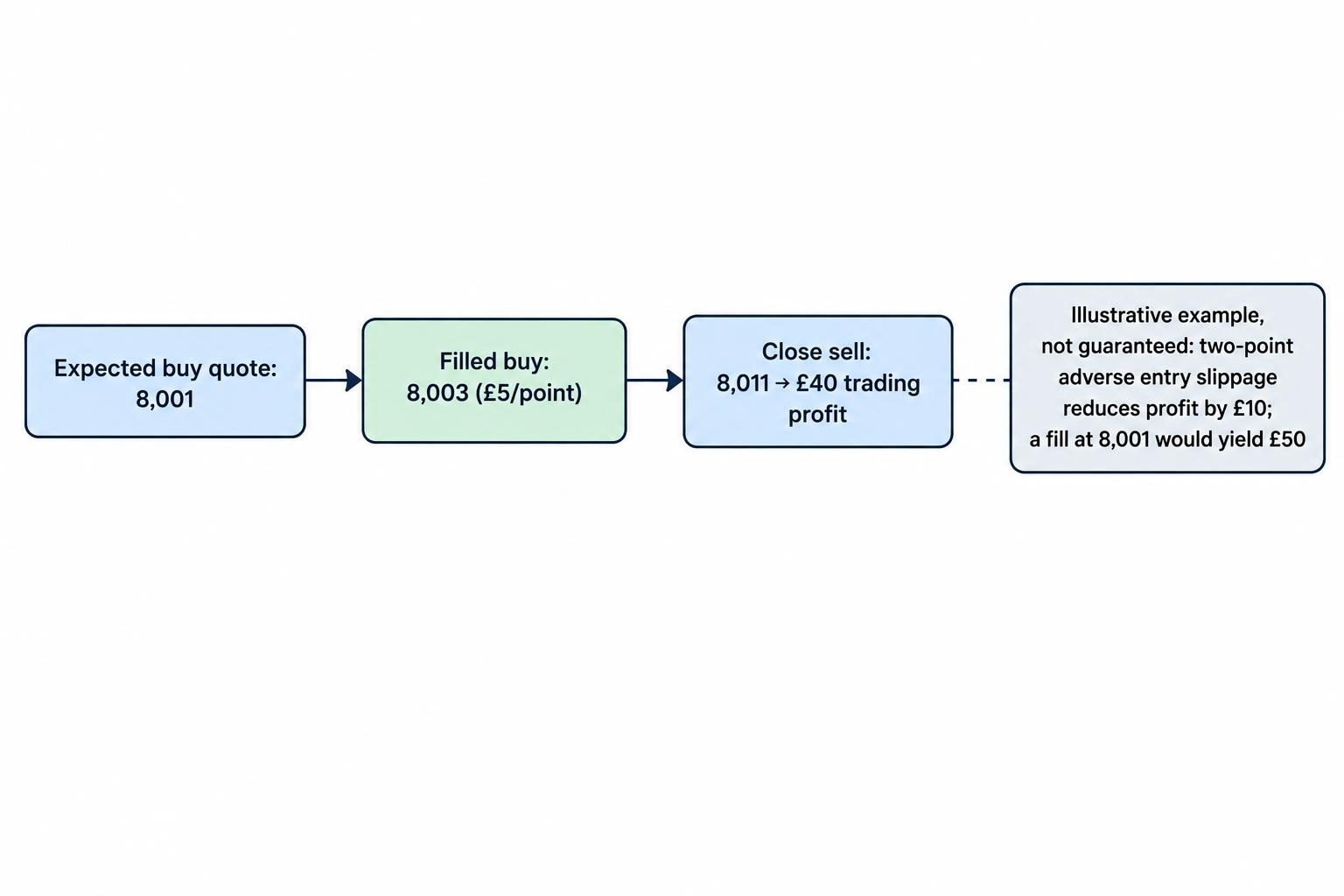
Return to the example above. If the buy quote moves from 8,001 to 8,003 before execution, your £5 per point order might fill at 8,003. Closing at 8,011 would then produce £40 rather than £50. The two points of adverse entry slippage reduce the result by £10.
Slippage can also work in your favour. Price changes, connection speed and market data delays can affect execution; the FCA’s review of best execution and price slippage addresses both favourable and adverse movements.
Separate slippage from spread widening. A wider spread changes the distance between the buy and sell quotes. Slippage changes your execution price relative to the quote you expected. Both can affect the same trade, but they are not the same cost.
Market Orders Versus Limit and Stop Orders
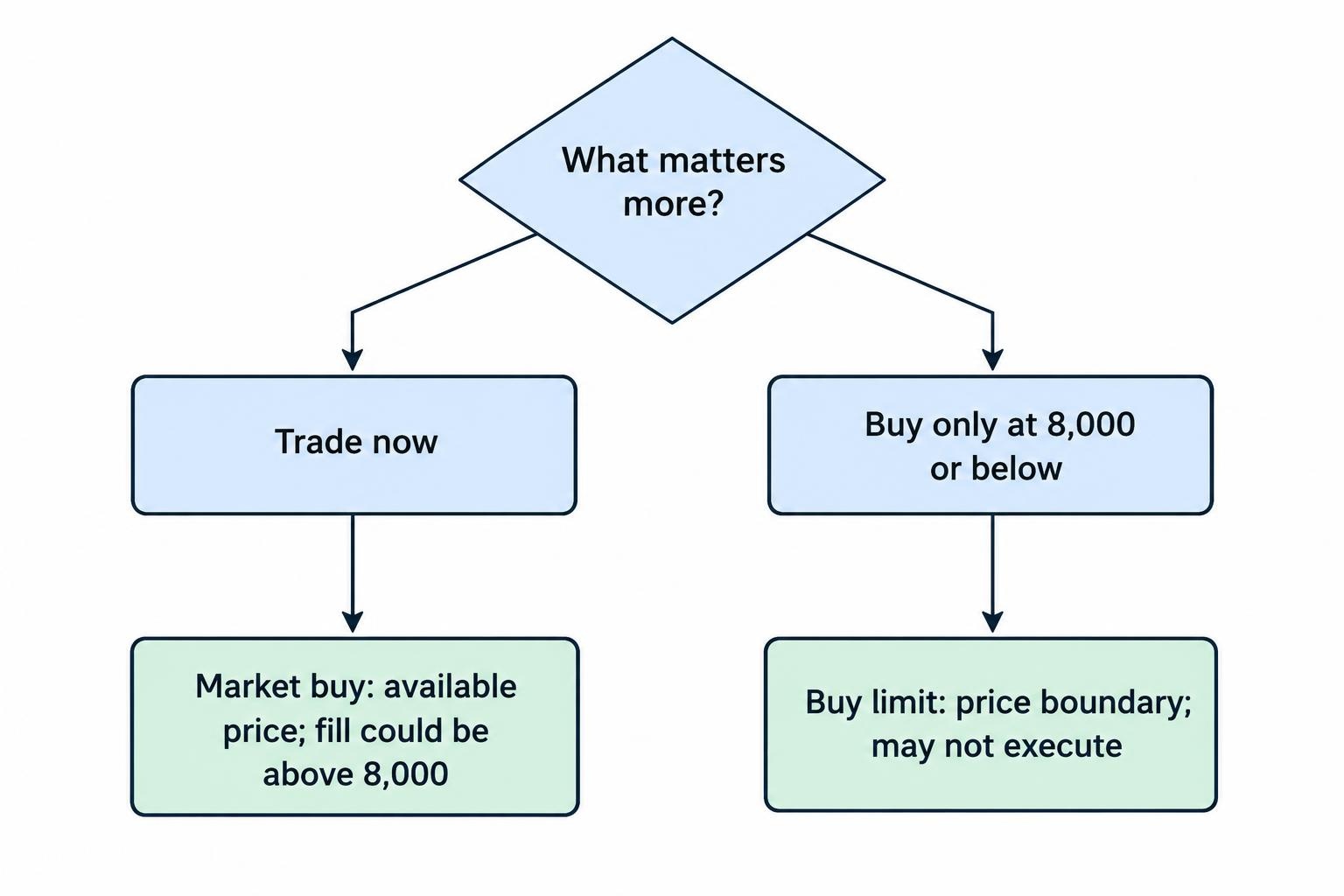
The practical choice is whether timing or price matters more. A market order says, “Trade now at the available price.” A limit order sets the worst acceptable price: a maximum purchase price or minimum selling price. That price control comes with the possibility of no execution.
Suppose you want to buy only at 8,000 or below. A market order is the wrong instruction if you would reject a fill at 8,003. A buy limit expresses that condition; a market buy does not.
A stop-loss order serves a different purpose. It waits for a trigger level before seeking to close a position. An ordinary stop can suffer slippage after triggering. Manually closing at market is an instruction to act now, not a substitute for a protective order already in place.
Checks Before Submitting a Market Order
The instruction is simple enough that most mistakes happen around it: the wrong contract, an oversized stake or a closing trade entered as a new position. A short check is more useful than a hurried correction.
- Confirm the contract. Check the market name and whether you have selected a daily funded or dated product. Similar names do not make contracts interchangeable.
- Check direction and stake. Verify buy or sell and the pounds per point. Use your planned exit distance to assess exposure, rather than choosing a stake from the available margin. The position sizing guide covers that calculation.
- Read both dealing prices. Base the decision on the current bid and offer, not just a chart level. If the quote has moved beyond what your plan allows, reconsider the instruction before submitting it.
- Verify the confirmation. Check the executed price, filled stake and position status. Confirm that any attached protective orders are active at the intended levels.
When closing, use the close control attached to the existing position. Depending on account settings, a fresh opposite trade may open a separate position instead of closing the original one. Check whether any remaining stake is still open after a partial close.
If the screen appears unresponsive, check the order and position records before clicking again. A second instruction is not a reliable way to find out whether the first one worked.
When a Market Order Makes Sense
A market order can suit a planned entry where the current dealing price remains acceptable, or an exit where reducing exposure matters more than waiting for a better quote. The reason should be the trade plan, not impatience.
Be more cautious around scheduled announcements, market reopenings and periods of thin trading. If a few points of adverse execution would make the trade unacceptable, an unrestricted market instruction does not match that requirement.
Market availability also matters. Check how the provider handles instructions outside its dealing hours rather than assuming an order will execute immediately or remain queued for reopening.
What Best Execution Does—and Does Not—Mean
UK best execution requirements are not a promise that every market order will match the price you saw. For retail clients, the best possible result is assessed through price and execution costs under the FCA’s COBS 11.2A best execution rules.
Read the provider’s execution policy for its treatment of price changes, rejected instructions and dealing interruptions. Keep the trade confirmation if an execution needs querying.
The decision remains straightforward: use a market order when prompt execution at the available price fits your plan. If an exact price boundary matters more, choose an instruction that expresses that boundary rather than hoping the market will respect it.