A stop order instructs your spread betting provider to buy or sell once a stated price condition is met. You can use it to open a position after the market rises or falls through a chosen level, or to close an existing position when the price moves against you.
The distinction matters: a stop entry opens exposure, while a protective stop aims to reduce it. Neither should be confused with a promise to trade at the exact trigger price. Within the broader range of spread betting order types, stops provide conditional execution rather than immediate dealing.
How a stop order works
A stop order has two stages. It remains pending until its trigger condition is met. Once triggered, a standard stop becomes an instruction to execute at the available market price, subject to the provider’s execution terms.
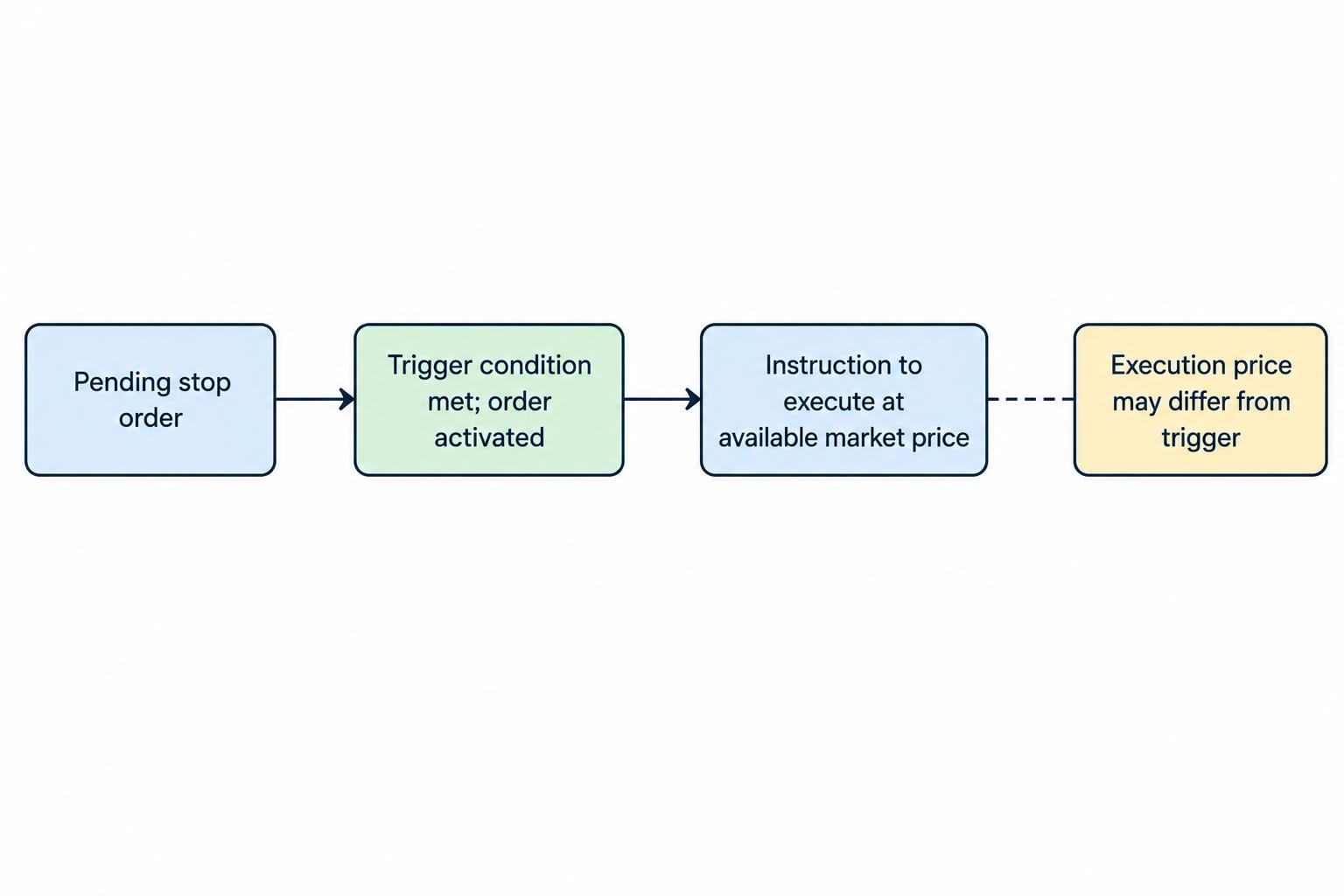
The stop price controls activation, not necessarily the final dealing price. The FCA technical standards for order records distinguish the stop price, which activates an order, from a limit price, which restricts the price at which it can trade.
In spread betting, the order also needs a stake per point. A buy stop at 8,220 with a £2 stake means you want to buy at £2 per point after the relevant quote reaches or passes 8,220. It does not mean that 8,220 is the highest price you have agreed to pay.
Buy stops and sell stops
A buy stop sits above the current market price. A sell stop sits below it. Whether either order opens or closes a trade depends on its purpose and how it is linked to your positions.
| Order | Trigger location | Purpose |
|---|---|---|
| Buy stop entry | Above the current buy quote | Open a long position after a rise |
| Sell stop entry | Below the current sell quote | Open a short position after a fall |
| Sell stop attached to a long position | Below the current sell quote | Close or reduce the long position |
| Buy stop attached to a short position | Above the current buy quote | Close or reduce the short position |
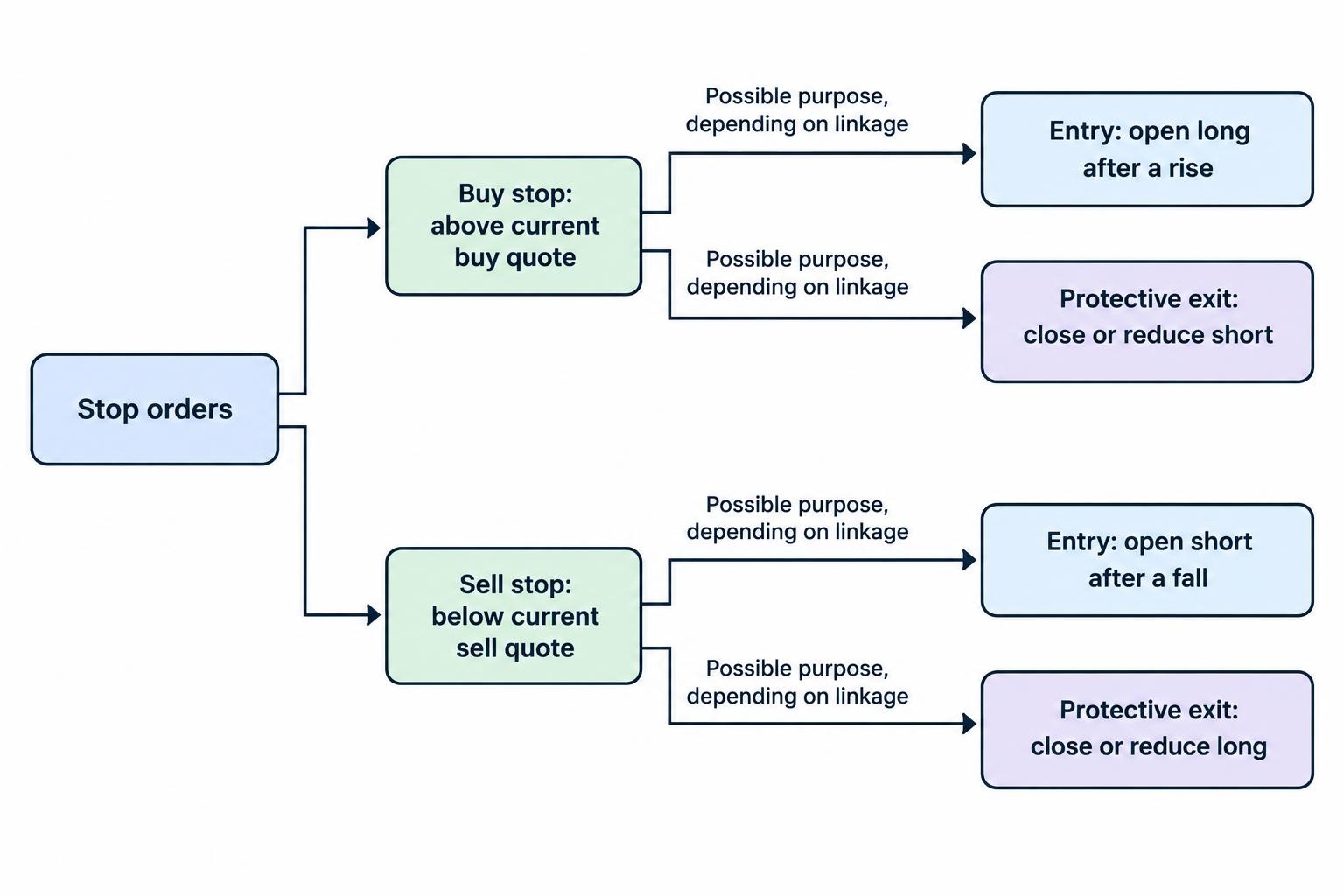
For an entry, the logic is to wait for movement before committing. A trader might place a buy stop above resistance rather than buy while the market remains below it. That waits for a price threshold, not proof that the breakout will last.
A protective stop serves a different purpose. It attempts to exit a trade if the market reaches an adverse level, though it can also protect part of an existing profit. The separate guide to stop-loss orders covers that closing instruction in more detail.
Worked example: opening a spread bet with a buy stop
Assume an index spread bet is quoted at 8,200 sell and 8,202 buy. These are hypothetical prices, not a live market quote.
You want to buy only if the buy quote reaches 8,220. You submit a buy stop entry at 8,220 for £2 per point, with an attached protective stop set at the fixed price of 8,180.
If both orders execute at their stated levels, the price difference is 40 points. The resulting trading loss would be:
(8,220 − 8,180) × £2 = £80.
Now suppose the market moves quickly through the entry trigger and the buy order fills at 8,224. Your protective stop remains at the fixed level of 8,180. The distance has increased to 44 points, making the loss £88 if the closing order executes at 8,180.
If that closing order also slips and fills at 8,172, the loss becomes 52 points × £2, or £104. These calculations use the actual opening and closing dealing prices and exclude financing and other applicable charges.
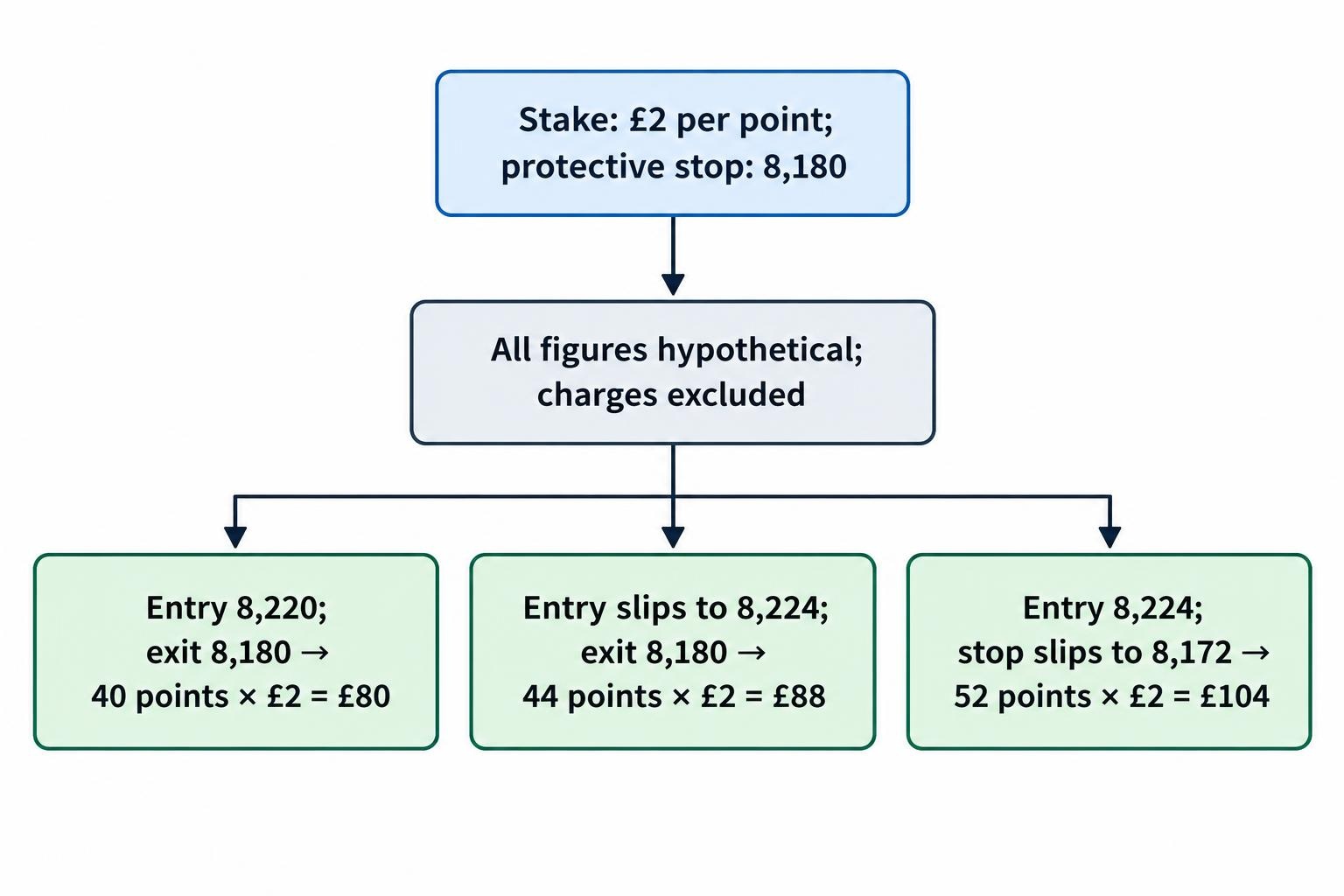
The lesson is not to abandon pending orders. It is to avoid treating the trigger price as a confirmed entry. Base your position sizing on a realistic allowance for execution risk, not just the neatest possible arithmetic.
Which price triggers the order?
A spread betting quote has a sell price, or bid, and a buy price, or ask. Check which quote your provider uses to activate the order. Do not assume the line shown on a chart is the relevant trigger price.
Under a quote-based trigger convention, a buy stop activates when the buy quote reaches or exceeds its level. A sell stop activates when the sell quote reaches or falls below its level. Confirm that convention in the market information and execution policy before relying on it.
Suppose the quote reaches 8,218 sell and 8,220 buy. A buy stop at 8,220 can meet its trigger condition even though a chart displaying only the sell price still shows 8,218.
A widening spread can also move the relevant quote through a stop level without an equivalent move in the midpoint. Before disputing an activation, compare the order with the correct quote, timestamp and contract rather than a different chart feed.
Why the execution price can differ from the stop price
A market can move through a stop level without offering an executable price at that exact point. Fast price changes, reduced liquidity and market gaps can all produce a worse fill. Ordinary stops do not provide a fixed loss ceiling during volatile conditions; this distinction forms part of ESMA’s risk guidance for CFDs and other speculative products.
For an entry order, that can mean opening a trade farther beyond the intended breakout level. For a closing order, it can mean losing more than the amount calculated from the stop price.
The difference between the requested or expected price and the actual execution price is slippage. Review it in pounds as well as points. An extra five points at £1 per point costs £5; the same movement at £20 per point costs £100.
Stop orders versus limit and stop-limit orders
A stop entry waits for the market to move through a threshold. A limit entry sets a maximum buying price or minimum selling price. If you want to buy after a pullback rather than after a rise, a limit order is usually the relevant instruction.
A stop-limit order combines activation with a price restriction. Where the platform supports it, you might set a buy stop trigger at 8,220 and a buy limit at 8,225. Once activated, the order can buy at 8,225 or lower, but not above that limit.
If the market jumps straight to 8,235, the order may remain unfilled. Price control comes with the possibility of no trade. The same distinction applies in share dealing: the SEC investor bulletin on stop and stop-limit orders separates an ordinary stop’s uncertain execution price from a stop-limit order’s risk of non-execution.
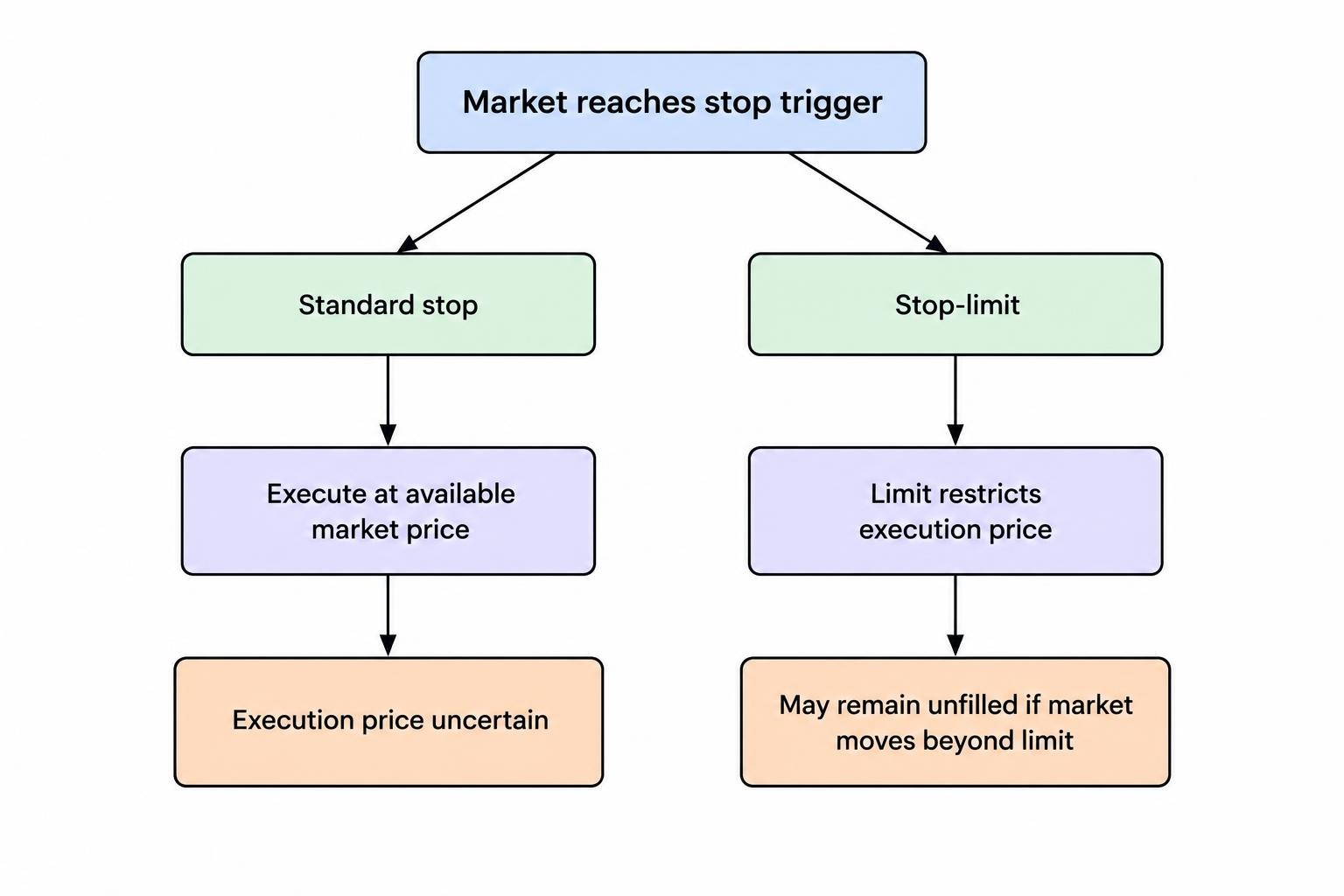
That trade-off matters more for an exit than an entry. Missing a new trade leaves you without the planned position. Missing an exit can leave an existing position exposed while the market continues against it.
What to check before submitting a stop entry
Read the completed ticket rather than relying on the order line drawn on the chart. A correctly chosen level does not rescue the wrong stake, direction or contract.
- Order purpose: Confirm whether the instruction opens a new position, reduces an existing one or interacts with the account’s netting settings.
- Trigger and stake: Check the buy or sell direction, activation level, stake per point and the market’s definition of a point.
- Validity: Choose an expiry that matches the trade idea. Check how the provider handles orders described as good till cancelled.
- Execution conditions: Review dealing hours, minimum order distances, gap handling and the funds required when the order triggers.
- Attached exits: Establish whether protective orders use fixed prices or distances from the eventual fill, and when they become active.
After submission, check that the platform shows the order as accepted and pending. A ticket filled in on screen is not the same as an accepted instruction.
Review unfilled entries when the original setup expires. An order placed for a morning breakout can become an unwanted afternoon trade if it remains active after your reason for entering has disappeared.
Is a stop order guaranteed?
No. A standard stop order does not guarantee its execution price. A guaranteed stop is a separate arrangement intended to close an eligible position at the agreed stop level under its terms. The FCA technical standards listing order types distinguish guaranteed stops from ordinary stops.
Do not assume that attaching a guaranteed exit also guarantees the entry price. They are separate instructions. Check availability, premiums and restrictions before placing the trade.
The guide to guaranteed stop-loss orders covers those arrangements. For an ordinary stop entry, the practical rule remains straightforward: choose the trigger in advance, but assess the position using the price at which it actually opens.
After the order triggers
Check the fill confirmation, the live stake and the attached exit orders. If the entry slipped, recalculate the distance to your protective stop. If an order only partly executed, check both the open position and any remaining pending amount.
A stop order can automate a price-based decision. It cannot judge whether the trade still makes sense after execution. That review remains yours.