A stop-loss order instructs your spread betting provider to close a position if its relevant dealing price reaches or passes a chosen level. It gives the trade a planned exit when the price moves against you, without requiring you to click the close button at that moment.
The important qualification is that an ordinary stop-loss does not guarantee the closing price. Your intended loss and your actual loss can differ. This guide covers how stops trigger, how to calculate the planned exposure and what to check on the order ticket. For the broader relationship between entry and exit instructions, see our guide to spread betting order types.
What a Stop-Loss Order Does
A stop-loss attached to a long position closes it by selling. A stop attached to a short position closes it by buying. When first protecting a new trade, the stop normally sits below the entry price for a long bet and above the entry price for a short bet.
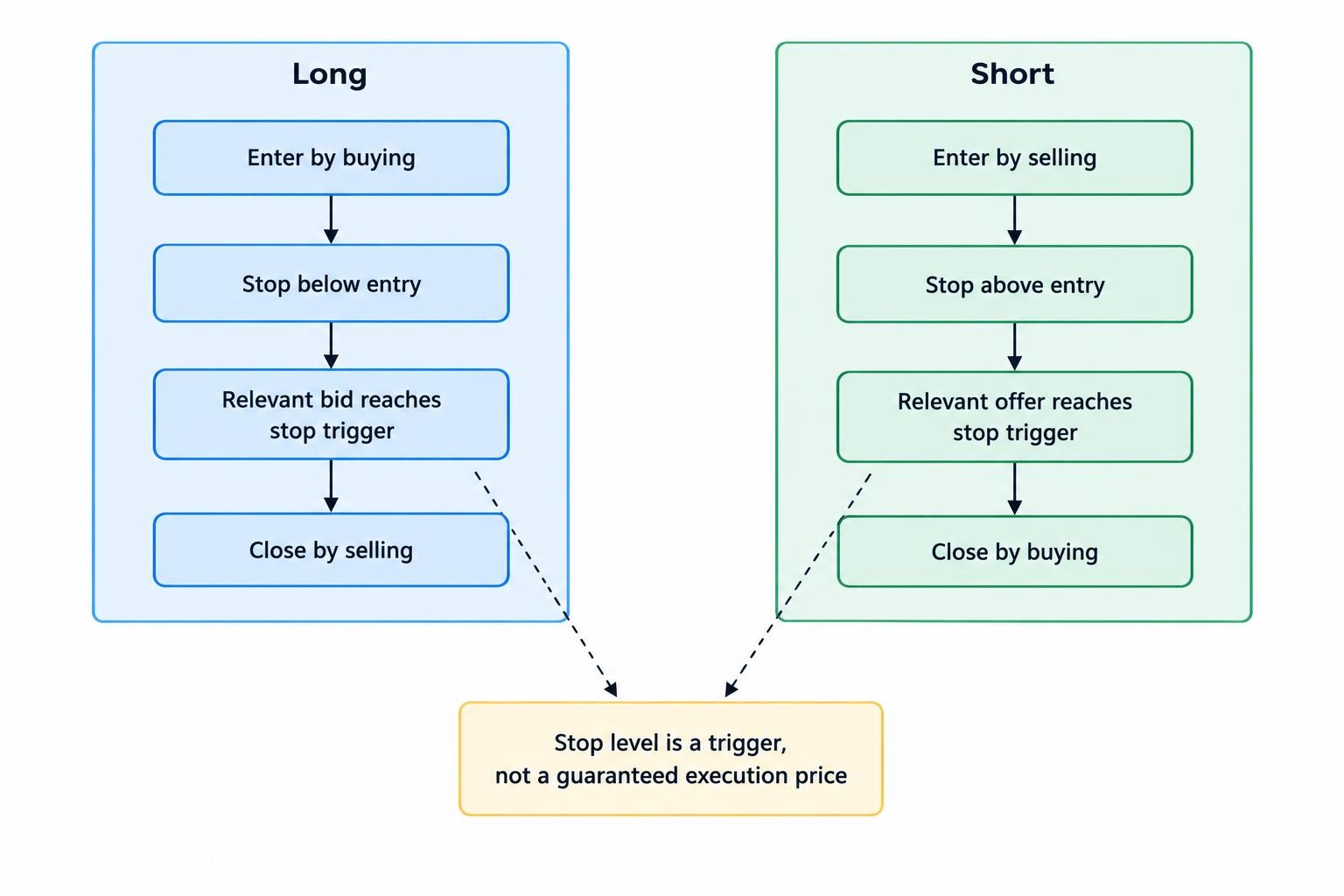
The stop level is a trigger, not a promise that the position will close at that exact price. Once triggered, an ordinary stop instructs the provider to execute the closing trade under its execution arrangements. Rapid price moves and market closures can prevent the expected outcome, a risk covered in the ESMA and EBA warning on stop-loss limits and execution risk.
Despite its name, a stop-loss can also protect an unrealised profit. If a long trade rises enough, you might move its stop above the original entry price. The order still responds to an adverse move from the current market level, even though the intended exit would now produce a profit.
Which Price Triggers a Stop?
Spread betting prices have two sides: the bid, at which you sell, and the offer, at which you buy. Under common platform arrangements, a long position’s stop responds to the bid because closing the position requires a sale. A short position’s stop responds to the offer because closing requires a purchase. Check the provider’s trigger rules rather than assuming every platform uses identical settings.
This matters when reviewing charts. A chart displaying only the bid may not show the offer that triggered a short position’s stop. A midpoint chart may show neither dealing price exactly. The mechanics of spread betting spreads explain why a visible chart level and an executable closing price can differ.
Spread widening can also bring the relevant closing price to a stop even when the midpoint barely moves. That is different from slippage: widening affects the quoted prices and potentially the trigger; slippage concerns the price received when the order executes.
Compare the same instrument and contract when checking a disputed trigger. A provider’s spread betting quote need not match an underlying exchange price tick for tick. Pricing methods, reference prices and execution arrangements are covered in ESMA’s questions and answers on speculative product pricing and execution.
Stop-Loss Examples for Long and Short Spread Bets
Assume an index spread bet is quoted at 7,998–8,002, with each whole index point worth the chosen pound stake. The following examples are separate trades, each using £3 per point.
| Trade | Entry price | Stop level | Entry-to-stop distance | Loss if filled at the stop |
|---|---|---|---|---|
| Long: buy | 8,002 | 7,972 | 30 points | £90 |
| Short: sell | 7,998 | 8,028 | 30 points | £90 |
Long Position
You buy at 8,002 and place a stop at 7,972. If the relevant sell price reaches the trigger and the closing trade executes at 7,972, the loss is:
(8,002 − 7,972) × £3 = £90.
The opening bid was already 7,998, four points below your purchase price. The stop therefore sits 26 points below that opening bid, but the planned loss still covers 30 points from the actual entry. Confusing those two distances understates the exposure.
Short Position
You sell at 7,998 and place a stop at 8,028. If the closing purchase executes at 8,028, the loss is:
(8,028 − 7,998) × £3 = £90.
These calculations already use the opening and closing dealing prices. Do not subtract the spread again. Financing and other separate charges still need their own allowance.
Why the Actual Loss Can Exceed the Estimate
An ordinary stop may execute beyond its trigger when prices change before the closing trade can be completed. This is adverse slippage. Volatility, delays and the available market pricing can affect execution; these mechanisms are examined in the FCA review of best execution and price slippage.
Return to the long position bought at 8,002 with a stop at 7,972. Suppose a price gap occurs and the closing trade executes at 7,952 instead. The loss becomes 50 points × £3, or £150, rather than the planned £90.
The stop did not necessarily fail to trigger. It may have triggered correctly but executed at a worse price. That distinction matters when reviewing the order history or raising a query with the provider.
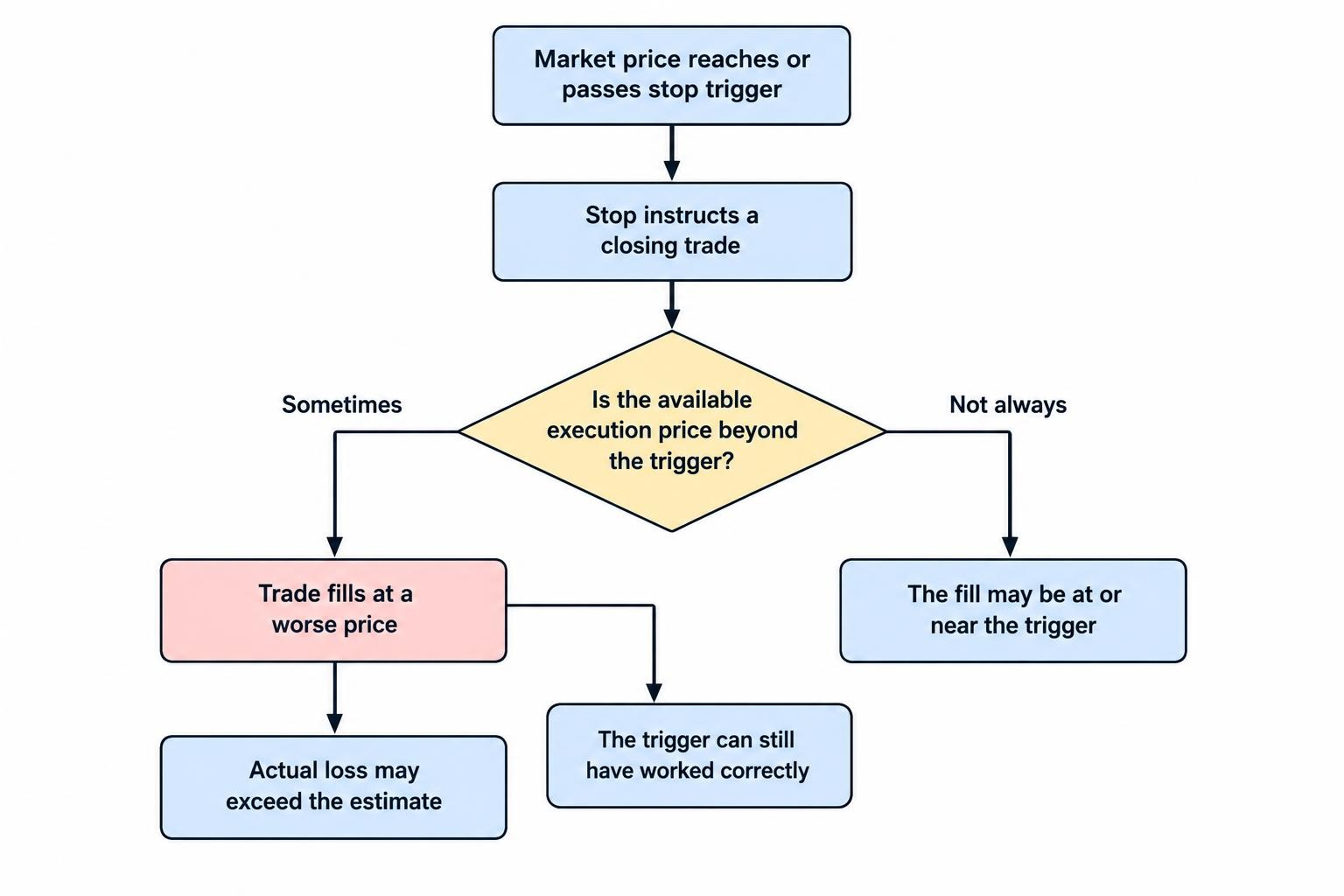
A market closure creates another practical constraint. If the contract is unavailable for dealing, the stop cannot manufacture an executable price during that closure. When dealing resumes, the next available price may already be beyond the trigger. Our guide to slippage in spread betting covers this execution risk in more detail.
Small stakes reduce the pound impact of an adverse fill, but they do not remove the possibility. An ordinary stop provides a planned exit mechanism, not a fixed maximum loss.
How to Place a Stop-Loss Order
Providers use different ticket layouts, but the checks are broadly consistent. Before submitting an order, establish whether the ticket expects an absolute price, a distance in points or a monetary amount.
- Select the correct position and contract. Check the market, direction and whether you are trading a daily funded or dated contract.
- Choose the stop type. Confirm whether the ticket shows an ordinary, guaranteed or trailing stop. These are not interchangeable.
- Enter the level or distance. If using a distance field, check whether the platform measures it from the proposed entry, the current closing quote or another reference.
- Review the stake and estimated loss. Recalculate the entry-to-stop distance in the contract’s point units. Treat a displayed loss as an estimate unless the relevant execution price is guaranteed.
- Confirm acceptance. After submission, verify that the position shows the intended stop level and that no rejection or error message remains.
Minimum stop distances can prevent an order from being placed close to the current price. Check the contract’s current requirements before submitting or amending the instruction. A rejected stop leaves you without the protection you intended.
Where the platform permits an attached stop on the opening ticket, review it before opening the position. Adding it afterwards creates an interval in which the trade has no accepted protective stop.
Also check where the instruction is held. A stop accepted and stored by the provider should not depend on your browser remaining open. A locally running script or automation tool may depend on your device and connection. Do not assume the two arrangements behave alike.
Choosing the Stop Distance and Stake
The stop level and stake work together. A wider stop at the same stake creates a larger planned loss; reducing the stake can keep that planned exposure closer to the original budget.
A useful starting calculation is:
Stake per point = planned price-loss budget ÷ entry-to-stop distance.
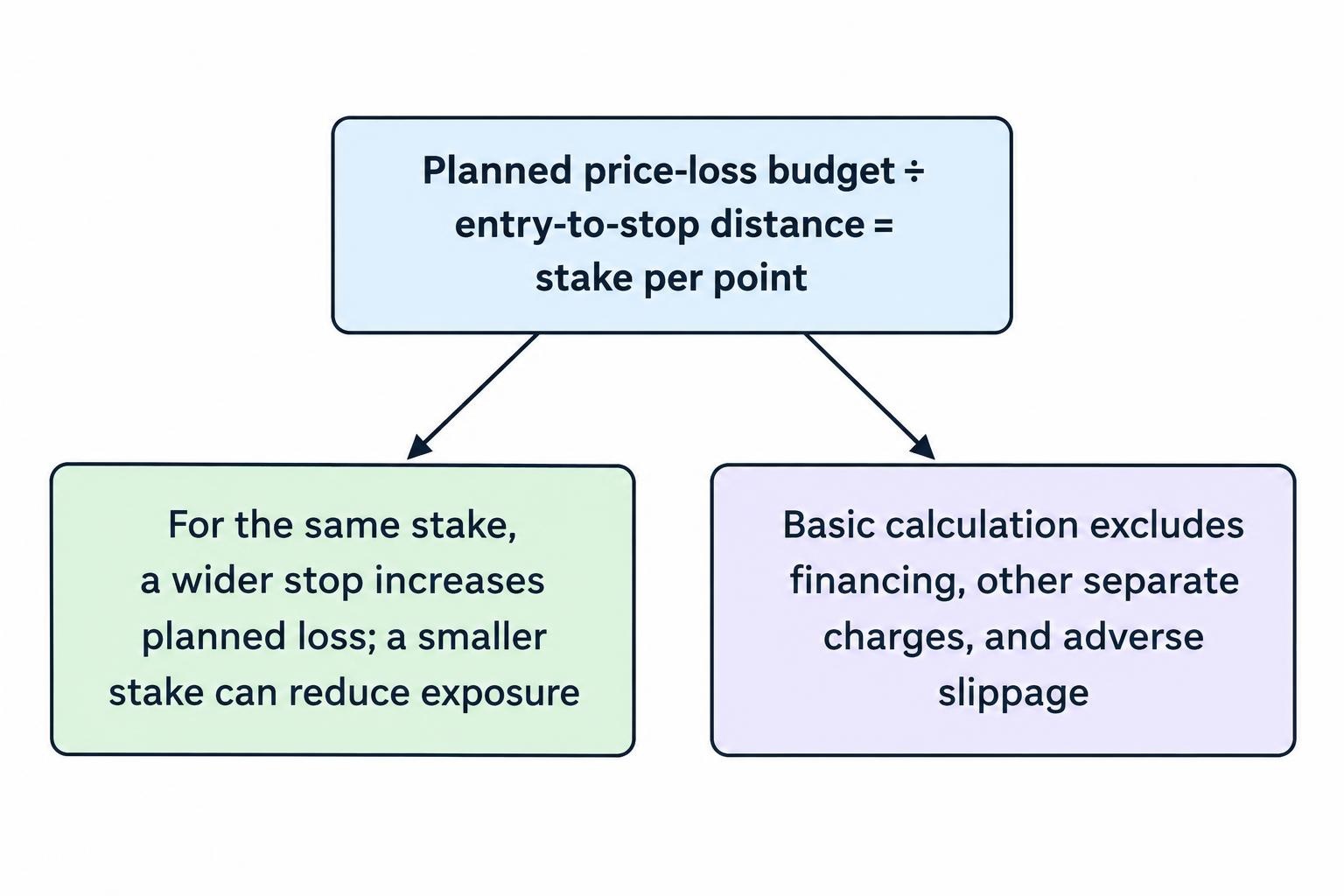
With a £100 price-loss budget and a 40-point stop distance, the calculation gives £2.50 per point. That figure excludes separate costs and any adverse slippage. If £100 is intended to cover more than the price movement alone, the stake needs to leave room for those other amounts.
Choose a stop level that fits the trade’s exit logic, then assess whether the resulting stake is affordable. Squeezing the stop closer simply to accommodate a larger stake changes the trade, not just the arithmetic.
If the provider’s minimum stake makes the planned exposure too large, that contract may not fit the budget. Opening it anyway and hoping to close manually is not an equivalent substitute. The wider process is covered in our guide to position sizing for spread betting.
Amending a Stop and Protecting Profit
A fixed stop stays at its accepted level until you change it, the position closes or another applicable event ends or alters the instruction. It does not automatically follow a profitable trade.
Suppose the long position entered at 8,002 rises until the bid reaches 8,070. You might amend the stop to 8,022. At £3 per point, an exit exactly at that level would produce a £60 price profit before separate charges. Because this is still an ordinary stop, an adverse fill could reduce that amount.
Moving a stop to the entry price is often called moving to break even. It only targets break even on the price difference. Financing, other charges and slippage can still leave a net loss.
Do not assume a dragged chart line has changed the live instruction. Check the accepted level in the position details after every amendment. Moving a stop farther away also increases the planned exposure unless you reduce the stake.
If you want the trigger to follow favourable price movement automatically, trailing stops perform that different function. Their distance and update rules need separate attention.
How Stop-Losses Differ From Other Orders
Guaranteed Stops
A guaranteed stop provides contractual protection against execution beyond the agreed stop level, subject to the provider’s terms. Guaranteed protection can carry a premium; the distinction between ordinary and guaranteed stops is covered in ASIC’s guide to stop-loss protection in derivative trading.
Check availability, minimum distances, amendment conditions and when any premium becomes payable. A guarantee concerns the agreed exit price, not whether the trade makes money. Our guide to guaranteed stop-loss orders covers those terms without treating them as a feature of every ordinary stop.
Take-Profit and Stop-Limit Orders
A take-profit instruction normally targets a favourable exit: above the entry for a long position or below it for a short position. A protective stop responds to an adverse move. Where both are attached, check how the platform cancels the remaining instruction after one closes the position.
A stop-limit order, where available, adds a price constraint after its trigger activates. That constraint can leave the closing order unfilled if the required price is unavailable. It is not the same as a guaranteed stop and should not be assumed to provide a hard loss cap.
Stop Entry Orders
A stop entry opens a trade after a trigger is reached; a protective stop-loss closes an existing trade. The word “stop” alone does not identify the purpose. Check the instruction’s direction and whether it is attached to a position. The separate guide to stop orders covers entry uses.
A Stop-Loss Is Not a Margin Close-Out Rule
Your chosen stop is a trade-level instruction. Margin close-out operates at account level and can cause positions to close before their individual stops are reached.
For retail accounts within the FCA’s relevant rules, if net equity falls below 50% of the required margin, the firm must close open positions as soon as market conditions allow. This is set out in FCA Handbook COBS 22.5.13. The threshold is not a promise that half the original account balance will remain.
Losses elsewhere in the account can therefore affect a trade whose own stop has not triggered. A stop does not reserve account equity for that position or exempt it from closure. See the margin close-out rule for the account-level mechanics.
What to Check After the Position Closes
Review the accepted stop level, trigger time, execution price, stake and separate charges. If the fill differs from the trigger, calculate the pound effect rather than judging the result from the chart alone.
After a manual closure or partial reduction, check that any remaining orders match the remaining exposure. Do not assume an independent pending order has disappeared because you closed a position elsewhere on the platform.
A useful review separates three questions: was the stop accepted, did it trigger under the stated rules, and was the closing trade executed correctly? Those checks help distinguish an order-entry mistake from market execution risk. For decisions about placement and adjustments within a trading plan, use the guide to managing risk with stop losses.