A guaranteed stop-loss order closes a spread bet at an agreed price when the stop is triggered, even if the market moves straight through that level. Unlike a standard stop, it protects the exit price against adverse slippage. The protection comes at a cost, and it does not cancel the account’s margin requirements or other trading terms.
The practical question is not simply whether a stop is “guaranteed”. It is how much loss the accepted order protects against, what the guarantee costs and whether the position could close for another reason first. Within the broader range of spread betting order types, this is the distinction that matters.
What a guaranteed stop actually guarantees
A guaranteed stop-loss order, often shortened to GSLO, protects the execution price of the stop. Once the provider has accepted the instruction, a triggered order closes the covered position at the agreed level under the contract’s terms. Execution at the stop price is the defining feature in the FCA technical standards’ guaranteed stop definition.
For a long spread bet, the protective stop sits below the current market. For a short spread bet, it sits above it. The direction changes, but the purpose stays the same: prevent an adverse price jump from producing a worse stop execution price.
A standard stop-loss order works differently. It triggers a closing instruction when its price condition is met, but the eventual fill can be worse than the stop level. A market that jumps past the trigger does not have to return and offer that price again.
The guarantee does not mean the trade cannot lose money. It also does not mean the total account debit equals only the distance to the stop multiplied by the stake. Premiums, financing and other applicable charges need separate treatment.
Guaranteed stop-loss example: a market gaps below your stop
Suppose an index spread bet has an opening quote of 7,998–8,000. You buy at 8,000 for £3 per point and attach a guaranteed stop at 7,960. Assume the provider accepts it and the position remains open until the stop triggers.
The distance from your entry to the guaranteed exit is 40 points. Your price loss at that level is therefore £120:
40 points × £3 per point = £120.
Now suppose the market gaps lower and the first available closing sell quote is 7,920. The following comparison assumes a hypothetical guaranteed stop premium of one point, charged only if that stop triggers.
| Calculation | Guaranteed stop | Standard stop |
|---|---|---|
| Opening buy price | 8,000 | 8,000 |
| Stop level | 7,960 | 7,960 |
| Closing execution price | 7,960 | 7,920, assumed available fill |
| Price loss at £3 per point | £120 | £240 |
| Guaranteed stop premium | £3 | None in this example |
| Loss including that premium | £123 | £240 |
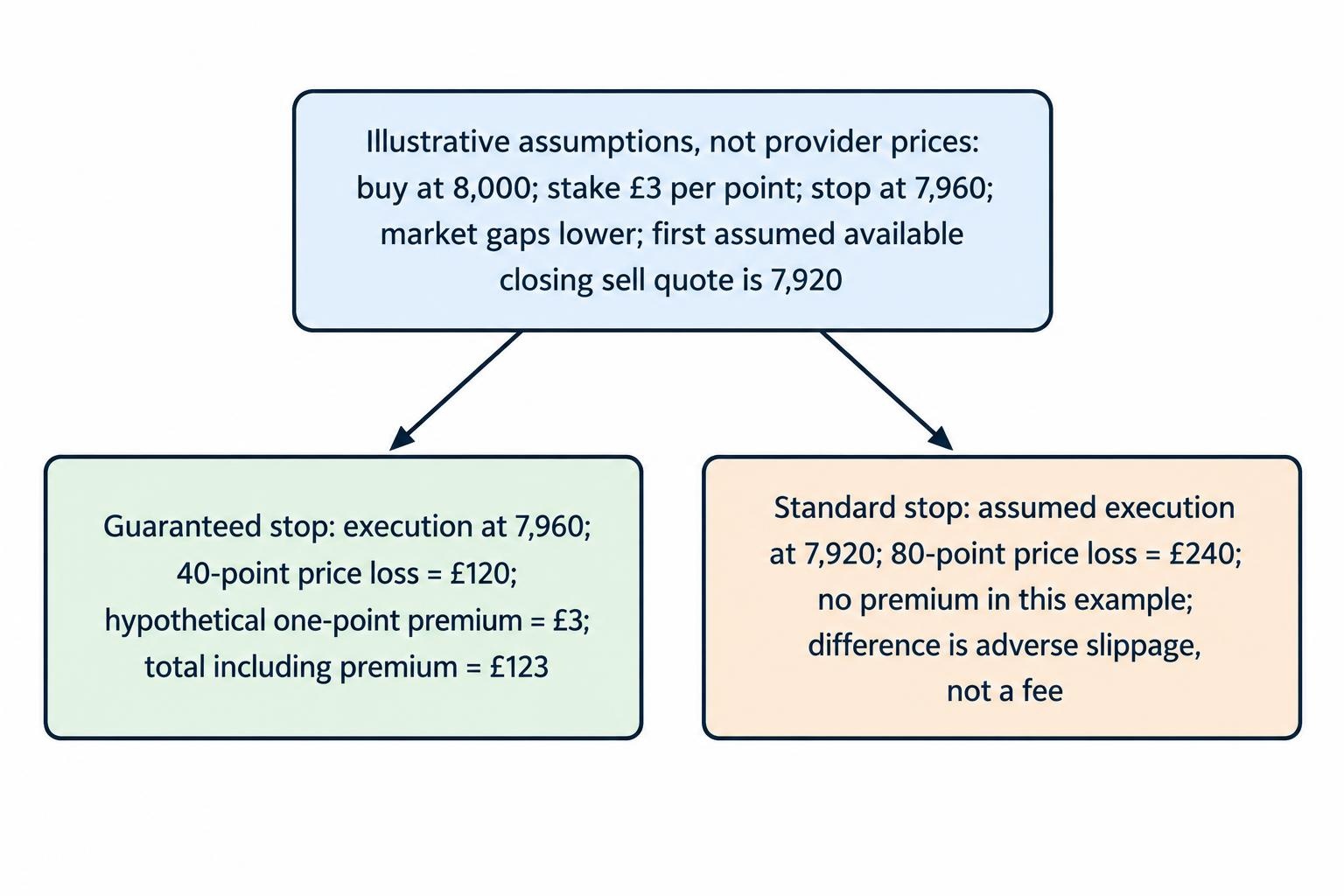
These are invented trading figures, not a provider’s current prices or charges. Financing and other account adjustments are excluded. Because the calculation uses the actual opening buy price and closing sell price, do not subtract the opening spread again.
The extra £120 loss on the standard stop comes from the 40 points between the intended exit and the assumed fill. That difference is adverse slippage, not an extra fee.
For a short bet, reverse the calculation. Selling at 8,000 with a guaranteed stop at 8,040 creates the same 40-point price risk. An upward gap would threaten the short position rather than the long one.
How much does a guaranteed stop cost?
The provider charges for taking on the risk of executing your stop at a price the market may no longer offer. The distinction between ordinary stop execution and a paid guaranteed service appears in ASIC’s investor booklet on CFD stop losses. That resource concerns CFDs, but the execution-price distinction is relevant to the same order feature on spread bets.
Read the charging terms rather than assuming every guarantee follows the example above. Check whether the cost is collected when the order is attached, when it triggers, or through another pricing arrangement. Establish what happens if you close the trade manually, remove the stop or change the position size.
If the premium is quoted in points, convert it into cash using the stake covered by the order. A one-point premium at £3 per point means £3. A premium expressed as a percentage needs the provider’s stated calculation instead; one percentage point and one market point are not interchangeable.
For budgeting, use:
Loss if the GSLO triggers = entry-to-stop distance × stake per point + applicable premium + other net charges.
A guarantee protects the exit price, not the bill for holding the position. Keep financing and other applicable costs separate from the stop calculation. The guide to guaranteed stop premiums covers the charging side in more detail.
How to place a guaranteed stop correctly
Choose the market and stake, then select the guaranteed stop option rather than leaving the ticket on an ordinary stop. Enter the stop level or distance, review the cash loss and premium, and submit the instruction. Treat protection as active only after the platform confirms acceptance.
Before submitting, check these five points:
- Eligibility: confirm that the selected market, contract and account support a guaranteed stop.
- Minimum distance: check how close the guaranteed stop can sit to the relevant market quote.
- Covered size: confirm that the order protects the intended stake, including any later increase.
- Trigger method: establish which quote or price condition activates the stop.
- Changes and charges: check amendment rules, premium treatment and what happens after a partial closure.
Check the quote that triggers the stop
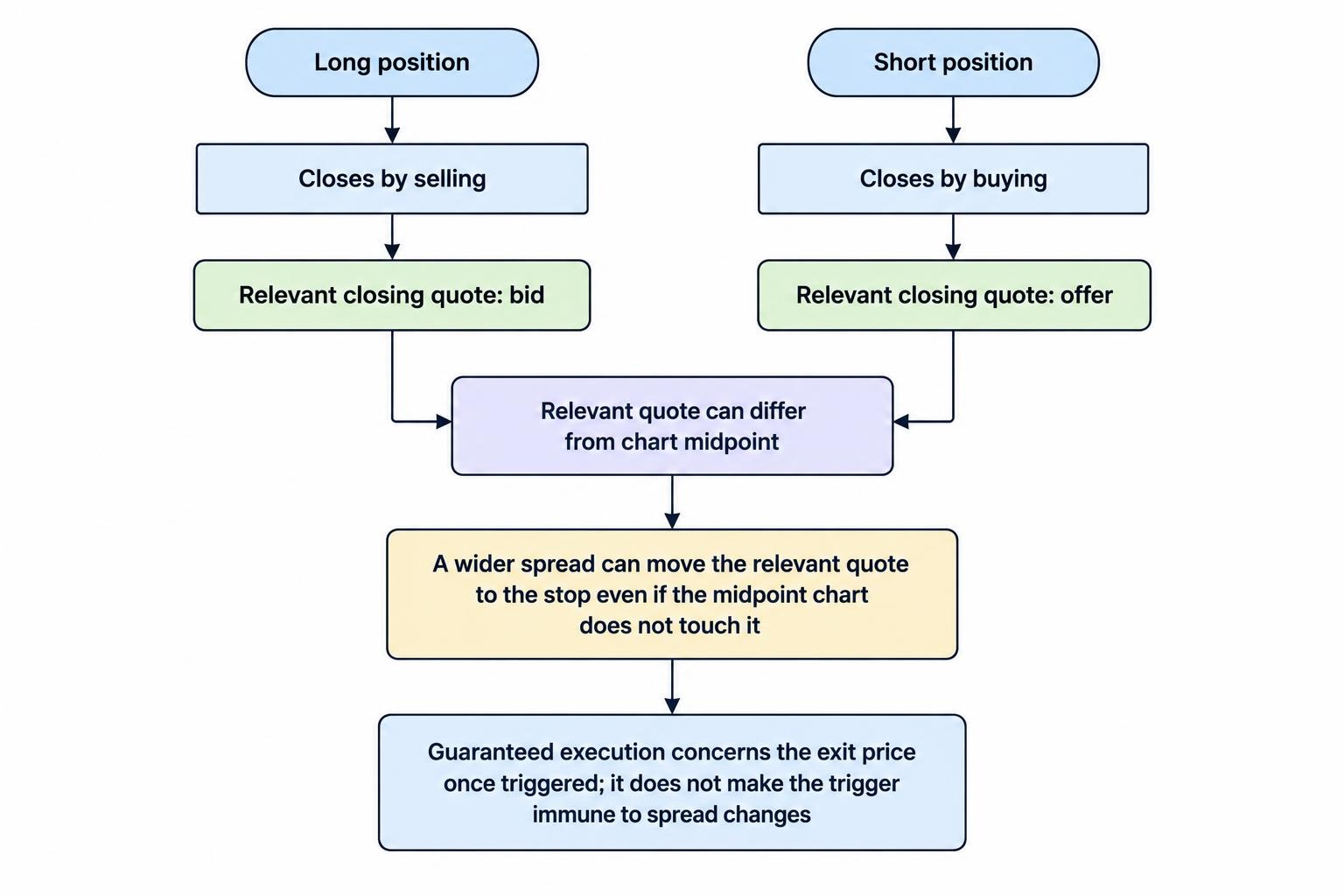
On a bid-and-offer based spread bet, a long position closes by selling and a short position closes by buying. The relevant closing quote can therefore differ from the price displayed on a chart. Check the contract’s trigger method and the chart’s price setting before deciding that a stop has activated incorrectly.
A wider spread can move the relevant closing quote to your stop even if a midpoint chart appears not to have touched it. Guaranteed execution does not make the trigger immune to changes in the spread.
Fit the stake to the accepted stop distance
Suppose your intended price-loss budget is £150 and the ticket requires a stop at least 60 points away. Before allowing for a premium or other costs, £2.50 per point uses that entire budget. If you want those costs inside £150 too, the stake must be smaller.
Do not keep the original stake and widen the stop simply to get the order accepted. That changes the trade’s cash risk. Use position sizing for spread betting to work backwards from the amount at risk.
Verify the accepted order, not just the request
Check the live position details after submission. They should show the correct stop type, level and covered stake. Save the confirmation if the protection matters to your trading plan.
Disputes can turn on whether a guaranteed stop was actually requested and placed. In Financial Ombudsman decision DRN3629821 on disputed guaranteed stops, the evidence included whether the expected premiums had been charged. A fee entry can be supporting evidence, but it should not replace checking the accepted order itself.
Guaranteed stops do not replace margin protection
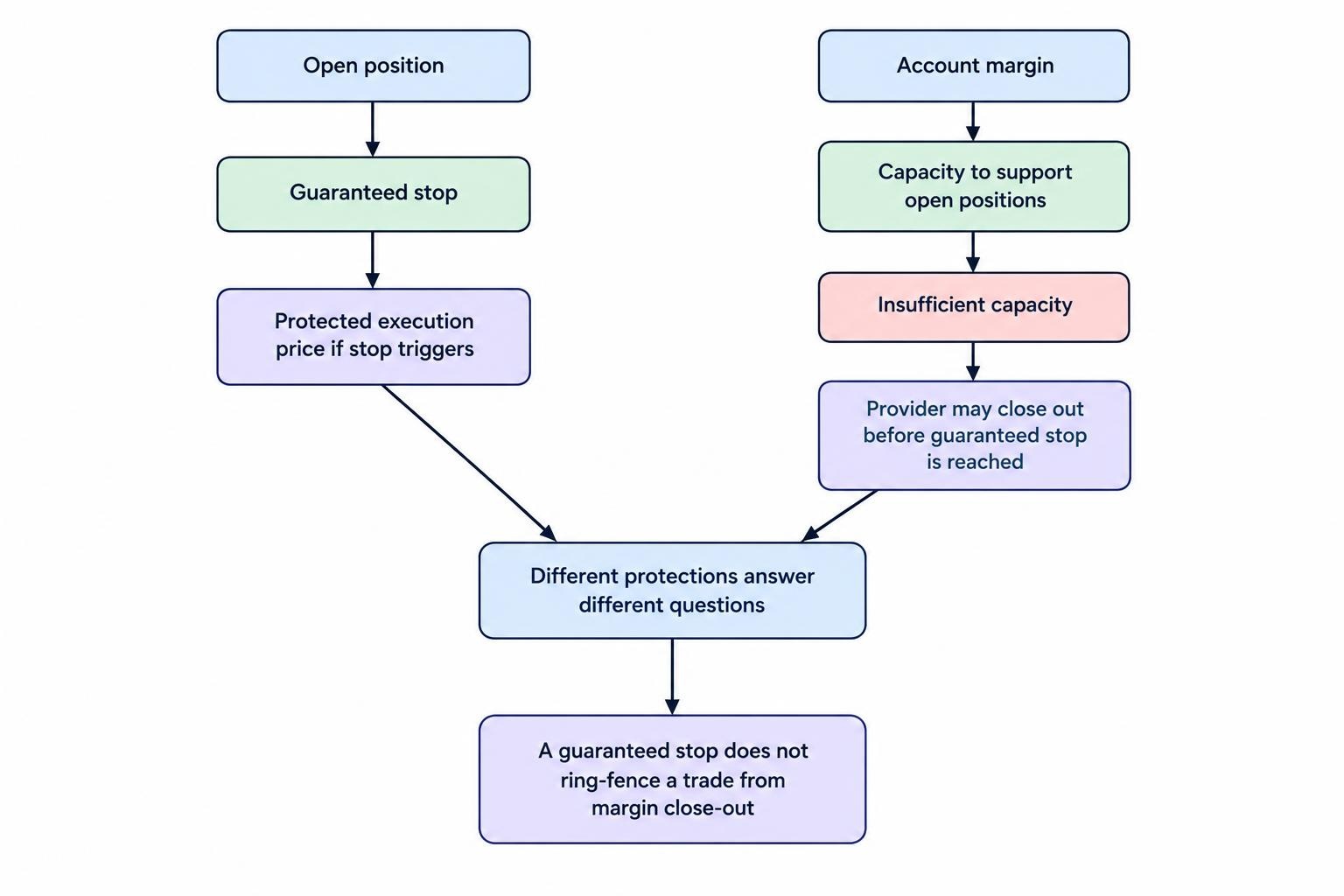
A guaranteed stop and the money required to maintain a position answer different questions. The stop addresses its protected exit price. Margin determines whether the account can continue supporting its open positions.
For retail accounts within the scope of the UK rules, firms must close open positions as soon as market conditions allow when account net equity falls below 50% of the relevant margin requirement. The same rules cap the client’s liability for covered investments at the funds in the account. These are separate protections under FCA COBS 22.5 on retail speculative investments, not a promise that every trade closes at its chosen stop.
Negative balance protection operates at account level. It does not preserve the amount you intended to risk on one position. A guaranteed stop can protect a much smaller trade-level loss while money elsewhere in the account remains exposed to other positions.
A position with a GSLO can also close before the stop is reached if the account cannot support it. Financial Ombudsman decision DRN7660732 on guaranteed stops and margin distinguishes guaranteed execution when the stop triggers from the provider’s contractual right to close a position for insufficient margin.
Keep enough account capacity for the positions you intend to maintain. Do not assume that attaching a guarantee ring-fences a trade from the margin close-out rule, or that its required margin will equal only the protected loss.
When is a guaranteed stop worth considering?
The strongest reason to consider one is an unacceptable difference between the planned exit and a possible fill after a price jump. The decision is about the loss you can tolerate, not a prediction that the next session will produce a gap.
A trade held across a market closure, company announcement or economic release may create a reason to compare guaranteed protection with an ordinary stop. Check availability and terms before opening the position. Buying protection after the price has already jumped is not much of a plan.
Compare the premium with the protected amount. In the worked example, £3 equals 2.5% of the £120 price loss at the stop. That calculation does not prove the guarantee is cheap or worthwhile: it says nothing about the chance or size of a gap. It does show how much the protection adds to the planned stopped-trade loss.
If the accepted distance or charge makes the trade unattractive, reducing the stake, closing before the event or not opening the position are valid alternatives. The guarantee is an order feature, not an obligation to trade.
Moving the stop and protecting a profit
A guaranteed stop does not have to remain below your original entry on a long trade, or above it on a short trade, once the market has moved favourably. If the provider permits an amendment and accepts the new level, it can protect an exit that produces a price profit.
Moving a stop to the entry price does not necessarily create a cost-free trade. A triggered premium, accumulated financing or other charges can still leave a net loss. “Break even” needs to include costs, not just the two execution prices.
Check the terms before assuming you can move, remove or reattach the guarantee whenever you choose. A manually amended guaranteed stop is also not automatically a trailing stop. The accepted order details, rather than the label you use for the strategy, determine the protection.
Keep the guarantee inside the trading plan
Before opening the bet, you should be able to state the accepted stop level, covered stake, loss at that level and applicable charge. You should also know which price triggers it and whether the account has enough margin to maintain the position.
For provider selection, compare the contract terms covered in the guide to spread betting brokers with guaranteed stops, rather than choosing on the presence of a GSLO button alone.
The useful outcome is a more predictable exit on the covered trade. It is not a reason to increase the stake. Use the order alongside a cash risk budget and the account controls covered in managing risk with guaranteed stops. A guaranteed price can still produce a loss that is too large.