A suitable spread betting broker for beginners should let you practise, trade at manageable stakes and see the cost and risk before placing an order. A crowded platform, a low advertised spread or a long list of markets does not make an account beginner friendly.
Start with two or three candidates from the spread betting broker directory, then compare their account terms against the markets, stake sizes and trading hours you intend to use. Eliminate unsuitable accounts before comparing optional features.
This guide focuses on choosing a UK retail spread betting account. Check that the provider accepts residents of your country and identify the legal entity offering the account. A recognisable brand is not a substitute for those checks. Spread betting involves substantial risk; a simpler platform does not make the product itself low risk.
What Makes a Spread Betting Broker Suitable for Beginners?
Beginner suitability comes down to whether you can use the account correctly without taking more risk than intended. Prioritise the following checks rather than searching for one broker that supposedly suits everyone.
| Feature | What to check | Reason to reject an account |
|---|---|---|
| Authorisation and account entity | Match the contracting firm, permissions and contact details against official records. | You cannot establish which firm will hold your account. |
| Minimum stake | Check the minimum and stake increments for each intended market. | The smallest available position exceeds your planned risk. |
| Practice account | Check whether you can rehearse orders, stops and position management. | You cannot practise the functions you need before funding. |
| Trade ticket | Look for clear stake, margin, stop distance and charge information. | You cannot confidently calculate the exposure you are opening. |
| Costs | Compare spreads, funding, stop premiums and account charges. | Important charges are missing or difficult to interpret. |
| Account administration | Check withdrawals, statements, security controls and support access. | Basic account questions remain unanswered. |
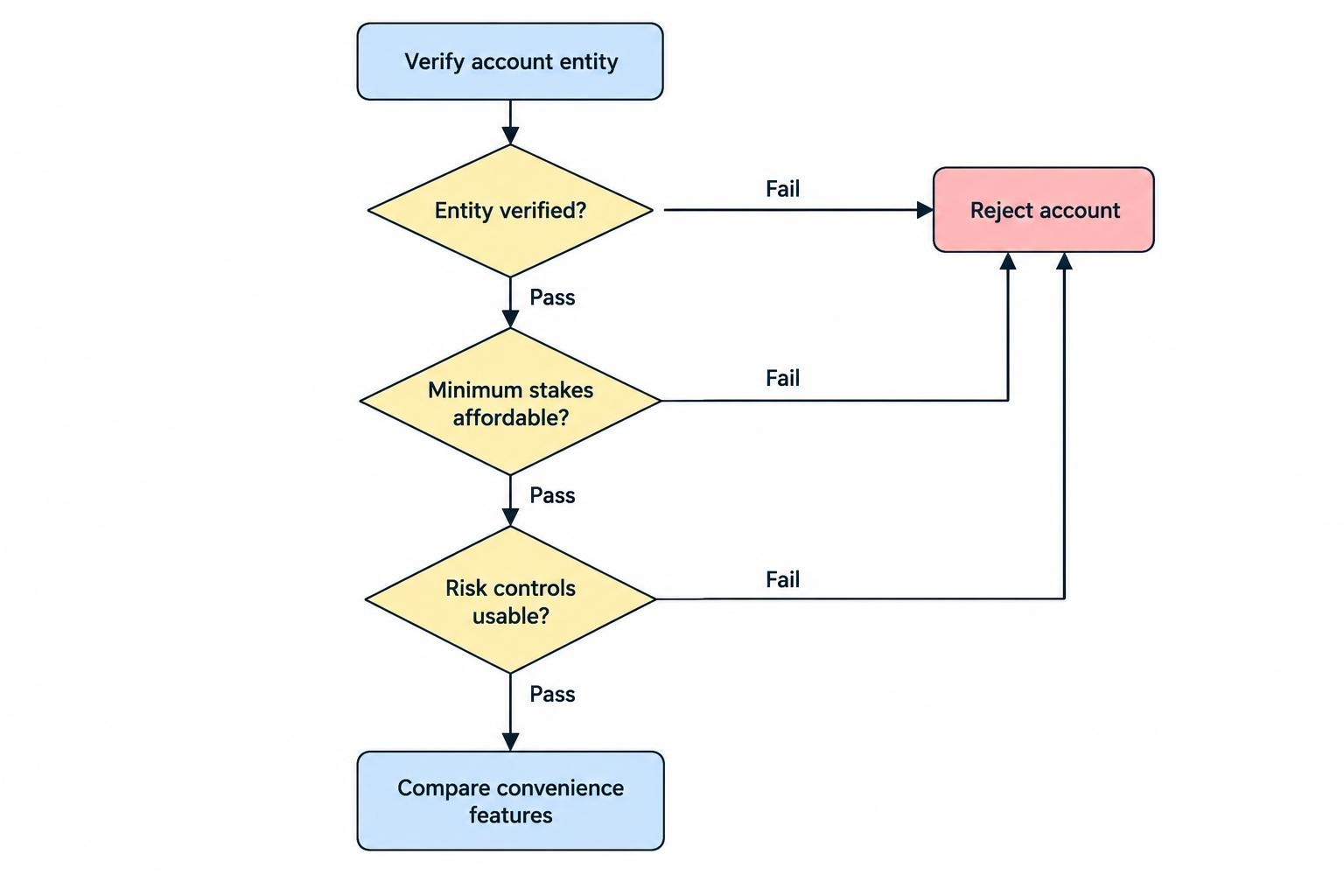
Treat authorisation, affordable position sizes and usable risk controls as pass or fail checks. Attractive charting cannot compensate for a minimum stake that is too large. Only compare convenience features after a broker passes those first checks.
Check the Firm Behind the Trading Account
Find the legal name in the account agreement, not just the trading name displayed above the application form. Match that firm against official records and check that it has permission for the service being offered. Match the contact details too: clone firms can impersonate authorised businesses using genuine names and reference numbers. The FCA’s instructions for checking a firm’s authorisation cover these checks.
Save the account agreement and note the entity named in it. If the application switches you to another company within the same group, stop and establish what has changed before proceeding. Do not assume that every company using the same brand provides identical account terms.
Our guide to checking a broker on the FCA Register covers the verification process in more detail. Keep that exercise separate from judging whether you like the platform. Both matter, but they answer different questions.
Check the Retail Protections, Not Just the Logo
For accounts within the FCA’s retail spread betting rules, protections include minimum margin requirements, account level margin close out and negative balance protection. When account equity falls below 50% of the required margin, positions must be closed as soon as market conditions allow. Negative balance protection caps liability at the funds in the relevant trading account, not at the amount allocated to one trade. Firms must also display prescribed risk warnings, including provider loss percentages where applicable. These requirements sit within FCA Handbook COBS 22.5 on retail speculative investments.
None of this makes an individual trade safe. Ask the broker to show you where its platform displays account equity, required margin and the close out level. You should be able to distinguish them before opening a position.
Keep Compensation Separate From Trading Losses
Eligible investment claims against a failed firm can receive FSCS compensation of up to £85,000 per eligible person, per firm, subject to the scheme’s requirements. That is not insurance against losing trades: the scheme does not cover poor investment performance. Check the FSCS investment protection requirements and compensation limits, and ask the provider to confirm the position for your account.
Also request the broker’s client money information. Establish how it holds customer funds and what its documents say would happen if the firm failed. Avoid treating a protection badge as an answer to every question about custody, access or eligibility.
Compare Minimum Stakes Before Minimum Deposits
The minimum deposit tells you how much money is needed to fund an account. The minimum stake tells you whether you can place a suitably sized trade. For a beginner, the second figure deserves more attention.
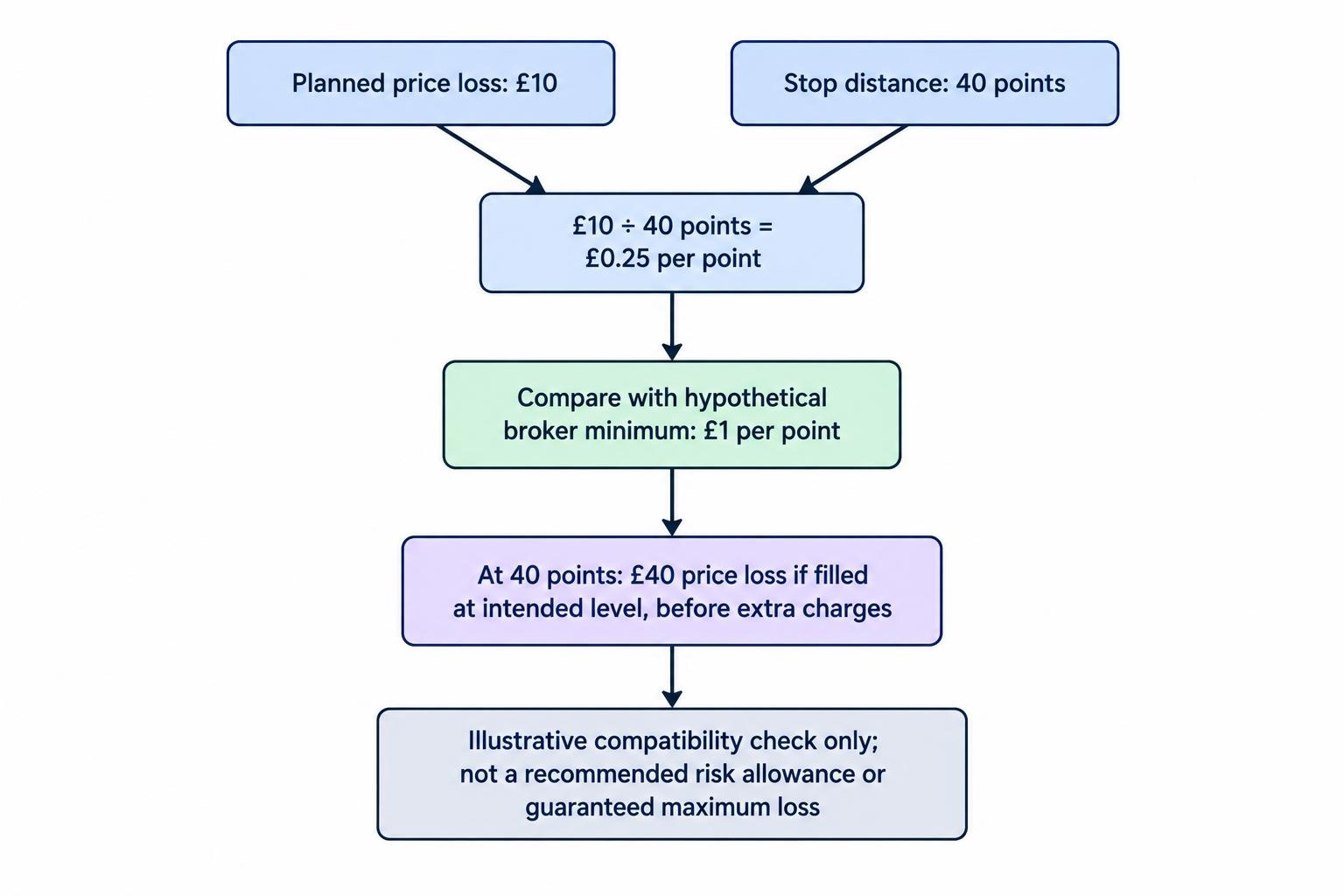
Consider a hypothetical £1,000 account with a planned price loss of £10 on one trade. If the intended stop is 40 points from the entry price, the stake would be £0.25 per point:
£10 planned price loss ÷ 40 points = £0.25 per point.
If a broker’s minimum stake on that market is £1 per point, the same stop distance produces a £40 price loss if filled at the intended level, before any extra charges. That does not fit the original plan. Moving the stop closer simply to accommodate the broker changes the trade rather than solving the sizing problem.
Use the comparison of spread betting brokers for small stakes to investigate this requirement. Check each intended market separately, including the stake increments above the minimum.
These figures illustrate account compatibility, not a recommended risk allowance. Ordinary stops can fill at worse prices, so the calculated loss is not a guaranteed maximum. Apply a consistent position sizing method before deciding whether an account balance and minimum stake work together. If they do not, continue practising rather than forcing a live trade.
Choose a Platform You Can Operate Without Guesswork
Open a practice trade ticket and read it from top to bottom. You should be able to identify the market, product type, direction, stake per point, required margin and attached orders. Check what one point means on that product. A familiar market name does not establish how its spread betting contract is quoted.
Then rehearse an amendment. Change the stop, reduce the position and close the remainder. Check whether an opposite order closes an existing position or opens another one under the account’s settings. Do not leave that question until there is real money on the screen.
Pay particular attention to confirmation messages. Did the platform accept the stop, reject it or leave it pending? Can you find the order status without searching through several menus? Clear feedback matters more than an impressive collection of indicators.
If you expect to manage positions by phone, compare the functions covered in our guide to mobile spread betting apps. Test the tasks you will actually perform, rather than judging the app from screenshots.
A sensible first setup is deliberately plain: a short watchlist, readable prices, visible positions and accessible order controls. Add extra tools when they solve a problem. More buttons are not a trading plan.
Use the Demo Account to Test the Broker
A demo account is useful for assessing whether you can operate the platform correctly. It is not evidence that you will make money in a live account.
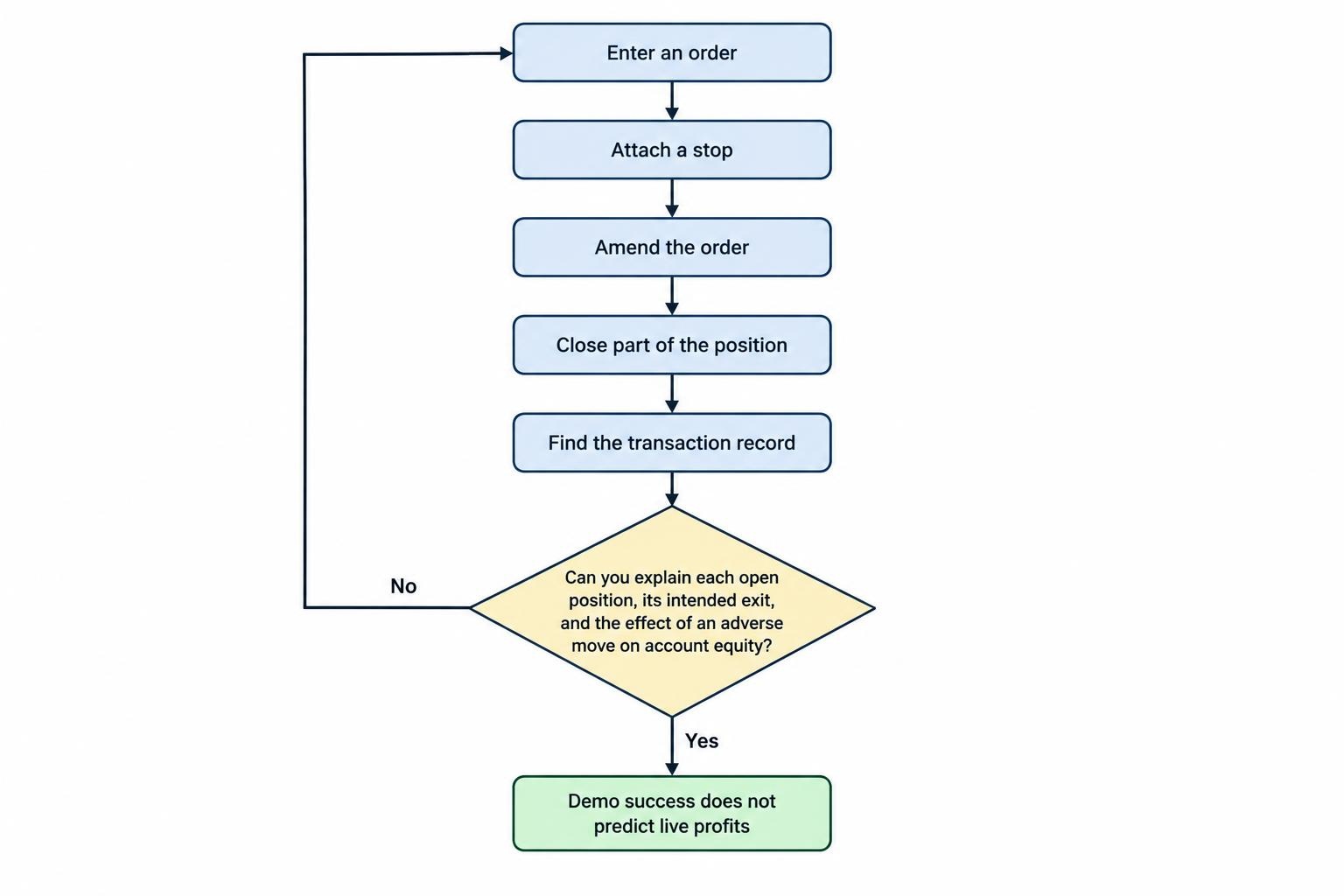
Use a practice balance that resembles the amount you might allocate to trading. An enormous virtual balance makes poor sizing decisions harder to notice. Repeat the same tasks across your shortlisted providers: enter an order, attach a stop, amend it, close part of the position and find the transaction record.
Compare spread betting demo accounts on access, expiry, available markets and the functions you need to rehearse. Ask which features differ between practice and live accounts, including prices, execution, charges and available order types.
Keep brief notes about operational mistakes. Selecting the wrong stake, confusing an order with a position or overlooking a rejected stop matters more than whether the practice trade happened to win.
Do not use demo profits as your only reason to fund an account. A better readiness test is whether you can explain every open position, its intended exit and the effect of an adverse move on account equity. If that explanation is unclear, more practice has a purpose.
Compare Costs for the Way You Intend to Trade
A broker advertising a narrow minimum spread may not be the cheapest choice for your intended use. Compare the same product, position size, trading period and holding time. Otherwise, the comparison mixes unlike trades.
Read Spread Figures in Context
Distinguish an advertised minimum spread from the spread shown when you expect to trade. Ask whether the published figure applies during particular hours or under stated conditions. Also check that competing products use the same point size.
As a hypothetical example, opening and immediately closing a £0.50 per point position across an unchanged one point spread produces a £0.50 loss before other charges or execution differences. At a 1.5 point spread, that becomes £0.75. The difference is 25p for that transaction, not evidence that one account is cheaper under every circumstance.
Our guide to comparing total spread betting costs provides a fuller framework. For your shortlist, record the applicable terms rather than relying on a headline.
Include Holding and Account Charges
If you intend to hold positions beyond the funding cutoff, obtain the financing formula and work through it for a sample position. Check the reference rate, broker adjustment, charging days and treatment of long and short positions. Do not assume a short trade earns a funding credit.
Use the guide to overnight financing costs to check the calculation. Establish whether the product is a daily funded bet or an expiring contract, then read the terms for that product rather than applying one charging model to both.
Check guaranteed stop premiums, market data subscriptions, currency conversion, inactivity charges and withdrawal fees where applicable. A charge need not be large to matter, but it does need to be understood. Ask for a worked explanation if the tariff leaves you guessing.
Check Stop Controls Before You Need Them
A beginner friendly broker should make it straightforward to attach, inspect and amend a stop. Check minimum stop distances, amendment restrictions and the price used to trigger an order. Ask whether the chart and the stop use the same quoted price.
An ordinary stop is a trigger for execution, not a promise of the final exit price. When comparing platforms, inspect how they explain slippage and market gaps. A risk estimate displayed on a ticket should not be mistaken for a contractual guarantee.
A guaranteed stop provides a different form of price protection, subject to the provider’s terms. If that feature matters to your plan, compare spread betting brokers offering guaranteed stops and verify availability on the exact market you intend to trade.
Ask when any premium becomes payable, whether the stop can be moved and whether a wider minimum distance applies. Include the charge when calculating the intended trade outcome.
Test the full sequence in practice: place the order, confirm the stop appears against the position, amend it and check the accepted level. The relevant question is not whether a platform has a stop button. It is whether you can use that button correctly and verify the result.
Match Market Access to Your Learning Plan
Choose a small group of markets before comparing broker coverage. You do not need thousands of instruments to learn how to manage one position properly.
For each intended market, check the product name, point value, minimum stake, dealing hours, funding arrangements and expiry terms. Confirm whether similarly named instruments are daily funded or dated contracts. Keep those details beside your cost comparison so that you do not compare one product’s spread with another product’s funding structure.
Then check the timetable against your own availability. If you can only trade during a short evening window, assess the account during that window. A price or support arrangement available at lunchtime may not answer your practical needs.
Broader coverage can matter later, but it should not rescue an account that fails on your first market. Start with what you intend to use, not what looks impressive in a product catalogue.
Assess Account Opening, Support and Withdrawals
Read the application questions carefully and answer them honestly. Do not search for answers designed to get an account approved. If the questions expose gaps in your knowledge, use that as a reason to pause. Our guide to the spread betting appropriateness test covers this part of account opening.
Before funding, send support a practical question about your intended product. Ask how a funding charge is calculated, how to amend a stop or what happens after an order rejection. Judge the response on whether it resolves the question, not just how quickly a greeting arrives.
Check support hours and alternative contact methods. Ask what procedure applies if you cannot access the platform while a position is open. Do not assume a particular telephone service exists without confirming it.
Read the withdrawal terms too: accepted destinations, identity checks, processing arrangements, charges and how open positions affect available funds. Record the stated process so that you can distinguish an expected check from an unexplained delay.
Keep order confirmations, statements and relevant correspondence. Eligible spread betting complaints may be considered by the Financial Ombudsman Service after you have complained to the business; its spread betting complaints guidance sets out the process. A losing trade alone does not establish that the broker acted incorrectly.
Build a Shortlist Without Turning It Into a Research Project
Use the same short assessment for each candidate. This makes differences easier to spot and prevents an attractive extra from distracting you from an account that does not fit.
- Verify the account entity. Establish the contracting firm, relevant permissions and proposed account classification.
- Check one representative trade. Compare minimum stake, margin, stop conditions and charges for the same intended position.
- Rehearse the trading process. Practise entry, amendment, partial closure and finding the transaction record.
- Check administration. Read funding, withdrawal, security and support arrangements.
- Reject failures before scoring extras. Only compare optional charts, research and convenience features among accounts that pass the earlier checks.
Use detailed spread betting broker reviews to identify questions worth checking. Confirm the answers against the account documents and platform available to you before applying. Keep a dated note of the terms you compared.
There is no need to open several funded accounts simply to complete this exercise. Two or three carefully examined candidates are more useful than a spreadsheet full of unchecked claims. If none passes your requirements, keeping your money outside a trading account is a valid result.
Questions Beginners Ask About Spread Betting Brokers
Is the Broker With the Lowest Deposit Best for Beginners?
No. A low deposit requirement does not establish that the minimum trade size is affordable or that enough free margin will remain after opening a position. Check brokers with no minimum deposit only after working out the position sizes your plan requires. An easy deposit is not permission to take a badly sized trade.
Should I Choose the Broker With the Most Trading Tools?
Only if those tools serve a clear purpose. Start by checking order entry, position management, risk displays and transaction records. Advanced charting has little value if the basic trade ticket remains confusing. You can reassess extra tools as your requirements become clearer.
Does a Lower Advertised Client Loss Percentage Prove a Broker Is Better?
No. A provider’s published percentage is not your personal probability of losing money, and it does not isolate platform quality from customer behaviour. Read the warning, but do not turn it into a league table that replaces checks on costs, account terms and usability.
When Should I Move From Demo to Live Trading?
There is no universal timetable. Consider whether you can size positions, calculate charges, place and amend stops, and explain margin without guessing. Demo profits alone do not answer those questions. If you proceed, use only money you can afford to lose and do not increase exposure to make small results feel more worthwhile.
Choose the Account That Fits, Not the Longest Feature List
The strongest beginner shortlist starts with a verified firm, manageable minimum stakes and clear risk controls. It then compares usable platforms, understandable costs and practical account administration.
Choose only after you can explain how your intended trade would work on that account, including how it could lose money. A broker should make that explanation easier. If the terms or platform keep getting in the way, keep looking—or keep practising.