A spread betting demo account lets you practise with virtual funds before putting real money at risk. You can learn the dealing ticket, choose a stake per point, place orders and watch how price movements affect an open position.
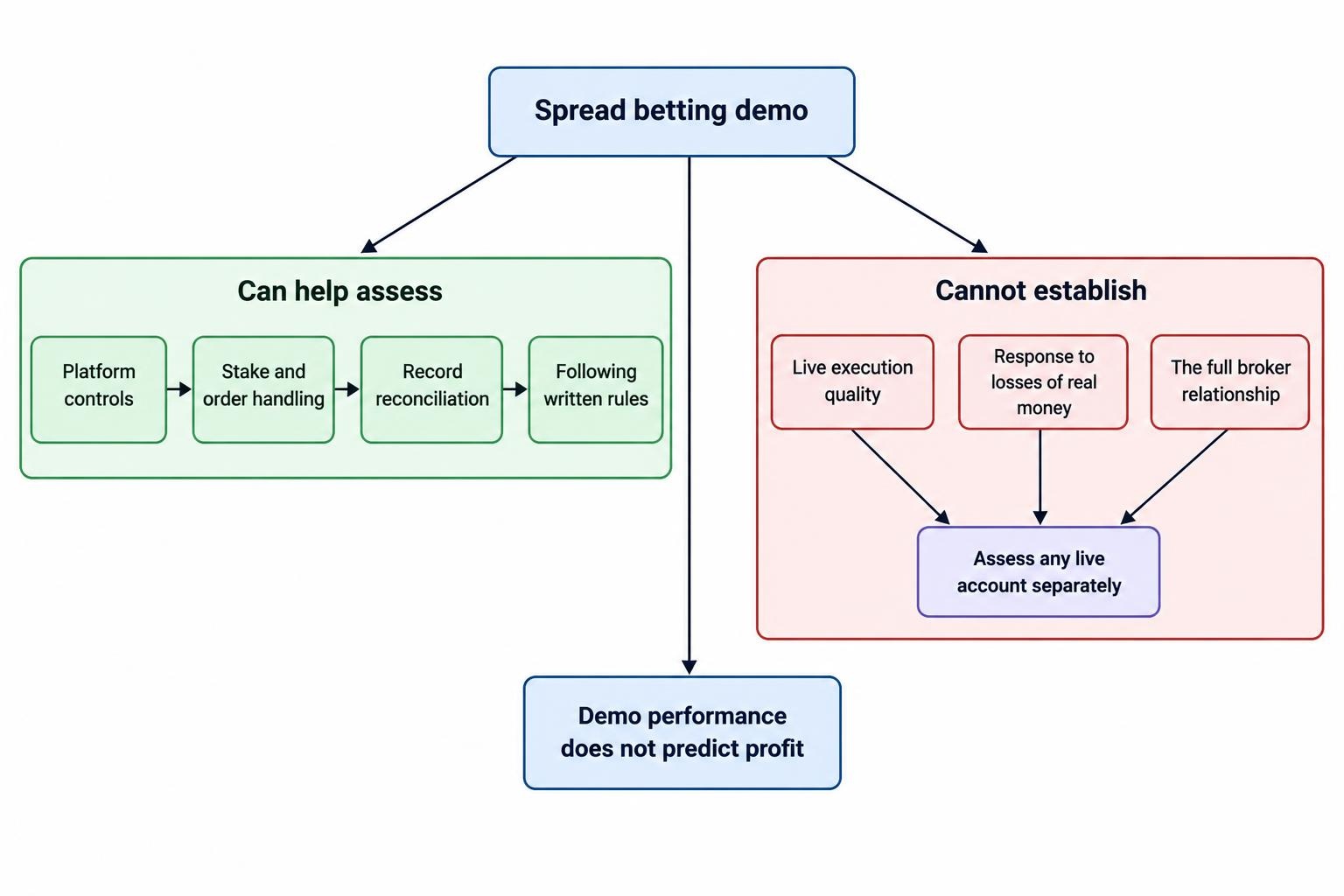
Its most useful role is testing your process, not proving that you can make money. A simulator can show whether you entered the wrong stake or misunderstood a stop order. It cannot establish how you will trade when losses come out of your own savings.
Financial spread bets sit within the FCA’s high-risk CFD product category. Practising does not remove those risks. Use a demo to assess the platform and your trading discipline, then assess any live account separately.
What a Spread Betting Demo Account Should Let You Test
A useful demo should reproduce the main tasks you would perform on the live platform: finding a market, reading its quote, entering a stake, checking margin, attaching an exit order and closing the position. Look for clear transaction records too. You should be able to reconstruct what happened without relying on memory.
Start by confirming that you are testing financial spread betting rather than a different product on the same platform. A CFD demo may teach you the layout, but its trade sizing can use contracts or units rather than pounds per point. That distinction matters when you move between products. Our comparison of spread betting and CFDs covers the differences.
Also check the instrument itself. A cash index market and a dated index contract are not interchangeable practice instruments. The same applies to daily funded bets and contracts with an expiry date. Match the demo market to the product you are considering, not just to a familiar market name.
How to Compare Spread Betting Demo Accounts
The best demo for your purpose is the one that answers your practical questions. A large virtual balance and a polished chart package are not enough. Focus on how closely the account matches the account, markets and devices you might use.
| Feature | What to check | Why it matters |
|---|---|---|
| Product and account type | Whether the ticket offers spread bets with the intended account currency and stake units | Prevents practising the wrong sizing method |
| Market coverage | Whether your intended instruments and contract types are available | A platform demonstration is less useful if your actual markets are absent |
| Prices and execution | Whether data is live or delayed, and how simulated fills are calculated | Determines what you can reasonably infer from the results |
| Orders and costs | Which orders, charges and account adjustments appear in the simulation | Exposes gaps between the practice balance and a realistic trading record |
| Access terms | Expiry, inactivity rules, registration requirements and any charges | Helps you plan practice without unexpected interruptions |
| Records and devices | Trade exports, account history and functionality on each intended device | Supports review and reveals differences between desktop and mobile use |
Do Not Confuse Real Market Data With Real-Time Data
Ask what the price feed actually provides. Real market data can still arrive with a delay. For a clear example outside spread betting, the CME Group simulator FAQ distinguishes delayed practice data from real-time challenge data. Do not assume another simulator follows either arrangement.
For spread betting practice, check whether the chart, dealing quote and order triggers use consistent prices and timestamps. A delayed feed may still help you learn the controls, but it is unsuitable for assessing your reaction to a live announcement against an undelayed news feed.
Check Access Terms Before Registering
Read the demo offer rather than assuming that access is free, permanent or available without a live application. Establish whether the account expires, whether virtual funds can be replenished and whether inactive accounts are removed. Save your records before any expiry date.
Review contact preferences too. Access to a practice platform is not a reason to accept pressure to deposit. When comparing spread betting brokers, keep the demo offer separate from the live account’s pricing, contractual terms and regulatory status.
Set a Realistic Virtual Balance and Stake
Use a virtual balance that resembles the money you could genuinely afford to put at risk. If the platform supplies £50,000 but your hypothetical live budget is £2,000, do not base your practice stakes on the larger figure.
If you cannot change the displayed balance, maintain a separate practice ledger. Record £2,000 as the starting amount and calculate every position against that figure. Otherwise, an oversized virtual balance can conceal the pressure that losses and margin requirements would place on a smaller account.
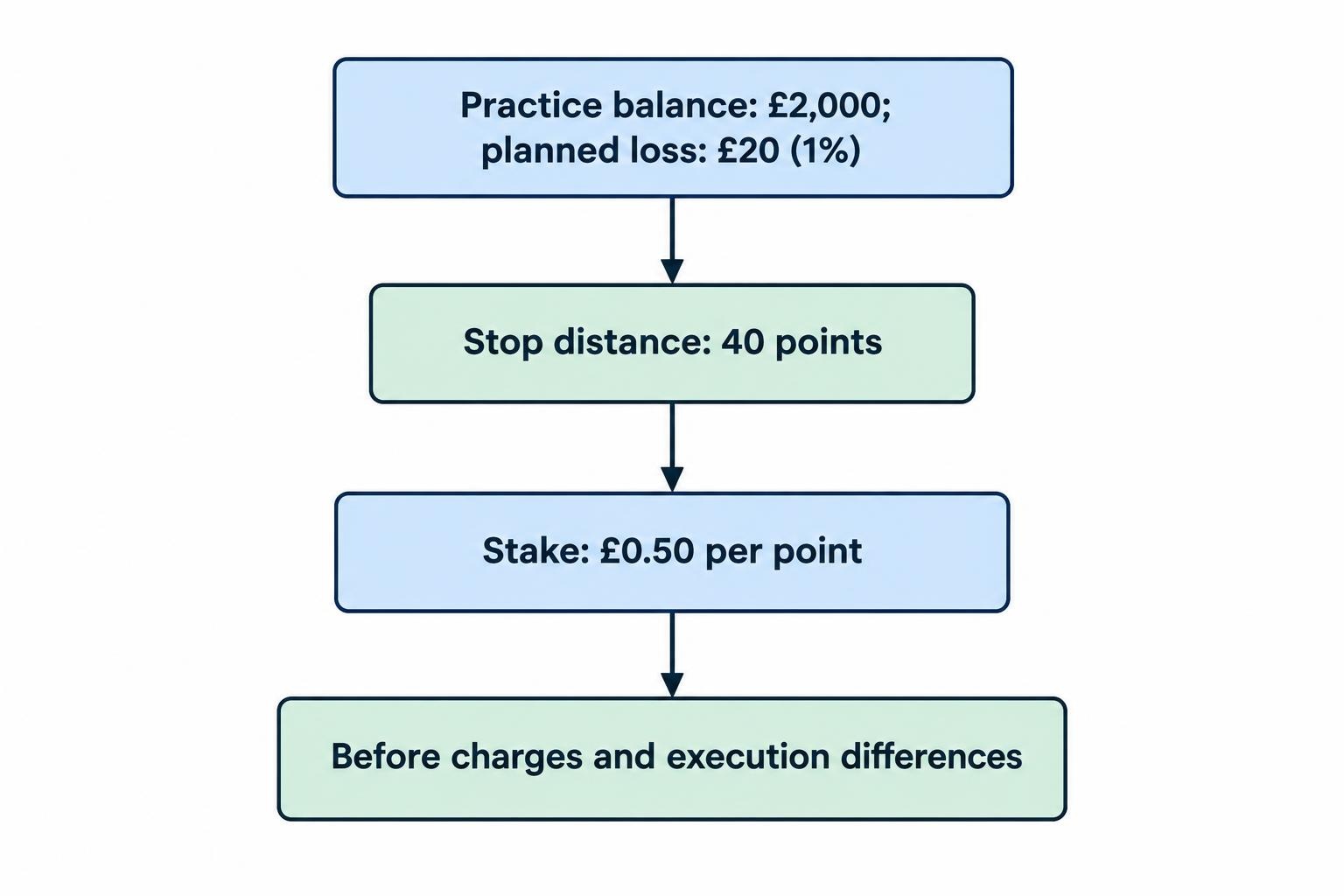
For illustration, a £20 planned loss represents 1% of a £2,000 practice balance. With a stop 40 points from the intended entry, the corresponding stake is £0.50 per point before allowing for charges and execution differences. This is an arithmetic example, not a recommended risk percentage.
The calculation should run from the amount at risk to the stake, not from the platform’s maximum permitted position back to a justification. Use our position sizing guide to work through that process.
Check the minimum stake on the intended live market as well. If it is too large for your proposed risk budget and stop distance, a successful demo session does not make that trade affordable.
A Worked Demo Trade
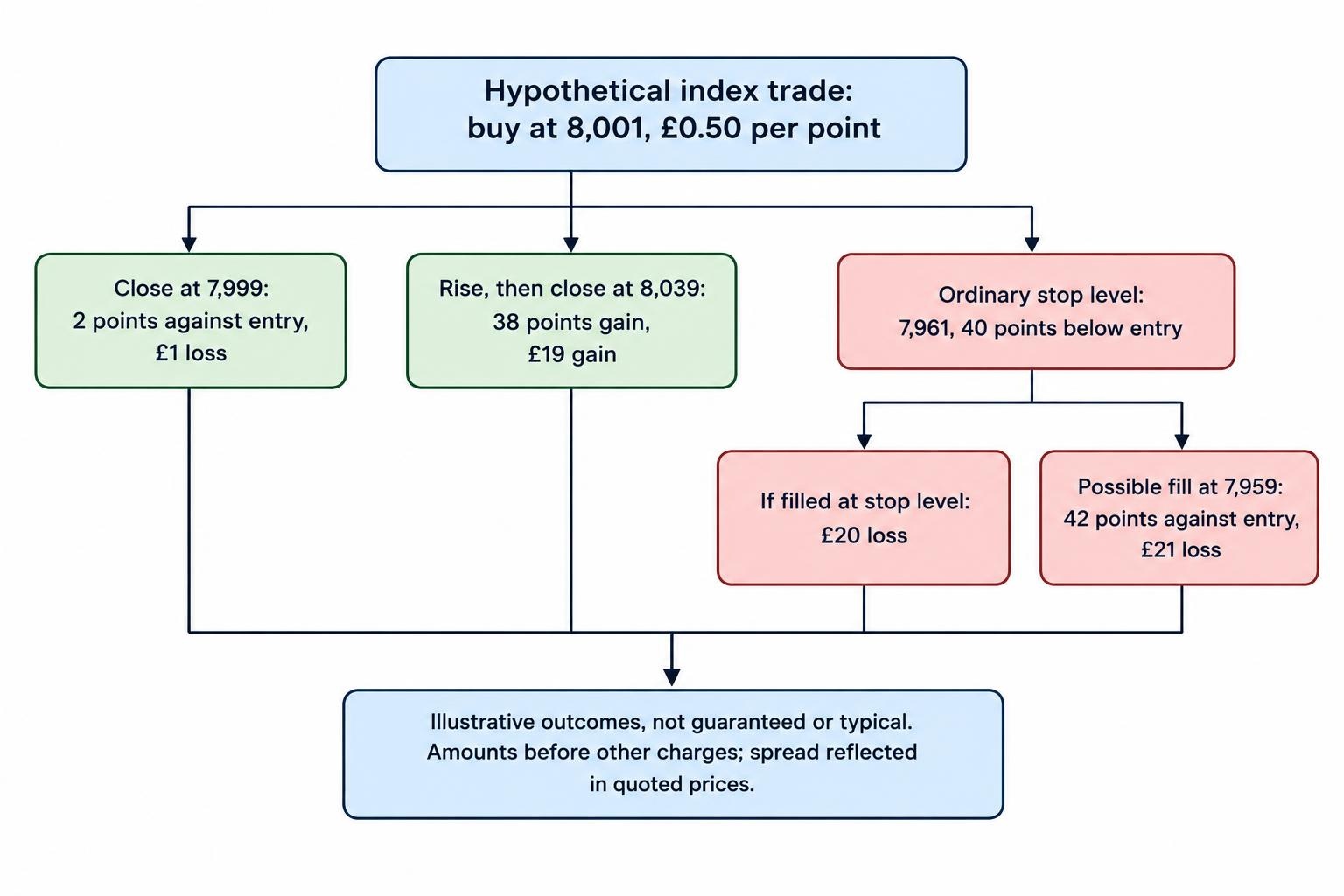
Suppose a hypothetical index market shows a sell price of 7,999 and a buy price of 8,001. You expect a rise and buy at 8,001 for £0.50 per point.
If you immediately closed at an unchanged sell price of 7,999, the two-point difference would produce a £1 loss. That is the spread showing up in the position. It is not a platform error.
You place an ordinary stop at 7,961, which is 40 points below your entry. A closing fill at that level would produce a £20 loss before other charges. If the market instead rises and you close at a sell price of 8,039, the 38-point gain produces £19 before other charges.
Use the exercise to check three things: the ticket accepted the intended stake, the stop attached to the correct position, and the account history agrees with your calculation. Also confirm what happens to any remaining linked order after you close the trade.
The spread is already reflected in these entry and exit prices. Do not deduct it again from the calculated result. Record separate charges only where they apply.
Now change one assumption. If an ordinary stop triggers at 7,961 but the eventual closing fill is 7,959, the loss becomes £21. The extra two points illustrate why a stop level and an execution price need not be identical.
Build a Practice Plan Around Tasks, Not a Profit Target
A target such as “make £500 in demo” tells you little without a balance, risk budget and trading rules. A more useful plan sets tasks you must complete correctly and records mistakes you need to eliminate.
Learn the Order Ticket Before Testing a Strategy
Practise opening and closing both buy and sell positions at modest virtual stakes. Check the meaning of every size field and whether stop distances are entered as points, price levels or another measure.
Then practise placing, amending and cancelling pending orders. Where supported, test partial closes and observe whether a second trade adds to an existing position or creates a separate one. Consult the spread betting order types guide before using an order whose behaviour you cannot explain.
Repeat the routine on mobile if that is a device you intend to use. Find the positions screen, order history and close controls before you need them. Leave one-click dealing disabled until you have checked its settings and understand the consequences of an accidental tap.
Record the Costs the Simulator Leaves Out
Establish whether the practice account includes applicable overnight funding, dividend adjustments and other charges. Do not treat an unchanged balance as evidence that holding a position costs nothing.
If a charge is absent, add an estimate to your practice ledger using the intended live account’s published terms. Label it as an estimate and record the rate, holding period and calculation. Our guide to spread betting costs provides a framework for checking what belongs in that ledger.
For a position held overnight, review the opening price, closing price, funding entries and any adjustment separately. The aim is to reconcile the balance, not just to recognise a green number.
Test One Written Set of Rules
Define the market, trading hours, entry condition, exit condition and sizing method before the session starts. Include circumstances in which you will not trade, such as an approaching announcement or a spread outside your chosen threshold.
Keep a compact journal with the planned trade, actual action, result after estimated costs and any rule breach. Distinguish a losing trade that followed the plan from a profitable trade that broke it. Profit does not retroactively turn an input error into good execution.
Preserve each run. If you change the rules, mark the start of a new test rather than blending the results. Resetting a balance can be useful for a fresh exercise; resetting it to erase losses defeats the exercise.
Where Demo Trading Can Mislead
Simulated Fills Are Not Evidence of Live Execution Quality
A simulator accepts orders under its programmed assumptions. That does not establish which price would have been available for a real order of the same size at the same moment. This matters most when prices move quickly, spreads change or a market reopens after a gap.
Hypothetical results can misrepresent the effects of execution prices, liquidity and trading costs. The CFTC advisory on hypothetical trading results identifies these weaknesses in simulated commodity trading records. The practical lesson for demo users is to question the assumptions behind a smooth performance chart.
Keep execution questions separate from platform questions. You can establish that you know how to submit a stop without establishing how accurately a demo reproduces live slippage. Equally, a quick simulated fill does not prove that the live service will behave identically under stressed conditions.
Virtual Losses Do Not Reproduce Financial Pressure
A demo cannot establish how you will respond when a loss affects money you need. Treating practice as a game can also encourage larger risks than you would otherwise accept. This behavioural weakness is addressed in ASIC’s discussion of CFD trial accounts.
You can make practice more disciplined by following a fixed budget, recording breaches and refusing to replenish funds during a test. Those habits make the record more useful. They do not turn virtual losses into real ones.
If you repeatedly double stakes to recover a demo loss, pause and examine the behaviour rather than celebrating an eventual recovery. The reset button is not a risk control.
A Demo Does Not Test the Whole Account Relationship
Charting and order entry are only part of using a broker. A demo cannot establish how a future withdrawal will be handled, how a complaint will be resolved or how reliably the service will operate over time.
You can still assess clarity. Ask support a factual question about a market or charge and check whether the response addresses it. Read the live agreement and execution policy. Keep unanswered questions on the comparison sheet rather than assuming that a tidy interface answers them.
How Long Should You Use a Demo Account?
There is no universal number of days or trades that proves readiness. Match the practice period to the decisions you need to rehearse. A few sessions may teach the controls; they tell you far less about a strategy intended to hold positions for several weeks.
Continue until you can operate the ticket without guessing, reconcile the account record and follow your written rules through losing as well as winning trades. Include the conditions relevant to your proposed approach, rather than collecting trades simply to reach a round number.
Do not use a profitable week as a certificate. Check whether the result depended on one unusually large winner, oversized positions or a market move your rules were particularly suited to. A useful demo record exposes those dependencies instead of hiding them.
Assess a Live Account Separately
Demo use is not the same as approval for a live account. In its 2017 review of CFD appropriateness assessments, the FCA warned against giving undue weight to attendance at courses or use of demonstration platforms when assessing knowledge and experience.
Answer application questions honestly. Do not treat a warning as an obstacle to bypass or change answers simply to obtain access. The spread betting appropriateness test concerns knowledge of the product and its risks, not whether your virtual account finished in profit.
Before depositing, verify the legal entity you would contract with, its permissions and its contact details. Follow the process for checking a broker on the FCA Register. A familiar brand name or convincing demonstration platform is not a substitute for that check.
If you choose to proceed, reassess stake sizes against the live account’s actual terms and money you can afford to lose. Research brokers offering small stakes where minimum trade sizes affect affordability, but do not assume that a small stake makes an unsuitable product suitable.
You can also remain on demo or decide not to trade. The strongest result from a practice account may be identifying a platform problem, an unaffordable minimum stake or a trading approach you cannot follow consistently. Finding that out without losing real money is useful work.