Forex spread betting brokers let you speculate on currency pairs using a cash stake per point of movement. Choosing between them takes more than finding the smallest EUR/USD spread. The account’s minimum stake, overnight charges, order handling and platform controls all affect whether it suits the way you trade.
The most useful comparison starts with your own requirements: the pairs you trade, your usual dealing hours, your holding period and the amount you intend to risk. A broker that works well for short EUR/USD trades may be a poor fit for holding less frequently traded currencies overnight.
This guide focuses on comparing forex accounts rather than ranking providers using headline prices. For a broader starting point, use our spread betting broker guide. Spread betting involves substantial risk, and choosing a suitable provider does not make the underlying trade safe.
What Makes a Forex Spread Betting Broker Suitable?
A suitable broker must pass two separate tests. It needs the right authorisation and account arrangements, and its trading conditions must fit your strategy. Good charts cannot compensate for an unsuitable minimum stake. A narrow spread cannot compensate for unclear financing charges.
Use the following framework to reduce a long list of providers to a manageable shortlist.
| Comparison area | What to check | Why it matters |
|---|---|---|
| Account and legal entity | The contracting company, permissions, client classification and eligibility | Check the actual account agreement, not just the trading brand |
| Trading costs | Spreads on your chosen pairs, financing and other applicable charges | A headline minimum does not establish the cost of your trades |
| Stake sizes | Minimum stake, stake increments and the cash value of a point | The smallest available trade must fit your risk budget |
| Execution and orders | Order triggers, slippage treatment, stop distances and trading restrictions | These determine how closely an executed trade can follow your plan |
| Platform access | Supported account types, mobile controls, charts and statement exports | A platform logo alone does not confirm spread betting compatibility |
| Account administration | Funding, withdrawals, support and complaint procedures | Managing the account should not become a second occupation |
Set your non-negotiable requirements before comparing optional features. If a provider does not offer your chosen pair, your required stake size or your preferred order type, there is little value in debating its chart colours.
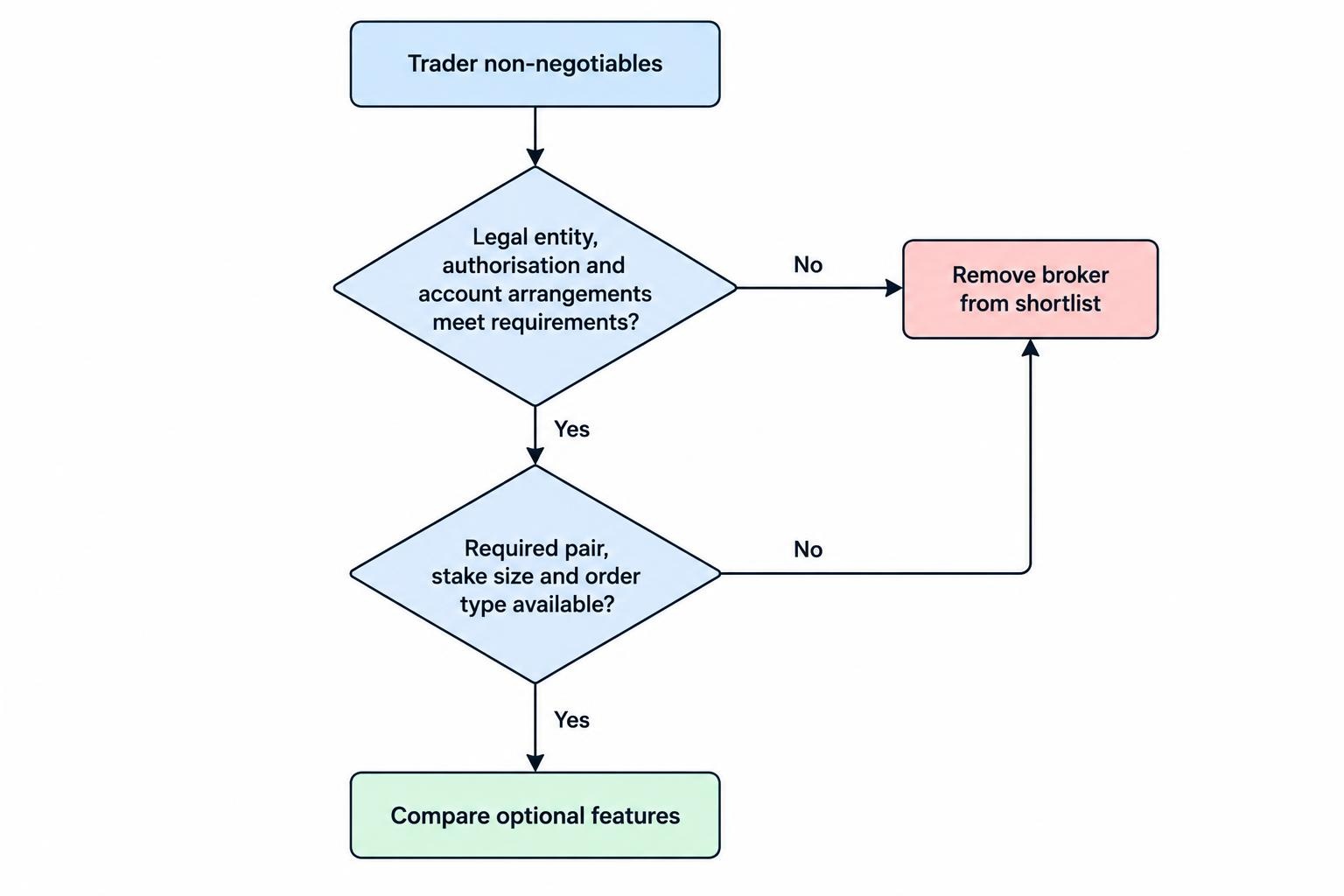
Check the UK Legal Entity Before Comparing Prices
Identify the company named in the account agreement. Do not stop at the brand name displayed above the application form. Compare that company’s details and permissions with the FCA’s guidance on checking an authorised firm. Match the contact details too: clone firms can copy the name and reference number of a genuine business.
Keep a record of the entity you checked and the account terms you were offered. During an application, read any notice that changes the contracting company, jurisdiction or client classification. A comparison made for one entity should not automatically be carried across to another.
Our guide to FCA-regulated spread betting brokers covers this part of the selection process in more detail. Treat authorisation as an initial screening requirement, not a promise about investment returns or service quality.
Also confirm that you are applying for a forex spread betting account. Do not assume a provider’s CFD account, professional account and spread betting account have interchangeable pricing or platform access. Obtain the terms for the product you will actually use.
Compare Forex Spreads on Equal Terms
The spread is the difference between the price at which you can sell and the price at which you can buy. For broker selection, the useful question is not “How low can this spread go?” It is “What spread would apply to my trades, at my dealing times and stake sizes?”
Minimum spreads are not a trading budget
A minimum spread describes the lowest advertised level under the stated conditions. It does not tell you how often that level is available. An average spread is more informative only when its calculation period, trading session and account type are clear.
When comparing published figures, check whether they refer to the same currency pair and the same product. A forex CFD quote with a separate commission should not be treated as the price of a spread bet. Likewise, a professional account price is not automatically available on a retail account.
Use our comparison of spread betting brokers with the lowest spreads as a starting point, then inspect the relevant market information on each shortlisted account. Record the conditions attached to the price rather than copying the largest number in the advertisement.
Compare quotes during your trading session
Build a small comparison sheet for the pairs you intend to trade. Record bid and ask prices at matching times across providers. Include ordinary market conditions and the periods when you expect to enter or exit.
If your strategy trades economic announcements, a calm afternoon sample will not answer the question you need answered. If you normally close before the daily funding cutoff, focus on that window rather than collecting prices throughout the night.
Keep the sample practical. Several observations across different days are more useful than one screenshot, but they still describe that sample rather than proving future pricing. Mark demo quotes as demo quotes and avoid presenting them as verified live execution costs.
A worked spread cost comparison
Suppose two hypothetical brokers quote spreads of 0.8 and 1.2 pips. You trade at £3 per pip and complete 30 opening and closing trades. Assume the spread stays unchanged, the midpoint does not move during each immediate round trip, and there are no other charges.
| Calculation | Broker A | Broker B |
|---|---|---|
| Spread | 0.8 pips | 1.2 pips |
| Spread cost per round trip | £2.40 | £3.60 |
| Spread cost across 30 round trips | £72 | £108 |
The difference is £36. These are illustrative figures, not current broker quotes. They show why a modest spread difference matters more as stake size and trading frequency increase.
Do not automatically charge two full spreads to each round trip. With an unchanged midpoint and spread, buying at the ask and immediately selling at the bid loses one quoted spread. Where entry and exit spreads differ, comparing each execution with its contemporary midpoint gives a more accurate cost breakdown.
Spreads are only part of the calculation. Our guide to comparing total spread betting costs provides a framework for including financing and other charges without counting the same cost twice.
Check Overnight Funding Before Choosing a Swing Trading Account
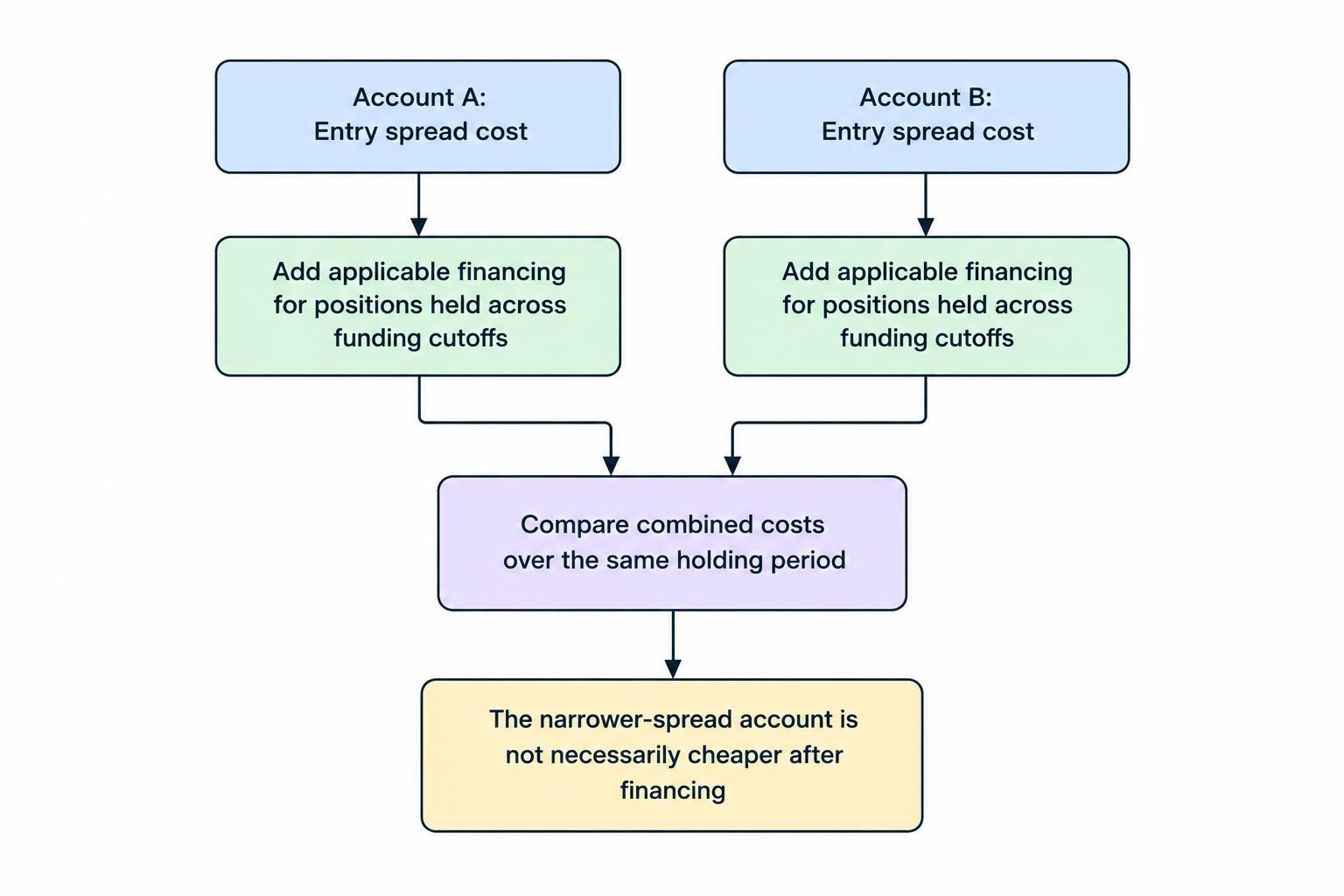
For positions held across a funding cutoff, compare the applicable long and short holding rates. Check the calculation method, the amount of exposure used, the charging currency and any broker adjustment. Do not budget using the interest rate difference between two currencies alone; use the account’s actual financing terms.
Ask how the provider handles weekends and currency holidays. Check whether the displayed rate applies to one day or a longer settlement period, and whether it can change while your position remains open. Our guide to overnight financing costs covers the mechanics separately.
A simple hypothetical comparison shows why this matters. At £3 per pip, a 0.8 pip spread costs £2.40. Add £1.20 of funding for each of five charged days and the combined cost reaches £8.40. A competing account with a 1.2 pip spread costs £3.60 initially, but funding of £0.60 for each of those days brings its total to £6.60.
The wider spread wins that cost comparison. Neither account is universally cheaper; the holding period changes the result.
Where a broker offers a dated forex product, compare its full pricing and expiry terms with the rolling product. The absence of a separate daily funding entry is not enough to establish that the contract is cheaper. Include the dealing spread and any cost of maintaining exposure beyond expiry.
Minimum Stakes Matter More Than Minimum Deposits
A low opening deposit does not establish whether an account supports sensible position sizing. The more useful figures are the minimum stake, the permitted stake increments and the cash movement represented by one point.
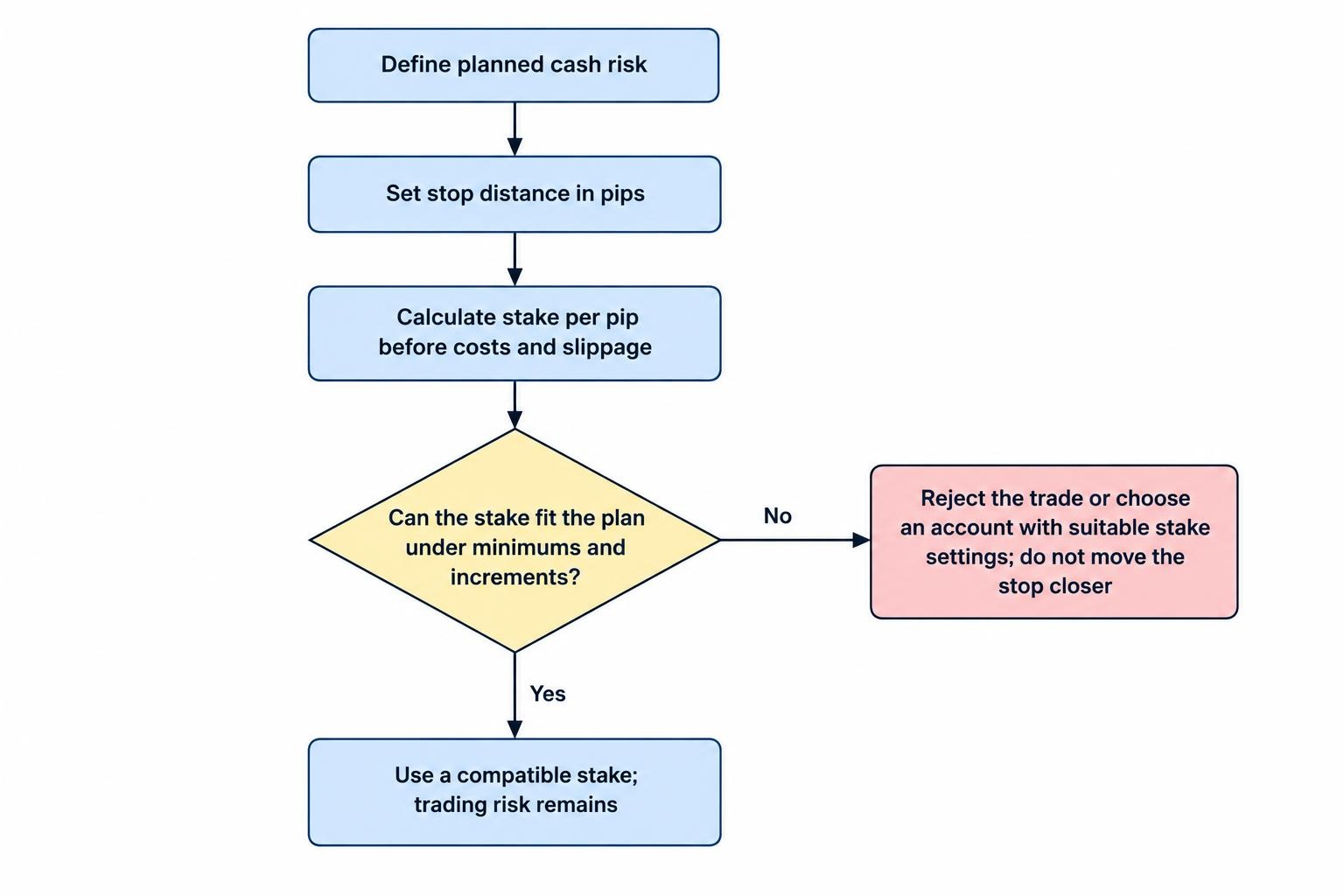
Suppose a hypothetical trading plan allows £10 of price risk and requires a stop 25 pips from entry. The corresponding stake is £0.40 per pip before costs and slippage. If the account requires at least £1 per pip, that trade carries £25 of price risk instead.
The correct response is not to squeeze the stop closer just to make the ticket affordable. Reject the trade or choose an account whose stake settings fit the plan. Our guide to spread betting brokers for small stakes focuses on this requirement.
Check what the platform means by a point
Forex tickets can display fractional pips, so inspect the contract specification rather than inferring cash risk from the final decimal place. For a conventional EUR/USD quotation, a movement from 1.08000 to 1.08010 is one pip. The fifth decimal place represents a tenth of a pip.
Before submitting an order, confirm how much a one pip move would gain or lose at the selected stake. Check the same calculation for yen pairs and any unfamiliar quotation format. A clear deal ticket should let you reconcile stake, price movement and cash exposure.
Your available margin is a separate consideration. It determines whether the account can support the position under the provider’s requirements; it does not replace a loss budget. Our position sizing guide explains how to work from planned risk to stake size rather than from available buying power.
Assess Currency Coverage and Trading Hours
Start with a written list of the pairs you need. A large advertised market count is useful only if it includes the contracts you intend to trade on the spread betting account.
For each required pair, check the spread, minimum stake, margin requirement, funding terms and available orders. Do not assume that conditions on EUR/USD tell you anything reliable about a less frequently traded currency pair.
Then check when the broker accepts orders. Record the weekly opening and closing times, maintenance periods, holiday arrangements and the time zone used by the platform. Our guide to forex trading hours provides the wider session context, but the provider’s contract hours determine when you can deal on that account.
Time settings deserve particular attention if you use automated rules or trading journals. Establish whether chart timestamps, order history and funding cutoffs use UK time, another local time or server time. Check how seasonal clock changes affect your routine.
Also consider the account as a whole. Trading several pairs involving the same currency can create overlapping exposure. A broad currency menu is not, by itself, a reason to hold more positions.
Choose the Platform for the Account, Not the Logo
Platform selection should begin with account compatibility. Ask whether the exact spread betting account supports the platform you want, which forex instruments are available through it and whether its features differ from the provider’s other interfaces.
If you use automated strategies, indicators or scripts on MetaTrader 4 spread betting accounts, check symbol names, stake conventions and order settings before transferring a strategy. A familiar chart layout does not confirm that the trading rules match your previous account.
Test the tasks you perform repeatedly: opening an order ticket, attaching protection, changing a stop, partially closing a position and cancelling a pending order. Check whether closing a position also cancels its associated orders or whether further action is needed.
For TradingView spread betting connections, distinguish chart access from trading access. Confirm that you can select the correct account and place the required orders. Check which controls remain available only through the broker’s own platform.
Compare mobile controls and account records
On mobile, inspect how clearly the app separates stake, margin and estimated loss at a stop. Test whether trade confirmations can be enabled and whether existing positions are easy to distinguish from pending orders. Speed is useful; accidentally opening the opposite trade is less useful.
Look beyond order entry. Check whether you can export statements showing execution prices, funding entries, deposits and withdrawals. An attractive charting package is a poor substitute for records that let you reconcile the account.
Read the order execution policy
Ask how market orders are handled when prices move during submission. Check the treatment of partial fills, rejected orders and price improvements, and establish how the provider records an execution dispute.
For stops, determine which price triggers the order: bid, ask or another defined reference. This matters when comparing a chart with an order history. Also read any restrictions on scalping, automated trading or trading around announcements before assuming your intended method is permitted.
Compare Retail Protections and Stop Options
The FCA rules for retail leveraged spread bets require opening margin of at least 3.33% for major foreign exchange pairs and 5% for other currency pairs, equivalent to approximately 30:1 and 20:1 exposure. Providers can require more margin.
The rules also require account margin closeout when net equity falls below 50% of the applicable regulatory margin requirement, with positions closed as soon as market conditions allow. That threshold is not 50% of your original deposit and is not a substitute for a stop.
Negative balance protection limits a retail client’s liability for these products to the funds dedicated to trading them in the account. It does not protect the balance against trading losses or cap each position at its opening margin.
Separately, compare ordinary and guaranteed stops. An ordinary stop does not guarantee the eventual execution price. Where offered, a guaranteed stop provides contractual price protection subject to its terms, including eligibility, distance requirements and any premium.
Our guide to brokers with guaranteed stops covers that feature. Check availability on the currency pair and platform you plan to use, not simply whether the provider advertises guaranteed stops somewhere in its product range.
Use a Demo Account to Test the Workflow
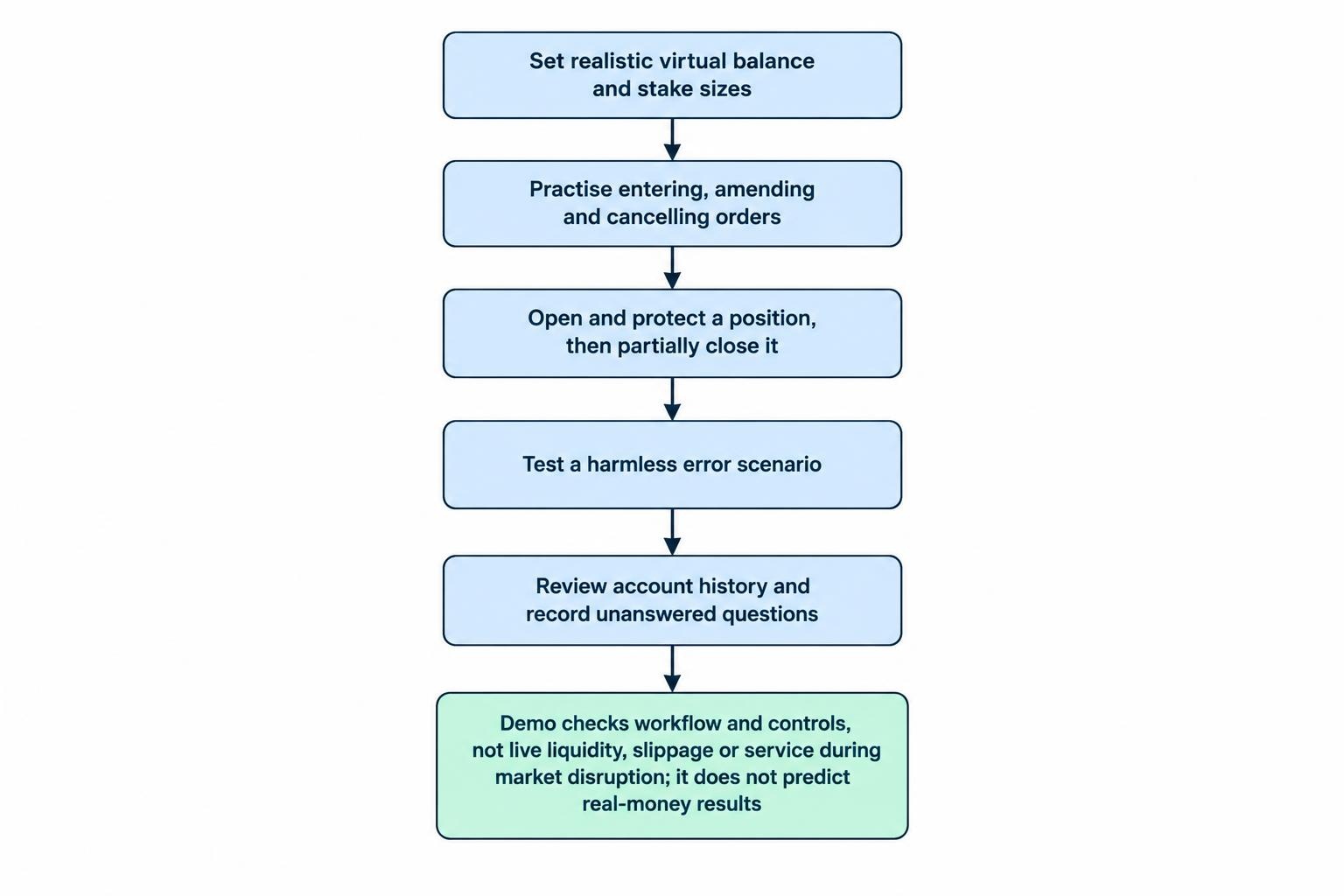
A demo account is useful for checking whether you can operate the platform accurately. Treat it as a rehearsal for account controls, not proof of the execution prices you will receive with real money.
Set a realistic virtual balance and use the stake sizes your intended budget would support. An oversized demo account can make unsuitable trade sizes look harmless. Our guide to spread betting demo accounts covers what to assess before moving beyond practice.
Work through a complete trade lifecycle. Enter a pending order, amend it, cancel it, open a position with protection attached and close part of it. Check what happens to remaining orders after the position is closed. Then find every action in the account history.
Test one error scenario without creating real financial exposure: a rejected order, an invalid stop distance or a lost connection. Find out how the platform reports the problem and whether another authorised route exists for managing positions.
Record what you could verify and what remains unanswered. Demo testing can establish whether the controls suit you. It cannot settle every question about live liquidity, slippage or service during a market disruption.
Check Withdrawals, Support and Failure Protection
Read withdrawal terms before depositing. Check supported payment methods, documentation requirements, charges and the provider’s stated processing times. Distinguish the time needed for internal processing from the time taken by the receiving bank or payment service.
Send support a practical question during the hours you expect to trade. Ask about something relevant to the account, such as the point value of a chosen pair or its funding cutoff. Assess whether the reply answers the question clearly rather than counting how quickly an automated acknowledgement arrives.
For firm failure, the FSCS investment protection rules provide compensation of up to £85,000 per eligible person, per firm for qualifying claims. Eligibility depends on the firm, activity and circumstances. Protection may apply to a shortfall when a provider fails; it does not reimburse poor trading performance.
Ask the provider to confirm the protection relevant to your account. Keep account statements and funding records accessible outside the platform, and retain the complaint procedure. These are administrative precautions, not reasons to deposit more money.
Keep Tax Treatment Separate From Broker Quality
Tax should not become a shortcut around comparing costs and risk. For an individual’s financial spread betting, HMRC’s capital gains guidance on financial spread betting states that no chargeable gains or allowable losses arise. The loss treatment matters: a losing spread bet does not create an allowable capital loss under that guidance.
That is not a blanket assessment of every taxpayer, company or business arrangement. Obtain advice where residence, business use or other circumstances make the position unclear.
Our guide to whether spread betting is tax free addresses the wider questions. Choose the correct account deliberately rather than assuming that all forex products from the same provider receive the same treatment.
Build a Shortlist Around Your Trading Method
For short intraday trades, give more attention to spreads during your dealing session, order handling and minimum stakes. For positions held over several days, put financing and account margin arrangements alongside the entry spread. If you rely on automation, platform compatibility and trading restrictions become screening requirements rather than optional extras.
Before opening an account, confirm that you can answer these questions:
- Which legal entity will hold the account, and have its details and permissions been checked?
- Does the spread betting account offer every pair, platform and order type you need?
- Can its minimum stakes accommodate your planned trade risk?
- What would a representative trade cost, including its expected holding period?
- Can you manage positions, retrieve records and contact support during your trading hours?
- Are the withdrawal terms, client classification and applicable protections clear?
Choose the provider that meets those requirements with terms you can verify. The right forex spread betting broker is not necessarily the one advertising the lowest single spread. It is the one whose account conditions fit your trades without forcing you to change your risk limits to accommodate the platform.