Spread betting brokers for professional traders should be judged on execution, dealing capacity, total costs and contractual risk, not simply the largest advertised leverage ratio. A lower margin requirement can release cash, but it does not reduce the loss on an unchanged position.
The first decision is whether you need a better broker, professional client classification, or both. Those are separate choices. Start with the wider spread betting broker comparison, then assess whether each provider can support your markets, stake sizes and trading methods under acceptable account terms.
Professional trader and professional client are different things
Trading full time, placing large orders or using automated strategies does not, by itself, establish professional client status. For broker selection, separate your trading requirements from your regulatory classification.
An experienced trader might need reliable order handling, detailed account exports and telephone dealing while remaining a retail client. Another trader might have a genuine reason to request professional classification, such as a trading process that requires different margin terms. Neither should choose an account because its name sounds more prestigious.
Compare the actual retail and professional agreements before applying. The relevant question is not whether you qualify for an upgrade, but whether its commercial benefits justify the protections you surrender. Our guide to retail versus professional client classification covers that distinction in more detail.
Spread betting brokers worth assessing
CMC Markets, Pepperstone, Spreadex and Trade Nation provide different starting points for a shortlist. The following are research candidates rather than a ranking. Their platform offerings help identify what to investigate; they do not establish which provider will offer you the best professional spread betting agreement.
Obtain confirmation of the UK contracting entity, spread betting account availability and proposed professional terms before comparing prices. Do not transplant figures from an international CFD account into a UK spread betting comparison.
CMC Markets: assess for discretionary analysis and market choice
CMC Markets is a candidate for traders who want a proprietary trading workspace with charting, drawing tools, watchlists and a broad product selection. Its web platform supports a configurable layout and several ways to manage orders, documented in the CMC Markets platform and account review.
Build a watchlist containing your actual instruments, rather than assessing the platform from its headline market count. Request professional margin tiers and dealing sizes for those instruments. If automation is part of your process, confirm that the required connection supports the spread betting account itself, not just a separate CFD offering.
Pepperstone: assess for third-party platform workflows
Pepperstone merits investigation when your trading process depends on external platforms. Its wider offering includes MetaTrader 4, MetaTrader 5, cTrader and TradingView, alongside spread betting, as covered in the Pepperstone account and platform review.
The decision still needs an account-level check. Ask which platform connections, instruments and order functions are available under the proposed UK spread betting arrangement. Do not assume that Razor CFD commissions, international margin figures or a group-wide platform list describe the account you will receive. For systematic trading, request confirmation of automation permissions and any operational restrictions in writing.
Spreadex: assess for manual trading and UK share selection
Spreadex is worth examining for discretionary traders whose shortlist includes UK shares, particularly smaller companies. Its proprietary web and mobile platforms, manual order controls and UK equity coverage are examined in the Spreadex trading platform review.
For a professional-sized share position, availability is only the beginning. Request maximum stakes, short availability, margin tiers and the process for closing an order that exceeds the displayed dealing size. A share appearing in a search result does not tell you whether the broker can support your intended exposure at an acceptable price.
Trade Nation: assess for spread predictability
Trade Nation offers another route for traders who prioritise predictable dealing costs on mainstream markets. Its TN Trader proposition includes fixed spread pricing in ordinary conditions, although exceptional-event provisions still need scrutiny. The Trade Nation account and pricing review examines that structure and its platform behaviour.
Ask for the spread betting schedule covering your trading hours, including any wider scheduled spreads and circumstances in which fixed pricing may change. Then compare those terms with observed execution. A predictable quote can help planning, but it does not remove slippage, funding charges or the risk of a market gap.
Check eligibility before comparing professional terms
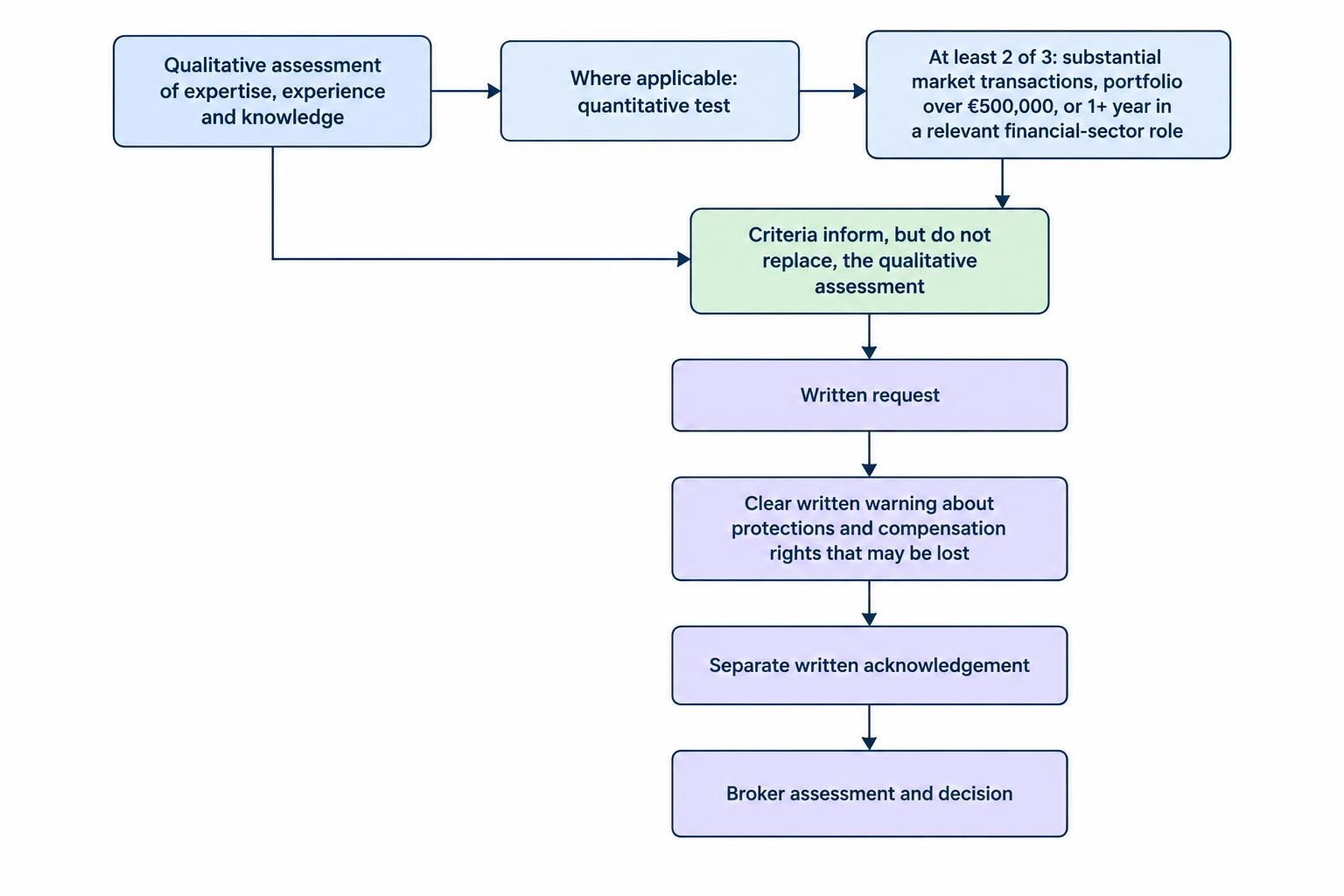
Under the current FCA framework, elective professional classification requires an assessment of expertise, experience and knowledge. Where the quantitative test applies, at least two of these conditions must also be met:
- Transactions of substantial size on the relevant market, averaging 10 per quarter over the previous four quarters.
- A financial instrument portfolio, including cash deposits, exceeding €500,000.
- At least one year working in a financial sector professional role requiring knowledge of the proposed transactions or services.
The procedure includes a written request, a clear written warning about protections and compensation rights that may be lost, and a separate written acknowledgement of those consequences. Meeting two numerical conditions is not automatic approval: the qualitative assessment remains part of the FCA professional client classification requirements in COBS 3.5.
Ask prospective brokers what evidence they require before gathering statements or employment records. The guide to qualifying for professional client status covers the application process separately. Never manufacture trading volume to satisfy an application.
Establish which retail protections would change
UK retail spread betting protections include asset-dependent margin requirements, account-level margin close-out rules and negative balance protection. The retail close-out threshold is 50% of the required margin, with positions closed as soon as market conditions allow when equity falls below that level. Retail liability for the covered products is restricted to the funds dedicated to that trading account under the FCA rules on restricted speculative investments in COBS 22.5.
Do not assume those retail requirements continue unchanged after professional classification. Ask the broker to identify the replacement margin and close-out terms, together with any contractual negative balance protection. If protection is offered voluntarily, read its eligibility conditions, exclusions and withdrawal provisions.
Without applicable negative balance protection, losses may create a debt beyond the money held in the account. Treat that as a balance-sheet risk, not a footnote. The distinction between a trading stop and negative balance protection matters: one is an order instruction, the other concerns liability at account level.
Request a written comparison of the two agreements. A sales description such as “the same account with higher leverage” is not enough to evaluate what changes.
Compare execution at your intended stake size
Measure completed orders, not advertised speed
Execution should be assessed using the orders your strategy actually places. A small market order during a calm session tells you little about a larger order around a cash-market opening or economic release.
Record the submitted price, filled price, submission time, fill time and any rejected or partially filled quantity. Separate market entries, stop exits and limit orders. Combining them into one average can conceal a problem that affects only the most expensive part of your trading process.
Measure favourable slippage as well as adverse slippage. Review the full distribution, including poor outcomes, rather than relying only on the average. A strategy can tolerate ordinary fills yet fail because its occasional exits become disproportionately expensive.
The broker execution quality research framework provides a basis for organising those observations. Use consistent instruments, sessions and order sizes when comparing candidates.
Inspect dealing capacity and margin tiers
Request both the maximum stake per order and the maximum aggregate position. They answer different questions. A broker might accept a position through several orders while applying a higher margin rate once total exposure crosses a tier.
Ask how the proposed terms treat existing positions when margin requirements change. Also establish whether pending orders reserve margin, how opposing positions are handled and whether several related markets share an exposure limit.
For larger orders, discuss the dealing process before you need it. Can the desk quote a size beyond the platform maximum? Can it close only part of a position? What happens if the platform accepts an instruction but its final status remains uncertain?
These answers should inform the comparison even if your present stake sits comfortably below the maximum. Capacity becomes more useful when it is documented before a busy market, not negotiated during one.
Make the platform fit the trading process
A professional trading setup needs dependable order management more than decorative complexity. Assess how quickly you can find exposure, amend stops, cancel pending orders and reconcile a completed trading session.
Test the relationship between the desktop, browser and mobile interfaces. Check whether amendments appear consistently, whether working orders remain active after disconnection and how the platform distinguishes an acknowledged order from a completed fill.
For automated trading, request confirmation of the permitted methods, connection limits and handling of rejected instructions. Establish what the system does after a reconnect: it should reconcile actual positions and pending orders before issuing replacements. A duplicate order is not a sophisticated strategy.
Platform compatibility must extend to the product you intend to trade. The guide to TradingView spread betting brokers addresses one common route, but the same account-level checks apply to other platforms and connections.
Also inspect exports. Download a sample statement containing opening and closing prices, financing, adjustments and charges. If reconciling the file requires repeated manual repairs, include that administrative burden in your assessment.
Check the markets you use, not the advertised total
Prepare a representative instrument list before contacting brokers. Include your regular markets, less frequently traded instruments and any positions you might use to offset exposure.
For each one, request the point definition, stake increment, trading hours, available contract types and proposed margin schedule. Two similarly named products may have different expiry arrangements or funding treatment. Compare like with like.
Share traders should also ask about short availability, borrowing charges, position recalls and corporate-action handling. These details deserve more weight than the number of shares listed in a product library. Our guide to short selling shares through spread betting covers the mechanics separately.
Test market access at the times you plan to trade. Ask whether overnight or out-of-hours prices have different dealing sizes and spreads. If your strategy regularly holds through an underlying market closure, include that period in both the cost model and the risk review.
Compare total costs after rebates
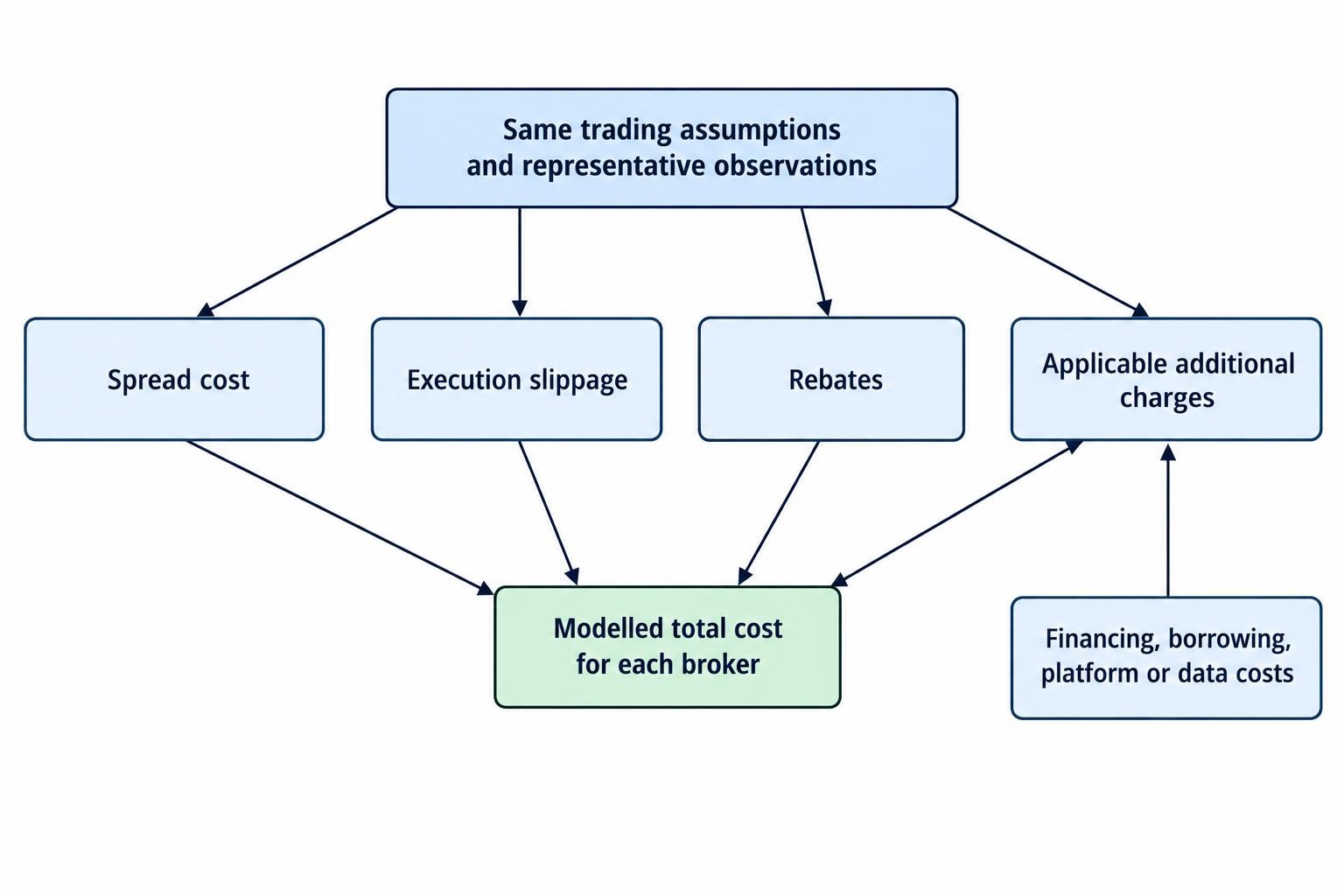
A professional broker comparison should model the cost of your trading pattern, not a collection of minimum advertised spreads. Include spread costs, execution differences, financing, borrowing charges and any platform or data costs that apply to the proposed account.
Use the same assumptions for every candidate. The total spread betting cost comparison explains how to bring those charges into one calculation.
A hypothetical monthly comparison
Suppose a trader completes 120 round trips in one index at £20 per point. The following figures are invented solely to demonstrate the calculation; they are not broker quotations or forecasts.
| Monthly cost component | Broker A | Broker B |
|---|---|---|
| Assumed spread per round trip | 0.8 points | 1.1 points |
| Spread cost across 120 trades | £1,920 | £2,640 |
| Assumed net adverse slippage per round trip | 0.6 points | 0.2 points |
| Net adverse slippage cost | £1,440 | £480 |
| Assumed rebate received | £150 | £0 |
| Total modelled cost | £3,210 | £3,120 |
Broker A has the narrower spread and pays a rebate, yet costs £90 more under these assumptions. Execution consumes the apparent saving. The slippage figures represent the combined net effect across entry and exit; the spread is counted once per round trip, not twice.
This example excludes financing and other charges. Replace every assumption with applicable terms and representative observations before using the model for a decision.
Give financing its own calculation
For positions held overnight, compare the reference rate, broker adjustment, charging basis, weekend treatment and any difference between long and short positions. Establish whether funding is calculated on the full exposure and how the provider determines that exposure.
As a simple illustration, a one percentage point annual cost difference on constant exposure of £200,000 equals £2,000 a year before changes in rates or position value. That can outweigh a modest saving on entry.
Use the overnight financing cost guide for the calculation mechanics. Do not increase turnover just to reach a rebate tier: evaluate the rebate on trades the strategy already calls for.
Lower margin does not lower position risk
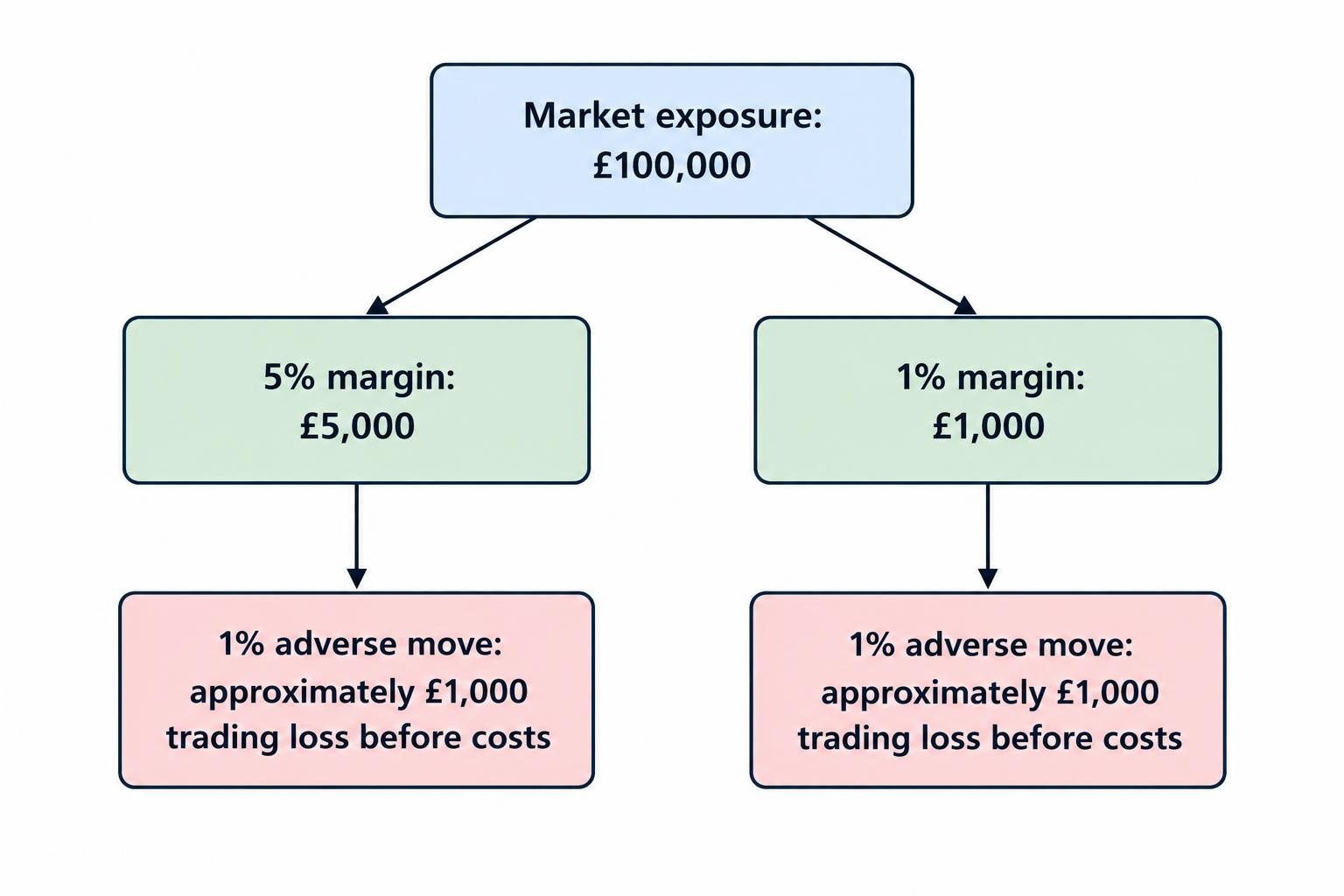
Consider an illustrative position with £100,000 of market exposure. At a 5% margin rate, the required deposit is £5,000. At 1%, it is £1,000. A 1% adverse move still creates approximately £1,000 of trading loss before costs in either case.
The lower requirement releases £4,000 of cash. It does not make the existing position safer. If account equity is £20,000, that £1,000 loss remains 5% of equity regardless of the opening margin.
Keep three decisions separate: the position size justified by the trade, the cash buffer needed to withstand adverse movement, and the broker’s minimum deposit requirement. Treating all three as the same number invites avoidable trouble.
Set exposure through a spread betting position sizing process, then check whether the broker can accommodate it with adequate spare cash. Do not reverse the calculation by starting with the maximum exposure the platform permits.
Before accepting professional terms, run scenarios for a price gap, a margin increase and several correlated positions moving against you at once. Use the proposed contractual terms in those scenarios rather than assuming a warning call will arrive before action is needed.
Check the legal entity and treatment of cash
Match the legal entity in the account agreement with the firm you intend to use. Record its legal name, reference number, relevant permissions and official contact details. Group branding alone should not determine where you send money.
Follow the process for checking a broker on the FCA Register. If an application redirects you to another entity, pause the comparison and establish which agreement, jurisdiction and complaint route would apply.
Ask whether your money will be held as segregated client money or under another collateral arrangement. Request an explanation of ownership, withdrawal rights and the consequences of broker failure. Do not accept “your funds are safe” as a substitute for contractual detail.
The separate guide to spread betting client money rules covers that subject. For this comparison, the task is to obtain the proposed treatment in writing and decide whether it is acceptable.
FSCS eligibility needs a separate check
FSCS investment protection can cover eligible claims when an authorised provider fails and qualifying conditions are met. The current investment compensation limit is up to £85,000 per eligible person, per firm. It does not cover poor investment performance, as set out in the FSCS investment protection conditions.
Professional classification does not justify a blanket statement that compensation is always available or always lost. In the SVS Securities failure, certain eligible elective professional clients with FX account balances were covered because of the investment type and how it was held. The FSCS determination for SVS professional clients demonstrates why the arrangement requires examination; it is not a guarantee for another account.
Check complaint rights without assuming the answer
Access to the Financial Ombudsman Service can involve questions about whether a professional client acted as a consumer in the activity concerned. That distinction appears in the Financial Ombudsman decision on professional client eligibility.
Ask the broker to explain the complaint route for your proposed account. Keep its response with the classification warning and agreement, but do not treat a broker’s explanation as a binding determination of eligibility.
Use a staged selection process
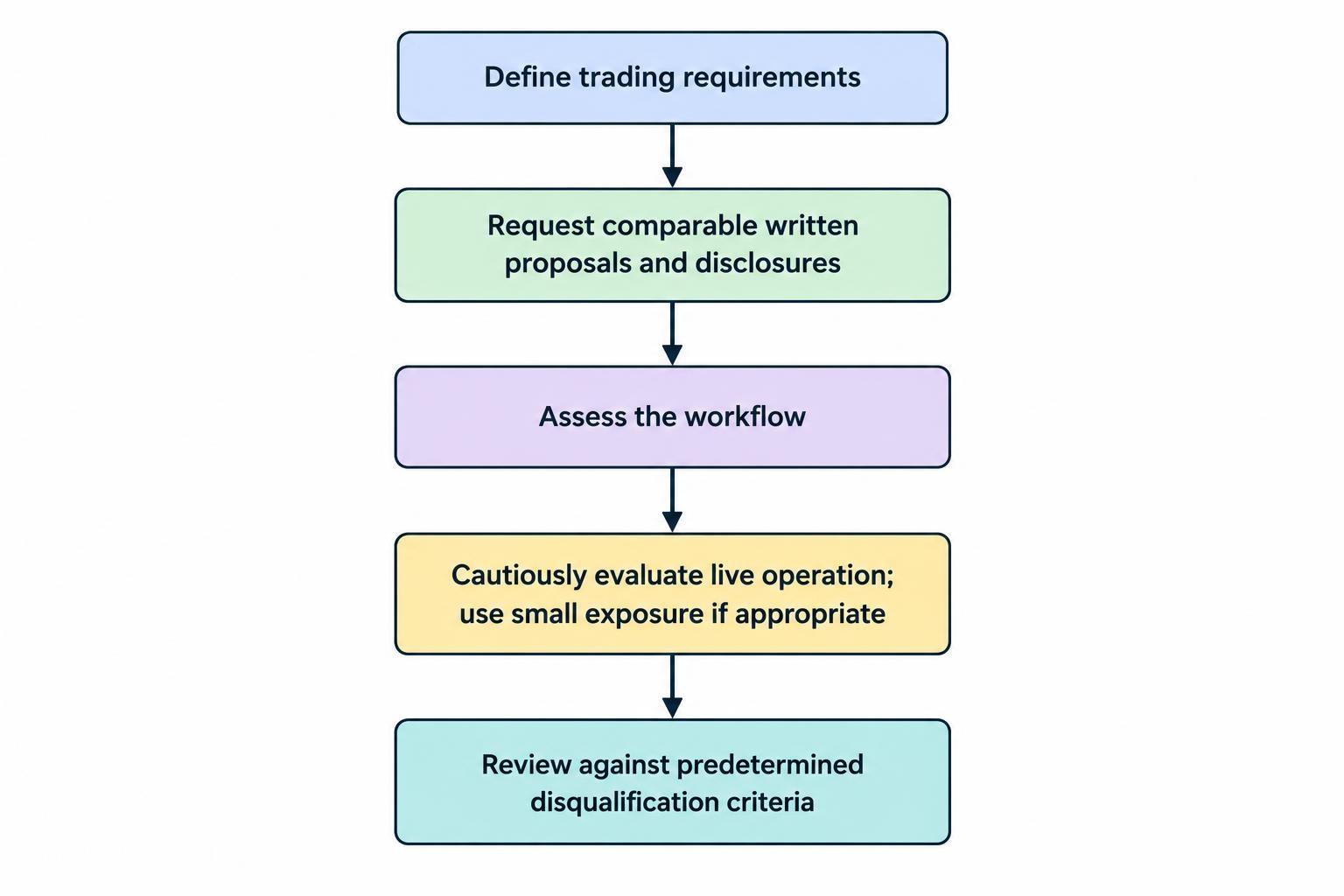
Narrow the candidates through written terms before committing substantial capital. A practical sequence is:
- Define the trading requirement. List instruments, normal and maximum stakes, holding periods, order types and platform dependencies.
- Request comparable proposals. Obtain the professional agreement, margin schedule, cost schedule and protection disclosures from each candidate.
- Assess the workflow. Check order entry, position reconciliation, exports and support escalation without increasing trading risk unnecessarily.
- Evaluate live operation cautiously. Where appropriate, begin with small exposure and test funding, withdrawals and statement accuracy before scaling.
- Review against predetermined criteria. Decide in advance which execution, cost or contractual outcomes would disqualify the account.
Where available, spread betting demo accounts can help assess the interface and order workflow. Treat that exercise as platform familiarisation, not proof of live execution quality or professional dealing capacity.
Support deserves a practical check too. Ask how to report an uncertain order, obtain a trade investigation and contact the dealing desk if the normal interface is unavailable. Save those procedures somewhere accessible outside the platform.
When remaining retail is the better choice
Professional classification deserves consideration only when a documented benefit serves an established trading process. If the main attraction is taking a much larger position with the same cash balance, reconsider the objective before comparing providers.
Remaining retail can be the more suitable choice when the desired improvement is better reporting, clearer pricing, more suitable markets or a different interface. Ask whether those needs can be met without changing classification.
Choose the broker and account whose terms you can evaluate, whose costs you can model and whose operational limits fit your trading. The numbers matter, the badge does not. If a proposed professional agreement leaves material questions unanswered, do not fund it until they are resolved.