The best spread betting broker for scalping is not necessarily the one advertising the smallest spread. It is the provider whose account terms permit your trading style, whose prices remain usable during your trading session, and whose platform lets you control a position without unnecessary delays.
Scalping leaves little room for friction. A fraction of a point lost on entry, an awkward order ticket or a stop distance that does not fit your setup can change the economics of a trade. Repeat that across frequent transactions and small differences stop being small.
This guide explains how to shortlist spread betting brokers for short holding periods, compare their real trading costs and check whether their execution arrangements suit your approach. It does not assume that a broker’s CFD account and spread betting account offer identical conditions.
What makes a spread betting broker suitable for scalping?
A suitable broker needs to pass three tests: contractual permission, workable trading costs and practical order handling. A strong result in one area does not compensate for failure elsewhere. Cheap pricing is irrelevant if the account prohibits your strategy, and permission to scalp is not much use if transaction costs absorb your expected return.
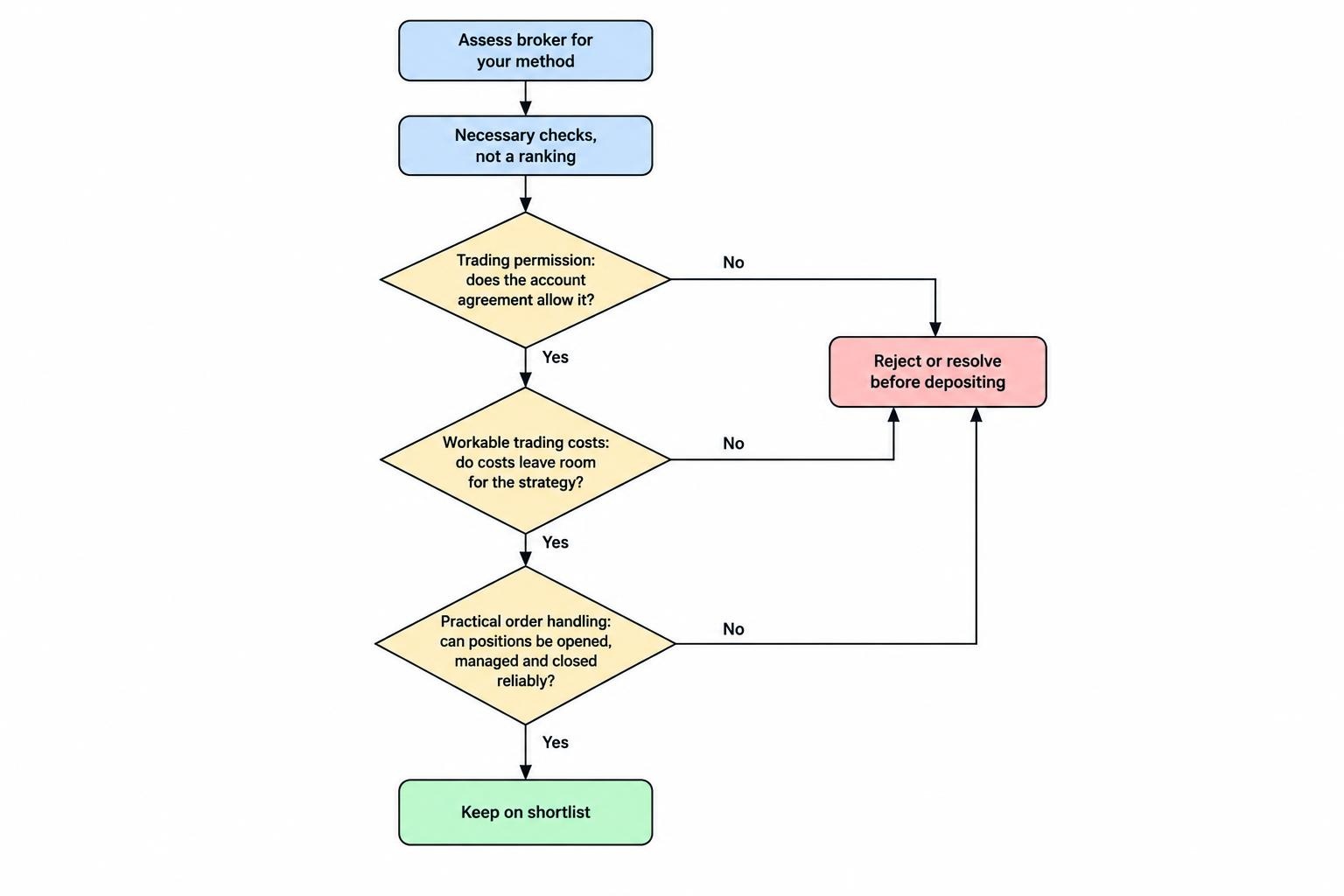
Start by defining what you intend to do. “Scalping” could mean manually trading an index for several minutes, entering currency positions for a few seconds, or running software that submits frequent orders. These approaches place different demands on a broker.
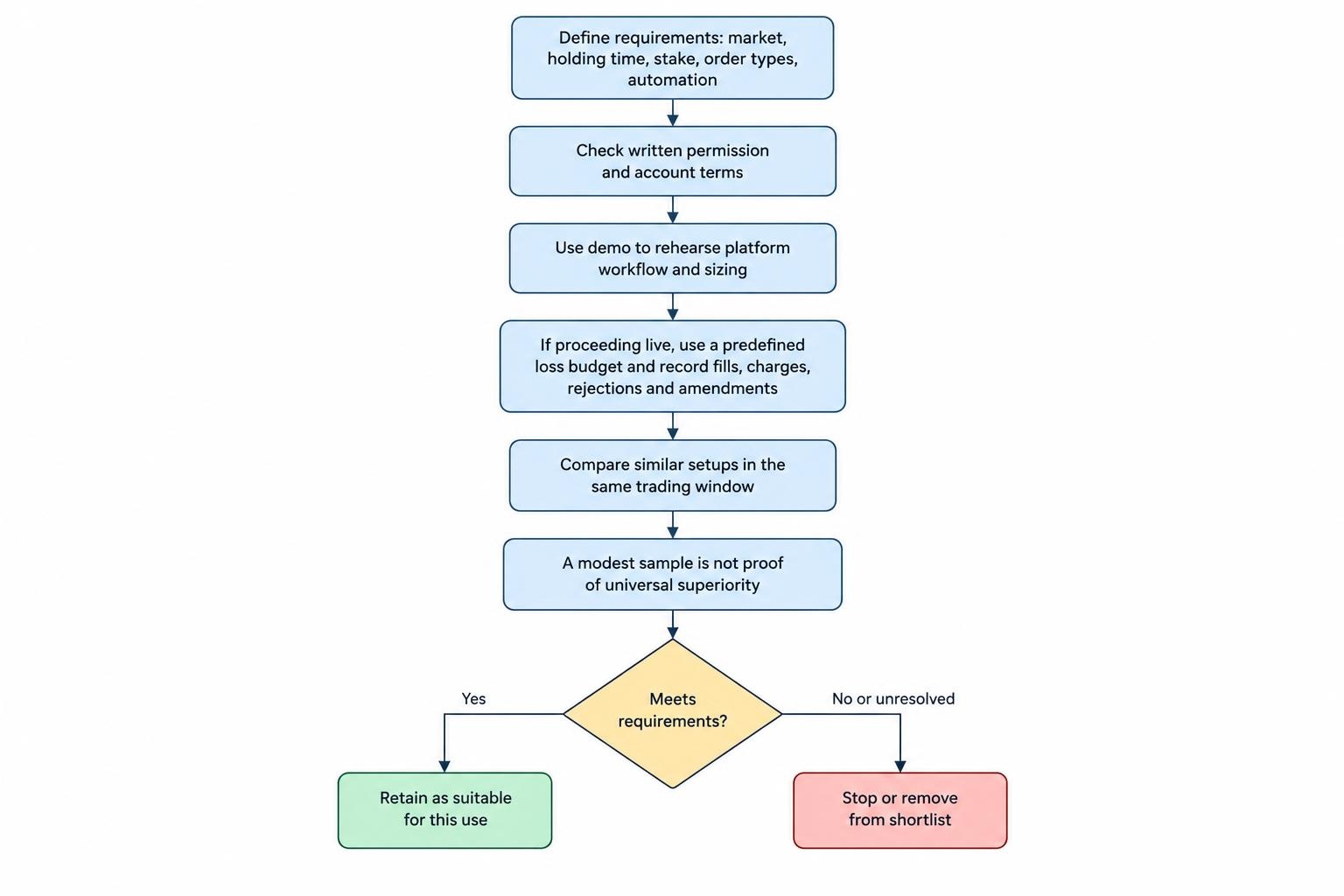
Write down your intended markets, usual holding time, stake range, order types and whether you use automation. Include whether you trade around scheduled announcements. That gives the broker something concrete to assess, rather than inviting a vague answer to a vague question.
The trading method itself is covered in our guide to scalping with financial spread betting. Broker selection is a separate task: finding an account that can accommodate that method at a cost it can reasonably bear.
Check the legal entity and scalping policy first
Before comparing trading features, establish which company would hold your account. Check the legal name in the application and account agreement, rather than relying on the trading brand. Use the FCA Firm Checker to check authorisation and permission to provide the services you want. Match contact details too, rather than treating a familiar logo as verification.
Ask about the spread betting account, not the brand
Ask whether your proposed approach is permitted on the actual spread betting account and platform you would use. An answer about a forex CFD account does not settle the question. Nor does a platform’s ability to submit rapid orders establish that the account agreement permits every strategy those tools could execute.
Request written clarification of minimum holding periods, restrictions on automated trading, order frequency and any different treatment of news trading. Read provisions covering incorrect prices, delayed quotes, prohibited trading and trade cancellation. If support gives an answer that appears inconsistent with the agreement, resolve that before depositing.
These are not theoretical concerns. The Financial Ombudsman’s approach to spread betting disputes includes examining contractual restrictions on short holding periods and specialist software when firms cancel trades over alleged unfair advantage.
Separate short holding periods from exploiting delayed prices
A directional trade held briefly is not the same strategy as attempting to trade against a quote that has fallen behind another price feed. Do not assume a statement such as “scalping allowed” settles how a broker treats delayed prices, obvious pricing errors or software designed to exploit them.
Explain your approach plainly. A useful enquiry would state the market, approximate holding time, expected order frequency and whether decisions are manual or automated. Keep the response alongside the version of the terms you reviewed. A chat agent’s cheerful “yes” is not a substitute for checking the contract.
Compare brokers against the same requirements
Build a short comparison sheet before opening several accounts. Record the same market, trading window and intended stake for each provider. Otherwise, you may end up comparing one broker’s best advertised forex spread with another’s ordinary index pricing.
| Area | What to check | Why it matters for scalping |
|---|---|---|
| Trading permission | Holding periods, automation rules and prohibited strategies | Your intended method must fit the account agreement. |
| Trading cost | Observed spreads, applicable charges and execution differences | Small costs consume a larger share of a small price target. |
| Order handling | Acceptance, rejection, fills and amendments | An entry is only useful if the position can also be managed and closed. |
| Risk controls | Minimum stake, stop distances and attached orders | The account must accommodate your planned risk. |
| Platform workflow | Order entry, position display, closing and connection recovery | Unnecessary steps create opportunities for delay and mistakes. |
| Trading records | Order history, timestamps, statements and exports | You need evidence to assess costs and investigate problems. |
Treat essential requirements as pass or fail. A provider that cannot accommodate your required stake or holding period should leave the shortlist before you start awarding points for chart layouts.
Compare the cost of a completed trade
Advertised minimum spreads are a starting point
A spread advertised as “from” a stated number is not a promise that every trade will receive that spread. Check the conditions attached to the figure, including the instrument, account type and trading hours. Then observe the quote during the period you actually intend to trade.
For scalping, compare spread consistency as well as the lowest reading. Record ordinary conditions, the opening period if relevant, and any announcement window your strategy includes. Do not let a few unusually cheap quotes stand in for the session.
Our comparison of spread betting brokers with the lowest spreads addresses quoted pricing. Your scalping shortlist needs another step: checking how those prices translate into completed trades.
Understand how the spread affects profit
Consider a hypothetical index quoted at 7,999.5 to sell and 8,000.5 to buy. The spread is one point. Buying at £2 per point and immediately selling at an unchanged quote produces a £2 loss, assuming both orders fill at those prices and no other charges apply.
Now suppose the midpoint rises four points and the quote becomes 8,003.5 to sell and 8,004.5 to buy. Closing the long position at 8,003.5 produces a three point gain, worth £6. The midpoint moved four points, worth £8 at that stake, but the spread accounts for the £2 difference.
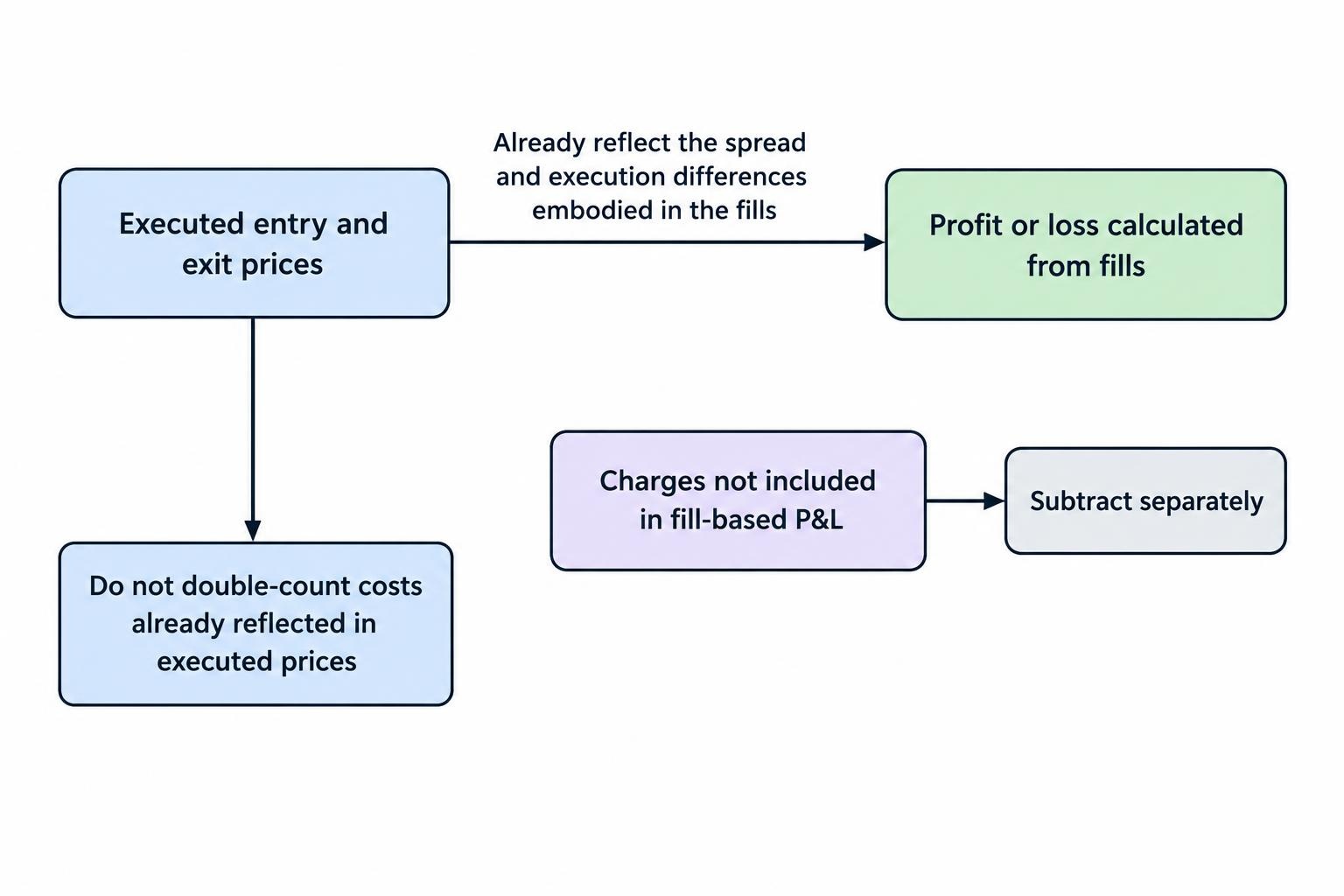
Under these unchanged spread assumptions, do not subtract another full spread from the £6 result. The actual entry and exit prices already contain it. Double counting costs can make a workable setup look worse than it is; ignoring them does the opposite.
Include execution differences and other charges
Suppose, purely for illustration, Broker A has a 0.8 point spread but an additional net adverse execution difference of 0.4 points across entry and exit. Broker B has a 1.1 point spread and no additional execution difference. Their effective costs in that example are 1.2 and 1.1 points respectively.
At £2 per point, the difference is £0.20 per completed trade, or £10 across 50 trades. These are invented comparison figures, not broker results. They show why the smallest quoted spread does not automatically produce the lowest trading cost.
Check whether charges include commission, subscriptions, market data or order protection premiums. If positions might cross a funding cutoff, include that possibility too. Our guide to comparing total spread betting costs provides a broader framework without treating every account as if it has the same charging model.
Measure net results from actual transaction records. If you calculate profit and loss from executed prices, the spread and execution differences are already reflected there; subtract only charges that have not yet been included.
Judge execution by more than a speed claim
A broker’s advertised execution time is useful only if you know what it measures. Check whether the figure concerns order processing, completed execution or another stage, and whether rejected orders are excluded. Your own experience also includes the connection, platform response and time taken to submit or amend an instruction.
For a scalper, a quick acknowledgement is not enough. You need to know whether the order was accepted, what price it received and whether the resulting position matches the intended stake. Closing and reducing positions deserve the same attention as opening them.
Record price differences in both directions. Slippage can improve or worsen a fill, so a comparison that counts only favourable outcomes is not much of a comparison. Separate entry orders, stop exits and other closing orders rather than mixing everything into one average.
Inspect the less comfortable outcomes too: rejected entries, unusually poor fills and amendments that failed. A low average cost can conceal occasional losses large enough to matter to a strategy targeting small movements.
Check stop distances before choosing a platform
A minimum stop distance that exceeds your planned exit distance can make an account unsuitable, even if its spread looks attractive. Check the rules for your chosen instrument and whether they change under different conditions.
Ordinary stops do not guarantee the execution price. Account for that distinction when assessing stop-loss orders, particularly if your method depends on very small planned losses. An alert that tells you to close a position is also not the same as an accepted closing order.
Choose a platform that fits the actual workflow
Test the full sequence: select the market, confirm the stake, submit the order, check the position, amend protection and close. Count the steps that require attention. A platform can have excellent charts and still make that sequence awkward.
Watch how it behaves after a disconnect or an uncertain submission. Can you quickly establish whether an order exists? Is the open position obvious? Repeatedly pressing a button because nothing appears to happen can turn one intended trade into several.
One click dealing
MT4 provides a chart panel for sending market buy and sell orders with a chosen volume through its Quick Trading controls. That can shorten order entry, but the selected volume still needs checking. Faster submission is not a guarantee of faster execution or a better price.
Practise with the exact account setup you would use. Confirm how its volume field translates into money per point, whether the previous trade’s size remains selected and what happens when you close or reverse a position. Familiar software can still contain unfamiliar account settings.
Chart trading and attached exits
Where supported, TradingView’s order bracket functionality allows stop-loss and take-profit orders to accompany a trade, with the other linked order cancelled when one executes. Availability depends on the broker connection, so do not assume a paper trading feature will be present on a connected account.
When assessing TradingView spread betting brokers, verify the spread betting account connection rather than just the brand’s presence in the trading panel. Test which orders can be attached, amended and cancelled through that connection.
For automated methods, obtain permission for the intended use and test failure handling. Software should recognise rejected orders, uncertain connection states and existing positions before trying again. Automation makes mistakes faster as readily as it submits valid trades faster.
Compare the market you trade, not the market count
A broker offering thousands of instruments is not automatically better for someone trading one index during a narrow daily window. Availability matters, but unused markets do not improve your fills.
For an index strategy, compare the same contract type across providers. Check whether you are looking at a cash style market or a dated contract, what one point means and which quote your chart displays. Our guide to index spread betting brokers covers the wider market selection question.
For currencies, verify the monetary value of the movement you call a point or pip. For gold, oil and other commodities, inspect the contract details rather than assuming a displayed decimal has the same value at every provider.
Choose observation periods around your intended schedule. If you trade an opening session, an afternoon spread reading does not answer your question. If you avoid announcements, keep announcement trades out of the ordinary session results rather than allowing them to distort the comparison.
Minimum stakes must fit your risk budget
A low deposit requirement does not establish that an account suits a small trading balance. Minimum stake size and permitted stake increments are more relevant to controlling individual positions.
Suppose your planned monetary loss is £15 and your intended stop distance is five points. That implies £3 per point before allowing for execution differences or extra charges. If the account’s minimum is £5 per point, the same distance implies a £25 planned loss before those allowances.
Do not move the stop closer just to make an unsuitable minimum stake fit. Compare spread betting brokers for small stakes instead, or reconsider whether the trade fits the available balance.
Keep margin separate from planned loss. The amount required to open a position is not a reliable measure of what that position could lose. Our guide to position sizing for spread betting explains the relationship between stake, exit distance and monetary exposure.
Keep retail protections in the comparison
For UK retail accounts, the FCA’s restrictions covering CFDs and financial spread bets include asset dependent leverage limits between 30:1 and 2:1, account level margin close-out protection at 50% of required margin, and negative balance protection. The FCA also warns that opting up to professional status removes some retail protections.
These safeguards do not make a scalping strategy profitable. Negative balance protection is not protection against losing the money in the account, and margin close-out is not a substitute for a planned exit.
Compare the service available to you as a retail customer before considering a different classification. More borrowing capacity does not repair a strategy whose costs exceed its trading advantage. It only allows a larger position to express the same problem.
Test a shortlist without mistaking practice for proof
Use a demo to check operation
Use spread betting demo accounts to learn the platform, confirm sizing and rehearse entries and exits. Test order cancellation, partial closing and what remains visible after reconnecting.
Ask how demo pricing and execution are simulated. Do not treat successful practice fills as proof that live orders will receive identical treatment. A demo can establish whether you can operate the platform; it cannot establish future profitability.
Keep any live assessment small and structured
If you decide to assess live trading after reviewing the risks, use a predefined loss budget and a stake you can afford to lose. Do not increase size simply because the opening trades go well.
Record the instrument, time, quoted prices, requested instruction, fill, stake and charges. Note rejections and failed amendments, not just completed trades. Keep ordinary sessions separate from unusual market conditions.
Compare similar setups across the same trading window. Results from different days still reflect different market conditions, so avoid claiming that a modest sample proves one broker is universally better. The purpose is to identify whether the account works for your requirements and whether there are reasons to stop using it.
Retain order identifiers and relevant screenshots when something appears wrong. Clear records are more useful than a recollection that the platform “felt slow”, especially when you need support to investigate an individual order.
Reasons to remove a broker from your shortlist
Reject an account when an essential requirement remains unresolved. Warning signs include unclear scalping permission, unexplained differences between support answers and contractual terms, incompatible minimum stakes, and an order workflow you cannot reliably control.
Also question any offer that encourages additional transactions without improving the economics of trades you already intended to make. A volume threshold is not a trading signal. Our guide to avoiding overtrading addresses that pressure separately.
The final decision should be straightforward: choose only among brokers that permit your method, accommodate your risk budget and provide usable execution during your session. Then compare completed trading costs, not slogans. If no account passes those tests, keeping the money uncommitted is a valid decision.