Choosing an FCA regulated spread betting broker starts with the company behind the account, not the logo above the login button. Check the legal entity, its permissions and the terms offered to you before comparing spreads, platforms or market coverage.
Regulation should be a starting requirement, not the entire buying decision. A broker still needs to suit your stake size, trading hours and approach to managing losses. This guide covers regulatory checks and how to compare providers once those checks are complete. For the wider selection, see our spread betting broker directory.
Which FCA Regulated Spread Betting Brokers Can You Compare?
IG, CMC Markets and Spreadex are examples to investigate. The table identifies the UK companies and firm reference numbers relevant to checking these providers. It is not a performance ranking or a recommendation to open an account.
| Broker brand | UK legal entity to check | FCA firm reference number |
|---|---|---|
| IG | IG Index Limited’s FCA register entry | 114059 |
| CMC Markets | CMC Markets UK plc’s FCA register entry | 173730 |
| Spreadex | Spreadex Limited | 190941 |
Use these details as a starting point, then compare them with the agreement presented during your own application. Do not substitute an old review, saved screenshot or familiar company name for a fresh check.
At IG, distinguish IG Index Limited from other companies carrying the IG name. At CMC Markets, use the entity named in the current spread betting agreement rather than assuming an older reference to CMC Spreadbet plc remains the correct contracting company. For every provider, the question is the same: which company will owe you money, hold your account and execute your trades?
Keep regulatory identity separate from product quality. A firm reference number cannot tell you whether the minimum stake suits your account or whether financing costs make a week-long position too expensive. Those require a second round of checks.
Check the Authorised Company Before Sending Money
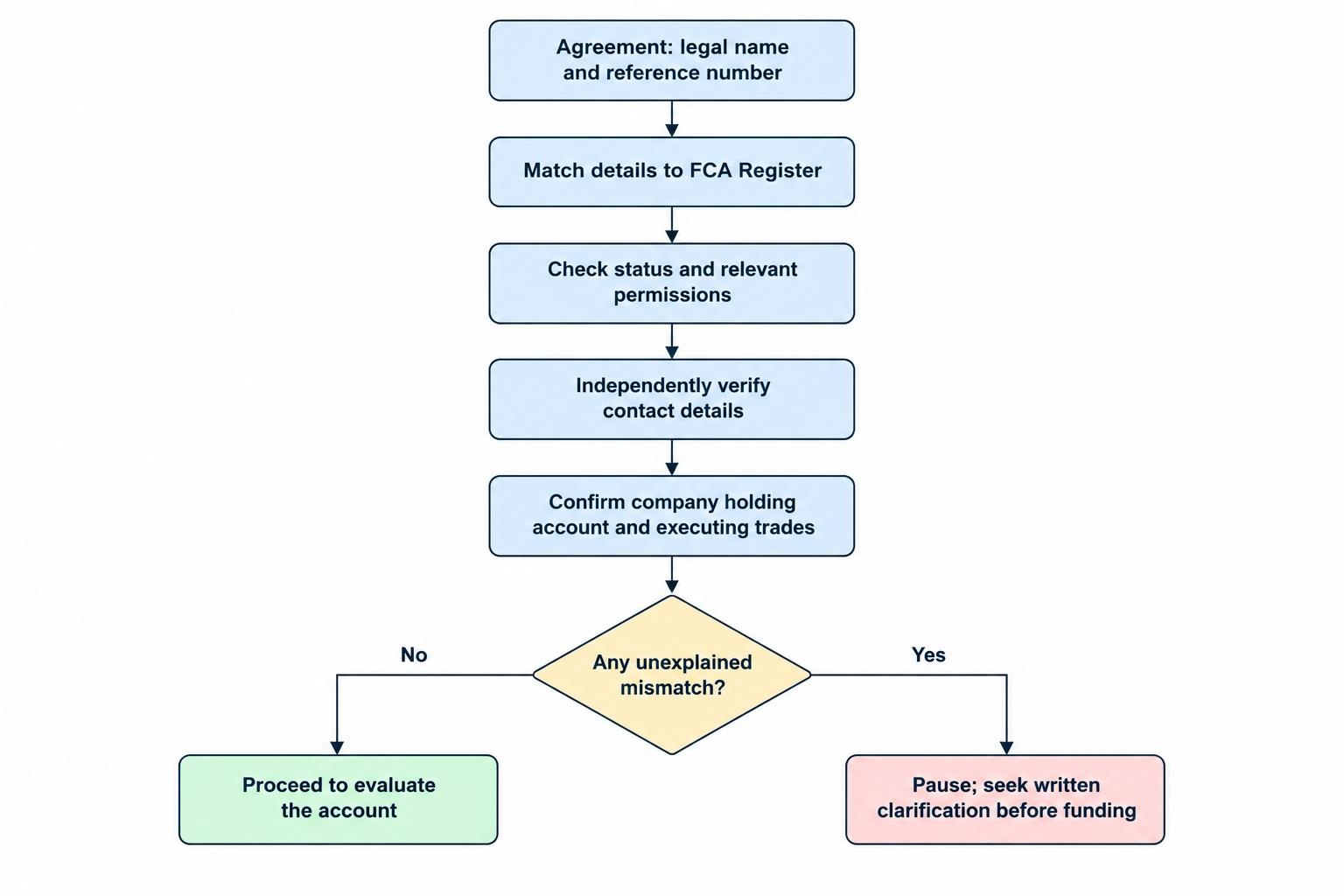
Start with the legal name in the account agreement. Then inspect its regulatory record independently. Our guide to checking a broker on the FCA Register covers the process in more detail.
- Match the legal name and reference number. Check the agreement, application and regulatory record against one another.
- Read the current status. Inspect any restrictions, requirements or notices rather than stopping at the first matching search result.
- Check the permitted business. Look for permissions relevant to the service you intend to use and whether the firm can deal with retail clients.
- Verify contact details independently. Compare the domain, telephone number and address with the official record.
- Confirm the account being opened. Ask for written clarification if the application switches company, jurisdiction or client category.
A genuine reference number does not prove that the person contacting you represents that firm. Fraudsters can copy it. On February 24, 2026, the FCA published a warning about a clone impersonating Spreadex Limited, identifying the genuine authorised company and reference number 190941. The warning concerns the impersonator, not an allegation that the genuine firm operated the scam.
If an unexpected caller offers to “help” with registration, stop and contact the provider through independently verified details. Do not let the caller supply both the claim and the means of checking it.
Save the agreement and regulatory details before funding. Repeat the check if you receive notice that your account is moving to another company. Treat an unexplained mismatch as a reason to pause, not a minor administrative inconvenience.
What Retail Account Protections Should You Check?
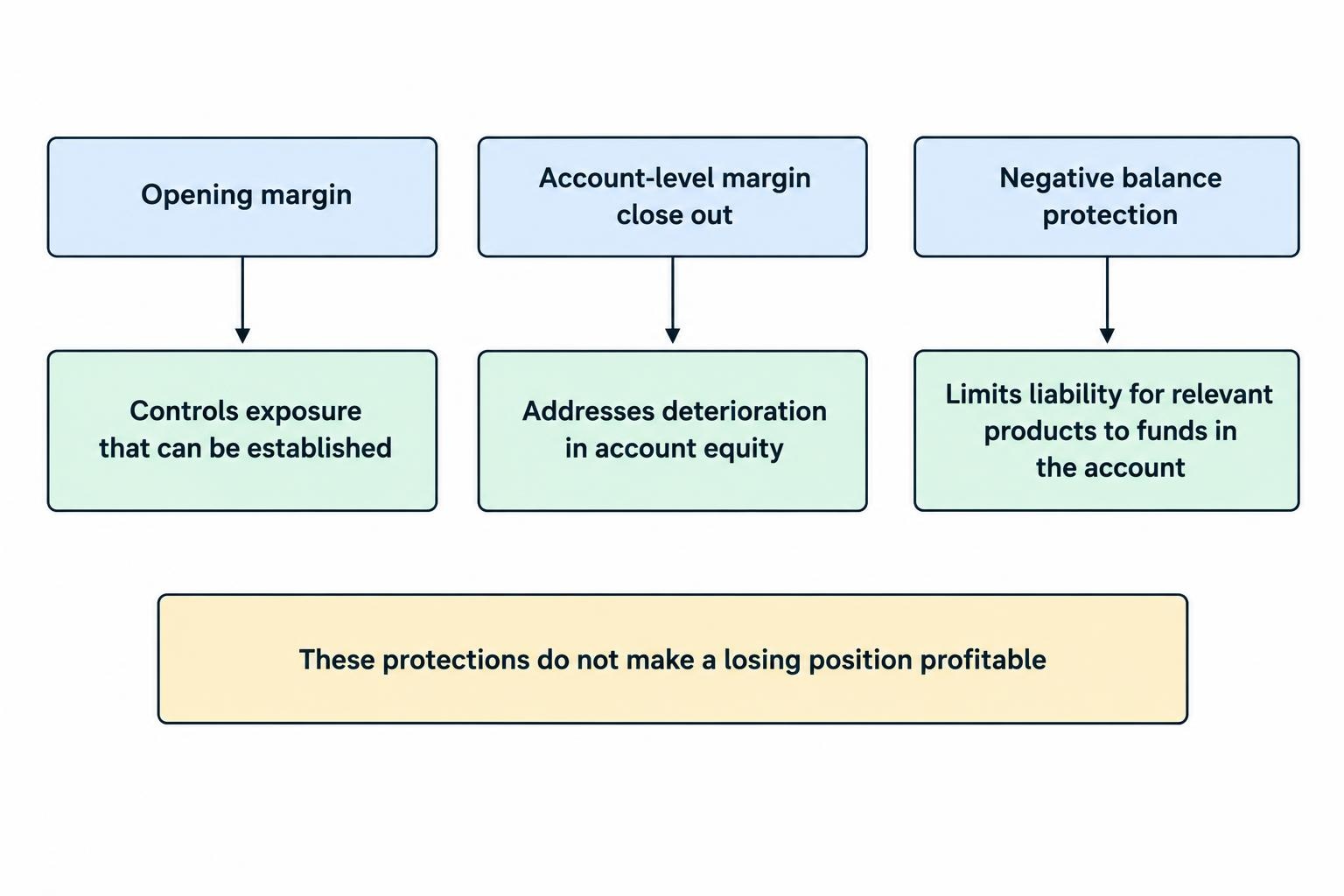
The FCA’s retail rules for these products include minimum opening margins, account-level margin close out and negative balance protection. Examples of minimum margins are 3.33% for major currency pairs, 5% for major stock indices and gold, and 20% for individual shares. If account equity falls below 50% of the required margin, positions must be closed as soon as market conditions allow. Liability for the relevant products is restricted to the funds in that account. These requirements appear in FCA Handbook COBS 22.5 on retail speculative investments.
These protections serve different purposes. Opening margin controls how much exposure you can establish. Margin close out addresses a deteriorating account. Negative balance protection addresses liability beyond the account’s funds. None makes a losing position profitable.
Consider a simplified account containing £2,000, with open positions requiring £1,000 of margin. Half that requirement is £500. If losses reduce equity below £500, the regulatory close out threshold becomes relevant, assuming the margin requirement remains unchanged. That is not the same as losing half the original deposit.
Ask the broker how its own liquidation process works, including whether it closes one position or several and whether it acts at a higher threshold. The margin close out rule should not replace a position-level exit plan.
Also distinguish account protection from trade protection. An ordinary stop does not promise an exact execution price during a gap. Before opening a position, decide what loss you intend to accept and what could happen if the market moves beyond that level.
Compare Total Costs, Not Just the Advertised Spread
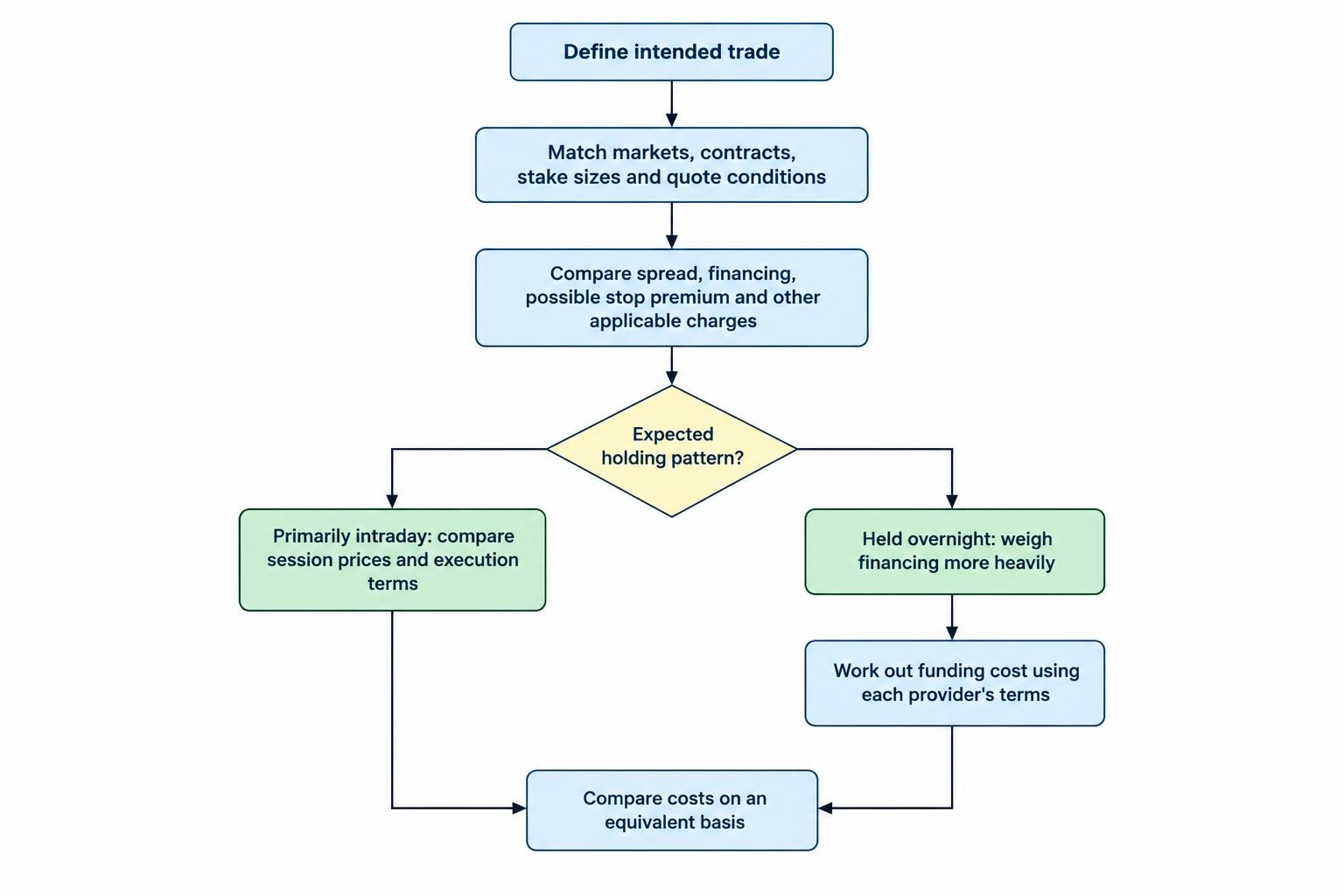
Once regulatory checks are complete, build a cost comparison around the trades you expect to place. A narrow headline spread is useful, but it does not settle the question.
The FCA’s November 13, 2025 review of this sector, which included financial spread bets, found wide variations in overnight funding rates and shortcomings in some cost disclosures. Its review of CFD providers’ price and value supports looking beyond the entry price when assessing an account.
Use the Same Market, Stake and Holding Period
Compare equivalent contracts. A cash index bet and a dated index contract are not interchangeable cost examples. Nor should a minimum spread advertised during favourable conditions be compared directly with another provider’s typical spread.
Suppose one hypothetical broker quotes a one-point spread and another quotes 1.4 points. At £5 per point, the difference in the spread component is £2, assuming those quotes apply to otherwise equivalent trades. That matters to a frequent trader. For a position held several nights, a difference in funding charges could matter more.
Write down the expected spread cost, financing calculation, any stop premium and other applicable charges. Use our guide to comparing total spread betting costs to structure the calculation.
Ask for a Worked Funding Calculation
Before choosing an account for positions held overnight, ask the provider to calculate the charge on a sample trade. Give it the market, direction, stake, reference price and intended holding dates.
Check the amount on which funding is calculated, the reference rate, the provider’s adjustment and how weekends are treated. Ask whether a short position produces a charge or credit under the quoted conditions. Do not assume that selling automatically earns interest.
For a day trading account, focus more closely on prices during your normal session and execution terms. For a swing trading account, give financing greater weight. The better choice depends on the trading pattern, not which pricing page has the largest “from” number.
Check the Platform and Order Terms You Will Actually Use
Assess the account as a working tool. Can you see the stake, margin requirement and stop distance clearly before submitting an order? Can you distinguish an instruction that closes a position from one that opens an opposing trade?
Choose two or three markets you expect to trade and inspect their order tickets. Check minimum stakes, trading hours, minimum stop distances and contract expiry arrangements. A long market list is not much help if your intended position size is unavailable.
If you want a guaranteed stop, check availability on the exact market and account type. Read the premium, minimum distance and amendment conditions before deciding whether the feature suits you. Our comparison of spread betting brokers with guaranteed stops focuses on that requirement.
Also ask how to contact the dealing desk during a platform outage. Check whether telephone dealing is available, what information you would need and whether charges or minimum stakes differ. An emergency procedure should be something you can follow under pressure, not a document you first open during the problem.
Use a spread betting demo account to practise order entry, amendments and position closure. Treat it as a workflow check rather than proof of future live execution quality. Record the questions it exposes and obtain answers before committing money.
Separate Client Money Arrangements from FSCS Compensation
Ask the broker how it holds client money and what the agreement says happens if the firm fails. Identify any clauses dealing with pooled accounts, banks holding the money, insolvency and the costs of returning funds. Our guide to spread betting client money rules examines those arrangements separately.
FSCS protection answers a different question. For eligible investment claims involving firms that failed after April 1, 2019, the compensation limit is up to £85,000 per eligible person, per firm. Cover depends on the provider, regulated activity and circumstances. The scheme may cover a shortfall when a provider fails, but it does not reimburse poor investment performance. See the FSCS investment protection conditions.
Do not interpret “FSCS protected” as a promise that every pound deposited will be returned immediately or that losing trades qualify for compensation. Ask the provider to confirm the basis on which your intended account and activity may be covered.
For larger balances, map the money to each contracting company rather than counting brand names or account logins. Keep copies of statements and funding records somewhere you can access without logging into the trading platform.
Be Careful with Professional Status and Overseas Accounts
The retail protections described above apply to retail clients. If you consider professional classification, compare the proposed agreement with your existing retail terms rather than treating the change as a platform upgrade.
Ask the firm to identify, in writing, which protections would no longer apply and which it would retain voluntarily. Our comparison of retail and professional client classification covers the distinction.
Use the same approach if an application directs you to an overseas group company. Do not assume that an FCA authorised company elsewhere in the group determines the terms of your account. Establish the contracting company, regulator, complaint route and compensation arrangements before accepting.
Pressure to change classification or jurisdiction deserves scrutiny. If the main attraction is greater exposure from the same deposit, calculate the loss from an adverse market move before considering the extra buying power. More room to open a position is not more room to survive one.
Check the Complaint Route Before You Need It
Locate the broker’s complaints procedure and keep its contact details with your account documents. If a dispute arises, record the order number, timestamps, relevant prices, statements and correspondence. Describe the disputed action and the remedy requested rather than relying on a general claim that a trade was unfair.
Complain to the business first. For most complaints, it has eight weeks to respond. An eligible complaint can then be referred to the Financial Ombudsman Service if you are dissatisfied with the final response or the response deadline has passed. Referral is generally required within six months of the final response, subject to exceptions. Check the Financial Ombudsman’s complaint time limits.
Keep complaint handling separate from trading decisions. A pending dispute is not a reason to increase stakes or attempt to win back the amount involved.
Choose the Account After the Regulatory Checks
A sound comparison has three stages: verify the company, establish the protections and compare the account against your intended use. Reject unresolved identity or permission mismatches before spending time on charting tools.
Then compare realistic trading costs, suitable minimum stakes, order controls and support arrangements. Ask the same questions of each shortlisted provider so that polished marketing does not become a substitute for evidence.
FCA authorisation belongs on the checklist, but it is not a forecast of trading results. Choose an account whose terms you can explain plainly, fund it only with money you can afford to lose and keep position risk separate from the amount the platform allows you to trade.