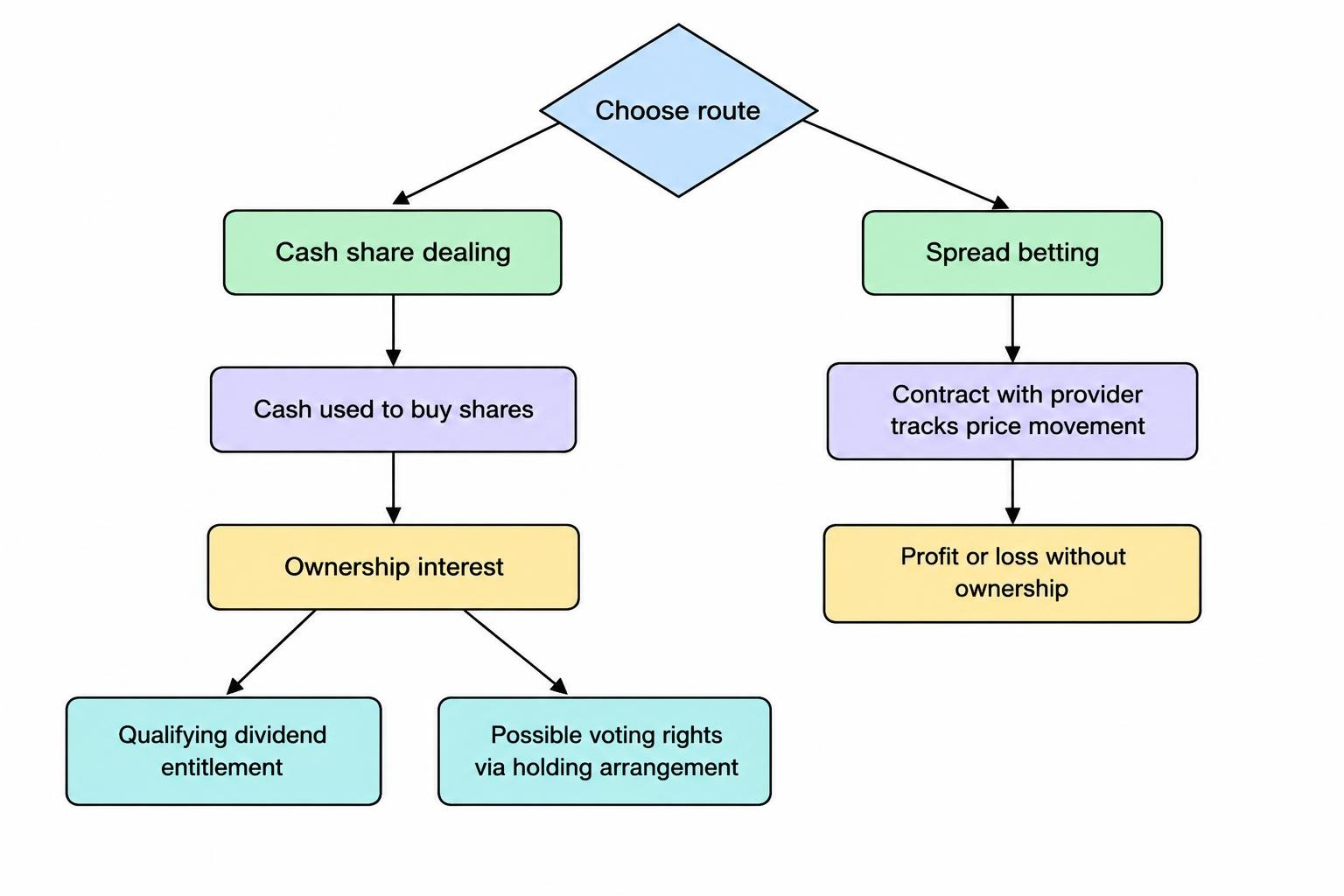
Spread betting and share dealing can give you exposure to the same company, but they create different obligations. Share dealing buys an ownership interest in a business. Spread betting creates a contract whose profit or loss follows a price movement, without giving you the shares.
For a funded investment held over several years, share dealing is usually the more straightforward structure. Spread betting can suit a shorter trading position or a hedge, but margin requirements, financing and forced closure make it a different proposition. A smaller opening deposit does not mean a smaller financial exposure.
This comparison uses UK rules for individual investors and retail spread betting accounts subject to FCA protections. Share dealing means buying shares outright with cash, rather than borrowing to buy them.
Spread betting vs share dealing: the practical differences
| Feature | Spread betting | Cash share dealing |
|---|---|---|
| What you hold | A contract with the spread betting provider | Shares, often held through a nominee account |
| Position size | A monetary stake for each point of price movement | A number of shares multiplied by their price |
| Opening funding | Margin covering part of the position’s exposure | The full purchase price, plus applicable charges |
| Trading direction | You can buy or sell to open, where the market is available | You normally buy first, then sell shares you own |
| Holding costs | Daily funded positions normally carry overnight financing | No leveraged financing charge on fully paid shares, though account fees may apply |
| Dividends | A contractual adjustment rather than a shareholder dividend | Dividend entitlement where the shares and holding dates qualify |
| Position closure | Can be triggered by margin rules, stops or contract terms | No margin closure caused solely by a falling share price |
These differences matter more than whether an app makes either transaction look simple. Both may involve pressing a button marked “buy”, but only one purchases shares. The account label and contract terms deserve more attention than the button.
Ownership: shares in a company or a contract on its price?
Share dealing gives you an ownership interest
Buying shares gives you an interest in the company itself. Your investment can rise or fall with the share price, and qualifying holdings can receive dividends. Ordinary voting shares can also carry voting rights, although exercising those rights through an investment platform depends on its arrangements.
With a nominee account, the nominee appears on the company’s shareholder register while you remain the beneficial owner. Access to meeting attendance and voting is handled through the intermediary, rather than being identical across every platform. The London Stock Exchange’s resource on nominee holdings and shareholder meetings sets out this distinction.
You do not need a paper share certificate for this to be an investment in actual shares. What matters is the legal holding arrangement, not whether something arrives in the post.
Spread betting gives you price exposure without ownership
A share spread bet tracks movements in a quoted share market. You choose a stake per point, then gain or lose money as the relevant closing price moves against your opening price. You do not become a shareholder in the underlying company.
The provider may hedge its exposure by trading shares or other instruments, but that does not turn your bet into ownership of its hedge. Your rights come from your agreement with the provider.
For the mechanics of individual equity contracts, the share spread betting guide covers the product itself. The comparison here is about whether that contract serves your purpose better than owning the shares.
Compare equal exposure, not equal deposits
The most common comparison error is to put £2,000 into shares and compare it with a spread bet requiring £2,000 margin. Those positions may have very different market exposure.
For an ordinary single share spread bet covered by the UK retail rules, the minimum opening margin is 20% of exposure, equivalent to a maximum of 5:1 leverage. A provider can require more margin or decline the trade. The requirement appears in the FCA rules on retail margin requirements.
A £10,000 share position compared with a spread bet
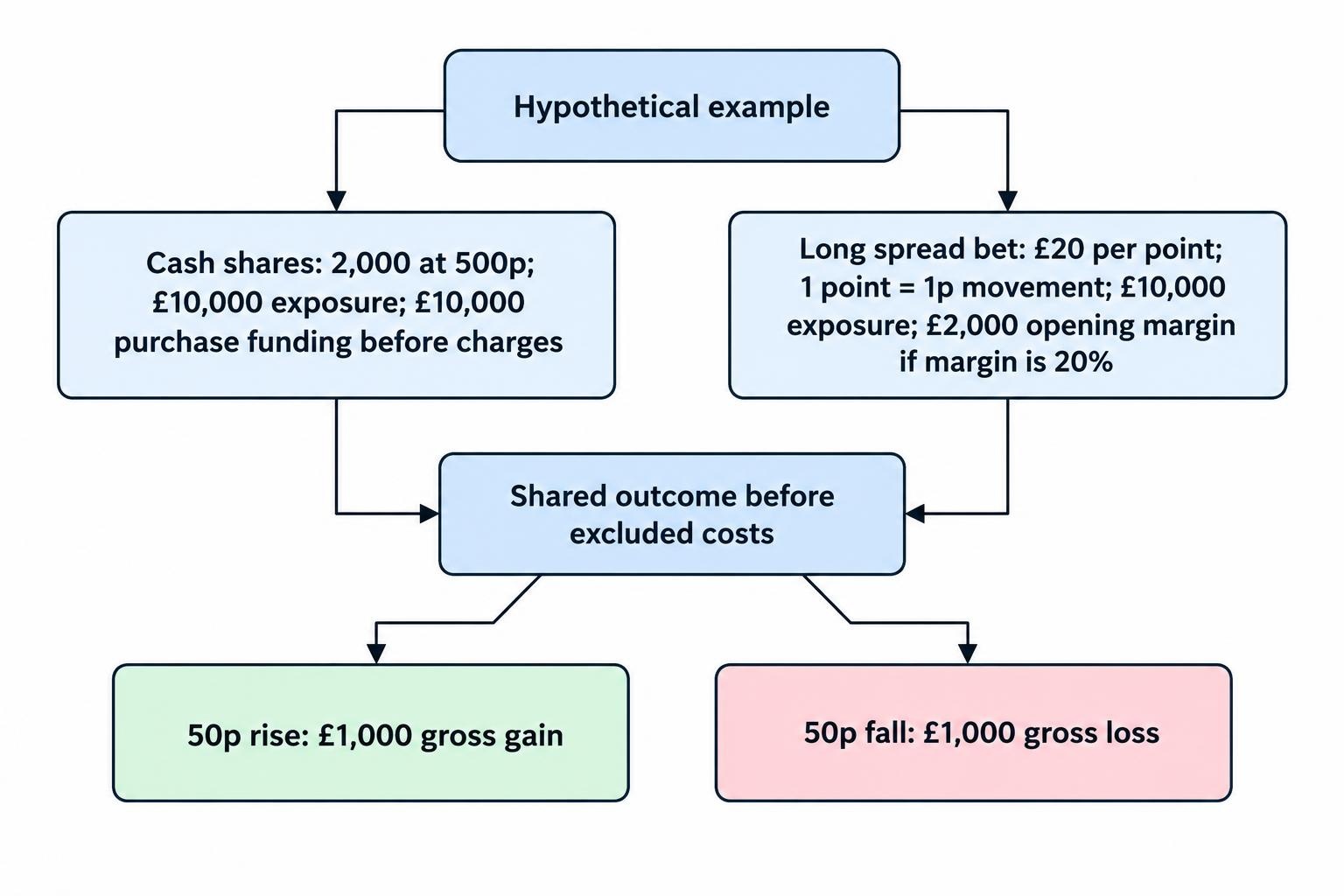
Assume a hypothetical UK share trades at 500p. To isolate exposure, the calculations below use matching reference prices and exclude spreads, commissions, financing, dividends and taxes. Actual trade results must use the available execution prices.
Buying 2,000 shares at £5 creates a £10,000 holding. If the spread betting contract defines one point as a 1p share price movement, a £20 per point stake creates matching price sensitivity: each 1p move changes either position’s value by £20.
| Measure | Cash shares | Long spread bet |
|---|---|---|
| Position | 2,000 shares at 500p | £20 per point at 500p |
| Initial market exposure | £10,000 | £10,000 |
| Purchase funding or opening margin | £10,000 before charges | £2,000 if margin is 20%, before other funding needs |
| Price rises to 550p | £1,000 gross gain | £1,000 gross gain |
| Price falls to 450p | £1,000 gross loss | £1,000 gross loss |
The pound gain or loss is the same because the exposure is the same. What changes is the amount initially committed. A £1,000 loss represents 10% of the cash purchase price but 50% of the spread bet’s £2,000 opening margin.
Check the contract’s point definition before applying this calculation. The stake per point explanation shows how the quoted unit converts a price change into a monetary result.
Margin is not a maximum loss
The £2,000 margin is collateral supporting the position. It is not a £2,000 purchase price for the equivalent shares, and it is not a guaranteed loss ceiling for that trade. Losses can exceed the opening margin and consume other trading funds.
Keeping £10,000 in the spread betting account instead of only £2,000 reduces effective account leverage, but it does not change the position’s £20 per point sensitivity. Nor does it remove financing charges or contractual margin controls.
By contrast, £2,000 used to buy cash shares at £5 purchases 400 shares. A 10% fall produces a £200 loss before costs, not £1,000. The smaller loss comes from owning a smaller position, not from a different forecast.
Use the spread betting leverage guide to distinguish position exposure from the cash supporting it. That distinction should come before comparing potential returns.
Costs: the holding period can change the answer
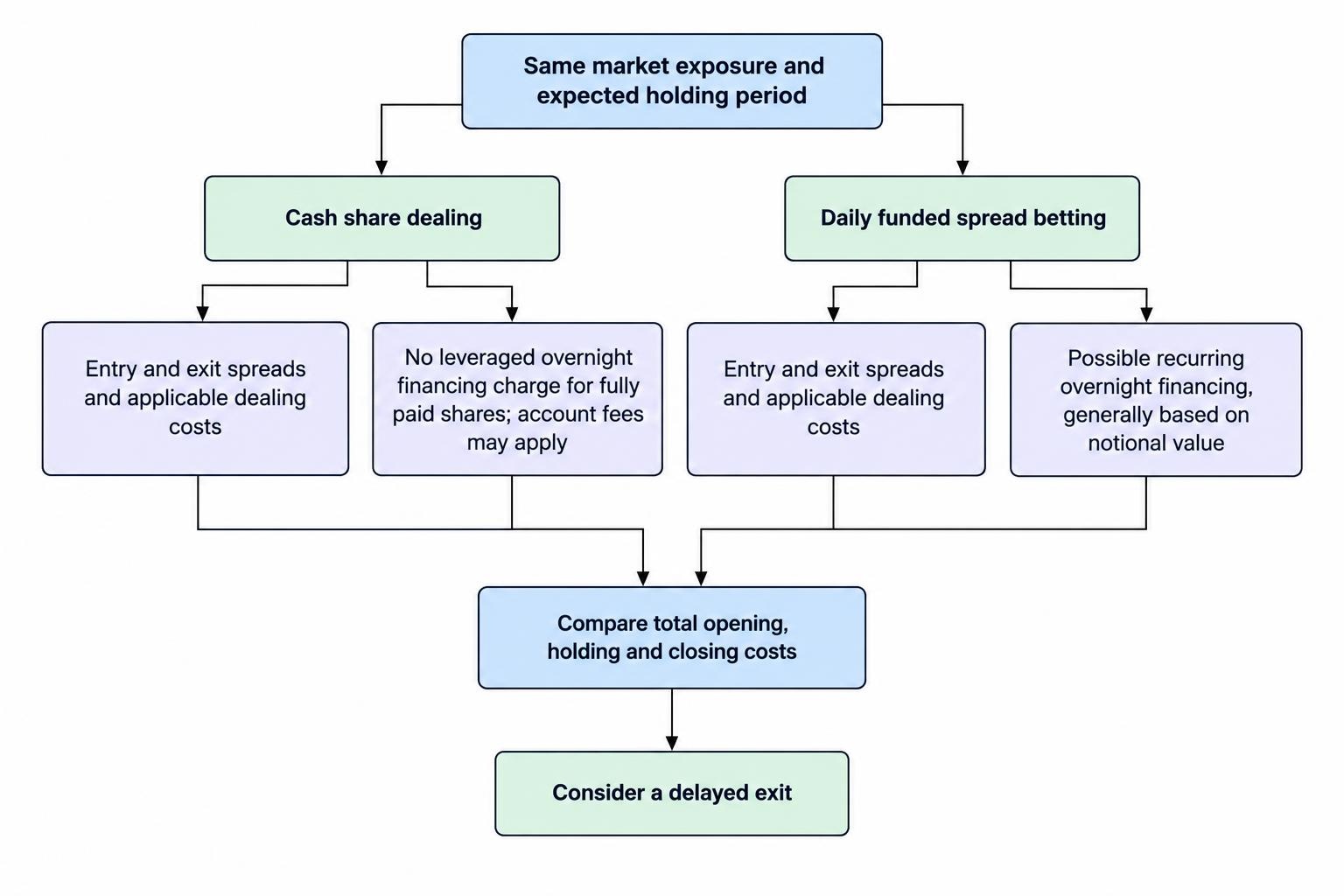
Neither route is automatically cheaper. Compare the complete opening, holding and closing cost for the same exposure over the period you expect to hold it.
Spread betting costs
The spread creates an immediate trading hurdle. A long position normally opens at the buy price and closes at the sell price; a short position does the reverse. The market must move far enough in your favour to cover that difference before the trade produces a net gain.
For daily funded share bets, overnight financing can become the larger expense as the holding period grows. The charge is generally calculated using the position’s notional value, not just its margin. A small deposit does not shrink the financing calculation to match.
Consider a hypothetical £10,000 long position charged at a constant annual rate of 8%, using a 365 day calculation. Thirty charged days would cost approximately £65.75. A full year at the same exposure and rate would cost £800. These figures illustrate the arithmetic, not a provider quote; rates, calculation methods and charging schedules vary.
The overnight financing cost guide covers the variables to check. Do not assume that depositing enough cash to cover the whole exposure stops the provider charging financing.
Dated spread bets have a different cost structure, with carrying costs reflected in their pricing rather than necessarily appearing as the same daily debit. They also have expiry and rollover considerations. “No daily financing charge” does not mean the holding period is free.
Share dealing costs
Cash share dealing may involve dealing commissions, platform or custody fees, currency conversion and transaction taxes. The market’s bid and offer prices still matter, even when the platform advertises commission free dealing.
Fully paid shares do not create the same leveraged overnight funding charge. That makes the cost structure easier to assess for a position held for months or years, although recurring platform charges still need checking.
A foreign share purchase may introduce an FX charge on the way in and another on the way out. A sterling denominated spread bet may produce its profit or loss in pounds, but that does not make its total pricing cheaper. Compare the complete terms rather than one attractive fee.
For a short holding period, spreads and dealing charges may dominate. Over a longer period, recurring financing can outweigh a saving at entry. The method in comparing total spread betting costs helps keep those calculations on the same footing.
UK tax: spread betting is not the only tax efficient route
Spread betting gains and losses
For an individual making ordinary financial spread bets, no chargeable capital gains or allowable capital losses arise from the bets. That treatment is recorded in HMRC’s capital gains guidance on financial spread betting.
The loss treatment deserves as much attention as the gains. A £3,000 spread betting loss does not become an allowable capital loss simply because the bet tracked a listed share. You cannot treat it as though you had bought and sold that share at a loss.
Tax treatment does not improve the trade’s underlying economics. A losing position remains a loss, and financing still reduces a winning position’s net result.
Tax on buying and selling shares
Buying existing shares in a UK incorporated company normally attracts a 0.5% transaction tax, subject to exemptions and reliefs. Electronic purchases generally fall under Stamp Duty Reserve Tax. Selling shares can also create a Capital Gains Tax liability. These points are covered by HMRC’s guidance on tax when buying shares.
For a £10,000 purchase subject to the standard 0.5% charge, the transaction tax is £50. Do not apply that calculation to every share purchase: the company, market and transaction can change the result.
Dividend income outside a tax shelter may also be taxable, with the amount depending on allowances and your tax band. MoneyHelper’s investment income tax guidance covers the separate treatment of dividends.
Keep records of purchases, sales, distributions and charges. Cash available to withdraw from an account is not, by itself, a calculation of taxable profit.
A stocks and shares ISA changes the comparison
Eligible investments held within a stocks and shares ISA can produce gains free of UK Capital Gains Tax and dividends free of UK Income Tax. The wrapper does not prevent investment losses. These protections are set out in MoneyHelper’s stocks and shares ISA tax guidance.
This weakens the argument that someone must use spread betting to obtain tax efficient equity exposure. For an eligible investor building a funded share portfolio, an ISA can combine ownership with favourable UK tax treatment.
Personal circumstances, residence and unusual business arrangements need separate consideration. The guide to whether spread betting is tax free examines that question beyond the ordinary individual comparison.
Dividends: a payment and an adjustment are not the same
A qualifying shareholder receives a dividend from the company’s distribution. A spread bettor does not receive that dividend as a shareholder. Instead, the provider normally makes an adjustment under the contract’s terms around the underlying share’s ex dividend date.
A long share bet generally receives a credit, while a short bet generally receives a debit. Check the provider’s calculation, deductions, timing and treatment of unusual distributions rather than assuming it will match the cash received by a shareholder.
The adjustment is not a free return. When a share trades without entitlement to the next dividend, that change affects its price, though other market movements can obscure the effect. Receiving an adjustment does not, by itself, create an economic gain.
Consider a hypothetical 10p dividend on the 2,000 share equivalent position used earlier. The corresponding gross amount is £200. A long spread bet may receive a contractual credit related to that amount, but any price movement and other charges must still enter the total return calculation.
The guide to dividends and share spread bets covers those mechanics. For someone building an income portfolio, actual distributions, ownership and holding costs are usually more relevant than the appearance of a credit on a trading statement.
Short positions and hedging
Spread betting makes it possible to open a bearish position by selling a market the provider offers. You do not first need to own the underlying shares. Ordinary cash share dealing works differently: selling normally disposes of shares you already hold rather than creating a new short position.
Availability is not guaranteed. A provider can restrict opening trades, increase margin requirements or apply stock borrowing charges to a short share bet. A market appearing on a platform does not promise that both trading directions will remain available on unchanged terms.
A short position also has an asymmetric price risk. A share can fall only to zero, but its price can rise far above your entry. The guide to short selling shares through spread betting examines the practical constraints and risks.
A hedge has a different purpose from a standalone bearish trade. Someone holding shares might open a short spread bet to offset part of a temporary fall without immediately selling the holding. However, the short bet can lose money and require cash while the shares are rising in value elsewhere.
That cash flow mismatch matters. An unrealised gain in a share account does not automatically meet a margin requirement in a spread betting account. Financing, imperfect matching and tax also need assessing. The spread betting hedging guide covers the strategy in more detail.
Risk and protection: regulation does not protect the trade
Forced closure and account losses
Under the UK retail framework, firms must close positions as soon as market conditions allow when account equity falls below 50% of the required margin. Negative balance protection limits liability to the funds in the relevant trading account. These safeguards form part of the FCA’s retail product protection measures.
Neither safeguard guarantees that a particular trade will close at your preferred price. Negative balance protection is an account protection, not a promise that losses stop at the opening margin of each position. Other money in the account can be consumed.
Fully paid cash shares have no equivalent margin liquidation triggered solely by a price fall. You can generally continue holding through a decline, provided no other account or corporate event requires action. That is flexibility, not proof that waiting will work: a company can deteriorate permanently or fail.
Gaps and stop orders
Both routes face price gaps. A company announcement can cause the next available dealing price to be far away from the previous one. An ordinary stop order does not guarantee its execution price.
Where available, a guaranteed stop loss order can set a contractual exit level for a spread bet, subject to the provider’s terms and charges. It does not make the forecast more reliable or remove the cost of repeated losing trades.
Provider failure is a separate risk
FSCS investment protection can cover eligible claims up to £85,000 per person, per firm, subject to its conditions. It may apply where a failed provider leaves a shortfall in money or assets, but it does not compensate for ordinary poor investment performance. Check the FSCS investment protection requirements rather than assuming every account has identical cover.
Before funding either account, establish which legal entity holds it and what that entity is authorised to do. The process for checking a firm on the FCA Register is more useful than relying on a familiar brand name or a regulation badge.
Which approach fits your objective?
Cash share dealing is generally the more natural structure when the aim is to own businesses, receive qualifying dividends and hold investments without leveraged financing or margin closure. It still requires a sensible portfolio and the financial capacity to absorb losses.
Spread betting can serve a defined trading or hedging purpose where you understand the contract, can monitor the position and can fund adverse moves. The ability to open a short position or commit less initial collateral may be useful, but neither benefit establishes that the trade is suitable.
Before choosing, answer four questions:
- What exposure do you want? Compare the same pound sensitivity to a share price move, not the same opening deposit.
- How long could you hold it? Include a delayed exit in the cost calculation, not just your preferred holding period.
- How much can you lose? Allow for gaps, charges and other positions drawing on the same account.
- Do you need ownership? Dividends, voting arrangements and a long investment horizon may favour actual shares.
Choose the position size before deciding how little margin you can deposit. The position sizing guide starts with the amount at risk rather than the platform’s maximum available exposure.
If the spread betting calculations are unfamiliar, a spread betting demo account can help you practise stake sizing and read the account figures without committing real money. It cannot reproduce the financial pressure of a live loss.
The decision is not simply “tax free trading versus taxable investing”. It is a choice between owning an asset and holding a financed price contract. Match that structure to the job, then compare costs, tax and risk on equal exposure.