Spread betting and forex trading are not opposing markets. Forex is the market being traded; spread betting is one way to trade it. You can take a position on EUR/USD through a spread bet, a forex CFD, a rolling spot contract or another currency product.
For a UK retail trader, the useful comparison is usually forex spread betting versus trading currencies through CFDs or rolling spot FX. Both can provide leveraged exposure without delivering currency. The differences sit in position sizing, account currency, charges and tax treatment—not in whether the euro rises against the dollar.
This comparison focuses on UK individual retail clients. Neither route removes the risk of losing the money committed to trading.
What are you actually comparing?
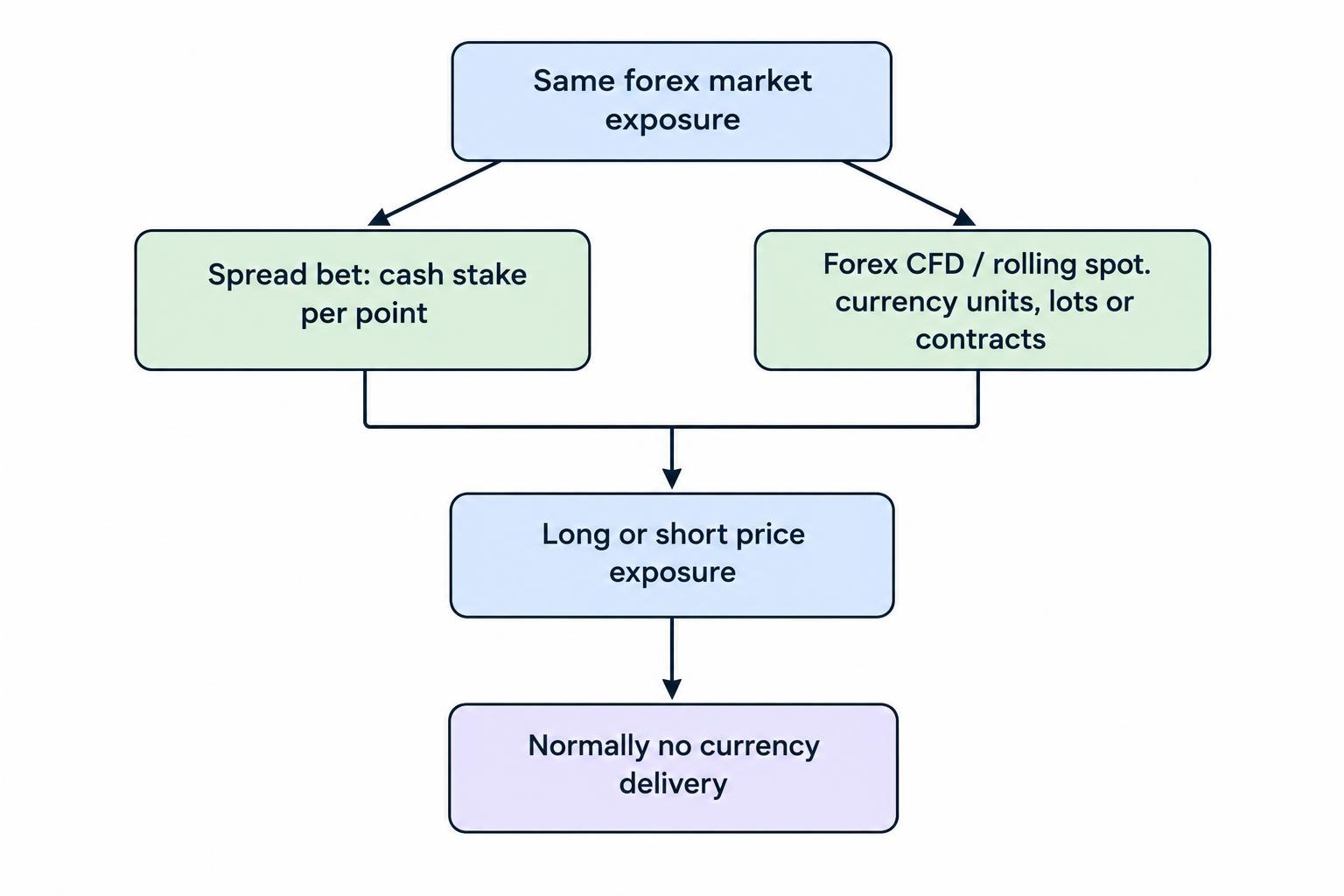
A forex spread bet expresses exposure as a cash stake per point. If your stake is £2 per point, each point of movement changes the position’s profit or loss by £2. You buy to speculate on a rise or sell to speculate on a fall.
A forex CFD or rolling spot position generally expresses exposure through currency units, lots or contracts. Profit and loss then depend on the position size, exchange rate movement and any conversion into your account currency.
These products belong to the same broad regulatory category: the FCA’s overview of retail CFD products includes spread betting and rolling spot foreign exchange. A different label does not automatically mean different market risk.
Deliverable currency exchange is another matter. Buying euros to pay an invoice gives you currency to spend. Opening a EUR/USD spread bet gives you exposure to a price movement, not euros for the invoice. Currency futures and options also have their own contract structures and should not be treated as interchangeable with retail forex accounts.
The forex spread betting guide covers the currency market itself. Here, the focus is choosing between the ways of accessing it.
Spread betting vs forex trading: the main differences
| Feature | Forex spread betting | Forex CFDs or rolling spot FX |
|---|---|---|
| Position size | Cash stake per point, such as £2 per point | Currency units, lots or contracts |
| Profit and loss | Points moved multiplied by the stake | Exchange rate movement multiplied by currency exposure, with conversion where needed |
| Currency delivery | No delivery of the underlying currencies | Normally no currency delivery for these speculative contracts |
| Trading direction | Long or short | Long or short |
| Charges to check | Spread, funding and any other contractual charges | Spread, commission where applicable, funding and conversion charges |
| UK capital gains treatment | No chargeable gains or allowable losses from financial spread bets | Retail forex CFDs normally fall within the capital gains regime unless taxed as trading income |
The sizing methods can look very different while producing comparable exposure. A £2 spread bet is not necessarily smaller than a forex position described as 0.25 lots. You need to translate both into the cash gained or lost for the same market movement.
Position sizing: pounds per point versus currency lots
How the spread betting calculation works
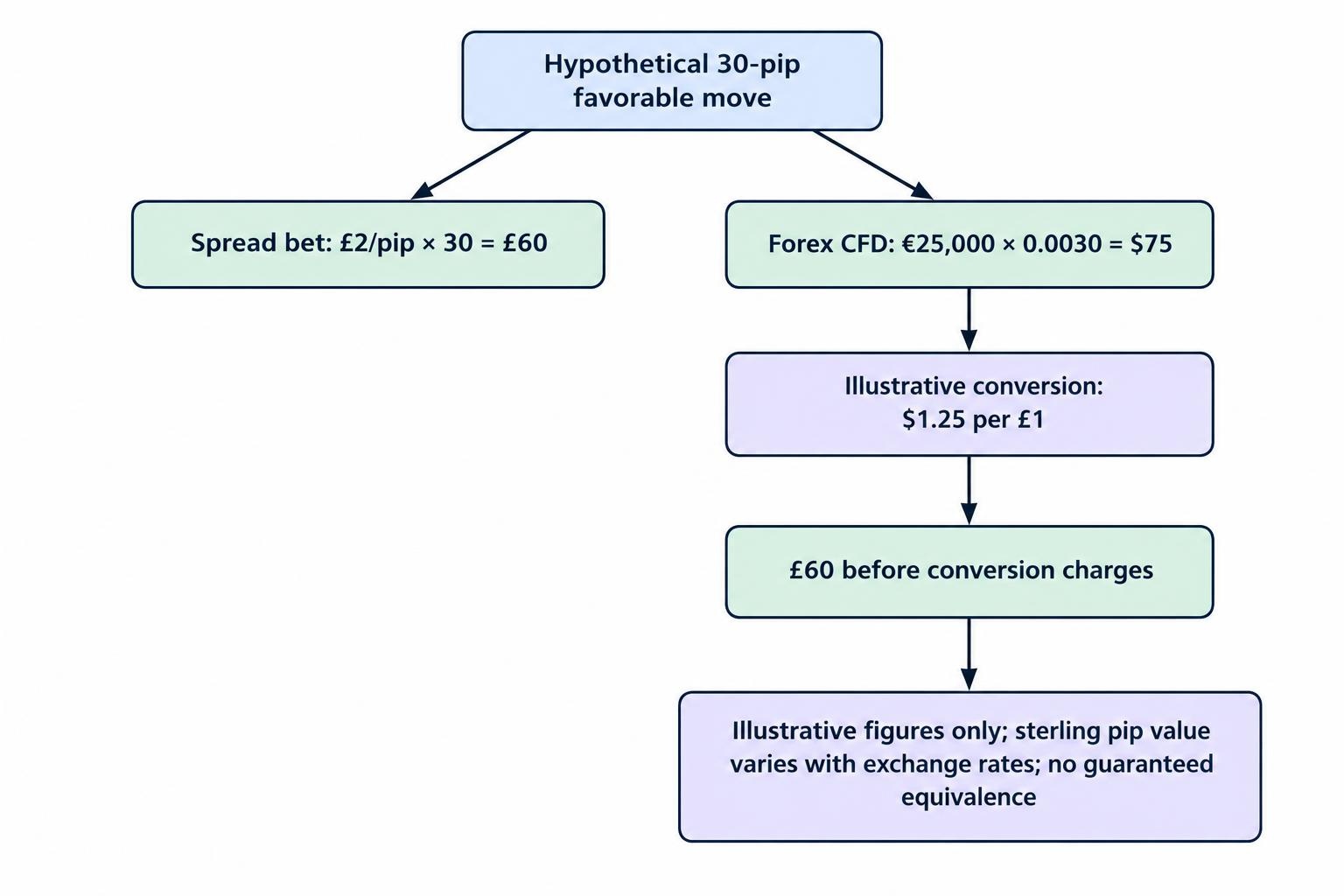
Consider a hypothetical EUR/USD spread bet where one point equals one pip, or 0.0001. The opening quote is 1.0800 to sell and 1.0801 to buy. You buy at 1.0801 for £2 per point.
Later, you close at a selling price of 1.0831. The difference between your opening and closing execution prices is 30 pips:
30 points × £2 per point = £60 profit.
If you instead closed at 1.0771, the 30 point adverse movement would produce a £60 loss. These figures already reflect the quoted entry and exit prices, but exclude financing and any separate fees.
Check the contract’s point definition before entering a stake. A platform displaying an extra decimal place does not necessarily treat that smallest displayed increment as one full betting point. The stake per point explanation covers this distinction.
How the forex calculation compares
Now consider a hypothetical forex CFD representing €25,000 of EUR/USD exposure. A standard lot commonly represents 100,000 units of the base currency, so this would be 0.25 standard lots under that convention.
Buying at 1.0801 and closing at 1.0831 produces:
€25,000 × 0.0030 = $75 profit.
At an illustrative conversion rate of $1.25 per £1, that equals £60 before conversion charges. The two trades therefore produce the same result under these assumptions.
They are not permanently identical positions. The dollar value of a pip on this EUR/USD forex position is $2.50, but its sterling value changes with GBP/USD. A spread bet explicitly denominated at £2 per pip retains that contractual sterling value per pip.
This distinction matters when planning a loss budget in pounds. With a forex contract whose result is calculated in another currency, allow for the exchange rate used at settlement and any currency conversion costs. Read the contract rather than assuming every account handles conversion the same way.
Which costs less?
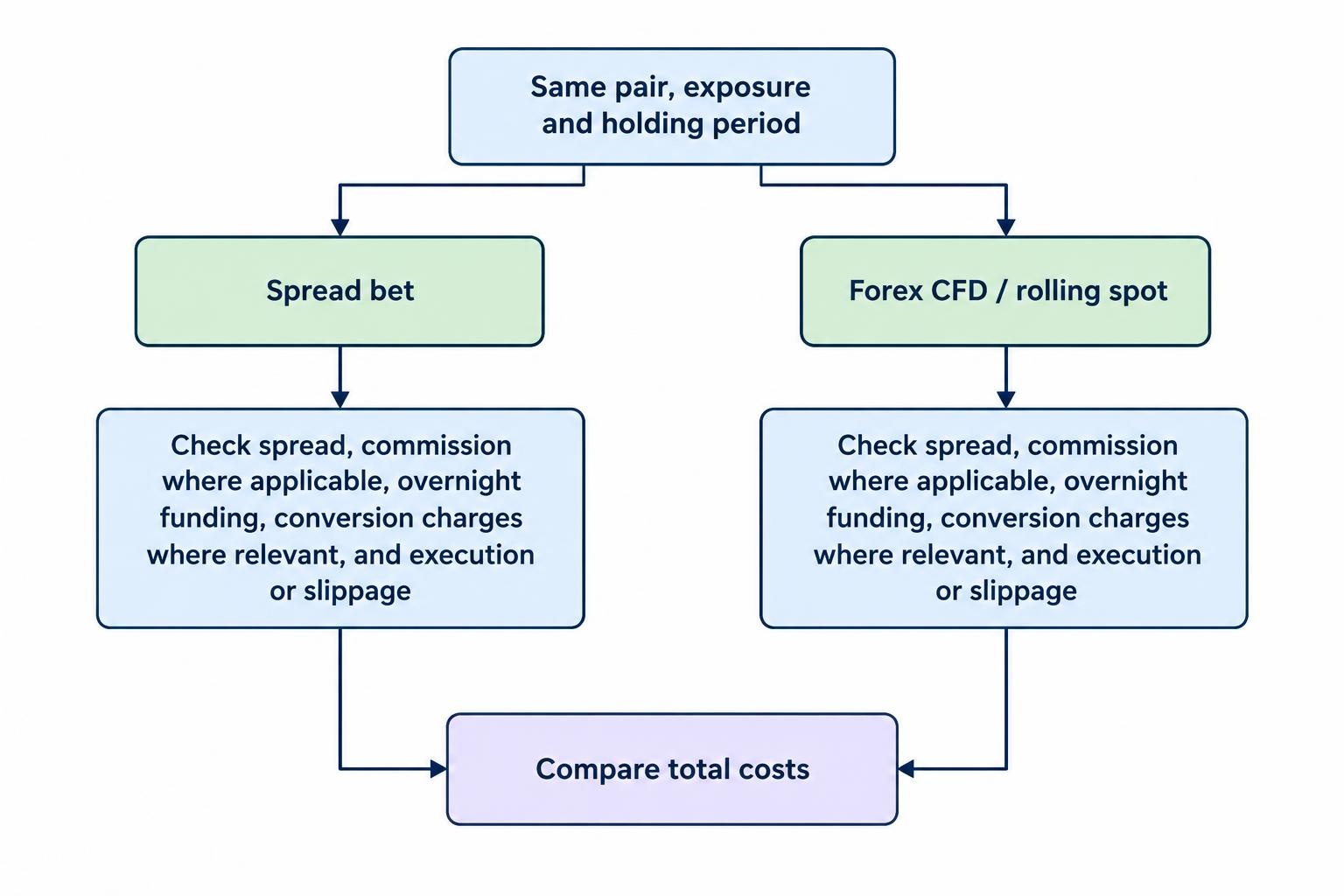
Neither spread betting nor forex trading is automatically cheaper. Compare the total cost of the same exposure, held for the same period and traded under similar market conditions.
The spread is the gap between the buying and selling prices. Both products can charge through that gap. A forex account may offer a narrower spread and charge a separate commission; a spread betting account may include more of its dealing charge in the quoted spread. Neither structure wins on presentation alone.
Take two hypothetical accounts with exposure equivalent to £2 per pip. A spread betting quote with a 1.2 pip spread creates a £2.40 spread cost if the underlying market does not move. A forex account with a 0.4 pip spread costs £0.80 through the spread, but adding £2 in total opening and closing commission brings the cost to £2.80.
The narrower headline spread is more expensive in that example. Change the commission or spread and the answer changes too. These figures illustrate the calculation, not current provider pricing.
Overnight funding can change the result
For positions held overnight, inspect the funding calculation rather than stopping at the spread. Currency funding can create a debit or credit depending on the pair, trade direction and provider’s terms. Administration charges can reduce a credit or increase a debit.
Check the funding cut-off, weekend treatment and the amount on which the adjustment is calculated. A small margin deposit does not mean funding is calculated only on that deposit.
Also compare execution. An advertised spread is of little comfort if your actual fills are consistently worse than expected. Orders can suffer slippage during rapid price moves, and spreads can widen. Use the total spread betting cost comparison to assess dealing and holding costs together.
Leverage and retail protections are broadly aligned
Moving from forex spread betting to a forex CFD does not provide an automatic escape from UK retail leverage restrictions. The FCA’s rules cover leveraged spread bets, CFDs and relevant rolling spot forex contracts.
For currency exposure, UK retail leverage limits are generally described as 30:1 for major pairs and 20:1 for minor pairs. The rules also require account equity monitoring, closure of positions when equity falls below 50% of the required margin as soon as market conditions allow, and negative balance protection. These requirements appear in the FCA rules on retail speculative investments.
Negative balance protection is an account protection, not a promise that each trade can lose only its opening margin. Money dedicated to trading these products can still be lost.
Separate margin from your planned loss. If a position requires £500 of margin, that does not make £500 its stop loss. Conversely, having enough money to open a larger position does not mean that position suits your account.
Suppose your planned loss is £100 and your stop sits 50 pips from entry. Exposure equivalent to £2 per pip gives a £100 planned price loss before fees and slippage. Increasing exposure to £10 per pip raises that figure to £500, regardless of the minimum deposit needed to open it.
The guide to leverage risk explains why available buying power is a poor substitute for a loss budget.
UK tax differences: profits and losses receive different treatment
For financial spread betting, no chargeable gains or allowable capital losses arise from the bets. That means a profitable personal spread bet does not create a capital gains tax charge, but a losing bet does not create a capital loss available to offset taxable gains elsewhere. Both sides of that treatment appear in HMRC’s financial spread betting guidance.
The absence of capital loss relief deserves attention. Comparing only the treatment of winning trades gives an incomplete picture, particularly if you also hold investments with taxable gains.
Retail forex CFDs have a different starting point. Their outcomes normally fall within the capital gains regime unless profits are taxable as trading income. Relevant debits and credits enter the calculation when the contract closes, including allowable losses and contractual charges covered by HMRC’s guidance on retail contracts for differences.
Do not extend that CFD treatment to every transaction called “forex”. Deliverable currency, business transactions and other derivatives need their own assessment. The pair being traded does not settle the tax question; the contract and circumstances matter.
These are capital gains distinctions, not a ruling on every possible Income Tax or business arrangement. Get advice before relying on an exemption, especially for company accounts, business hedges or cross-border circumstances. The separate spread betting versus CFD tax comparison examines the tax questions in more detail.
Can you use the same forex strategies?
A EUR/USD trend, support level or economic announcement does not change because you use a spread betting ticket instead of a forex CFD ticket. Both can express a directional view on the same pair.
What changes is implementation. Minimum position sizes, stake increments, order restrictions, funding terms and available tools can determine whether a strategy is practical on a particular account.
For short trades, transaction costs and execution deserve close attention because the intended price move may be small. For positions held over several nights, funding and the cash available to support the position become more prominent. A strategy can work on paper and still fail to cover its dealing costs.
Timing also matters. Spreads and executable prices can differ around session changes, funding cut-offs and economic releases. Compare the hours you intend to trade, not just an attractive quote displayed at another time. The forex trading hours guide covers session timing without treating every trading hour as equivalent.
Which account structure suits your needs?
Forex spread betting may suit a UK individual who wants to express exposure directly in pounds per point. That can make it easier to connect a stop distance to a planned sterling loss. Its capital gains treatment may also influence the choice, provided the trader considers the lack of capital loss relief.
A forex CFD or rolling spot account may suit someone who prefers sizing positions in currency units or lots, or whose existing trading process works in those terms. Account features matter here: check the actual platform, order controls and contract specifications rather than assuming every forex account offers the same tools.
For either route, minimum trade size can be decisive. If your loss budget is £20 and your intended stop is 40 pips away, you need exposure equivalent to £0.50 per pip before costs. An account with a larger minimum position forces you to exceed that budget or leave the trade alone. Moving the stop closer just to make the arithmetic fit changes the trade itself.
Use position sizing based on planned risk before comparing margin requirements. A small minimum deposit is not proof that an account supports suitably small trades.
How to make a fair comparison before opening an account
Build one sample trade and price it under both structures. Use the same currency pair, direction, intended entry, stop distance and holding period. Then check:
- Exposure: the cash gained or lost per pip, expressed in your account currency.
- Dealing costs: the spread and total opening and closing commission, where charged.
- Holding costs: funding adjustments and any currency conversion charges.
- Contract terms: minimum size, point definition, margin requirements and order conditions.
Practise the sizing and order process through spread betting demo accounts where available. A demo can help expose a mistaken point value or oversized order; it cannot establish how live execution will behave during a fast market.
The practical choice is the contract that lets you control exposure, account for costs and apply the correct tax treatment. Spread betting can simplify sterling sizing. Forex contracts can fit a lot-based process. Neither makes a weak trading decision cheaper to learn from.