Financial spread betting and sports betting both involve staking money on an uncertain outcome. The main difference is how the result becomes a profit or loss. A financial spread bet pays or loses an amount for every point a market moves. A conventional sports bet pays at agreed odds if the selected outcome wins.
That changes how much money is at risk, how positions are managed and what costs apply. A £2 financial spread bet is not comparable with a £2 football bet: the first usually means £2 per point, not £2 maximum exposure.
This comparison focuses on financial spread betting versus fixed odds sports betting in a UK context. Sports spread betting is a separate category, covered below. For the basic financial contract, see what financial spread betting involves.
The Main Differences
| Feature | Financial spread betting | Fixed odds sports betting |
|---|---|---|
| What determines the result? | The change in a quoted financial market price | Whether a sporting selection wins under the settlement rules |
| How is the stake expressed? | An amount per point, such as £2 per index point | A total amount wagered, such as £20 |
| How is profit calculated? | Favourable points moved multiplied by stake per point, less applicable costs | Stake multiplied by decimal odds, minus the original stake |
| What is paid upfront? | Margin supporting the position, rather than its full market exposure | The stake for a conventional back bet |
| Can losses exceed that initial amount? | Yes, losses on a position can exceed its initial margin | Not on an ordinary, fully paid back bet |
| Can the position end early? | Usually by closing during available trading hours | Sometimes through cash out or a separate offsetting bet, where available |
Neither activity requires ownership of the underlying subject. Buying a spread bet on a share does not make you a shareholder. Backing a football team does not give you a stake in the club, however strongly the language in the stands might suggest otherwise.
How the Payouts Compare
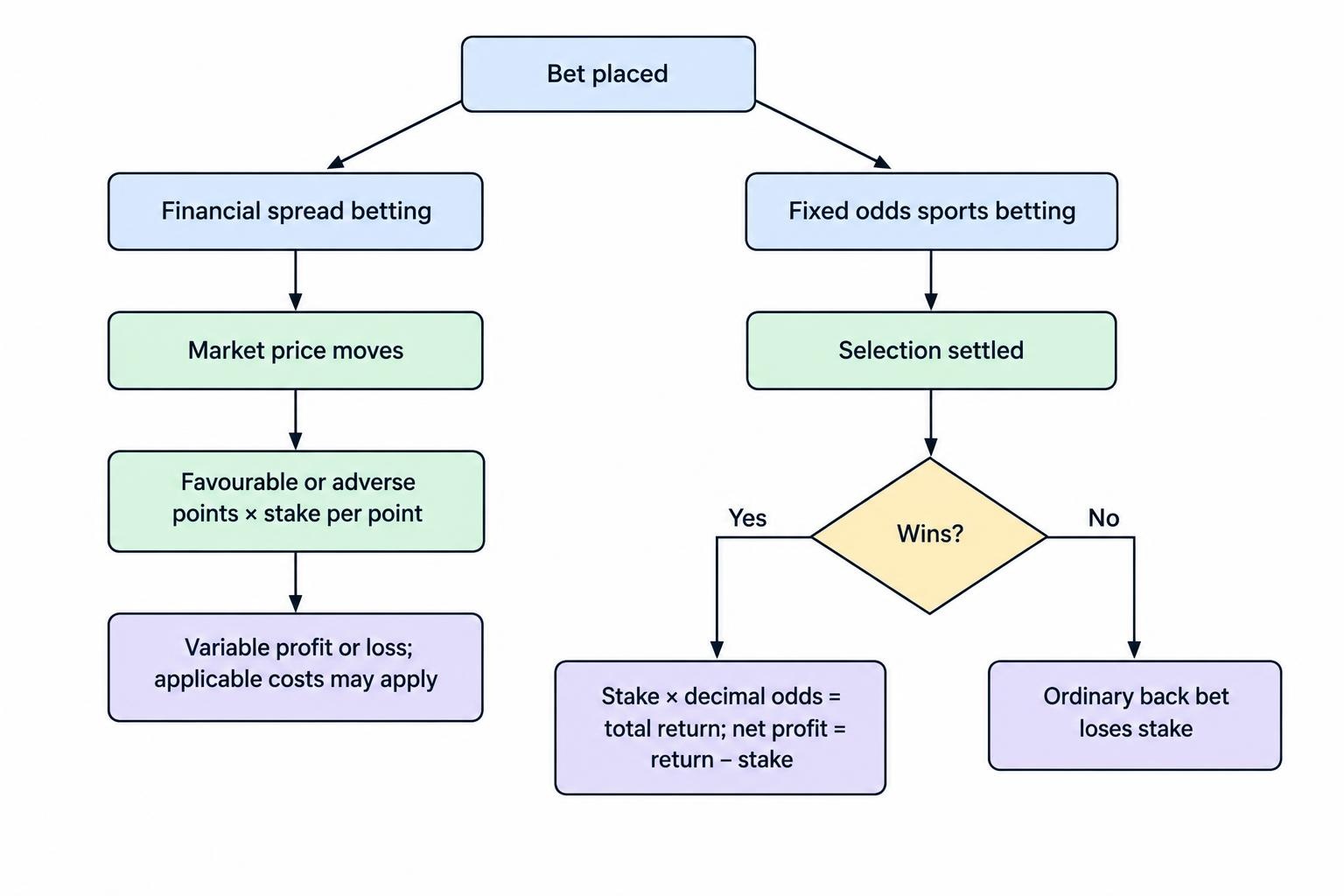
A financial spread betting example
Assume an illustrative stock index quote is 8,000 to sell and 8,002 to buy. You expect a rise and buy at £2 per point, entering at 8,002.
If you later close at a selling price of 8,052, the favourable movement is 50 points. Your trading profit is £100: 50 × £2. If you instead close at 7,952, the adverse movement is 50 points and your trading loss is £100. Both figures exclude any separate financing or other adjustments.
The distance travelled matters, not just whether the prediction was right. A five point rise and a 100 point rise produce very different results. The stake per point converts that distance into money.
A fixed odds sports betting example
Now assume you place £20 on a team at decimal odds of 3.00. If the selection wins, the total return is £60, including the original £20 stake. The net profit is £40. If it loses, the loss is £20.
For an ordinary match winner bet, winning by one goal or five goals makes no difference to that payout. The accepted odds and settlement rules determine the return.
The financial bet therefore has a variable monetary result tied to price movement. The sports bet has a predetermined winning payout, subject to matters such as void bets, dead heats or other relevant settlement provisions.
Risk: Margin Is Not the Same as a Stake
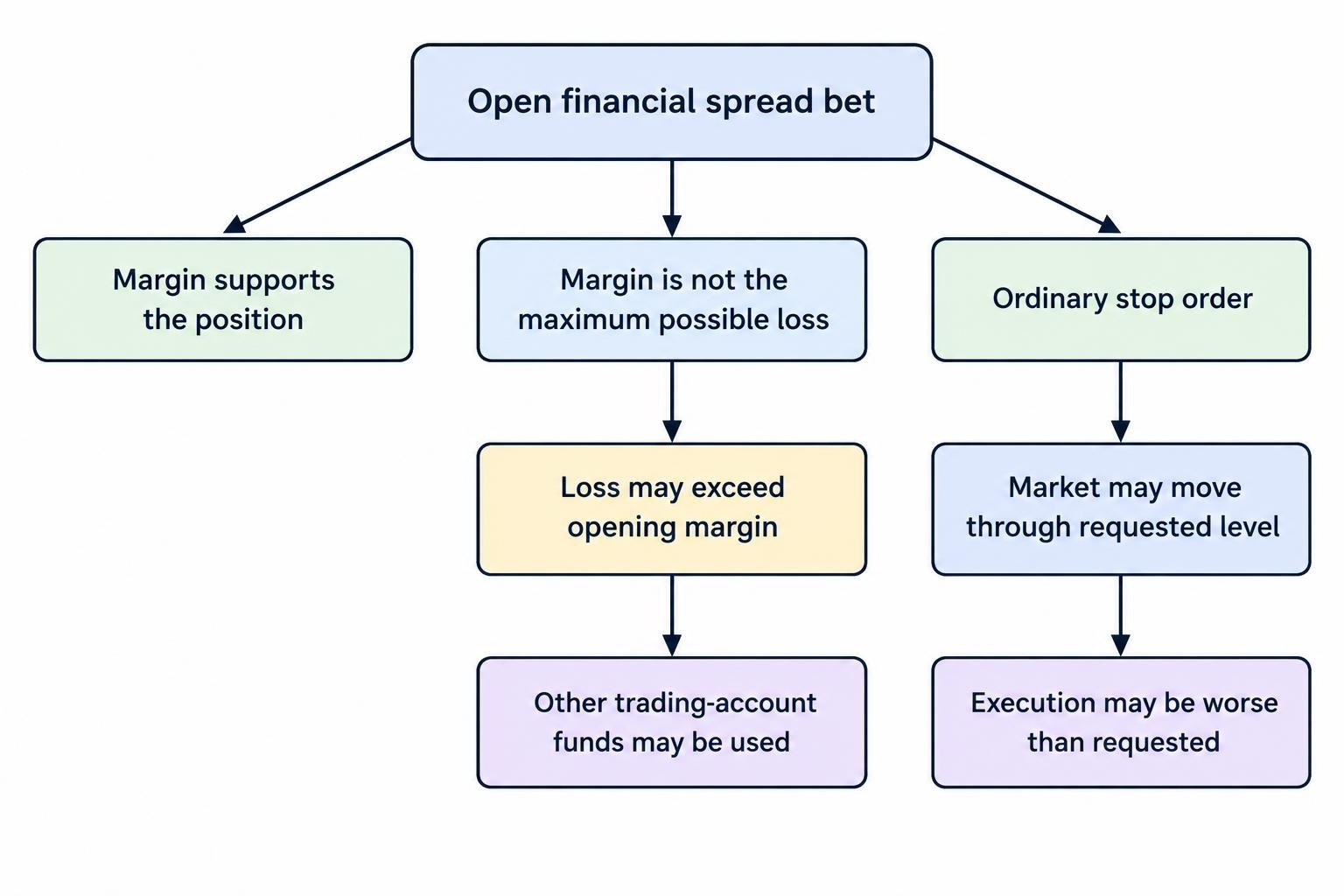
A conventional £20 sports back bet puts £20 at risk. Financial spread betting uses margin: money required to support an open position. That margin is not a purchase price and it is not a promise that losses will stop there.
A position can lose more than its opening margin, using other funds in the trading account. A provider may also close positions when account funds become insufficient. Choosing the smallest available margin therefore does not establish a sensible risk budget.
For a financial spread bet, work backwards from an affordable loss and a planned exit distance. A £50 loss budget with an exit 25 points away implies £2 per point before allowing for costs and execution differences. This is the practical role of position sizing for spread betting.
An ordinary stop order does not guarantee that exact loss. A market can move through the requested exit level, leaving execution at a worse price. Position risk should allow for that possibility rather than treating the stop as an insurance policy.
Sports betting also needs qualifications. On a betting exchange, laying a selection means betting against it. The liability can exceed the quoted lay stake. Cash out is not a guaranteed exit either: it may be unavailable or offered at an unattractive price.
Costs: A Quoted Spread Versus a Margin in the Odds
A financial spread betting provider quotes separate buying and selling prices. In the index example, opening at 8,002 and immediately closing at an unchanged selling price of 8,000 would lose two points, or £4 at £2 per point.
Holding a daily funded position overnight can introduce financing charges. Other possible costs include currency conversion, guaranteed stop premiums and account charges, depending on the product and provider. Comparing the headline spread alone can miss much of the bill; the guide to spread betting costs covers these separately.
With fixed odds sports betting, the bookmaker’s margin is built into the offered prices. One way to examine it is to convert each mutually exclusive outcome’s decimal odds into an implied probability. For a complete market, a total above 100% indicates an overround. That is not an exact forecast of the bookmaker’s realised profit.
The practical question is the same in both cases: does the expected advantage remain after the cost of placing and managing the bet?
Sports Spread Betting Is a Third Category
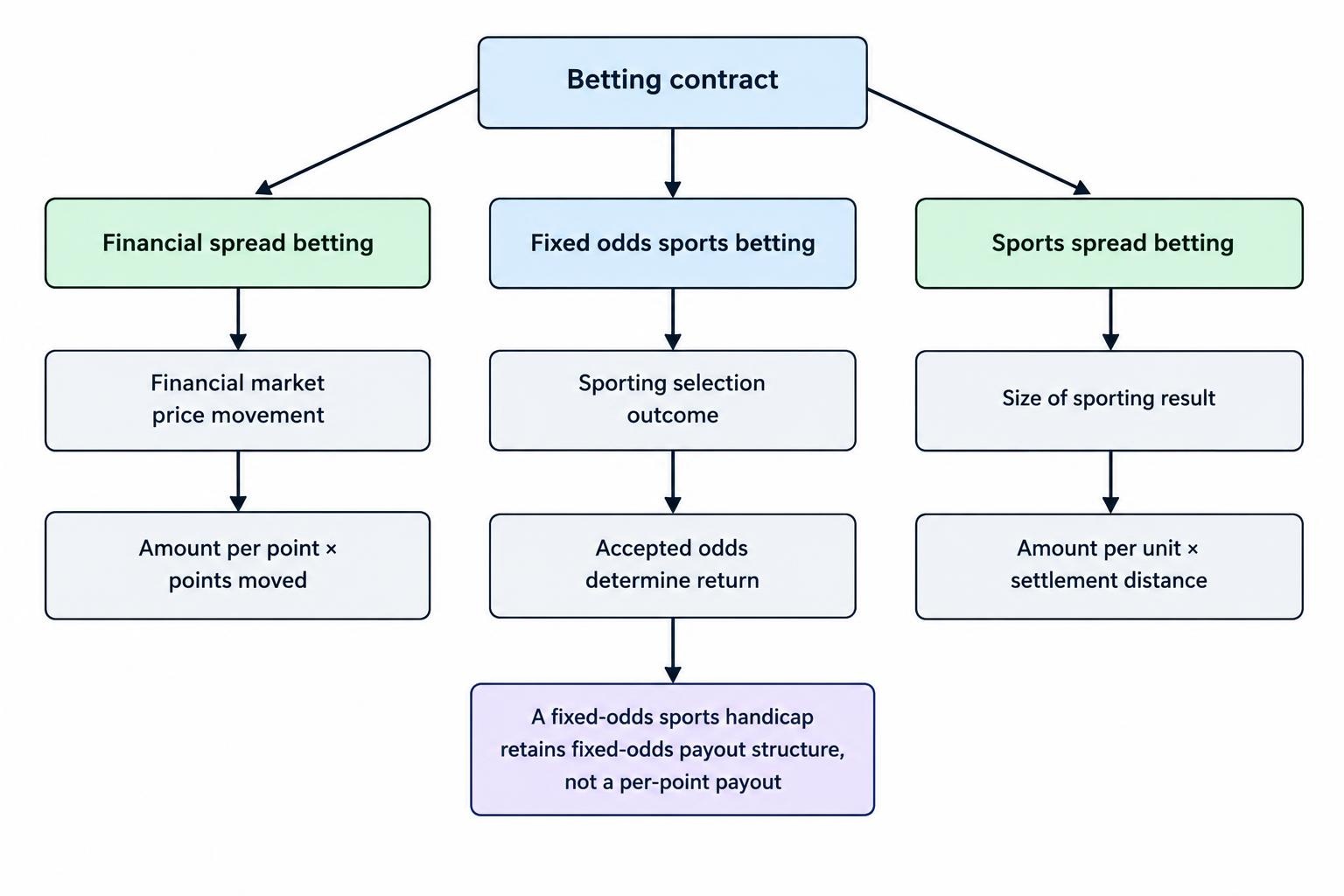
Sports spread betting combines a sporting subject with a payout based on the size of the result. It should not be confused with either fixed odds betting or financial spread betting.
Suppose an illustrative total goals spread is 2.6 to sell and 2.8 to buy. Buying at £10 per goal and settling at five goals produces a £22 profit: (5 − 2.8) × £10. Settlement at zero goals produces a £28 loss.
Here, “£10 per goal” is not a £10 maximum loss. The settlement distance determines the result. Depending on the market and whether the customer buys or sells, losses can be much larger than the quoted unit stake.
A sports handicap sometimes called a “point spread” is different again. If it is offered at fixed odds, it retains a fixed odds payout structure rather than paying an amount for every point beyond the quoted line.
UK Regulation and Customer Protections
In Great Britain, conventional licensed sports betting falls within the Gambling Commission’s remit. Spread betting is an exception regulated by the Financial Conduct Authority, rather than the Commission. The boundary is set out in the Gambling Commission’s explanation of activities it does not regulate.
For financial spread bets covered by the FCA’s retail product rules, protections include minimum margin requirements, account margin close out requirements and negative balance protection. The last of these caps liability for the covered products at the funds dedicated to trading them in the account. It does not cap each position’s loss at its opening margin, and it does not prevent the loss of the account’s trading funds. These requirements appear in FCA Handbook COBS 22.5.
Sports spread betting needs separate care. The FCA distinguishes non-financial sporting outcomes from financial spread bets and warns customers not to assume that financial compensation schemes or other financial safeguards cover those products. That distinction appears in the FCA perimeter report’s treatment of sports spread betting.
Check the contracting legal entity and the product being offered, not just the brand name. For financial accounts, the process for checking a broker on the FCA Register helps separate an authorised firm from a convincing imitation. Regulation is not a guarantee against trading losses.
Skill, Probability and the Problem With Being Right
Both activities allow research. A financial trader might assess interest rates, company earnings or price patterns. A sports bettor might assess team strength, injuries and scheduling. Research can inform a decision; it does not by itself establish a profitable advantage.
In fixed odds betting, the offered price must justify the estimated chance of winning. At decimal odds of 3.00, the break even win probability is approximately 33.3%, before any separate charges. A selection can be the most likely winner and still be poor value at its price.
In financial spread betting, accuracy alone is also insufficient. A trader who wins £20 on six trades but loses £50 on four trades has lost £80 before separate costs, despite winning more often than losing.
These examples show why a winning percentage is an incomplete measure. Average gains, average losses and costs matter. A short profitable run cannot establish that a method will remain profitable, whether the screen shows candlesticks or corner counts.
Tax Does Not Create a Clear Winner
For ordinary personal betting in the UK, winnings are generally not taxable and losses generally receive no tax relief. HMRC states that betting and gambling do not, by themselves, constitute trading, and that a person placing spread bets is not normally carrying on a trade. The starting position appears in HMRC’s guidance on betting and gambling profits.
Exceptions need attention. Spread betting receipts can be taxable where they arise from carrying on a trade; the contract and economic substance matter. This is addressed in HMRC’s guidance on spread betting within a trade.
Tax treatment depends on circumstances, jurisdiction and the arrangement involved. It is not a sound reason to choose a product whose risks are poorly understood. The separate guide to whether spread betting is tax free examines the UK position without treating the headline as a universal exemption.
Which Structure Fits the Intended Activity?
For a small, predetermined wager on a sporting outcome, an ordinary fixed odds back bet has a more straightforward loss boundary than a financial spread bet. That says something about the contract, not whether placing the bet is worthwhile.
Financial spread betting serves a different purpose: taking a position on a market price, with control over direction, stake per point and exit timing. Those controls bring more decisions, ongoing account exposure and execution risk. It should not be treated as sports betting with financial charts attached.
If the aim is to learn those mechanics, spread betting demo accounts allow practice without staking real money. Demo results do not establish how a strategy will perform with real execution or financial pressure.
Before either activity, identify the full amount at risk, how settlement works and what happens if an early exit is unavailable. Neither product is a dependable substitute for income. If the reason for the next bet is to recover the last loss, changing products will not fix the decision.