Spread betting and binary options both let traders take a view on financial prices without owning the underlying asset. Their payouts work very differently. A spread bet gains or loses money with each point the market moves. A typical binary option pays a fixed amount if a stated condition is met at expiry, or nothing if it is not.
For UK retail traders, there is also a decisive legal difference. Firms acting in or from the UK have been prohibited from selling, marketing or distributing binary options to retail consumers since 2 April 2019. The FCA’s permanent binary options ban means these products should not be presented as interchangeable choices for a UK retail account.
Spread Betting and Binary Options Compared
| Feature | Spread betting | Binary options |
|---|---|---|
| What determines the result? | The price difference between opening and closing, multiplied by the stake per point. | Whether a stated condition is met under the contract’s settlement rules. |
| Profit structure | Variable: a larger favourable move produces a larger gross profit. | A predetermined settlement payment, rather than a payment proportional to the price move. |
| Loss structure | Variable: losses can exceed the margin committed to an individual position. | For a fully paid purchased contract, the amount paid can be lost in full. |
| Timing | The trader can normally close during dealing hours; dated bets also have an expiry. | Expiry and settlement conditions determine the result if held to settlement. |
| Trade management | Positions can use stops and limits, subject to availability and execution conditions. | Early exit or cancellation depends on the contract and trading venue. |
| Costs to examine | Spread, financing and any other applicable charges. | Purchase price, settlement payment, fees and any early-exit pricing. |
Neither product gives you ownership of the referenced shares, currencies or commodities. Being right about market direction is also not enough by itself. Entry price, costs, timing and contract terms determine whether that view makes money.
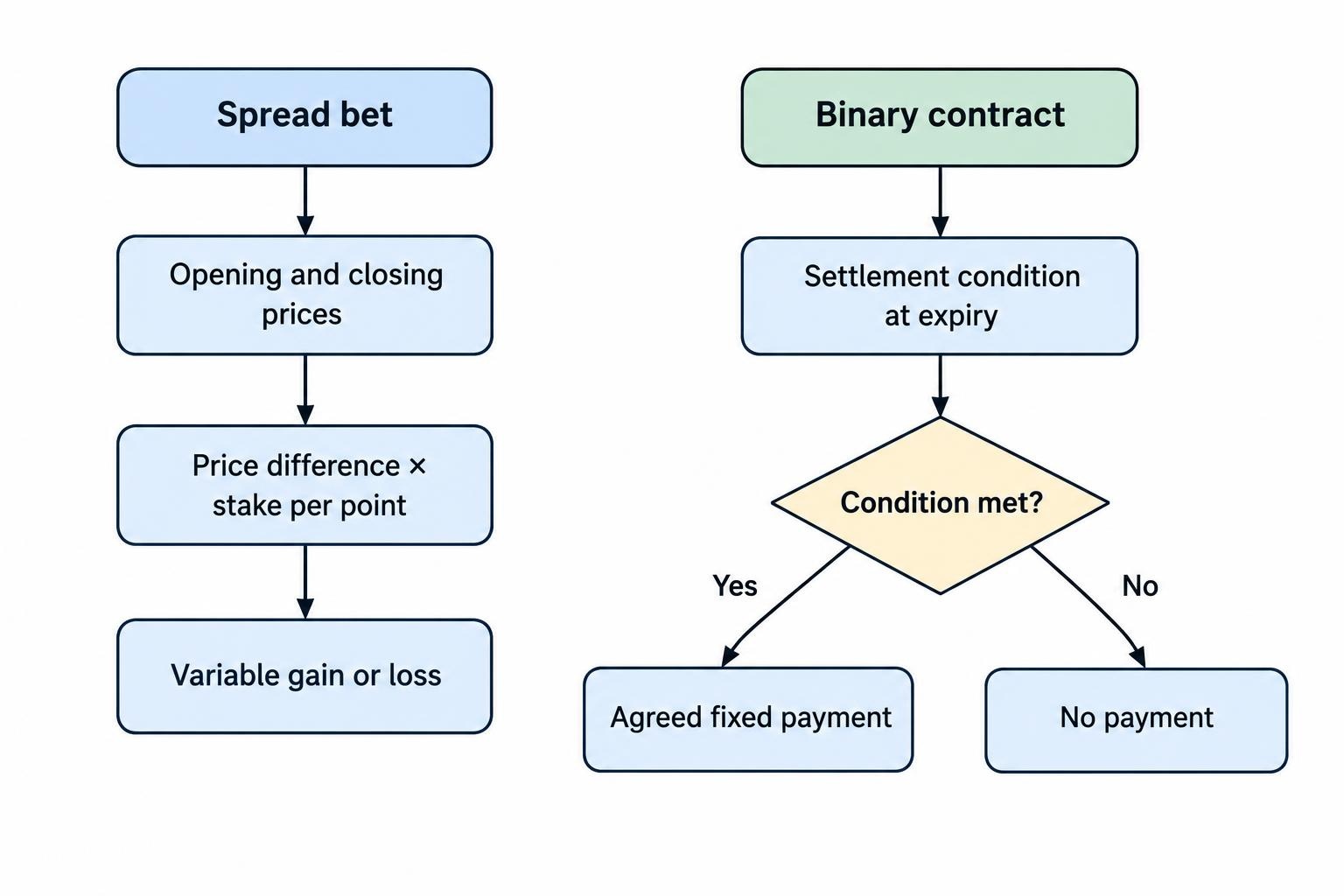
How Each Product Turns a Market View into Money
Spread betting: every point changes the result
With a spread bet, you choose a monetary stake for each point of movement. Buying expresses a view that the price will rise; selling expresses a view that it will fall. Your closing price then determines the gain or loss.
For a long position, gross profit or loss equals the closing sell price minus the opening buy price, multiplied by the stake per point. For a short position, the calculation runs in reverse. The broker’s definition of a point matters: a point in an equity index is not automatically equivalent to a point in a currency pair.
The stake per point sets the sensitivity of the position. At £5 per point, a ten-point movement changes the position’s value by £50. Double the stake and the same movement produces twice the gain or loss.
Binary options: the settlement condition decides
A simple binary contract might ask whether an index will finish above 8,000 at a stated time. If the condition is met, the contract pays the agreed settlement amount. If it is not met, it pays nothing.
The size of the move beyond that threshold does not increase the contractual payment. Finishing one point above the threshold can produce the same settlement as finishing 100 points above it. A brief move above the threshold earlier in the session does not settle an expiry-based contract unless its terms say otherwise.
This article uses a straightforward, fully paid, fixed-return example. Binary contracts do not all use identical pricing or settlement arrangements. The reference price, observation time, treatment of an exact tie and availability of early exit must come from the contract terms, not assumptions about how a trading screen looks.
Worked Examples: Variable Profit Versus a Fixed Return
The following figures are hypothetical. They illustrate the payment structures, not an available offer or a recommendation to trade.
A £5-per-point spread bet
Suppose a fictional index has a spread betting quote of 8,000–8,002. You buy at 8,002 for £5 per point.
If you later close by selling at 8,022, the favourable movement is 20 points. Your gross profit is 20 × £5 = £100. If you instead close at 7,982, the adverse movement is 20 points and your gross loss is £100.
The opening spread is already reflected in those entry and exit prices. Selling immediately at the original 8,000 bid would produce a £10 loss, assuming the quote had not changed. Financing and any separately charged fees still need to be deducted where applicable.
There is no fixed £100 winning payment. Closing 40 points above the entry price would produce £200 before other charges. Closing 40 points below it would lose £200. The spread betting profit and loss calculation stays the same as the price moves.
A hypothetical £100 binary purchase
Now consider a separate contract costing £100. It pays £180 in total if the index settles above 8,000 at expiry, and nothing otherwise.
A successful outcome returns the original £100 plus £80 profit. An unsuccessful outcome loses the full £100. Whether the index settles at 8,001 or 8,100, the successful settlement payment remains £180.
That difference changes what you need to forecast. The spread bettor needs enough favourable movement between entry and exit to cover costs. The binary purchaser needs the settlement condition to hold at the relevant observation time, at a purchase price that makes the possible payment worthwhile.
Why an 80% Binary Return Needs More Than a 50% Win Rate
A fixed maximum loss can make a binary option look easier to assess. But the relationship between the possible profit and the possible loss still matters.
In the hypothetical example, a win makes £80 and a loss costs £100. Winning half the time does not break even. Across ten purchases, five wins generate £400 while five losses cost £500: a £100 net loss before fees.
The break-even win rate is the loss per unsuccessful trade divided by the sum of the profit per successful trade and that loss:
£100 ÷ (£80 + £100) = approximately 55.56%.
You would need to win more than 55.56% of these contracts to make a profit before any further costs. That percentage comes from the example’s terms; it is not a universal binary options threshold.
Spread betting has no equivalent universal break-even win rate. A method can have more losing trades than winning trades and still make money if its average net winner exceeds its average net loser by enough. The reverse is also possible: many small wins can be wiped out by a few large losses.
Compare the amount won and lost, not just the percentage of trades labelled successful. A high win rate is not a profit statement.
Costs Are Charged Differently
In spread betting, the bid–ask spread creates an immediate trading hurdle. A long position opens at the buy price and closes at the sell price. The market must move far enough in your favour to overcome that difference before the position makes a profit.
Holding a daily funded position overnight can introduce financing charges. Other costs can include guaranteed stop premiums or charges associated with particular markets and account services. Their relevance depends on the product and provider, so compare spread betting costs against your intended holding period rather than judging an account by its headline spread alone.
With the hypothetical fixed-return binary, the imbalance between the £80 potential profit and £100 potential loss is visible in the payment terms. It should not be ignored simply because no separate commission appears on the screen.
For a binary contract priced as a purchase price against a fixed settlement amount, the amount paid determines both the potential gain and the amount at risk for a fully paid purchase. Any trading fee or cost of exiting early would change that calculation.
The useful comparison is the net result after all applicable costs, not whether a platform uses the phrase “commission free”.
Risk: Margin Is Not the Same as a Maximum Loss
The most dangerous comparison is to treat a £100 binary purchase and £100 of spread betting margin as equivalent exposures.
For the fully paid binary example, £100 is the amount at risk under the contract. For a spread bet, margin is collateral supporting the position. It does not set the loss on that individual trade. Losses continue to change with the market price and your stake per point.
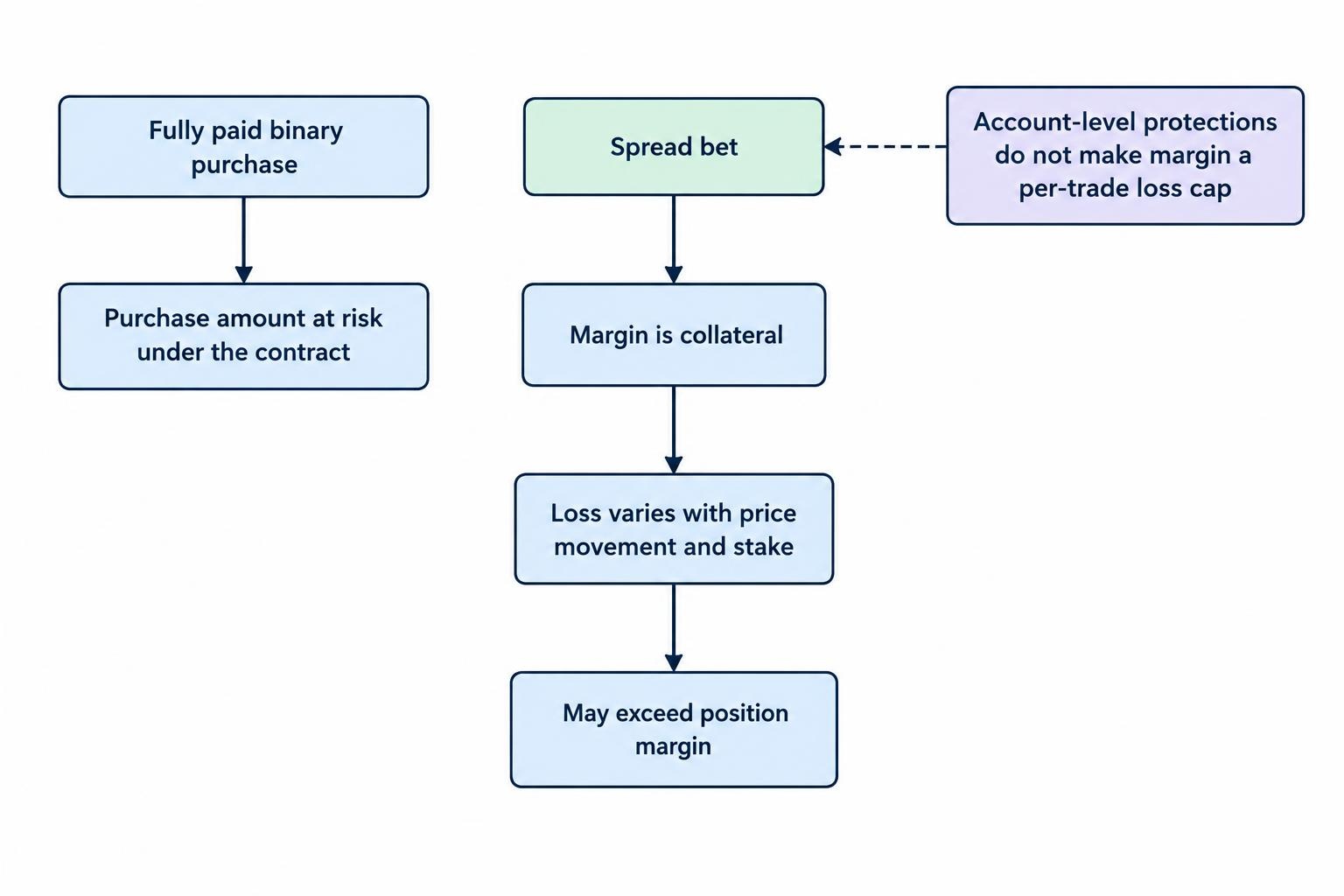
Start spread betting risk calculations with the distance to the intended exit and the monetary stake. If you plan to exit a £5-per-point position after a 20-point adverse move, the planned price loss is £100. That is a plan, not a guaranteed execution result. Position sizing for spread betting connects those figures to the capital you can afford to put at risk.
Stops provide control, but ordinary stops can slip
A conventional stop-loss order does not promise execution at its trigger price. If the market gaps through the level, the trade may close at a worse price.
In the earlier long example, an intended stop at 7,982 would represent a £100 price loss from an 8,002 entry. Execution at 7,967 instead would make the loss £175. The stake has not changed; the exit price has.
An available guaranteed stop-loss order can address execution beyond the agreed stop level under the provider’s terms, usually with a premium or other conditions. It does not make the trade profitable or remove its agreed loss.
Binary contracts replace this variable settlement exposure with a contractual payment structure, but they do not remove risk. Repeatedly losing the full purchase price can deplete an account just as effectively as poorly controlled spread bets.
UK Retail Protections Change the Comparison
UK retail spread betting falls within the FCA’s restrictions on contracts for difference and similar speculative investments. Minimum opening margin depends on the underlying asset. Major currency pairs require at least 3.33% of exposure; major stock indices require at least 5%. Firms can require more.
The rules also require account-level margin close-out. When net equity falls below 50% of the margin requirement for open positions, firms must close positions as soon as market conditions allow. Negative balance protection restricts a retail client’s liability for these investments to the funds dedicated to trading them in the account. These requirements appear in the FCA’s retail derivative margin and account protection rules.
Neither safeguard makes the opening margin a maximum loss for each trade. An individual position can consume other trading funds before it closes, and account protection does not prevent the loss of the money committed to trading. Check the scope of retail client protections before comparing account types.
Provider Risk Is Separate from Trading Risk
A contract can appear to have clear payment terms while the business offering it creates another problem entirely: whether prices, account balances and withdrawals can be trusted.
Complaints about fraudulent binary platforms include refusal to credit accounts or return funds, misuse of personal information and software manipulation affecting prices or outcomes. The SEC’s Investor.gov warning on binary options fraud details these risks. A displayed profit is of little use if the operator will not release the money.
For a UK retail customer, an offer of binary options should therefore trigger caution, not a search for a workaround. An overseas address or a claim of foreign regulation does not establish permission to provide a service to you.
Before funding a spread betting account, verify the contracting legal entity, its permissions and its contact details. Follow the process for checking a broker on the FCA Register rather than relying on a logo, a registration number in an advert or a link supplied by a salesperson.
Which Product Fits the Trading Objective?
Mechanically, spread betting fits a trading view expressed through price distance: enter at one level, exit at another and accept a changing monetary result between them. It also permits ongoing decisions about reducing exposure, moving an exit or closing the position, subject to dealing and execution conditions.
A binary contract expresses a different view: a stated condition will or will not be satisfied under the settlement rules. Its fixed payment can simplify the outcome calculation, but it adds dependence on the threshold, observation time and price paid. Simple settlement does not mean favourable odds.
For UK retail readers, binary options are not an ordinary alternative to an authorised spread betting account. Nor does that make spread betting suitable by default. If variable losses, margin requirements or the possibility of losing your trading funds are unacceptable, the appropriate decision may be neither product.
Anyone still assessing spread betting mechanics can use spread betting demo accounts to practise order entry and profit calculations without committing trading capital. A demo helps explain the controls; it does not prove that a method will be profitable or reproduce every condition of live execution.