Pepperstone is the stronger starting point for UK spread bettors who want cTrader, confirmed MT5 spread betting support or access to individual shares. OANDA deserves closer attention if you prefer its own web and mobile platform, trade mainly forex and major indices, or want guaranteed stop loss orders on eligible markets.
Neither is automatically cheaper for every strategy. Pepperstone’s Razor CFD pricing is not its spread betting pricing, and OANDA’s international account features should not be assumed to apply to a UK spread betting account. Those distinctions matter more than a broker’s position in a global ranking.
This comparison focuses on UK retail spread betting, using published information available in October 2026. It separates account features from matters that require a live quote or an account-level check. For comparisons with other providers, see the wider spread betting broker comparisons.
Pepperstone vs OANDA: The Practical Verdict
Choose Pepperstone when platform choice and share market access drive the decision. Its spread betting account supports MT4, MT5, cTrader, TradingView and Pepperstone’s own platform. That gives traders several ways to place orders without changing the underlying product from a spread bet to a CFD.
Consider OANDA when its own trading interface and guaranteed stops are more useful than a longer platform list. Its UK spread betting offering centres on OANDA Trade, MT4 and TradingView. Guaranteed stops provide a meaningful distinction from Pepperstone, which does not offer them.
| Comparison point | Pepperstone | OANDA |
|---|---|---|
| UK account entity | Pepperstone Limited | OANDA Europe Limited |
| Spread betting account structure | Separate from Standard and Razor CFD accounts | Spread betting sub-account within the UK account offering |
| Established spread betting platform options | Pepperstone platform, MT4, MT5, cTrader and TradingView | OANDA Trade web and mobile, MT4 and TradingView |
| Published EUR/USD minimum spread | From 0.5 points | From 0.6 pips |
| Minimum opening funding | £10 | No minimum deposit |
| Guaranteed stop loss orders | Not offered | Available on eligible instruments, subject to account and platform conditions |
| Individual share spread betting | Available | Do not assume the wider share CFD catalogue is available as spread bets |
| Most persuasive reason to shortlist | Platform flexibility and broader spread betting market access | OANDA Trade and access to guaranteed stops |
The spread figures are advertised minimums, not typical trading costs or results from a matched live-account test. For conventional EUR/USD contracts, the quoted point and pip normally represent the same exchange-rate movement, but confirm the contract’s point value before comparing the cash cost.
Neither account gives you ownership of the underlying shares, currencies or commodities. If you are still choosing between the products themselves, the spread betting versus CFD comparison covers the differences without mixing their fee schedules.
Start With the Correct UK Account
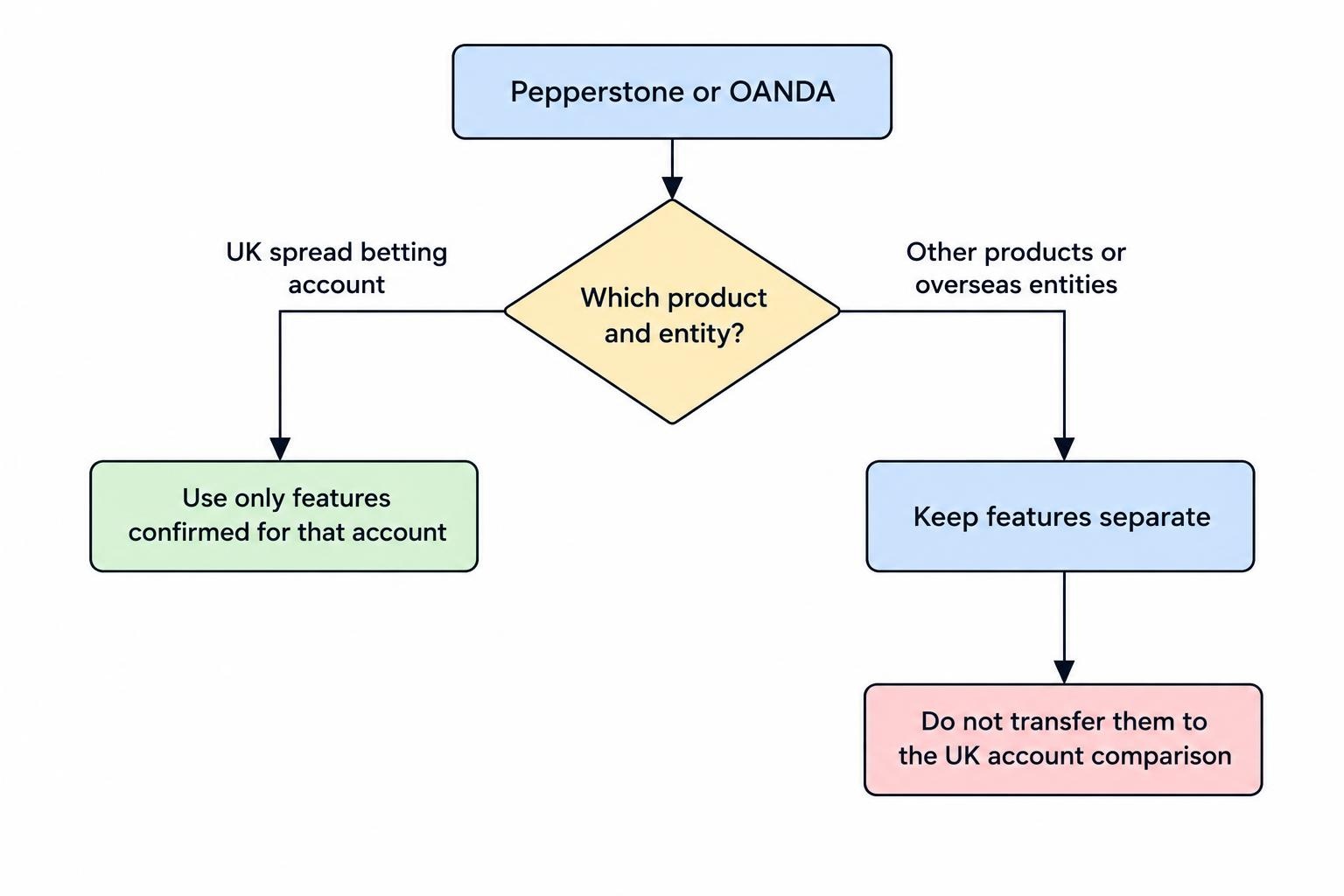
A broker’s brand does not tell you which company holds your account, which product you are trading or which protections apply. Pepperstone and OANDA operate through different companies across several jurisdictions. This article concerns Pepperstone Limited and OANDA Europe Limited, not their overseas affiliates.
The relevant UK firm reference numbers are 684312 for Pepperstone Limited and 542574 for OANDA Europe Limited. These identifiers appear in the FCA’s published firm-reference records. That historical document establishes the identifiers; it is not a substitute for checking a firm’s current permissions and contact details before opening an account.
At Pepperstone, select spread betting rather than Standard or Razor CFD trading. At OANDA, check that the sub-account you fund and connect to your platform is the spread betting version. A familiar chart and a sterling balance do not, by themselves, establish the product’s legal form.
This also prevents a common comparison error: applying one account’s benefits to another. A raw CFD spread, an overseas leverage allowance or a share dealing feature may be genuine and still have nothing to do with the UK spread betting account you intend to use.
Trading Costs: Compare Spread Bets With Spread Bets
Pepperstone Razor Is Not the Relevant Benchmark
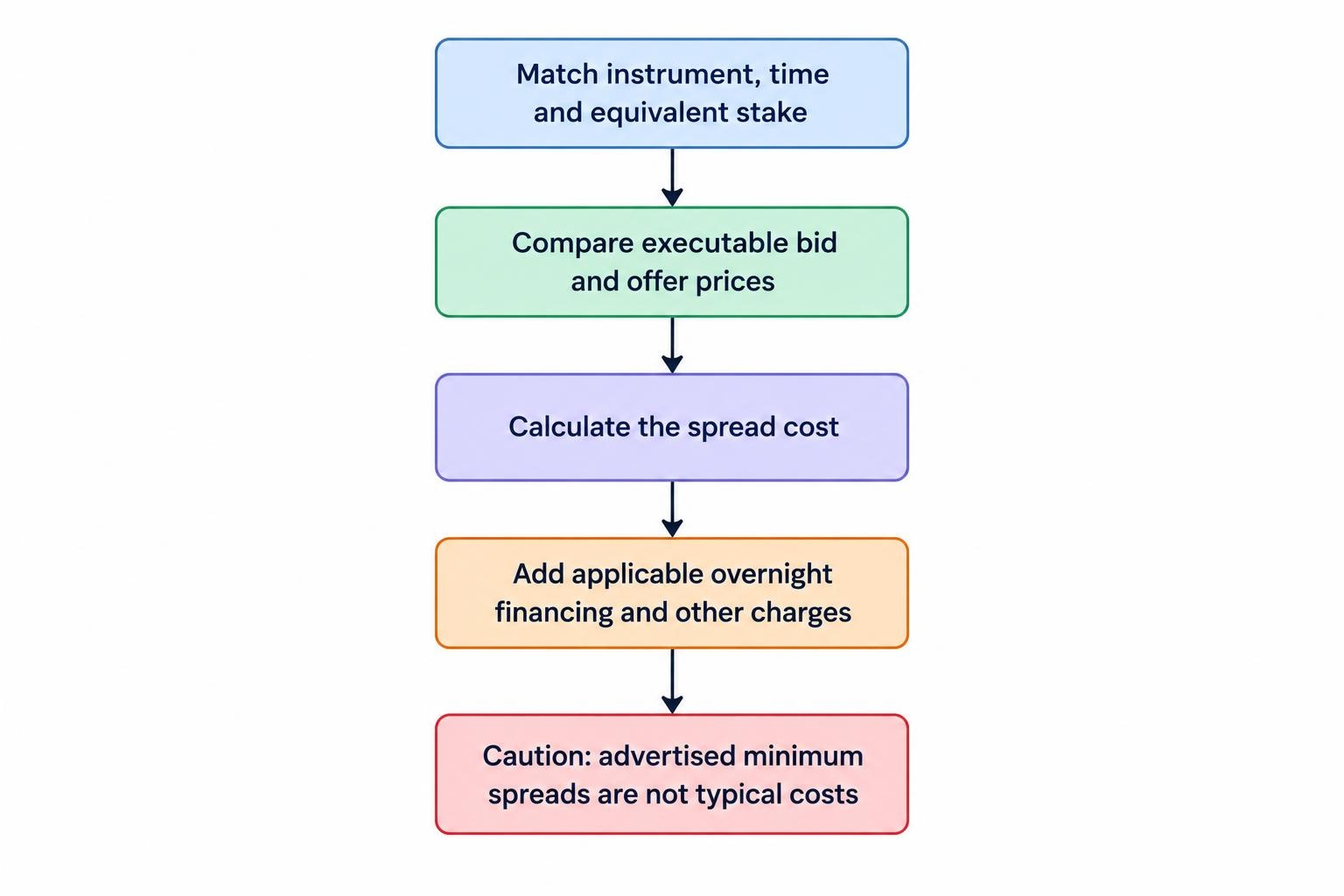
Pepperstone’s Razor account separates the spread from commission on certain CFD markets. Its spread betting account uses a different schedule, with trading charges incorporated into the spread rather than a separate dealing commission. Applicable overnight financing remains a further cost.
That means a comparison between “Pepperstone from zero” and OANDA’s spread-only pricing can be misleading. It may compare a CFD spread before commission with a spread betting quote that already includes the provider’s dealing charge. Attractive numbers, wrong comparison.
For spread betting, compare the executable bid and offer on the same instrument, at the same time, for an equivalent stake. Then add financing and any other applicable charges. The total spread betting cost comparison guide provides a fuller framework for that exercise.
What the Published EUR/USD Minimums Tell You
Pepperstone’s advertised EUR/USD spread betting minimum of 0.5 points is narrower than OANDA’s advertised 0.6-pip minimum. That gives Pepperstone a headline advantage on this measure. It does not establish that Pepperstone will quote the tighter spread throughout your trading session.
A minimum is the best advertised starting point. It says little about how often that price appears, how long it lasts or what happens during a busy announcement. An average taken across a stated period answers a different question, so it should not be placed beside a minimum and treated as equivalent evidence.
For a trader who only deals during the main London session, observations from that session are more useful than a broad claim about either broker being cheapest. For someone who trades near the daily rollover, the relevant comparison may look different again.
A Worked Spread-Cost Example
Suppose two spread betting accounts quote the same forex market at spreads of 0.7 and 1.0 points when you want to trade. These are hypothetical quotes, not measured Pepperstone or OANDA prices.
At £5 per point, the difference in spread cost is:
0.3 points × £5 per point = £1.50 per completed trade.
If you complete 40 equivalent trades, that becomes £60, before financing or execution differences. The arithmetic makes small pricing differences worth examining, especially for frequent traders. It also shows why a broker comparison should use your expected stake and trading frequency rather than a standard lot example borrowed from a CFD account.
Do not automatically double the quoted spread to calculate a round trip. With an unchanged market and spread, buying at the offer and immediately selling at the bid loses one spread. Actual entry and exit conditions may differ, of course.
Overnight Funding Can Change the Result
For an intraday trader, the spread may account for most of the direct trading cost. For someone holding a position for several days, funding can become the larger expense. A slightly better entry quote does not compensate for every difference in carrying cost.
Compare the same direction and holding period on both accounts. Check the applicable funding rate, the position value used in the calculation, the charging time and the treatment of weekends or holidays. A short position should not be assumed to earn a credit.
Product selection matters too. A daily funded position and a forward contract can package carrying costs differently. The guide to overnight financing costs covers the mechanics; the broker decision should use the actual contract you plan to hold.
Trading Platforms: Pepperstone Has the Broader Choice
TradingView
Both brokers offer TradingView connectivity, so access to TradingView alone does not settle the comparison. Pepperstone’s connection is established in the platform provider’s Pepperstone integration announcement, and its UK offering now includes spread betting through that connection.
The more useful questions concern the connected account and order ticket. Can you select the correct spread betting symbols? Is your stake displayed clearly? Can you add and amend the order protection you need? Does the position appear correctly when you switch to the broker’s own interface?
A broker connection also does not mean every feature available in its native platform will appear in TradingView. Check the functions you use rather than assuming the two screens are interchangeable. Our TradingView spread betting broker guide puts that issue in a wider broker context.
MT4, MT5 and cTrader
Pepperstone has the clearer advantage if cTrader is a firm requirement. Its spread betting account supports the platform, while cTrader is not part of OANDA’s offering. Existing cTrader users may therefore be able to retain their preferred trading workflow at Pepperstone.
Pepperstone also explicitly supports spread betting on MT5. OANDA offers MT5 within its broader business, but that should not be treated as confirmation that an OANDA UK spread betting sub-account can use it. Its established UK spread betting options are OANDA Trade, MT4 and TradingView.
If an MT5 Expert Advisor is central to your strategy, obtain confirmation of the exact account and symbol setup before depositing. The MT5 spread betting broker comparison is more relevant than a general list of brokers that offer MT5 for any product.
Even where an automated strategy can run, inspect its sizing assumptions. A program built around forex lots may not interpret a spread betting contract as intended. Symbol names, point values, minimum volumes and volume increments all need checking. A successful backtest is no protection against sending the wrong stake.
OANDA Trade and the Native Platform Route
OANDA Trade gives OANDA a credible alternative to choosing a third-party terminal. For a trader who wants charts, account information and order management within one broker interface, it belongs on the demo shortlist.
Do not confuse OANDA Trade’s charting with a separately connected TradingView account. They are different routes into the trading account. TradingView’s OANDA connection and order-entry instructions cover the external connection, including market, limit and stop orders.
Pepperstone also offers its own web and mobile platform. This is therefore not a choice between an OANDA native platform and no native alternative. The decision is whether either interface makes your routine tasks clearer: checking exposure, amending a stop, reducing a position and reviewing available margin.
Market Access: Pepperstone Is the Clearer Share Trading Candidate
Pepperstone offers spread betting across forex, indices, commodities and individual shares. Its share coverage makes it the more natural starting point if your watchlist includes company earnings, sector rotation or individual stock positions alongside major currency pairs.
OANDA’s established spread betting range focuses on forex, indices, commodities, metals and bonds. Its wider business also offers share CFDs, but a headline instrument total for the broker does not establish how many markets are available in a spread betting sub-account.
The practical comparison should begin with a watchlist, not a market count. Check the exact contracts you intend to trade, their minimum stakes and their dealing hours. Ten suitable contracts are more useful than a long catalogue containing markets you will never touch.
For individual shares, also check how the quoted spread changes around the underlying exchange’s opening and closing auctions, and whether the contract remains available outside normal hours. The share spread betting guide covers the market mechanics without assuming every broker offers the same access.
For a trader who only needs EUR/USD, GBP/USD, gold and a major index, Pepperstone’s broader catalogue may add little value. Availability becomes a deciding factor only when it changes what you can actually trade.
Guaranteed Stops: OANDA’s Most Important Distinction
OANDA offers guaranteed stop loss orders on eligible markets and supported account routes. Pepperstone does not. This is a more substantial difference than a small gap between advertised minimum spreads, particularly for traders who hold exposure through market closures or major announcements.
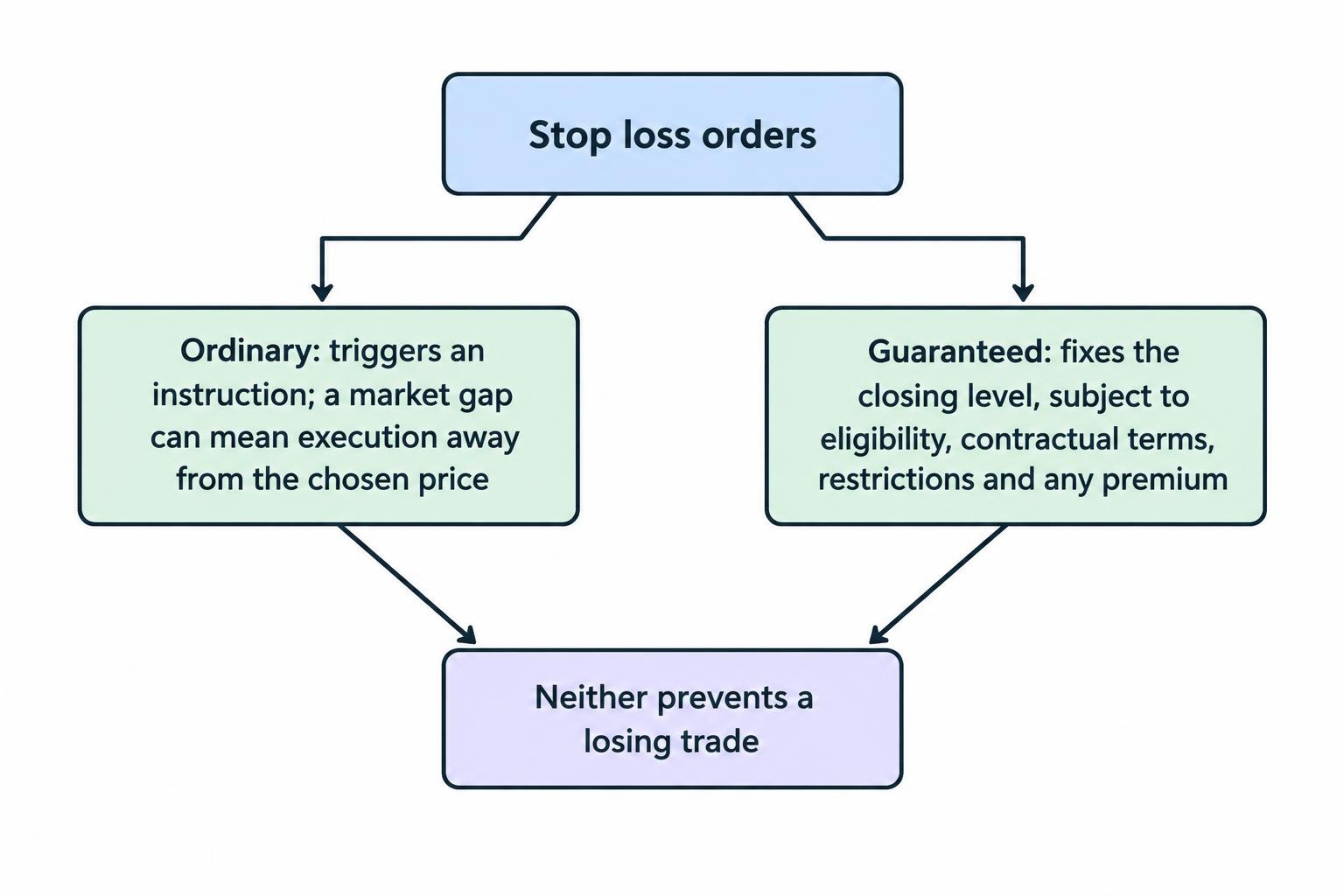
An ordinary stop triggers an instruction to close a position. It does not promise execution at the selected price. If the market gaps beyond that level, the eventual loss can exceed the amount calculated when the stop was placed.
A guaranteed stop fixes the closing level under the provider’s contractual terms, subject to its premium and trading restrictions. It still leaves you bearing the loss between entry and the guaranteed stop, plus applicable costs. It is protection against a worse exit, not protection against a losing trade.
Before choosing OANDA for this feature, confirm that the guarantee is available on your intended instrument and platform. Check the minimum stop distance, premium, size restrictions and rules for changing the order. The guide to managing risk with guaranteed stops explains how to assess that protection.
Pepperstone remains a possible choice for traders who use ordinary stops and accept gap risk. But an ordinary stop should never be presented as equivalent protection simply because both orders contain the word “stop”.
Retail Protections and Broker Failure
UK retail accounts sit within a regulatory framework that restricts leverage and provides account-level protections. The FCA’s retail CFD product restrictions require leverage limits, margin close-out protection, negative balance protection and standardised risk warnings. The framework covers financial spread bets as well as other products within its scope.
These protections should not be confused with a guaranteed stop. Negative balance protection concerns liability beyond the funds in the trading account. It does not cap each position’s loss at the amount you intended to risk, and it does not prevent the account balance from being lost.
Margin close-out is also a backstop rather than a trading plan. Positions can be closed because account equity no longer supports the required margin. Waiting for that process gives the broker’s close-out mechanism control of the exit.
If an authorised investment firm fails and eligible client money or assets are missing, compensation may be available. The FSCS investment protection rules provide cover of up to £85,000 per eligible person, per firm, subject to the qualifying conditions. They do not reimburse ordinary trading losses or poor investment performance.
Before opening either account, match the legal entity, permissions and contact details using the process in checking a broker on the FCA Register. Do not rely on a firm reference number supplied in an unsolicited message.
Minimum Deposits, Small Stakes and Account Fees
Pepperstone currently publishes a £10 minimum funding amount for its UK spread betting account. OANDA has no minimum deposit requirement. That makes both accessible at the account-opening stage, but neither figure establishes a sensible amount of trading capital.
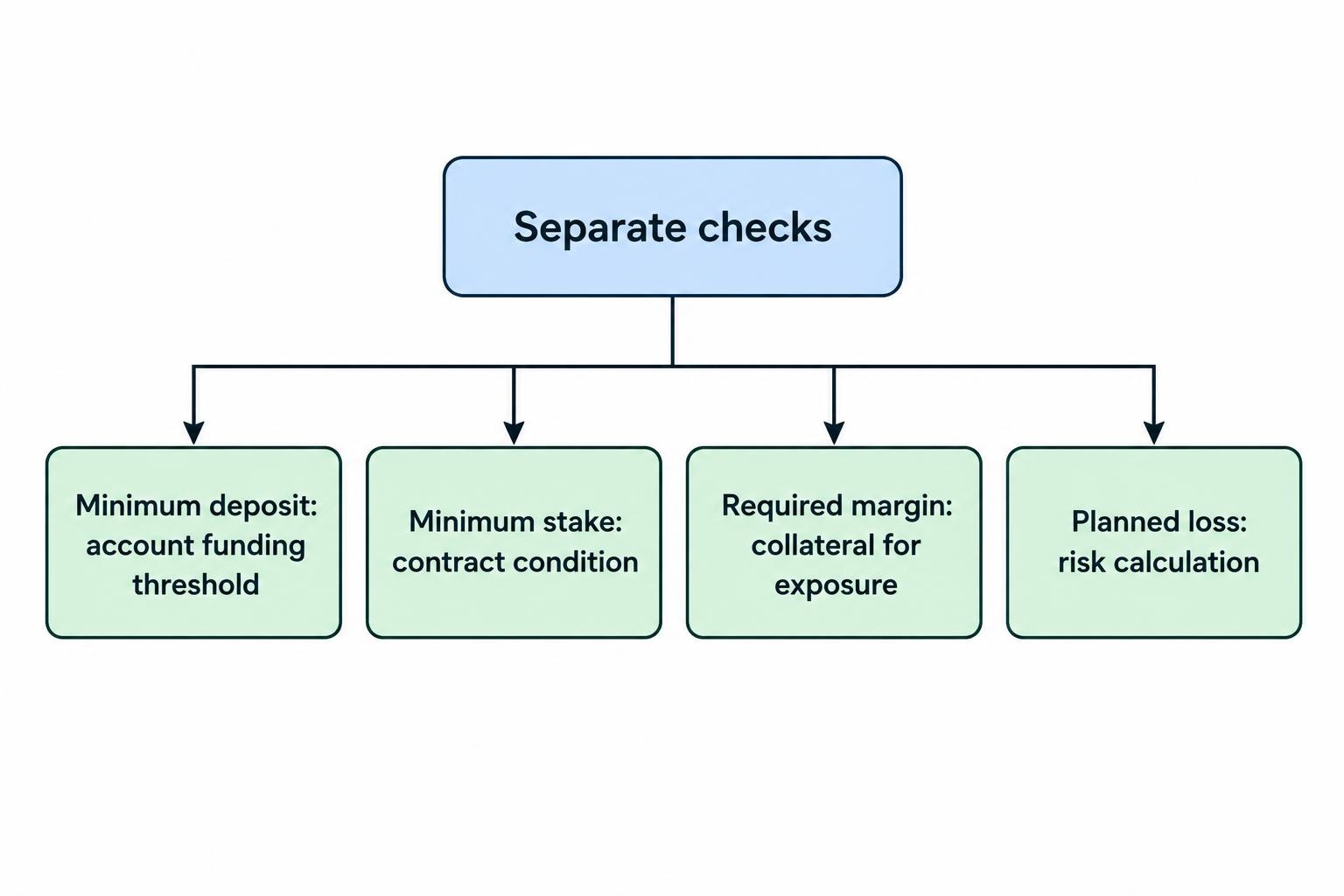
The minimum deposit is an administrative threshold. The minimum stake is a contract condition. Required margin is the collateral needed to open and maintain exposure. Planned loss is a separate calculation again. Treating these as the same number is how a small account becomes an oversized position.
Consider a hypothetical £1,000 account with a planned risk of £10 and a stop 50 points from entry. The stake would be £0.20 per point before allowing for costs and possible slippage. If the selected contract’s minimum stake exceeds that amount, the trade does not fit the plan.
Check that calculation on both brokers’ order tickets rather than relying on a general claim that one supports smaller trades. Contract values and permitted increments vary. Our spread betting position sizing guide sets out the process.
Non-trading fees deserve a separate check. Pepperstone does not charge an inactivity fee, while OANDA’s UK schedule provides for an inactivity charge after a prolonged period without trading, subject to its conditions. This can matter more to an occasional trader than a small spread difference.
Also review the funding method, withdrawal route and any bank or payment-provider charges. A broker charging no withdrawal fee does not guarantee that every intermediary involved in the payment will do the same. There is no matched withdrawal test here to justify calling either broker faster.
Which Broker Fits Your Trading Style?
Frequent Intraday Trading
Pepperstone belongs on the shortlist if you value cTrader, MT5 or the freedom to choose between several terminals. Its advertised spread betting prices also justify a closer cost comparison. Those are reasons to investigate, not proof that it will deliver the lowest realised cost on every trade.
Measure spreads at your usual entry times, then compare fills against the prices available when you submitted each order. A narrower screen quote can be offset by less favourable execution. No matched live execution study is used in this article, so neither broker is labelled faster.
Holding Positions for Several Days
OANDA’s guaranteed stops may be more useful for a trader who wants a contractual exit level across a market gap. Pepperstone’s broader market access may matter more to someone trading individual shares. In either case, calculate financing over the expected holding period before choosing.
The right answer may differ by contract. A forex position held for three nights and a share position held through earnings have different cost and risk considerations, even when both are expressed as a sterling stake per point.
Existing Platform Users
If you already use cTrader or have an MT5 strategy that requires spread betting support, Pepperstone is the more direct candidate. If you know OANDA Trade well and it handles your intended markets and protective orders, moving purely for a larger platform list may achieve little.
Switching costs include more than money. Rebuilding templates, checking automation and learning different order controls all take time. Keep a working setup unless another account offers a measurable improvement that matters to your trading.
Use the Demo to Test Decisions, Not Just Charts
Both brokers offer demo access. Use the closest available version of the account and platform you intend to fund, with a virtual balance resembling your planned deposit. A large default demo balance makes margin errors easier to overlook.
A useful comparison should answer four questions:
- Can you place the intended trade at a stake that fits your risk budget?
- Can you add, amend and identify the correct type of stop?
- Can you reduce or close the position quickly on desktop and mobile?
- Can you explain the displayed margin, point value and estimated costs before submitting the order?
Test a partial close and a stop amendment, not just a market entry. Check what happens when the order size falls below the minimum. If guaranteed protection is the reason for choosing OANDA, verify the guarantee itself rather than assuming an ordinary stop offers the same terms.
Demo use can reveal awkward controls and sizing misunderstandings, but it does not establish live execution quality, withdrawal performance or how you will behave with real money. The spread betting demo account guide covers those boundaries.
Tax Is Not a Pepperstone vs OANDA Advantage
Tax treatment follows the contract and the trader’s circumstances, not the broker’s branding. There is no sound basis for choosing one provider because its marketing describes spread betting as tax efficient while the other uses different wording.
Commercial hedging, company accounts and unusual arrangements require care. Whether a particular spread bet is taxable depends on the contract’s terms and the economic substance of the activity, as set out in HMRC’s spread betting tax guidance. Do not assume that treatment applying to an individual’s personal bets automatically applies to a business arrangement.
The guide to whether spread betting is tax-free covers the wider position. For this broker comparison, the immediate task is simpler: verify that the selected account actually places spread bets rather than CFDs.
Which Should You Choose?
Pepperstone is the stronger candidate for platform flexibility, cTrader, confirmed MT5 spread betting support and individual share access. Its headline spread betting prices are worth comparing, but do not substitute Razor CFD figures for the relevant account charges.
OANDA is the stronger candidate when OANDA Trade and guaranteed stop availability match your priorities. Its lack of a minimum deposit is convenient, though stake size, margin and planned loss should determine whether an account is adequately funded.
Build a short watchlist, compare executable prices during your normal trading hours and test the exact order protection you intend to use. Choose the account that fits those requirements. A feature you never use is not an advantage, however good it looks in a comparison table.