CMC Markets is the stronger starting point if you want a broad market catalogue, its proprietary trading platform or a confirmed MT4 spread betting account. City Index, now StoneX Trading, deserves consideration if you prefer Web Trader, built-in Performance Analytics or want to investigate its recently announced TradingView spread betting access. Neither broker wins on every cost, market or trading method.
There is an important name change behind this comparison. StoneX announced the City Index relaunch on 9 September 2026, and the City Index UK brand retired on 12 September 2026. The business now operates as StoneX Trading. Existing clients retained their platforms, accounts and support services through the transition. This article uses “City Index” where it helps identify the service readers know, but compares it with CMC Markets under its current StoneX Trading branding.
The comparison focuses on UK retail spread betting, using published product information available on 21 October 2026. It is not a live execution test. Minimum spreads, platform connections and account conditions need checking against the exact account you intend to open, particularly where older City Index material remains searchable.
For other pairings, the spread betting broker comparisons section covers alternatives without treating one broker as the right answer for every trader. Both providers offer leveraged products that can produce rapid losses.
CMC Markets vs City Index: Main Differences
| Comparison | CMC Markets | City Index / StoneX Trading |
|---|---|---|
| Main proprietary platform | CMC web platform, commonly known as Next Generation, plus its mobile app. | Web Trader and the StoneX Trading mobile app. |
| Published market range | Advertises 21,000 instruments across its offering. Availability depends on the account and platform. | Its platform comparison advertises 13,500 markets through Web Trader. Check the spread betting selection separately. |
| MT4 spread betting | Explicitly offered through a separate account, covering forex, indices and commodities rather than the full proprietary-platform catalogue. | MT4 is offered separately, but its account description should not be treated as confirmation of spread betting access. |
| Direct TradingView spread betting | UK connection information describes CFD account access rather than confirming spread betting. | A TradingView announcement dated 1 October 2026 includes spread bets, but older help material and the broker’s account table are inconsistent. Confirm eligibility. |
| Separate spread betting commission | No separate commission; spreads and other applicable charges remain. | No separate commission on spread betting markets; other charges remain. |
| Guaranteed stop charging | Premium charged when added and refunded if the guaranteed stop is not triggered, subject to its terms. | No upfront premium; a charge applies if the guaranteed stop is triggered, subject to its terms. |
| Dormant GBP account charge | £10 monthly after one year without trading activity, subject to account conditions and available funds. | £12 monthly after 12 months without trading activity, subject to account conditions and available funds. |
| Most useful initial comparison | Market availability, order controls and the proprietary platform versus MT4. | Web Trader workflow, Performance Analytics and the exact TradingView account connection. |
The practical difference is not simply “more markets versus fewer markets”. It is whether the broker offers your chosen contract, at a workable stake, on the platform you actually want to use. A large catalogue provides little benefit if your trading plan involves two indices and one currency pair.
Which Broker Is Cheaper?
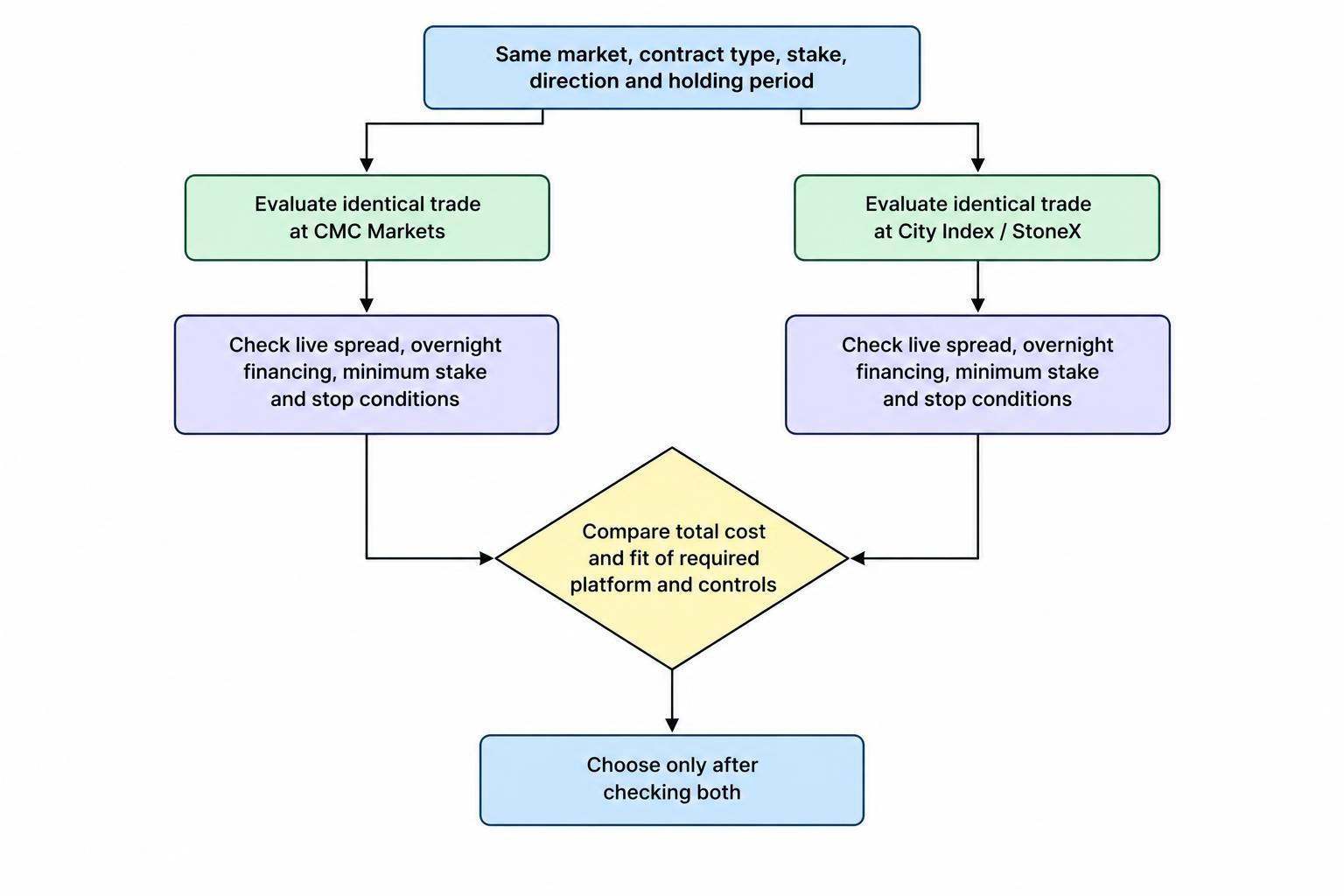
There is no defensible blanket answer. CMC Markets can have a pricing advantage on a particular instrument or promotion, while City Index may suit another contract or holding period. The useful comparison is the cost of your intended trade, not the smallest number displayed anywhere on either broker’s marketing pages.
For an intraday position, the spread and execution price usually deserve most attention. For a position held across several financing cut-offs, funding can outweigh a modest difference in the opening spread. Guaranteed stops, share pricing and account inactivity can change the result again.
A proper comparison of total spread betting costs starts with the same market, contract type, stake, direction and holding period at both brokers. Comparing a cash index spread bet at one with an expiring contract at the other produces a tidy table, but not a useful answer.
UK 100 Pricing Shows Why Dates Matter
At the time of research, CMC Markets advertised a temporary reduction in its UK 100 Cash minimum spread from 1 point to 0.5 points, ending on 13 November 2026. StoneX Trading’s trading-cost support page described a fixed UK 100 spread of 1 point between 08:00 and 16:30 UK time, with wider fixed amounts outside those hours.
That gives CMC a lower advertised starting spread for this comparison during the promotion, provided the quoted conditions apply to your trade. It does not establish a permanent advantage, an average realised spread or better execution. After the promotion ends, the comparison needs revisiting.
At £2 per point, a 0.5-point spread represents £1 of spread friction, while a 1-point spread represents £2. This assumes an unchanged underlying midpoint and excludes financing, slippage and other charges. The difference matters more as stake size or trading frequency rises.
Do not count the quoted spread twice when estimating an unchanged-price round trip. Buying at the offer and selling at the bid already captures that spread. If the spread changes before you close, the resulting cost changes too.
Forex Pricing Needs an Account-Level Check
CMC advertises standard forex spreads from 0.5 pips, including on its MT4 spread betting offering. Its separate FX Active pricing advertises spreads from zero with commission. Those are different pricing arrangements; the zero-spread headline should not be imported into a standard spread betting comparison.
At City Index or StoneX Trading, check whether the forex price belongs to Web Trader, a separate MT4 account or another product configuration. A broker can offer several account routes without making their spreads, contract sizes and product types interchangeable.
Use the live ticket to compare your intended stake during your normal trading session. A minimum quote reached during liquid trading hours does not tell you what happens around the daily rollover, a central bank announcement or a thin overnight session.
Overnight Financing Can Reverse the Result
Both providers apply overnight funding arrangements to relevant non-expiring positions. The calculation depends on the instrument and direction. Forex funding uses a different basis from many cash equity or index positions, so a single headline annual rate cannot describe every trade.
For a planned five-night position, record the estimated daily charge at each broker and include any multiple-day adjustment. Compare the same exposure. Funding on £10,000 of market exposure is not comparable with funding on £1,000 simply because both trades use a similar cash deposit.
The overnight financing guide covers the calculation in more detail. Here, the decision is narrower: which broker charges less for your market, your direction and the time you expect to hold it?
An expiring contract may avoid a separate daily financing debit because its price already reflects carrying costs. That does not make it cost-free. Use the daily funded bets versus futures comparison if the contract choice, rather than the broker, is driving most of the difference.
Guaranteed Stops Use Different Payment Arrangements
CMC’s published arrangement charges a guaranteed stop premium when the order is added, then refunds it if the stop is not triggered under the applicable terms. City Index’s successor, StoneX Trading, publishes no upfront charge and applies the premium when the guaranteed stop triggers.
For a stop that never triggers, these arrangements can produce the same eventual premium cost of zero. The difference is when money is committed or charged. For a triggered stop, compare the actual premium, permitted distance and eligible market rather than assuming one payment structure is cheaper.
Availability can also differ between proprietary and third-party platforms. CMC’s risk documentation distinguishes its proprietary platform’s guaranteed stops from MT4. The guaranteed stop premium guide explains how to include the charge in a trade’s planned loss.
Commission-Free Does Not Mean Cost-Free
Neither provider charges a separate commission on its spread betting markets. That is not a promise of free trading. The dealing spread remains, financing may apply, and share spread bets can include pricing adjustments that do not resemble a separate commission line.
CMC’s UK spread betting costs page also excludes currency conversion charges and market data fees for that product. StoneX states that its back-to-base conversion charge does not affect spread betting accounts because those trades take place in one base currency. These statements should not be extended to either broker’s CFD accounts.
The dormancy difference is smaller but worth noting: published GBP charges are £10 monthly at CMC and £12 at StoneX after the relevant year of inactivity. Do not place an unnecessary trade just to avoid a fee. If you no longer need an account, withdrawing unused funds or closing it may be the more sensible administrative choice.
Trading Platforms: Compare the Account, Not Just the Logo
Platform choice is one of the clearest reasons to prefer one provider. It is also where older broker comparisons can be misleading. Listing “web, mobile, MT4 and TradingView” beside both names conceals differences in account type, available markets and order protection.
CMC Markets: Proprietary Platform or Separate MT4 Account
CMC’s proprietary web platform, widely referred to as Next Generation, provides access to its spread betting offering alongside a native mobile app. Its spread betting platform materials cover market search, charts, news, order placement and position monitoring.
This is the first route to assess if you want to research and manage several asset classes within one broker interface. Rather than judge the platform by the number of tools available, build your normal workspace and check whether it makes the next decision clear.
A useful trial involves opening a chart, identifying the correct cash or forward contract, setting a stake and attaching an exit order. Then amend the order and partially close the position. Those tasks reveal more about suitability than a screenshot filled with indicators.
CMC explicitly offers spread betting through a separate MT4 account. Its published scope covers forex, indices and commodities, not shares, ETFs, rates or bonds. That makes it a credible candidate for an MT4-based spread betting workflow, but not a substitute for the entire proprietary-platform catalogue.
If MT4 is a firm requirement, the MT4 spread betting broker guide provides the wider comparison. Confirm symbol conventions, stake increments and order restrictions before moving an existing strategy across.
City Index / StoneX Trading: Web Trader and Performance Analytics
StoneX Trading’s platform comparison identifies Web Trader as supporting both CFD and spread betting accounts. It also highlights Performance Analytics. That makes Web Trader the clearest starting point for comparing the former City Index service with CMC’s proprietary platform.
Trade analysis is useful when it leads to a decision: whether one market produces poorer results, whether losses cluster at certain times, or whether a habit of closing winners early is damaging the strategy. A dashboard is not an improvement by itself. It needs a question worth answering.
During a demo, check how easily you can find completed trades, distinguish costs from trading results and export the records you need. A platform that suits your review process can be more valuable than another drawing tool you will never use.
StoneX also lists MT4 separately. However, its platform table describes the account as “Standard MT4” rather than explicitly confirming an MT4 spread betting account. Do not interpret the presence of both “MT4” and “spread betting” somewhere on the same broker’s site as proof that they connect.
TradingView: A Recent Change With Conflicting Documentation
TradingView’s 1 October 2026 announcement about City Index becoming StoneX Trading states that clients can trade forex, CFDs and spread bets directly from Supercharts. That is a meaningful development for traders who want to place spread bets without leaving TradingView.
There is a documentation problem, though. TradingView’s older City Index instrument eligibility help page still says spread betting is not available, while StoneX’s platform comparison labels the TradingView connection as a CFD account.
The newer announcement points to spread betting access, but the inconsistent account descriptions justify a check before funding. Ask whether your UK retail spread betting account can connect, which instruments are supported and whether your required order types remain available through that connection.
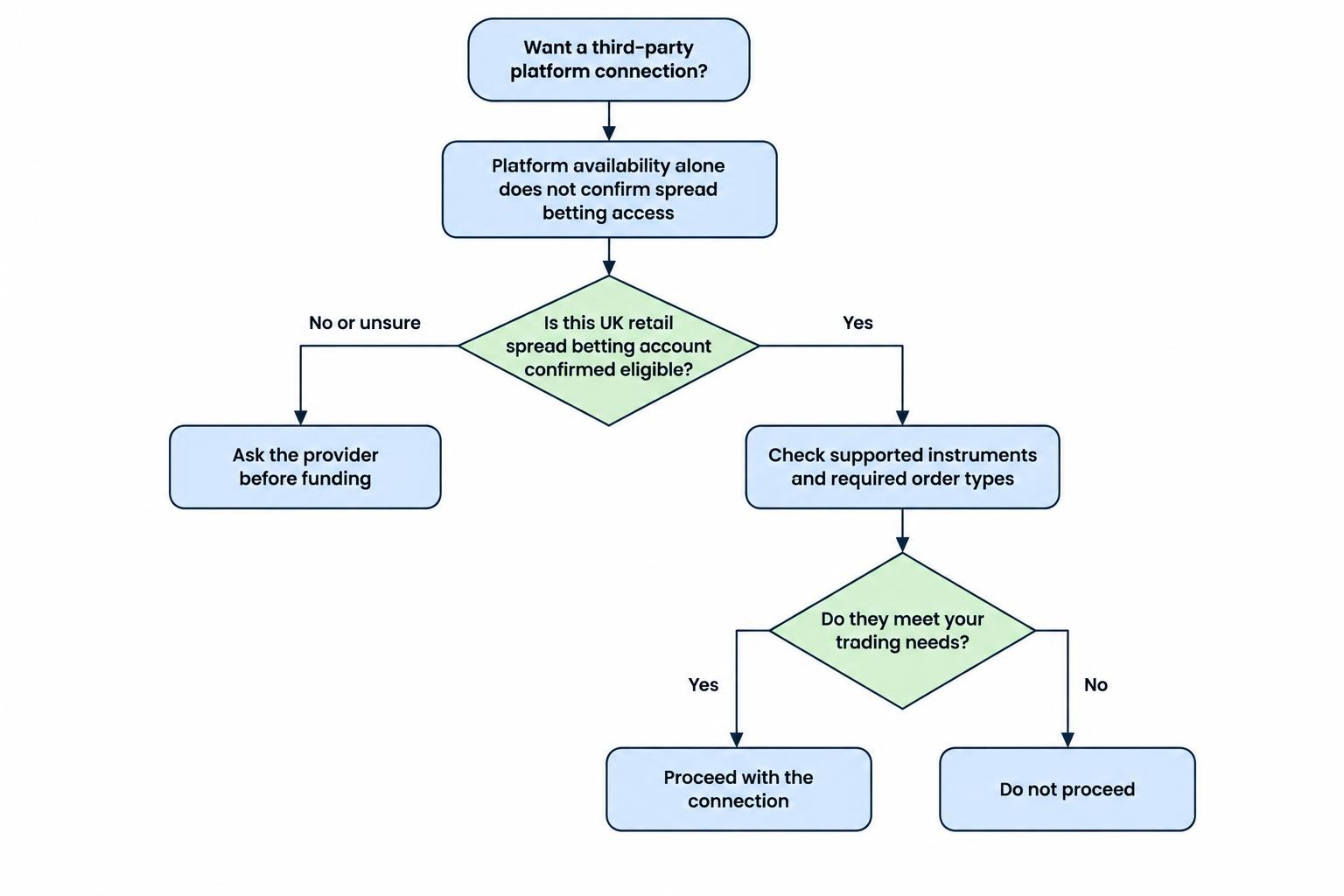
CMC’s UK platform information describes connecting a CFD account to TradingView. It does not provide the same confirmation for its spread betting account. TradingView analysis alongside a separate CMC order ticket remains a different workflow from direct spread bet execution.
For a broader shortlist, use the TradingView spread betting broker comparison. The platform name is not enough; the connected product must be the one you intend to trade.
Mobile Trading: Test Position Management First
Both providers offer mobile trading apps. The useful comparison is how comfortably you can manage risk on your own phone, not which app produces the most polished promotional image.
Check the visibility of stake size, attached orders, available funds and the final confirmation screen. Try reducing a position rather than closing it entirely. Check whether a stop amendment is clearly acknowledged and whether the account history makes the change easy to verify.
The mobile spread betting app guide covers a wider selection. For this pairing, choose the app that keeps the order ticket readable and makes costly input mistakes harder, not one that simply fits more buttons on the screen.
Market Range: CMC Has the Larger Advertised Catalogue
CMC advertises 21,000 instruments across its offering, while StoneX Trading’s platform comparison advertises 13,500 markets through Web Trader. These are broker-published catalogue figures, not an independently matched count of identical spread betting contracts.
The distinction matters. One underlying asset can appear through several contracts, currencies or expiries. A market may also exist on a proprietary platform but not on MT4 or the account connected to TradingView. Counting every available symbol does not establish how many useful choices you receive.
CMC’s broader advertised range gives it an initial advantage if you trade beyond the most common currency pairs and equity indices. The advantage disappears if the exact contract you need is absent, its minimum stake is too large or its trading hours do not suit your plan.
For either broker, search for your intended instruments before depositing. Check the cash and expiring versions separately, along with the point definition, opening hours, stop restrictions and maximum trade size. For shares, check whether both long and short positions are currently available.
The broker market coverage research addresses catalogue comparisons more broadly. For this decision, a written list of your ten most relevant contracts is more useful than arguing over several thousand instruments you will not trade.
Small Accounts: Minimum Stakes Matter More Than Minimum Deposits
CMC states that spread betting stakes can be as low as 1p per point, depending on the instrument. That is a product-dependent minimum, not a promise that every index, currency pair or share can be traded at that size.
For City Index or StoneX Trading, inspect the minimum stake on the relevant market information sheet or order ticket. A universal minimum should not be assumed from an example involving a different market.
Consider a hypothetical £1,000 account with a £10 planned trade-loss budget. With a stop 25 points from entry, the stake would need to be no more than £0.40 per point before allowing for charges and possible slippage. A £1 minimum stake would make that setup too large for the stated budget.
That does not mean moving the stop closer until the ticket accepts the trade. It means using a smaller permitted stake, changing the setup or not trading it. The position sizing guide explains the calculation without confusing the cash deposit with the amount at risk.
CMC publishes no minimum deposit requirement for opening a live account, although funds are needed to trade. City Index funding help distinguishes payment methods: card funding has a 100-unit base-currency transaction minimum, while bank wire has no minimum. Confirm the current requirement for your chosen StoneX account rather than treating a card payment floor as a universal account minimum.
Neither arrangement answers how much capital you need for a workable strategy. The relevant comparison includes minimum stakes, margin, expected losses and a cash buffer. The small-stake spread betting broker guide focuses on those constraints.
Risk Controls and Retail Protections
For UK retail accounts, the regulatory baseline matters more than a broker’s branding. The FCA’s rules for CFDs and related products, including spread bets require leverage restrictions, margin close-out protection and protection against losing more than the funds in the relevant account. Brokers can impose tighter trading requirements.
These protections do not make either account low risk. Negative balance protection addresses account debt; it does not prevent the account balance from being lost. Margin close-out can also force positions to close before a hoped-for recovery.
Keep three figures separate: the margin needed to open the trade, the planned loss at your stop and the account’s remaining capacity to withstand adverse moves. A lower margin requirement reduces the opening collateral requirement. It does not reduce the cash lost for each adverse point.
An ordinary stop can execute beyond its trigger level during a market gap. A guaranteed stop offers a different contractual protection, where available and subject to its conditions. Compare the premium and restrictions at CMC and StoneX for the actual market you intend to trade.
The retail client protections guide explains the regulatory baseline. Do not switch to professional classification simply to obtain greater exposure without assessing the protections that change.
Regulation, Legal Entities and Compensation
The UK disclosures reviewed identify CMC Markets UK plc with FCA reference number 173730, and StoneX Financial Ltd with reference number 446717 for the City Index / StoneX Trading service. Match the company named in your proposed agreement with the regulator’s records rather than relying on the trading name alone.
Use the FCA Financial Services Register and its firm-checking guidance to confirm the current status, permissions and contact details. A familiar name is not sufficient protection against a cloned website or an approach from someone impersonating an authorised business.
The guide to checking a broker on the FCA Register covers the process. This matters particularly during a rebrand, when legitimate changes to names and communications can make fraudulent messages harder to spot.
Eligible claims against a failed investment firm may receive FSCS compensation of up to £85,000 per eligible person, per firm, subject to the scheme’s conditions. The FSCS investment protection rules do not reimburse ordinary losses because a trade or investment performed badly.
Do not treat compensation eligibility, client money arrangements or the financial strength of a parent group as a guarantee that every pound is protected in every circumstance. They address different risks. They also do not create a reason to keep more trading cash with either provider than your plan requires.
Demo Accounts, Support and Execution
CMC’s spread betting materials describe a demo with £10,000 in virtual funds. City Index’s published demo terms describe £10,000 in virtual funds with 12 weeks of access. Confirm the terms attached to the current StoneX registration and the platform you select.
A useful demo comparison should reproduce the same tasks on both services. Find the same contract, enter the same hypothetical stake, attach exits, amend the stop and close part of the position. Then check the history and available records.
The spread betting demo account comparison covers other choices. Keep the virtual balance close to the amount you could realistically fund; a large demo balance can hide unsuitable position sizing.
Demo use can establish whether you understand the controls. It cannot prove future live fill quality, slippage or how you will react to a real loss. This comparison therefore does not award either broker an execution winner or a customer-service score.
For support, ask a precise operational question before funding. Request the minimum stake for your intended contract, clarification of the financing cut-off or confirmation of an account’s TradingView eligibility. A clear answer to your actual requirement is more useful than a generic welcome message.
Execution needs its own evidence. A proper broker execution quality assessment would distinguish markets, order types, trade sizes and trading conditions. Published speed claims should not be treated as a controlled comparison between CMC and City Index.
Does Either Broker Offer a Tax Advantage?
Choosing CMC rather than City Index does not itself create a different UK tax treatment for an equivalent financial spread bet. The contract and the taxpayer’s circumstances matter more than the provider’s name.
For capital gains tax, gains from financial spread betting are not chargeable and losses are not allowable under HMRC’s financial spread betting guidance. That should not be expanded into a promise covering every tax, business arrangement or country of residence.
The guide to whether spread betting is tax-free covers the qualifications. Check that the account is actually a spread betting account, especially when selecting a third-party platform connection that may instead use CFDs.
Which Broker Should You Choose?
Choose CMC Markets When Its Confirmed Account Features Fit
CMC is the stronger initial candidate if you want its proprietary platform, its larger advertised instrument catalogue or an explicitly offered MT4 spread betting account. It also deserves a close pricing check for UK 100 trading during the promotion ending on 13 November 2026.
The conditions are straightforward: verify the exact instrument, minimum stake and platform restrictions. CMC’s proprietary-platform range does not transfer wholesale to MT4, and its TradingView connection should not be assumed to support spread betting.
Choose City Index / StoneX Trading When Web Trader Fits Better
StoneX Trading is worth prioritising if Web Trader and Performance Analytics suit how you place and review trades. It is also the more promising lead of these two for direct TradingView spread betting following the October announcement, although the conflicting account documentation needs resolving before you rely on that route.
Its triggered-only guaranteed stop premium may suit your preference for when charges are collected. That is an administrative distinction, not proof of a lower final trading cost.
Make the Final Decision on a Repeatable Trade
Before funding either account, complete these checks:
- Find the same intended spread betting contract on both platforms.
- Compare the live spread at your normal trading time and intended stake.
- Calculate funding for your expected holding period.
- Confirm minimum stakes, stop restrictions and any guaranteed stop premium.
- Verify the legal entity and obtain confirmation of any third-party platform connection.
CMC has the clearer case for a broad proprietary-platform offering and confirmed MT4 spread betting. City Index’s successor has a credible case through Web Trader, trade-review tools and its newly announced TradingView access. Choose the account that supports your actual trades at an acceptable total cost. If neither permits sensible position sizing or the required risk controls, neither is the right choice.