EUR/GBP spread betting lets you trade changes in the euro’s value against the pound without buying either currency. You buy the pair if you expect the euro to strengthen relative to sterling, or sell it if you expect the pound to strengthen relative to the euro. Your profit or loss depends on the price movement and your stake per point.
The pair suits a view about the UK versus the euro area, rather than a direct position on the US dollar. But a familiar exchange rate does not make it a low-risk trade. Before placing a bet, check the point size, spread, funding terms and potential loss. For the wider mechanics, see our guide to forex spread betting.
How to Read a EUR/GBP Spread Betting Quote
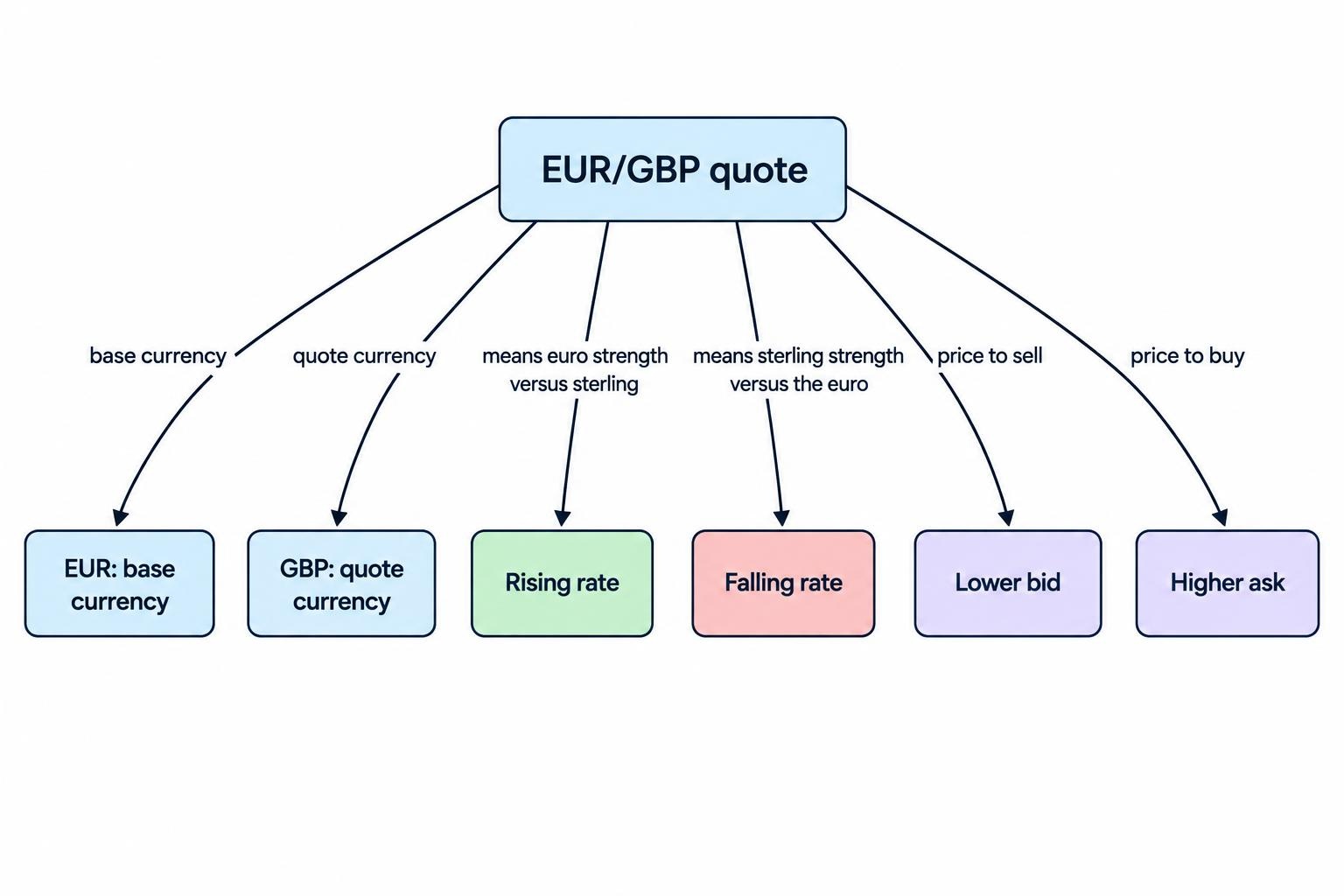
EUR is the base currency and GBP is the quote currency. A EUR/GBP rate of 0.8560 means one euro is worth £0.8560. If the rate rises to 0.8600, each euro buys more pounds: the euro has strengthened against sterling. A fall means the opposite.
This direction can trip up traders who normally think about how many euros they receive for a pound. A stronger pound means a lower EUR/GBP rate, not a higher one. The order of the currencies matters.
A spread betting ticket displays two prices. You sell at the lower bid price and buy at the higher ask price. A hypothetical quote of 0.8560–0.8562 has a spread of 0.0002, or two pips.
For the examples below, one betting point equals 0.0001, which is one conventional EUR/GBP pip. A platform using this scale could display the same quote as 8560–8562. At £2 per point, a ten-point movement changes the position’s value by £20.
Confirm the contract’s definition before entering a stake. An extra decimal place may show fractional pips; it does not mean your stake automatically applies to that last digit. Our stake per point guide covers the distinction between the displayed price and the amount you gain or lose.
EUR/GBP Spread Betting Examples
These examples use hypothetical prices, not live quotes. They assume one point equals 0.0001 and exclude funding charges and other separately charged fees. The spread is already reflected in the entry and exit prices.
Buying EUR/GBP
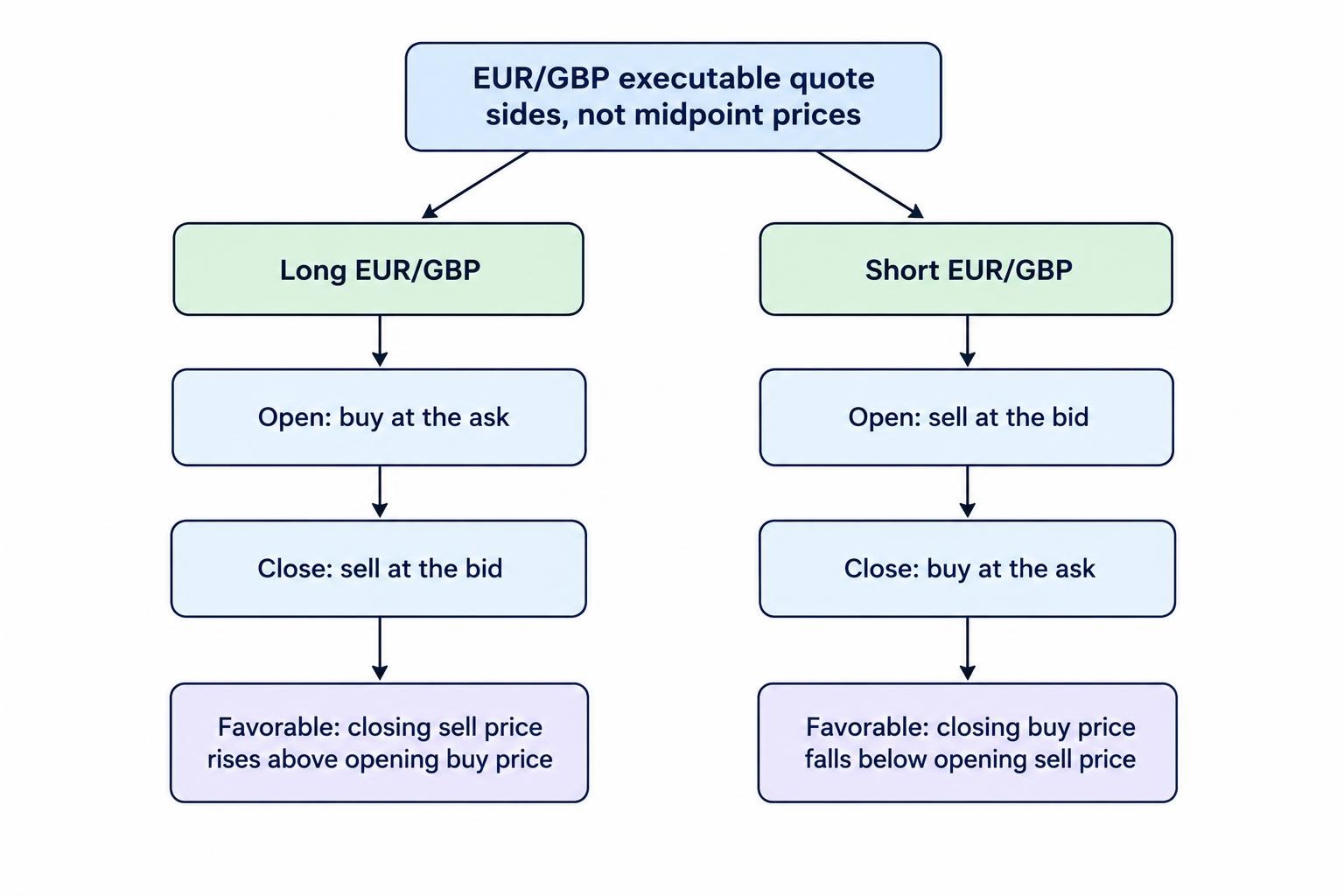
Suppose the quote is 8560–8562. You expect the euro to strengthen against the pound and buy at 8562 for £2 per point. You later close the position by selling at the available bid.
| Outcome | Opening buy price | Closing sell price | Movement | Profit or loss before separate charges |
|---|---|---|---|---|
| EUR/GBP rises | 8562 | 8592 | 30 points | £60 profit |
| EUR/GBP falls | 8562 | 8542 | −20 points | £40 loss |
The profitable calculation is straightforward: (8592 − 8562) × £2 = £60. For the losing outcome, (8542 − 8562) × £2 = −£40.
If you closed immediately while the original quote remained unchanged, you would sell at 8560 and lose £4. That is the two-point spread multiplied by your £2 stake. The position must first overcome that difference before it can show a trading profit.
Selling EUR/GBP
Now suppose you expect sterling to strengthen. With the same opening quote, you sell at 8560 for £2 per point. If the available buy price later falls to 8530, closing the position produces a £60 profit: (8560 − 8530) × £2.
If the closing buy price instead rises to 8580, the loss is £40. For a short position, subtract the closing buy price from the opening sell price. Do not calculate the result from a chart’s midpoint if that was not your executable price.
What Moves EUR/GBP?
A useful EUR/GBP trade idea compares the two currencies. “The UK economy looks weak” is only half an argument. You also need to consider whether the euro area looks stronger, weaker or equally troubled.
Interest Rate Expectations
Changes in interest rates and expectations about future policy can affect exchange rates. The ECB’s monetary policy transmission framework identifies both expectations and exchange rates as channels through which policy affects the economy.
For EUR/GBP, the practical question is whether the expected UK interest rate path is becoming more supportive of sterling relative to the euro area’s path. That is not the same as comparing the two headline rates and buying whichever currency has the higher number.
Consider a hypothetical decision in which the Bank of England leaves rates unchanged, but traders had expected a cut. Sterling could strengthen because the decision was less accommodative than expected. If both central banks deliver exactly what markets anticipated, the statements and future guidance may matter more than the rate decisions themselves.
Mark scheduled UK decisions using the Bank of England’s MPC announcement calendar. Decide beforehand whether your trade depends on the announcement, or whether it should be closed before that uncertainty arrives.
Inflation, Wages and Economic Activity
Build your UK release schedule around inflation, earnings, employment and economic output. The Office for National Statistics release calendar provides publication dates and times for official UK statistics.
Create a matching watchlist for the euro area. Otherwise, it is easy to follow every UK headline while overlooking the other half of the exchange rate.
Treat a release as a change in the evidence, not an automatic instruction to buy or sell. Higher UK inflation might support sterling if it raises expected interest rates. It could also accompany weaker growth or other concerns. The trade needs a reason why the balance between the currencies should change.
Political and Fiscal Uncertainty
Include a scenario for unscheduled policy news. Ask what an unexpected budget measure, election development or change in UK–EU trading arrangements would do to your original argument.
You do not need to predict every headline. You do need to avoid sizing a position as though the next scheduled economic release is the only event that can affect it.
When to Monitor and Trade EUR/GBP
The European working day is a practical starting point for monitoring a pair built around the UK and euro area. That does not establish one universally best trading hour. Compare the executable spread, available order types and price behaviour during the hours you can actually trade.
Check the ECB monetary policy meeting and press conference schedule separately from the UK calendar. Allow for both the decision and the following press conference rather than treating the first release as the end of the event.
Avoid turning “available to trade” into “worth trading”. A market can be open while the spread takes too large a share of your intended target. If your plan seeks eight points but the quoted spread is two points, the spread alone represents one quarter of that target.
Use the provider’s contract timetable to check daily pauses, holiday changes and weekly reopening arrangements. Our forex trading hours guide covers session planning. Check the time zone shown on each calendar and on your platform rather than assuming they match.
Spreads and Overnight Costs
The spread is an immediate hurdle, so assess it against the size of the move you intend to trade. A two-point spread matters differently to a ten-point target than to a hundred-point target. Neither target says anything about the probability of success, but the cost arithmetic is worth doing before entry.
Record the spread available when your setup occurs. A minimum advertised spread does not tell you what your trade will cost at that moment. Compare like with like: the same EUR/GBP contract, stake, time and holding period.
For a daily funded position held beyond the provider’s funding cut-off, inspect the applicable overnight debit or credit, any markup and any multi-day adjustment. Do not assume that selling EUR/GBP earns interest, or that the difference between central bank rates equals the amount applied to your account.
Our guide to overnight financing costs explains how holding charges affect a trade. For EUR/GBP, compare the estimated cash adjustment with the expected holding period and intended profit, rather than looking at the daily rate in isolation.
Where a dated forward contract is available, inspect its pricing, spread and expiry terms separately. The absence of a separate daily funding entry does not establish that holding the position is free.
Margin, Position Size and Stop Risk
EUR/GBP meets the FCA definition of a major foreign exchange pair, which includes pairs formed from currencies such as the euro and pound sterling. This regulatory category should not be confused with the market shorthand that calls non-dollar pairs “crosses”.
Margin is the deposit required to support the position, not the amount you have chosen to risk. A small deposit can support much larger exposure. A small decimal is not a small risk either.
For UK retail accounts within scope, the FCA rules on margin and retail account protections require at least 3.33% opening margin for major currency pairs, conventionally expressed as 30:1 leverage. Firms can require more. The rules also require account-level margin close-out when net equity falls below 50% of the required margin, with closure as soon as market conditions allow, and restrict liability to funds dedicated to that trading account. These protections do not cap each trade’s loss at its opening margin.
Calculate the Stake From the Planned Loss
Suppose you allow £100 for the price movement between entry and a planned stop, and that distance is 40 points. The calculation is:
£100 ÷ 40 points = £2.50 per point.
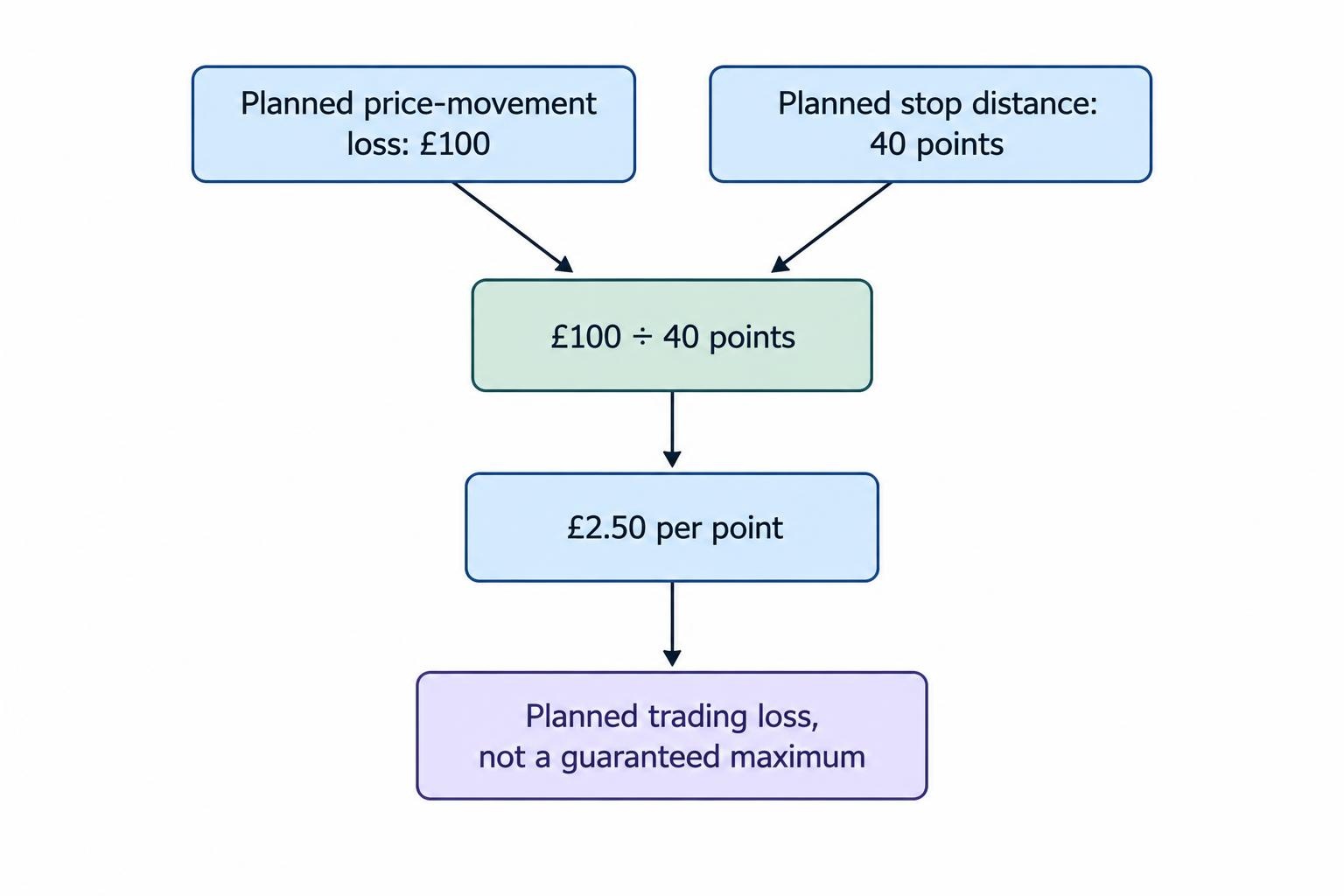
That is a planned trading loss, not a guaranteed maximum. If the £100 allowance must also cover charges, reserve those amounts before dividing. The broader method is covered in our position sizing guide.
Measure the distance using the executable entry price and the relevant exit side. A long position opens at the ask and closes at the bid; a short does the reverse. Check which price triggers your stop, especially if your chart displays only one side of the quote.
An ordinary stop can execute beyond its trigger during a fast move or gap. If available for the contract, a guaranteed stop provides a defined execution level subject to its terms and any premium. Compare the cost and restrictions using our guide to managing risk with guaranteed stops.
Choosing an Approach for EUR/GBP
Do not choose a strategy solely because EUR/GBP has a reputation for behaving a certain way. Define the price conditions your method needs, then check whether they are present. A currency pair does not sign a contract promising to remain range-bound.
A range approach needs identifiable boundaries and a clear failure point. Our guide to range trading with spread bets covers the method. Applied to EUR/GBP, the practical question is whether the distance to the opposite boundary leaves enough room after the spread, without placing the stop where the trade argument has already failed.
A breakout approach needs a different plan: what constitutes a break, whether confirmation is required and what happens if price returns inside the old range. Write those rules before the move. Chasing an announcement spike without a defined exit is not a substitute for them.
For a trade based on policy expectations over several days, include funding and scheduled announcements in the plan. A short-term chart entry and a longer-term economic argument should not become interchangeable excuses for keeping a losing position open.
Also inspect your other currency trades. A short EUR/GBP position and a long GBP/USD position both favour sterling, even though the tickets have different names. Assess their combined exposure using the principles in our portfolio correlation and spread betting risk guide.
Before Opening a EUR/GBP Bet
A brief written check can catch errors that a chart will not:
- Confirm direction: buying favours the euro against sterling; selling favours sterling against the euro.
- Confirm the contract: check point size, stake currency, spread, margin and funding terms.
- Define the exit: record the stop, target, time limit and circumstances that invalidate the trade.
- Check the calendar and account: review UK and euro area events, available funds and overlapping currency exposure.
If the ticket’s point convention is unfamiliar, rehearse the calculation through a spread betting demo account before committing money. Use it to check the order mechanics, not to assume that live execution or results will match.
The decision to trade EUR/GBP should rest on a clear relative-currency argument, an acceptable cost and a loss your account can absorb. If any one of those is missing, leaving the ticket empty is a valid decision.