Forex trading runs around the clock during the working week, but not every hour offers the same trading conditions. For UK spread bettors, the useful distinction is between when a currency pair is available to trade and when its spreads, price movement and execution suit the trade being considered.
This guide covers forex trading hours in UK time, the main session overlaps and the clock changes that can shift your schedule. For the mechanics of placing currency bets, see the broader guide to forex spread betting.
When Does the Forex Market Open and Close?
The forex market operates across financial centres rather than through one central exchange. There is no universal opening bell. Normal trading moves from the Asia-Pacific region through Europe and North America, with the working week ending around 17:00 New York time on Friday. The Australian Foreign Exchange Committee’s trading-hours guidance confirms that forex has no set daily market hours.
For a UK spread betting account, the practical schedule is usually Sunday evening through Friday evening. However, your provider sets the dealing hours for each contract. Check the currency pair’s market information rather than assuming that every forex product follows an identical timetable.
A contract using a 17:00 New York weekly boundary would reach that boundary at 22:00 UK time for most of the year. During the short periods when UK and US daylight saving arrangements differ, it would be 21:00. Sunday opening times can differ between providers, so treat those times as a conversion guide, not an account-specific promise.
Main Forex Sessions in UK Time
Traders commonly divide the day into Sydney, Tokyo, London and New York sessions. These describe periods of regional dealing activity, not compulsory exchange opening hours.
The table uses indicative local windows of 09:00–18:00 for Sydney and Tokyo, and 08:00–17:00 for London and New York. January and July provide clear seasonal comparisons without mixing in the clock-change weeks.
| Session | Local planning window | January: UK time, GMT | July: UK time, BST |
|---|---|---|---|
| Sydney | 09:00–18:00 | 22:00 previous day–07:00 | 00:00–09:00 |
| Tokyo | 09:00–18:00 | 00:00–09:00 | 01:00–10:00 |
| London | 08:00–17:00 | 08:00–17:00 | 08:00–17:00 |
| New York | 08:00–17:00 | 13:00–22:00 | 13:00–22:00 |
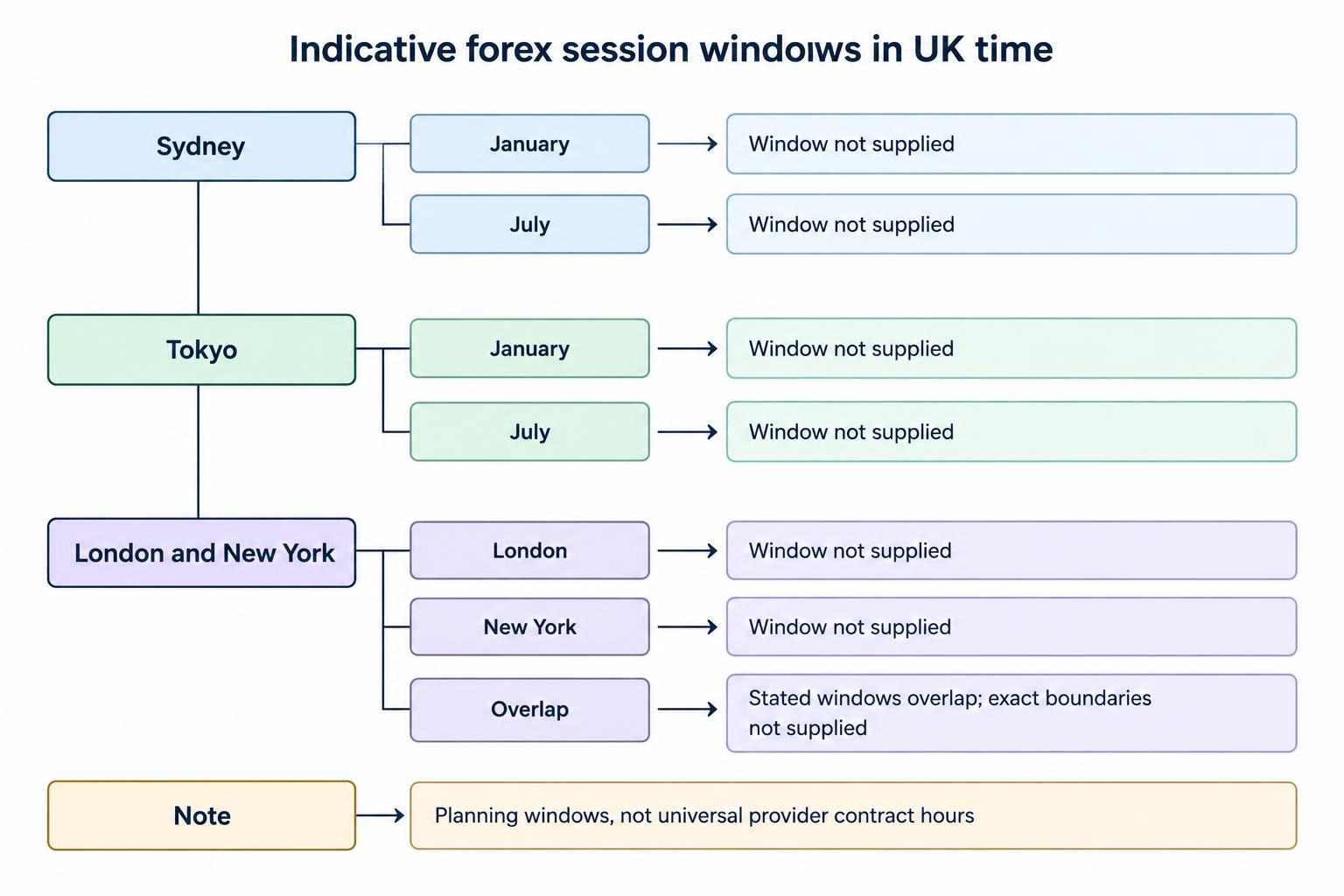
Sydney’s larger seasonal shift is not a typo. Its summer falls during the UK winter, so the two cities’ clock changes work in opposite directions. The New South Wales daylight saving schedule should be checked separately from the British calendar.
Different session clocks may use different boundaries, particularly for Sydney. What matters is using one consistent convention when reviewing charts and trading records. The Sydney row also does not define your provider’s Sunday opening time.
How Daylight Saving Changes Forex Trading Hours
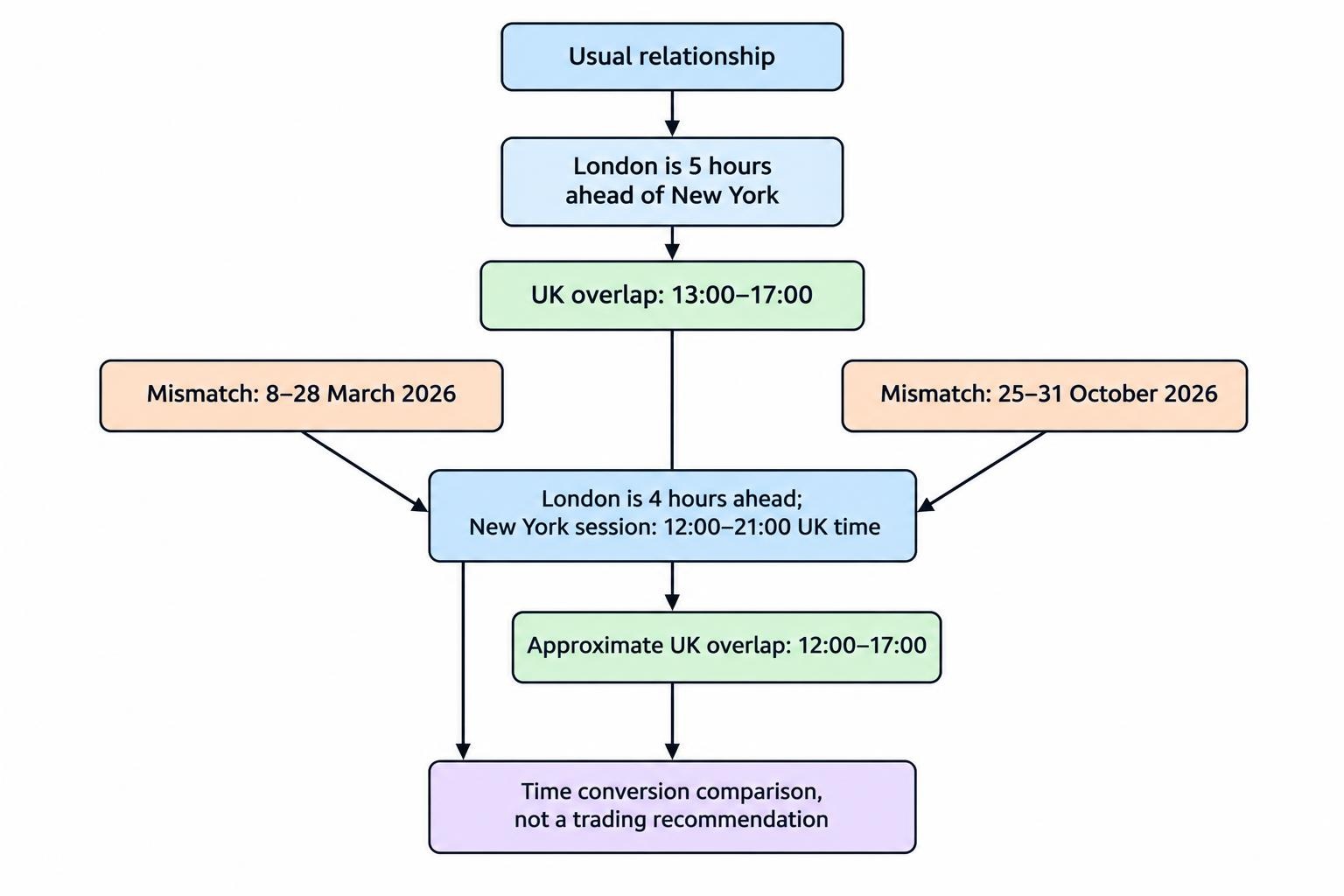
London and New York are normally five hours apart. The complication is that Britain and the United States change their clocks on different dates.
In 2026, Britain’s clocks moved forward on 29 March and go back on 25 October. These dates appear in the UK government’s clock-change calendar.
New York’s daylight saving period began on 8 March 2026 and ends on 1 November 2026, following the US daylight saving dates published by NIST. Between the respective changes, New York is four hours behind London rather than five.
For 2026, those mismatch periods are 8–28 March and 25–31 October. Using the session convention above, New York’s window shifts to 12:00–21:00 UK time. The London–New York overlap then becomes approximately 12:00–17:00 instead of 13:00–17:00.
Set calendars to named locations, such as London and New York, rather than saving a permanent GMT offset. Also check the platform’s chart clock: a timestamp on a candle is not necessarily UK local time.
Which Forex Trading Hours Are Most Useful?
There is no universally best hour to trade forex. A useful session must match the currency pair, the strategy and the amount of price movement the trade needs. An active market is not automatically an easier market.
London Morning
The London morning is a practical window to assess for trades in European currency pairs. For EUR/USD spread betting, compare the available spread with the distance to your intended stop and target. A setup that needs only a small move can become unattractive if the spread consumes much of that distance.
Apply the same check to sterling trades rather than treating the London session as a standing instruction to buy or sell. The GBP/USD market guide covers the pair’s drivers; the session clock only helps organise when to watch them.
The London–New York Overlap
Using the table’s convention, the overlap usually runs from 13:00 to 17:00 UK time. Historical evidence links this period with greater trading activity and volatility. The Reserve Bank of Australia’s 2007 study of intraday FX activity found higher turnover and volatility during the overlap across the currency pairs examined.
That finding is not a profitable trading rule. More activity can create more opportunities to transact, but rapid price changes can also make entries and exits harder to control. Judge the quoted market and the news calendar, not just the session label.
The Asian Session
For yen trades, the Asian session deserves a separate review rather than being dismissed as time spent waiting for London. A trader considering USD/JPY spread betting should check Japanese events alongside US developments and compare the pair’s behaviour across sessions.
A useful approach is to record results by trading window. If a setup behaves differently overnight, test it separately rather than assuming that rules developed during the London afternoon transfer unchanged.
Economic Releases Can Matter More Than Session Times
A session timetable tells you where the working day is taking place. It does not tell you when new information will arrive.
The US employment report provides a familiar example. The Bureau of Labor Statistics Employment Situation calendar schedules releases at 08:30 US Eastern time. That converts to 13:30 UK time for most of the year, or 12:30 during the UK–US clock-change mismatch.
Before entering a trade, check the release time in the calendar’s stated timezone. Do not rely on a remembered UK time from last month. Central bank decisions, inflation figures and other scheduled announcements also belong in that check.
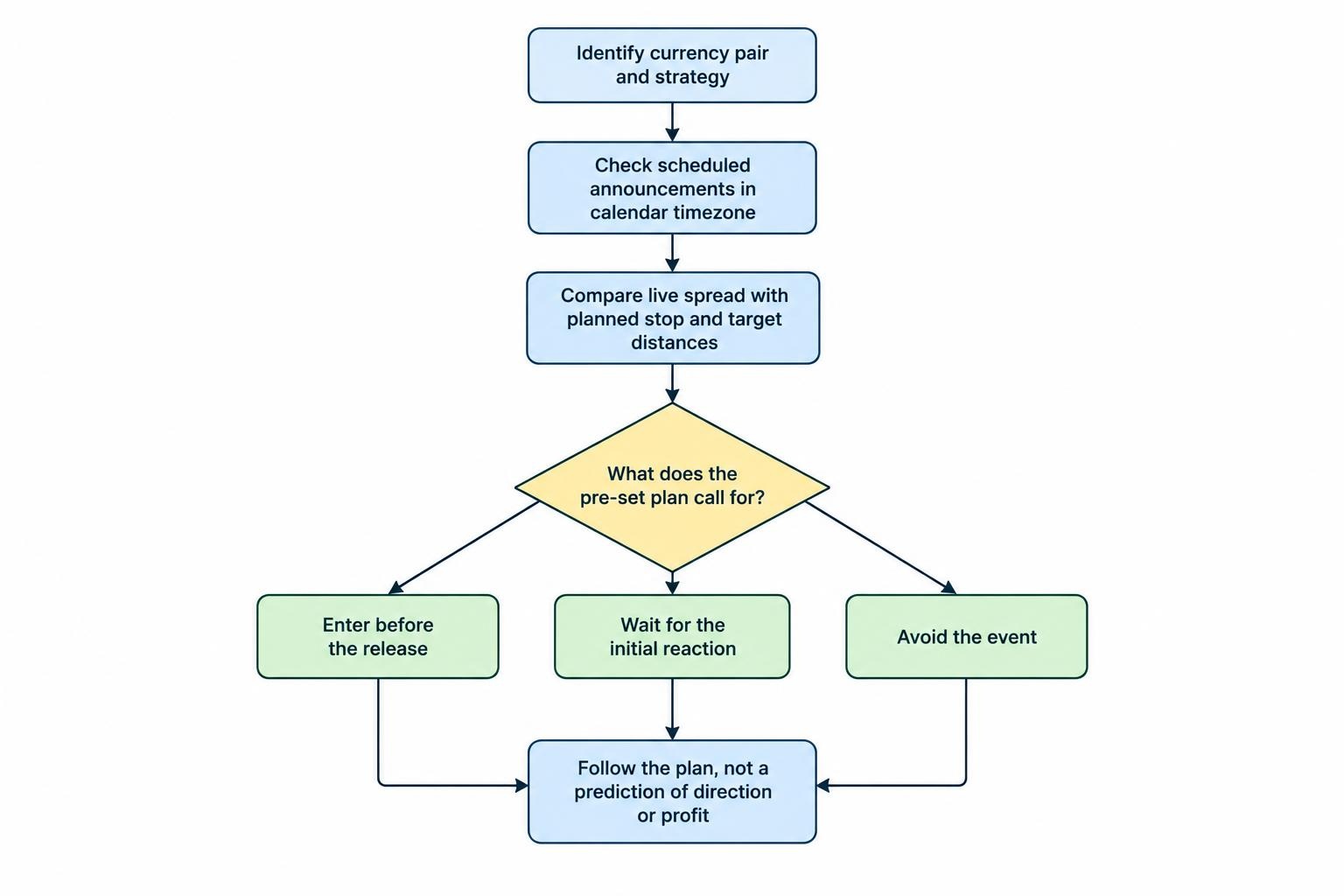
For a hypothetical trade planned around an afternoon release, decide beforehand whether the strategy requires entering before the announcement, waiting for the initial reaction, or avoiding the event. Changing that decision after prices start moving is not a substitute for a plan.
Rollover, Spreads and Overnight Positions
The daily rollover is another time boundary worth checking. In the institutional market, the standard-pair trade date changes at 17:00 New York time on EBS, as set out in CME Group’s EBS trading schedule. That does not establish a universal financing cutoff for every retail spread bet.
Your provider’s contract terms determine any daily dealing break, funding adjustment and applicable cutoff. Check the terms before carrying a position across that boundary. The guide to overnight financing costs covers the charging mechanics.
Also assess the actual spread rather than relying on an advertised minimum. At £2 per point, a hypothetical 0.8-point spread represents £1.60 of spread cost. A 2-point spread represents £4, before other charges or price movement. That difference matters far more to a short trade targeting five points than to one targeting fifty.
The relationship between quote width and trading cost is covered in spread betting spreads explained. Use the live quote when deciding whether the trade still makes sense.
Weekends and Public Holidays
Do not assume that an open position can be closed throughout the weekend. Check when your ordinary weekday forex contract stops accepting trades and when dealing resumes.
If a provider offers a separate weekend currency product, verify whether it is a different contract and how its positions interact with the weekday market. A similar name is not enough to establish identical dealing terms.
Holding through the closure also leaves the position exposed to news before trading resumes. The next available quote may be beyond an ordinary stop level, so the exit can differ from the intended price. Review market gap risk before choosing to keep a position open over the weekend.
Public holidays need their own check. Read the provider’s dated holiday notice for the contract concerned rather than assuming that every UK, US or Japanese holiday produces the same schedule.
Build a Trading Schedule Around the Contract
Use session hours to narrow your attention, then confirm the conditions that apply to the trade itself:
- Check the currency contract’s opening hours, breaks and holiday notices.
- Confirm the platform, chart and economic calendar timezones.
- Review announcements affecting either currency.
- Compare the live spread with the planned stop and target distances.
- Decide whether the position may cross rollover or the weekend closure.
A repeatable two-hour observation window is more useful than trying to monitor every session. Forex being available almost continuously during the working week creates flexibility, not an obligation to trade continuously.