FTSE 100 spread betting lets you take a position on the direction of the UK’s large company share index without buying its constituent shares. You choose whether to buy or sell, set a cash stake per index point, and make or lose money as the provider’s tradable price moves.
The arithmetic is straightforward. The harder decisions concern contract choice, trading hours, costs and position size. A £2 stake sounds modest until a 100 point move produces a £200 change in your account.
This guide applies the mechanics of index spread betting to the FTSE 100. Spread bets are leveraged products: losses can exceed the margin required to open an individual position, and your trading account funds are at risk.
What are you trading with an FTSE 100 spread bet?
The FTSE 100 represents the largest 100 eligible UK companies by full market capitalisation, subject to the index’s qualification and review rules. Membership is reviewed quarterly. Constituent weightings reflect investability adjustments, including free float, rather than giving every company an equal share of the index. These distinctions are set out in the FTSE UK Index Series ground rules.
For trading purposes, this means a price move in a heavily weighted constituent has more influence than the same percentage move in a smaller constituent. Counting how many shares rose or fell does not, by itself, explain the index’s performance.
Your spread bet is a contract with the provider, not an ownership interest in those companies. You receive no shareholder voting rights. The provider quotes a buying and selling price for its FTSE market, which may carry a label such as “UK 100”. Check the contract description rather than assuming similarly named markets have identical terms.
How FTSE 100 quotes and stakes work
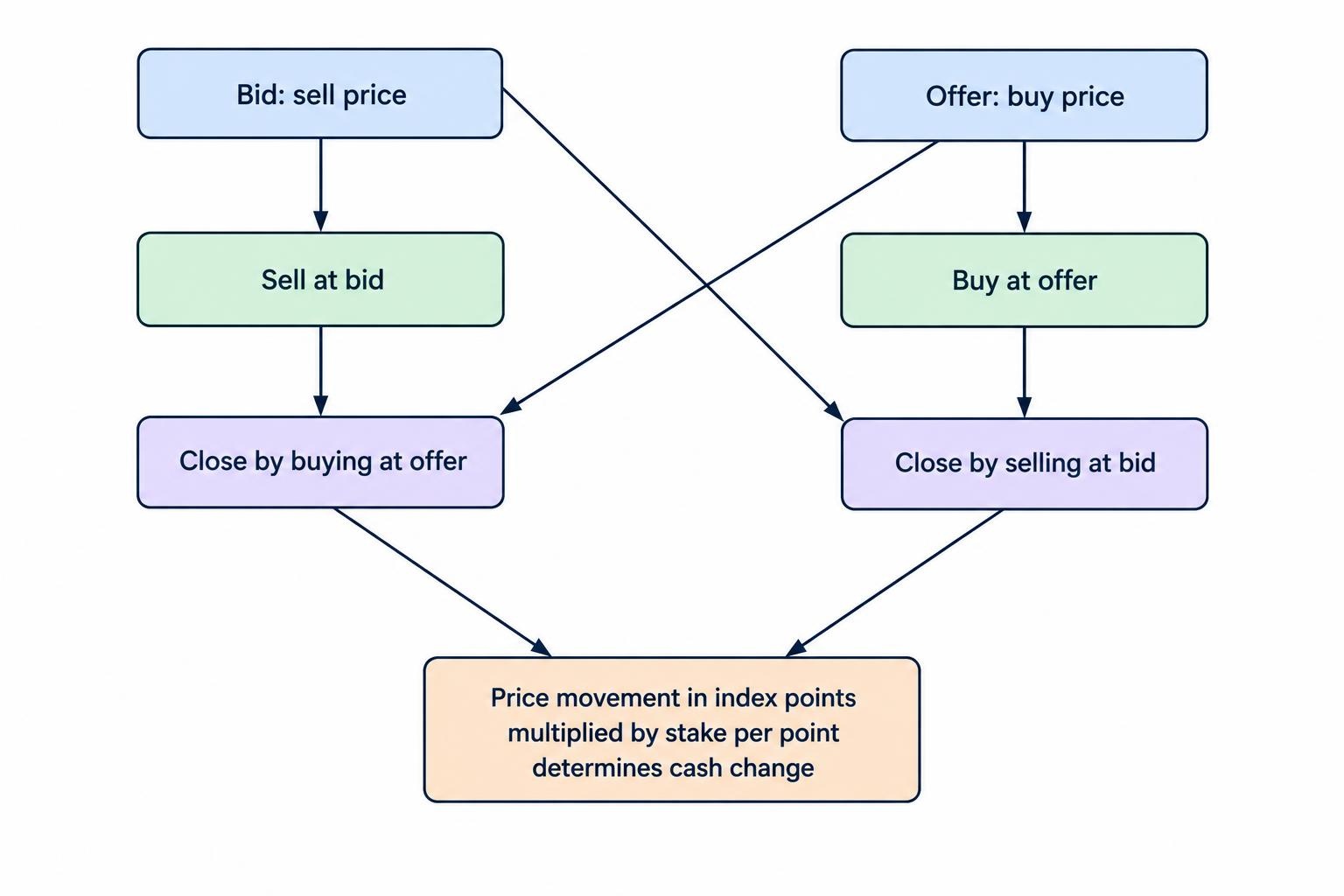
A spread betting quote has two sides: the bid, at which you can sell, and the offer, at which you can buy. Consider a hypothetical quote of 8,200–8,202. The spread is two index points.
If you expect the market to rise, you buy at 8,202. If you expect it to fall, you sell at 8,200. Closing the position uses the opposite side of the quote: a long position closes by selling, and a short position closes by buying.
Your stake determines the cash effect of each full index point. At £2 per point, a 10 point movement changes the position’s value by £20. A move from 8,200.0 to 8,200.5 is half a point, worth £1 at that stake. Decimal places on the screen do not change what a full index point means.
The distinction between stake and deposit matters. Your stake per point controls exposure; the money deposited in your account does not automatically cap an individual trade’s loss.
With an unchanged two point spread, buying and immediately selling at £2 per point would lose £4. That is the spread cost expressed through the execution prices. A chart showing the midpoint or a delayed index value may not display either price available to trade.
FTSE 100 spread betting examples
All prices below are hypothetical, not current market quotations. The examples assume execution at the stated prices and exclude financing, dividend adjustments and any separately charged fees.
Buying the FTSE 100
You buy at 8,202 for £2 per point. Later, the provider quotes 8,269–8,271, and you close by selling at 8,269.
Profit = (8,269 − 8,202) × £2 = £134.
The relevant gain is 67 points, measured between your actual opening and closing prices. It is not the difference between two chart midpoints.
If the market instead falls and you sell at 8,149, the result is:
Loss = (8,149 − 8,202) × £2 = −£106.
Selling the FTSE 100
You sell at 8,200 for £2 per point. The market falls, and you close by buying at 8,141.
Profit = (8,200 − 8,141) × £2 = £118.
If the market rises and your closing purchase executes at 8,251, the loss is £102: 51 adverse points multiplied by £2.
These calculations already include the effect of the quoted spreads through the opening and closing prices. Subtracting another spread charge would count that cost twice. The account result may still differ after financing and other adjustments; the guide to calculating spread betting profit and loss covers those additions.
Cash FTSE 100 bets versus futures and forward bets
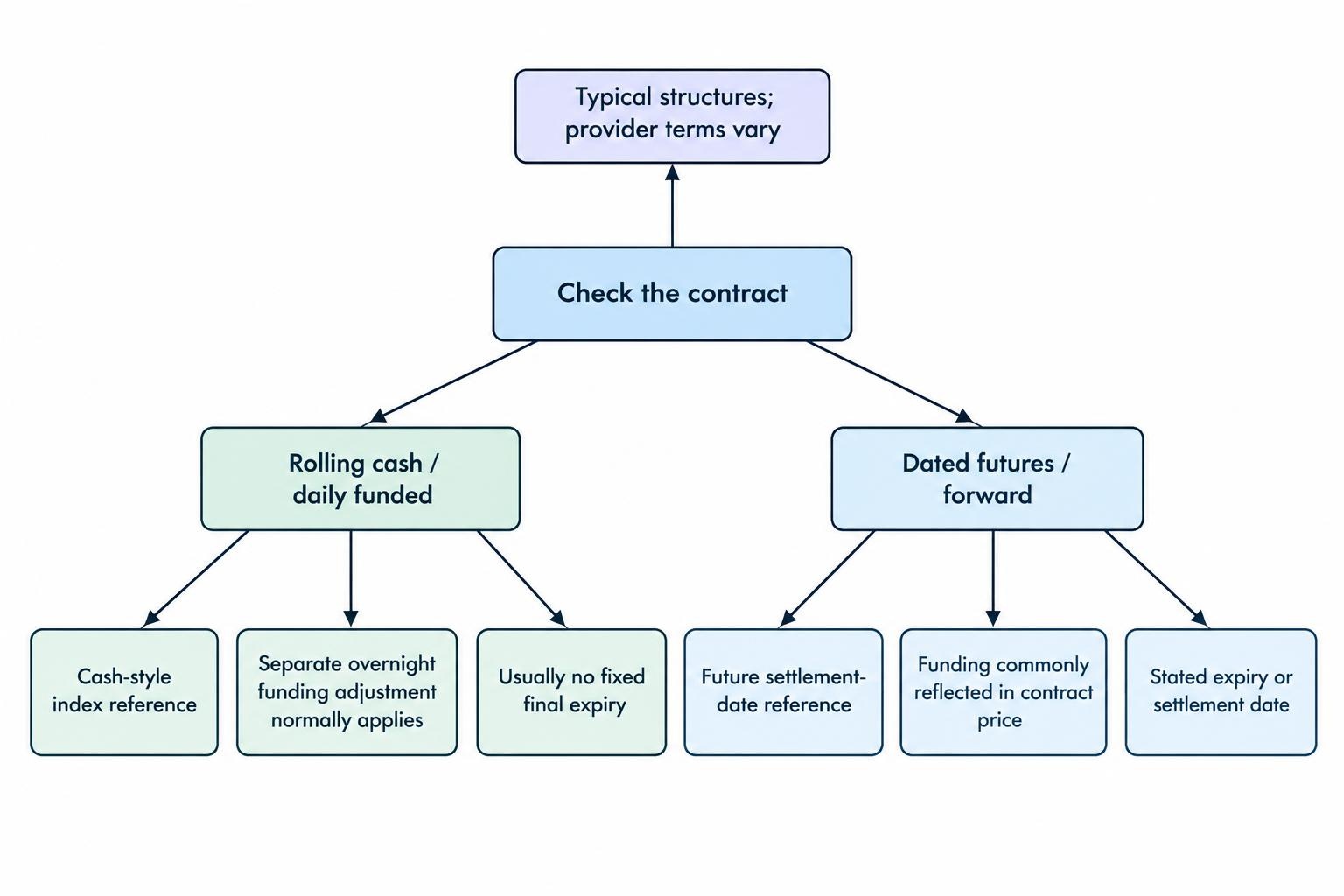
Before comparing prices, establish which contract you are looking at. A rolling cash FTSE bet and a dated FTSE bet can quote different levels without either being incorrect.
| Feature | Rolling cash or daily funded bet | Dated futures or forward bet |
|---|---|---|
| Price reference | Designed to track a cash style index price | References a price for a future settlement date |
| Holding costs | Normally has a separate overnight funding adjustment | Funding is commonly reflected in the contract pricing |
| Expiry | Usually rolls without a fixed final expiry | Has a stated expiry or settlement date |
| Dividend treatment | Normally uses cash adjustments for eligible open positions | Expected dividends are reflected in the dated price |
These are typical structures, not universal terms. Read the provider’s contract details for its funding calculation, dividend treatment and expiry arrangements.
The difference between cash and futures prices reflects factors such as financing, expected dividends and time remaining to settlement. A futures quote above the cash index is not, on its own, a prediction that shares will rise.
For a trade closed within the session, the executable spread may be the main contractual cost. For a position held over several weeks, funding and rollover terms deserve more attention. Compare daily funded bets with futures bets using the expected holding period, rather than choosing whichever contract displays the tighter opening spread.
FTSE 100 trading hours
The London cash share market normally trades from 08:00 to 16:30 London time, with auction processes around the session boundaries. The London Stock Exchange trading hours information confirms the core session.
A provider’s FTSE spread betting market may be available outside those hours. That does not mean the constituent shares are trading continuously on the London cash market.
There is also a separate exchange traded derivatives session. The standard FTSE 100 index futures contract currently lists London trading hours of 01:00 to 21:00 in the ICE FTSE 100 futures contract specifications. Those are futures exchange hours, not a promise that every spread betting provider follows the same timetable.
Outside the cash session, the provider’s quote can reflect futures and other available market information. Spreads, minimum order distances and execution conditions may differ from those during the London session. Check whether your stop orders remain active during every period in which the provider quotes the market.
Use London local time when planning a session. A platform using another time zone can display different clock times, and overseas clock changes can alter the timing of international releases. Check holidays, shortened sessions and maintenance breaks separately. The broader index trading hours guide covers these scheduling distinctions.
What moves the FTSE 100?
A useful FTSE trading view connects the proposed price move to company earnings, valuations or market positioning. “The UK economy looks strong” is too broad to do that job on its own.
International earnings and sterling
The FTSE 100 contains internationally focused businesses, so it is not a direct substitute for UK economic growth. FTSE Russell’s research on the FTSE 100’s composition and international exposure documents the role of business conducted outside the UK.
This creates a currency channel. A weaker pound can increase the sterling value of foreign earnings, other things being equal. A stronger pound can work in the opposite direction. However, operating costs, currency hedging and changes in demand can offset that effect. “Pound down, FTSE up” is a possible explanation, not a dependable trading rule.
Keep that economic exposure separate from your bet’s settlement currency. A sterling stake produces sterling profit and loss per point under the contract terms; overseas company revenues do not create a separate foreign currency balance in the spread bet.
Interest rates and economic surprises
Interest rate expectations affect financing costs, consumer demand and the value investors place on future profits. Different businesses can respond differently to the same announcement.
The surprise relative to expectations matters as much as the headline. A rate reduction that traders already anticipated may produce little reaction. An unchanged rate accompanied by unexpected guidance can prompt a larger move.
Sector news and global market sentiment
Commodity prices can affect energy and mining businesses. Banks respond to lending conditions, funding costs and credit concerns. Earnings announcements from heavily weighted constituents can also move the index even when the wider market is subdued.
Review current constituent and sector weights before building a view around one industry. Do not assume that an old description of the FTSE’s composition remains an accurate trading map.
Costs and dividend adjustments
The quoted spread is the starting point, not the complete cost calculation. For a cash position carried beyond the provider’s funding cutoff, a financing adjustment normally applies. It is generally calculated using the position’s notional exposure, not just its margin deposit.
A position with roughly £16,400 of exposure therefore does not have funding assessed solely on an £820 opening margin. The actual charge depends on the applicable rate, direction, day count and provider terms.
Check whether a particular day’s adjustment covers more than one calendar day. Also check the treatment of short positions: a funding credit is not automatic once the provider’s charge and prevailing rates are considered. The separate guide to overnight financing costs explains the calculation framework.
Why an ex-dividend fall is not a free short trade
When a constituent goes ex dividend, its share price can fall to reflect the dividend entitlement leaving the share. That can reduce the price index even without a deterioration in the business.
Cash index spread bets normally use dividend adjustments to account for that effect. Eligible long positions generally receive a credit and eligible short positions generally incur a debit, subject to the contract’s rules.
Suppose a hypothetical adjustment is 12 index points and your stake is £2 per point. The corresponding cash adjustment would be £24 before any contractual deductions. A short position that gains £24 from a purely dividend related price fall would not retain that as a free gain if it also receives a £24 debit.
Check the provider’s adjustment schedule and cutoff. These are contractual cash adjustments, not shareholder dividends paid to you. The spread betting dividend adjustments guide covers the accounting in more detail.
FTSE 100 margin and retail account protections
For UK retail business covered by the FCA rules, the FTSE 100 falls within the major stock index category. The minimum opening margin is 5% of exposure, equivalent to maximum gearing of 20:1 at that minimum. Providers can require more. The applicable requirement appears in FCA Handbook COBS 22.5.
At an illustrative index level of 8,200, a £2 per point position has approximately £16,400 of notional exposure:
Approximate exposure = 8,200 × £2 = £16,400.
Opening margin at 5% = £16,400 × 0.05 = £820.
That £820 is a funding requirement, not a planned loss allowance. A 100 point adverse move costs £200 at the same stake, before other adjustments. The position’s exposure does not shrink because the opening deposit was much smaller than its notional value.
The retail framework also requires account level closeout when net equity falls below 50% of the margin required to maintain open positions, with closure as soon as market conditions allow. Negative balance protection restricts liability to funds dedicated to the relevant trading account. Both protections form part of the FCA’s retail CFD and spread betting restrictions.
Neither protection replaces a trade level exit. Account closeout can affect several positions, while negative balance protection does not prevent the loss of account funds. Do not treat either as permission to deposit the bare opening margin and leave the position unattended.
These protections depend on the applicable entity, product and client classification. Review the retail client protection framework before considering a different account classification or contracting entity.
Set the stake from the risk budget
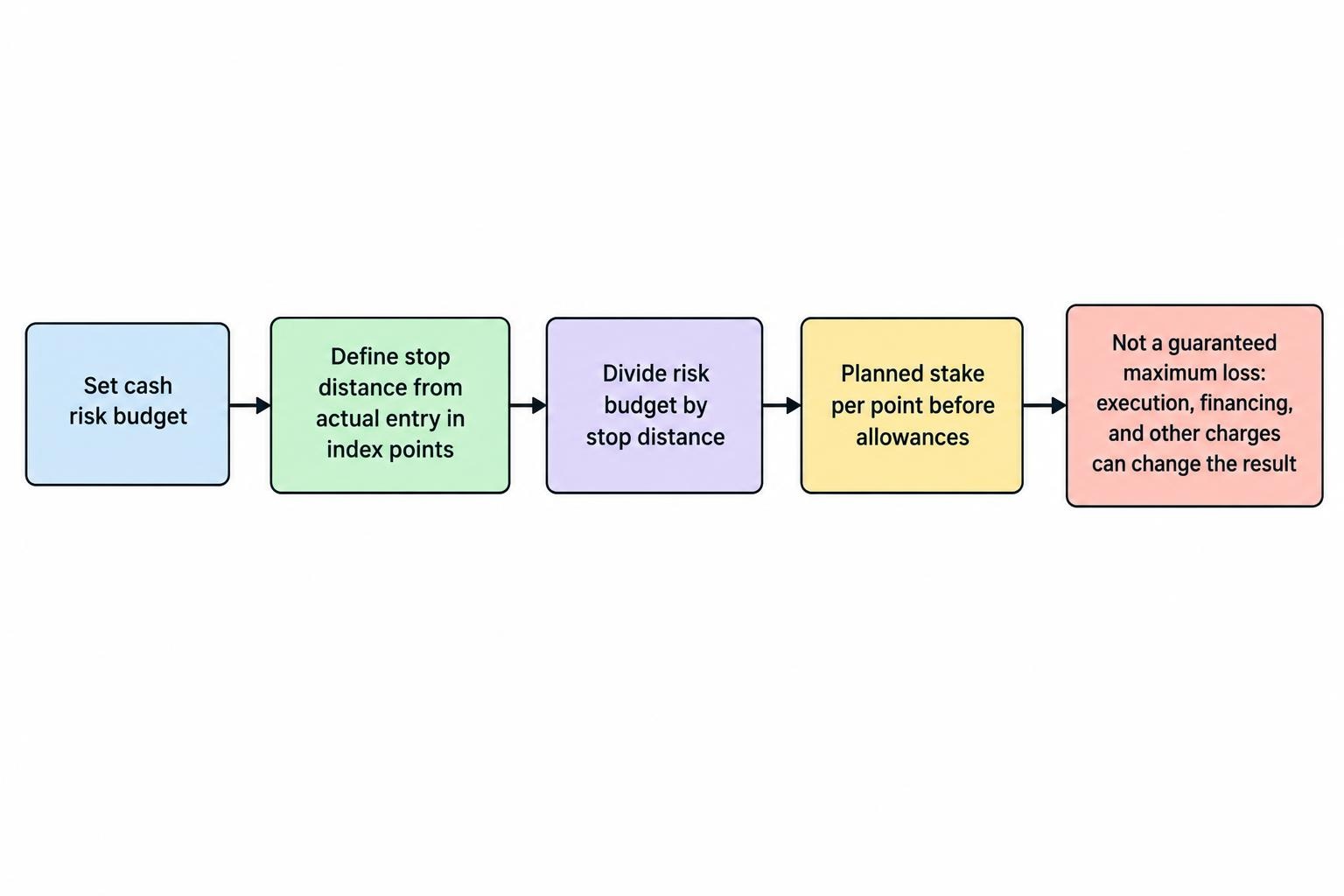
A practical sizing process starts with the amount you are prepared to lose if the trade fails, then considers the distance to a defensible exit.
Suppose your illustrative risk budget is £60 and the proposed stop is 30 points from the actual entry price:
Stake before allowances = £60 ÷ 30 points = £2 per point.
This is a planning calculation, not a guaranteed maximum loss. Financing, order execution and other charges can change the result. If the provider’s minimum stake exceeds the amount your calculation permits, the trade does not fit that risk budget. A smaller account does not make a larger stake safer.
Avoid selecting the largest stake allowed by available margin and then squeezing the stop closer to make the cash risk appear acceptable. That reverses the process. The guide to position sizing for spread betting develops this distinction.
Ordinary stops and guaranteed stops
An ordinary stop is not a promise of execution at the requested level. A price gap or fast move can produce a worse fill. This matters around overnight news, economic announcements and reopening after a trading break.
A guaranteed stop, where available, provides a contractual exit at its specified level, subject to the provider’s terms. Check its premium, minimum distance, amendment rules and availability for the chosen FTSE contract.
Use guaranteed stops as a risk control only after including their cost in the trade plan. A protected exit can constrain price gap risk; it cannot turn a poor entry into a sound trade.
Matching the FTSE trade to a strategy
The FTSE 100 can support different trading approaches, but the setup should determine the entry and exit rules. The market’s familiar name is not a strategy.
A breakout approach might wait for price to move beyond an established range and then assess whether that move holds. The failure condition should be defined before entry. The breakout trading guide covers the method without assuming every move above resistance will continue.
A range approach takes a different view: price is expected to remain between established boundaries. It needs a clear response when that assumption fails. Repeatedly selling a rising market because it “looks expensive” is not range trading unless there is an actual range and a controlled exit.
For either approach, assess costs relative to the intended move. A two point spread consumes 20% of a 10 point target before other costs, but only 2% of a 100 point target. That comparison does not make the larger target more achievable.
A short FTSE bet can also offset part of an equity portfolio’s market exposure. However, differences in holdings, sector weights and market sensitivity can leave substantial mismatch. Hedging with spread bets requires an exposure calculation, not an equal cash deposit on the opposite side.
Choosing a provider for FTSE 100 spread betting
Compare the contract you intend to trade, during the hours you intend to trade it. An advertised minimum spread is less useful if your orders are usually placed outside the period when that spread applies.
Check minimum stakes, typical quoted spreads, overnight funding, dividend adjustments, stop distances and order availability. For dated bets, inspect expiry and rollover terms. For cash bets, inspect the funding cutoff and any scheduled changes in quoting conditions.
Execution also matters. Establish how the platform displays bid and offer prices, which side triggers a stop, and what happens to pending orders during a trading break. A chart and an order ticket can look consistent while using different displayed price references.
The index spread betting broker comparison provides a relevant starting point, but the final check should use the current contract terms of the legal entity holding your account.
A demo account can help verify point values, order entry and statement calculations without risking cash. It does not establish that live execution will match the simulation. Use spread betting demo accounts to learn the platform, not as proof that a strategy will remain profitable under live conditions.
Before placing an FTSE 100 spread bet
A workable trade plan should answer the following questions before the order reaches the market:
- Is this the cash contract or a dated contract, and what determines its price?
- What cash amount does each full index point represent at the selected stake?
- What are the actual entry price, intended exit and planned loss?
- Are earnings announcements, economic releases or dividend adjustments relevant to the holding period?
- Can the spread or execution conditions change before the position closes?
- How much account equity remains available after allowing for other open positions?
- What happens if the market gaps beyond an ordinary stop?
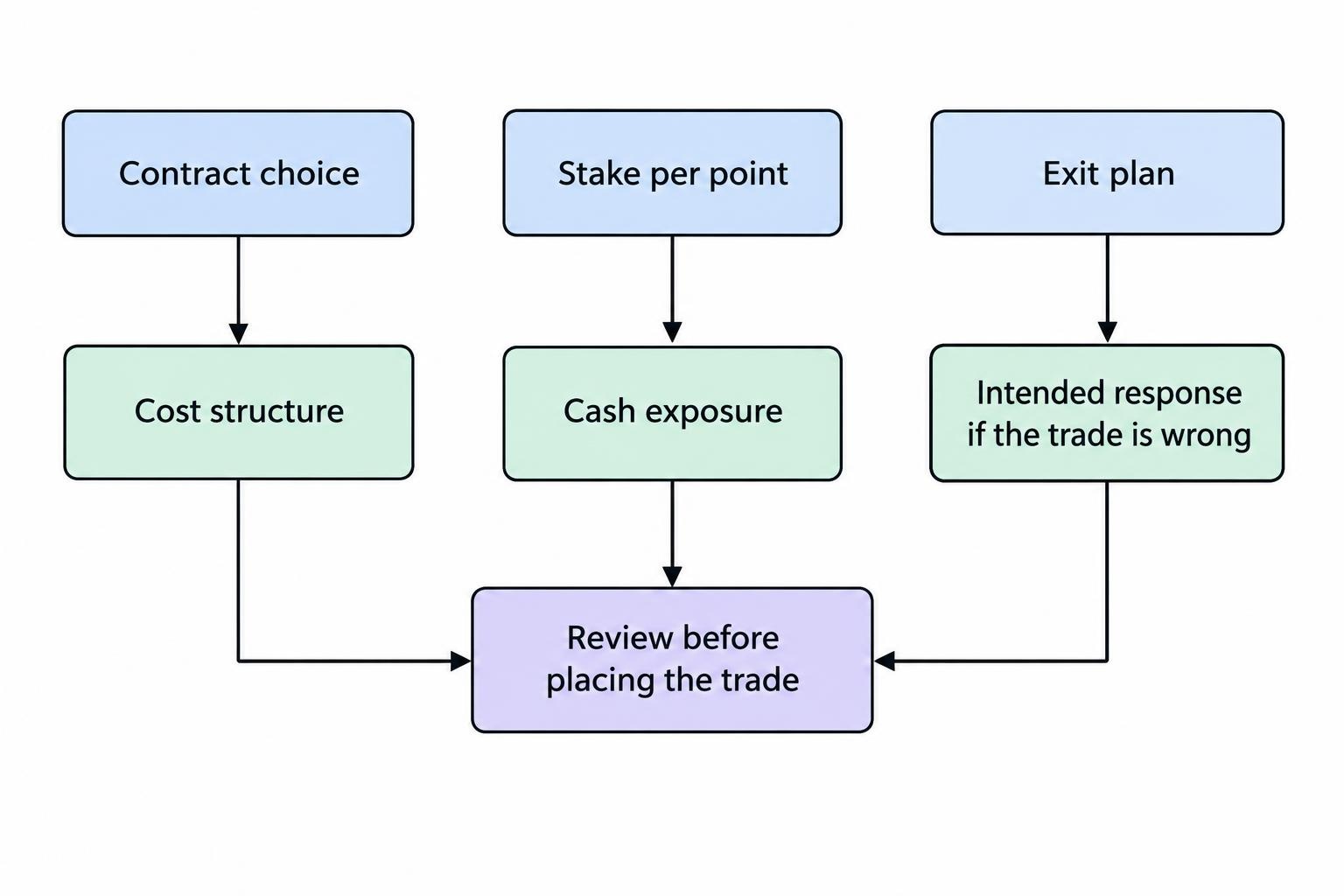
The FTSE 100 offers a single price through which to express a view on a basket of large company shares. Keep that convenience separate from risk. Contract choice sets the cost structure, stake size sets the cash exposure, and the exit plan determines how you intend to respond when the trade is wrong.