Nasdaq 100 spread betting lets you take a position on a rise or fall in the index using a cash stake per point. You do not buy the constituent shares. Your profit or loss depends on the distance between your opening and closing prices, multiplied by your stake, with funding charges and other adjustments applied where relevant.
The main decisions are which contract to trade, how much to stake and whether to hold through US economic announcements or company results. A small stake can still create substantial exposure. This guide focuses on the Nasdaq 100; the broader mechanics sit in our guide to index spread betting.
What does a Nasdaq 100 spread bet track?
The Nasdaq 100, identified by the index symbol NDX, measures 100 of the largest non-financial companies listed on Nasdaq. It uses modified market capitalisation weighting, so larger companies generally have more influence, subject to weighting constraints. Technology has the largest sector weight, but the index also includes consumer, healthcare and other businesses. These features are set out in Nasdaq’s overview of the Nasdaq 100.
It is not the Nasdaq Composite. Nor is it a basket containing every large US technology company. The listing and eligibility rules determine membership, rather than a company’s reputation as a technology business.
For a trader, weighting matters more than the number in the name. A strong move in a heavily weighted constituent can outweigh weaker moves across many smaller constituents. Do not assume that an index rise means most of its shares are rising.
If your view concerns a broader cross-section of US shares rather than this narrower basket, compare the contract with S&P 500 spread betting. Choose the index that matches the view you intend to trade, not whichever chart moved furthest yesterday.
How Nasdaq 100 spread betting works
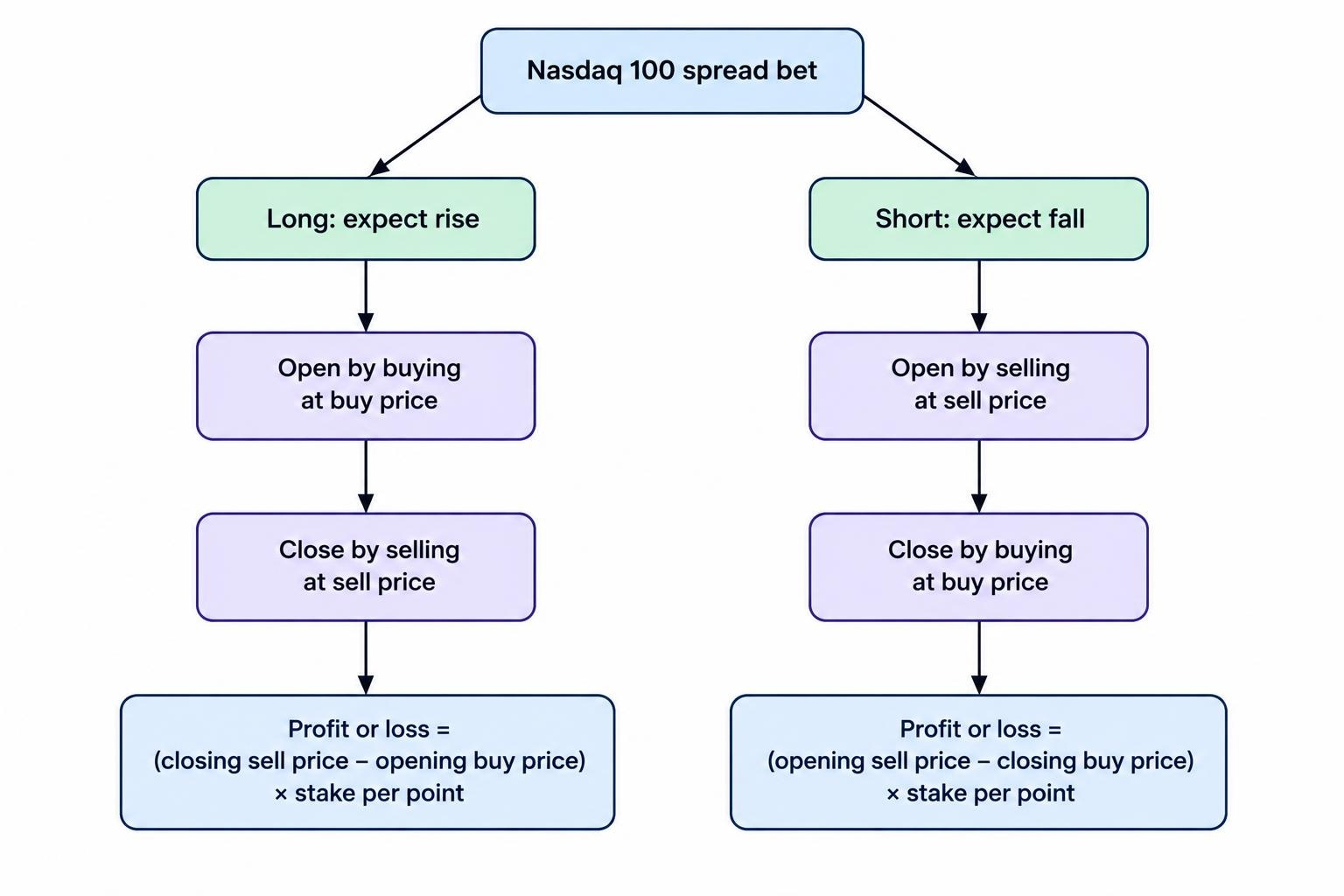
A provider displays a sell price and a buy price. You buy to open a long position if you expect a rise, or sell to open a short position if you expect a fall. Closing the position reverses that transaction: a long closes at the sell price, while a short closes at the buy price.
The calculation is straightforward:
Long profit or loss = (closing sell price − opening buy price) × stake per point.
Short profit or loss = (opening sell price − closing buy price) × stake per point.
Check what the provider means by one point. If £1 per point means £1 for each full index point, a move from 25,000 to 25,100 represents £100 of profit or loss before costs. Decimal places on the quote do not change that definition. Our explanation of stake per point covers the sizing mechanics.
Do not import futures tick values into a spread betting ticket. The exchange-traded E-mini Nasdaq 100 futures contract has a $20 index multiplier and a minimum price movement of 0.25 points, as shown in CME’s E-mini Nasdaq 100 contract specifications. A £1-per-point spread bet is a different contract.
Where your bet is denominated in pounds per full point, its trading profit or loss is calculated in pounds. That does not turn it into a currency hedge or remove the influence of exchange rates on the underlying companies.
Nasdaq 100 spread betting example
Suppose a provider quotes the Nasdaq 100 at 25,000 sell / 25,002 buy. You choose £2 per point. The table shows two separate trades and two alternative closing scenarios. All prices are hypothetical, not current market quotes.
| Trade detail | Long position | Short position |
|---|---|---|
| Opening price | Buy at 25,002 | Sell at 25,000 |
| Stake | £2 per point | £2 per point |
| Closing quote after a rise | 25,150 sell / 25,152 buy | 25,150 sell / 25,152 buy |
| Result after that rise | (25,150 − 25,002) × £2 = £296 profit | (25,000 − 25,152) × £2 = £304 loss |
| Alternative closing quote after a fall | 24,850 sell / 24,852 buy | 24,850 sell / 24,852 buy |
| Result after that fall | (24,850 − 25,002) × £2 = £304 loss | (25,000 − 24,852) × £2 = £296 profit |
The calculations already include the spread because they use the prices at which you could enter and exit. Subtracting another two-point spread would count that cost twice.
An immediate close at the unchanged opening quote would lose £4: the two-point difference multiplied by £2 per point. The trade needs a favourable movement simply to reach break-even.
These figures exclude overnight funding, guaranteed stop premiums and other applicable adjustments. They also assume execution at the stated prices. An order requested at one level may execute at another, particularly during a fast move.
Cash contracts versus futures or forward contracts
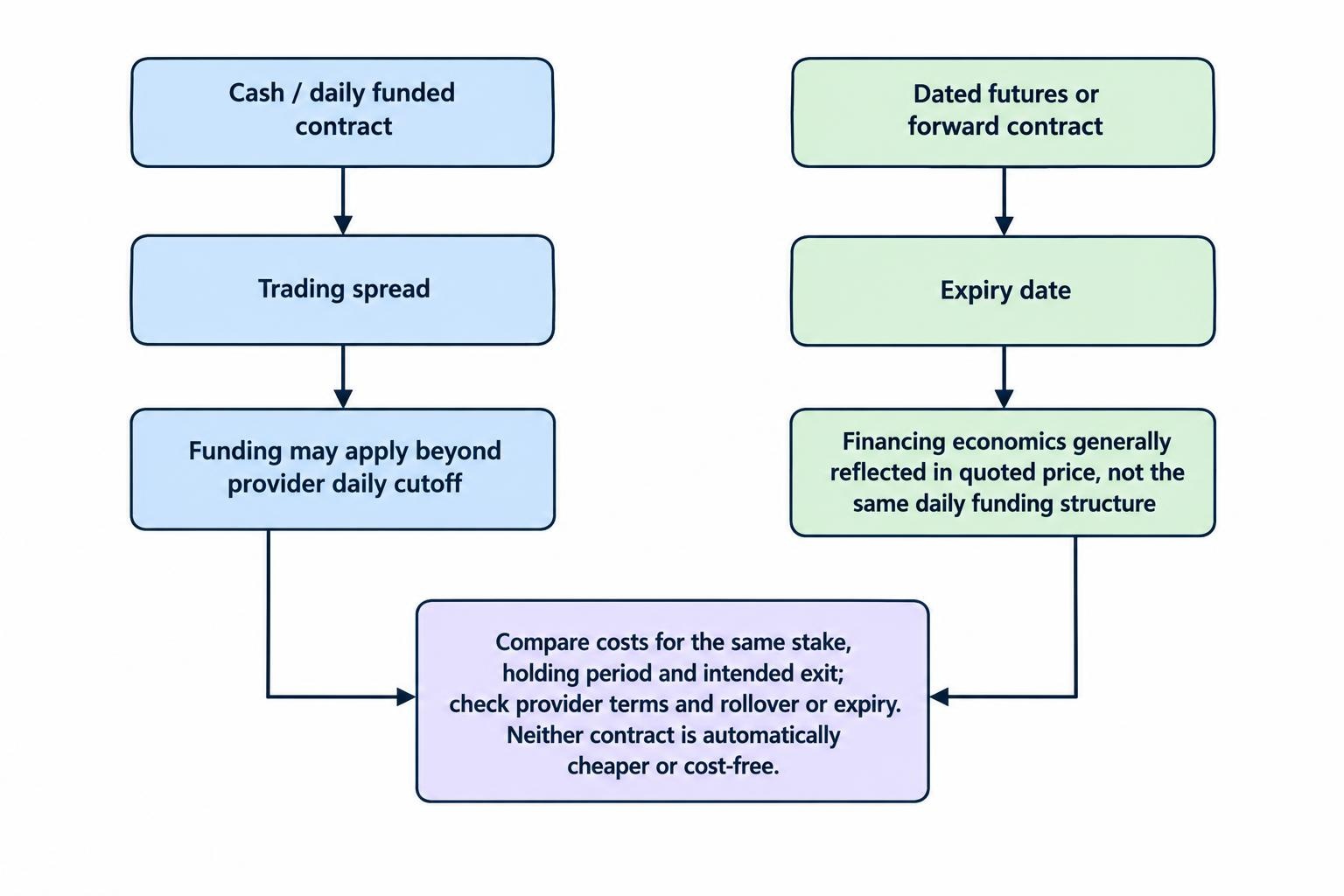
A Nasdaq 100 cash spread bet, often offered as a daily funded contract, generally separates its trading spread from funding applied when you hold beyond the provider’s daily cutoff. A dated futures or forward spread bet has an expiry and usually reflects its financing economics within the quoted price rather than through the same daily funding structure.
Those differences affect both costs and charts. A dated contract need not quote at the same level as the cash index. Interest rates, expected dividends and time to expiry help explain the difference between stock index futures and cash prices; CME’s stock index futures paper sets out that pricing relationship.
For a position held for an hour, the opening spread and execution may dominate the cost comparison. For a position held for several weeks, funding, expiry and rollover terms deserve more attention. Neither contract type is automatically cheaper.
Compare both using the same stake, expected holding period and intended exit. The fuller daily funded bets versus futures comparison explains the trade-offs without treating a dated contract as cost-free borrowing.
Also check what happens at expiry. An automatic rollover can close one position and open another, creating charges or adjustments. It should not come as a surprise because the date was hidden several tabs away.
Nasdaq 100 trading hours in UK time
The regular Nasdaq stock market session runs from 9:30am to 4:00pm Eastern Time, Monday to Friday, excluding market holidays and with some shortened sessions. The authoritative calendar is Nasdaq’s trading hours and holiday schedule.
For most of the year, that translates to 2:30pm to 9:00pm UK time. During the periods when the US and UK have changed their clocks on different dates, it becomes 1:30pm to 8:00pm UK time. Use Eastern Time for the event itself and check the UK conversion rather than assuming a fixed five-hour difference.
Your spread betting contract may be available outside the regular share session. That does not mean the constituent shares are trading under regular-session conditions. The provider may use futures prices and other inputs to maintain its quote, subject to its contract terms.
Keep three schedules separate: the underlying share session, the relevant futures market and your provider’s dealing hours. Maintenance breaks, holidays and special sessions can affect them differently. Our index trading hours guide covers those distinctions.
Before placing an order, establish whether it can trigger outside regular hours and whether the spread changes by session. A stop placed near the market can trigger because the executable side of the quote reaches it, even if the chart you are watching displays a midpoint.
What moves the Nasdaq 100?
Company earnings and changes in expectations
Focus on results from heavily weighted constituents rather than treating every earnings announcement as equally important. Revenue, margins, spending plans and management forecasts can all change investors’ assessment of future profits.
The comparison is against expectations, not simply last year’s figures. A company can report profit growth and still fall if investors expected more. For an index position, check both the announcement time and the company’s weight before deciding whether to hold through it.
A useful preparation habit is to write down the event that could invalidate your trade. “The chart looks strong” offers little guidance when a major constituent releases results after the regular close.
Interest rates and valuation
Share valuations depend partly on expected future cash flows and the rate used to translate them into present value. Holding other assumptions constant, a higher discount rate reduces that present value. The mechanism is outlined in the Federal Reserve’s discussion of asset valuation and discount rates.
This does not create a reliable rule that rising yields always mean a falling Nasdaq 100. Changes in earnings expectations, economic growth and investors’ willingness to take risk can offset one another. Treat bond yields as context, not a substitute for an entry and exit plan.
Economic announcements and policy decisions
Put US inflation releases, employment reports and Federal Reserve decisions on your preparation checklist. Then decide whether your method permits an open position through each event. Trading before the release and reacting afterwards are different decisions, with different execution risks.
If the plan depends on reacting to the announcement, account for the spread and possible price jumps rather than assuming you will receive the last displayed quote. Our guide to news trading with spread bets covers that execution problem.
Costs that matter on a Nasdaq 100 position
The quoted spread is the first cost to examine, but measure it against the trade you intend to make. A two-point spread consumes 10% of a 20-point gross target. It consumes 1% of a 200-point gross target. These are arithmetic comparisons, not assumptions about available returns.
A small target leaves less room for execution errors and spread changes. Compare the executable buy and sell prices at the time you expect to trade, not just an advertised minimum. The bid-ask spread determines how far the quote must move before the position breaks even.
For a cash contract held beyond the daily cutoff, financing can accumulate even when the index finishes near your entry price. Check the reference rate, provider adjustment, day-count method and weekend treatment. A short position should not be assumed to earn interest; the contract’s calculation determines the debit or credit.
Compare the expected holding cost in pounds before opening. Our guide to overnight financing costs explains how to build that estimate into a trade.
Dividend adjustments may also apply to cash index positions. These are contractual adjustments, not shareholder dividends, and should be read alongside the corresponding price movement. Add guaranteed stop premiums or other applicable charges before judging the position’s net result.
UK retail margin and account protections
The Nasdaq 100 falls within the FCA’s definition of a major stock market index. That classification determines the applicable retail margin category. It does not mean the index is a low-risk trade.
For UK retail business covered by these rules, the minimum opening margin is 5% of exposure, equivalent to maximum leverage of 20:1. Providers can require more. The rules also require account-level close-out when net equity falls below 50% of the required margin, as soon as market conditions allow, and negative balance protection for funds dedicated to the relevant trading account. These requirements appear in the FCA’s retail CFD and similar speculative investment rules.
Consider a hypothetical index level of 25,000 and a stake of £1 per full point. The approximate exposure is £25,000, so a 5% opening margin would be £1,250. A 250-point adverse move produces a £250 trading loss before charges: 1% of the reference index level, but 20% of that opening margin.
Margin is collateral, not a loss budget. Nor does the close-out threshold promise that you can keep a position open until your chosen stop is reached. Other positions and charges affect account equity too.
Negative balance protection does not protect your deposit from trading losses. You can still lose the funds committed to the account. These retail protections should not be assumed to apply unchanged to professional or offshore arrangements.
Choosing a stake and managing Nasdaq 100 risk
Set the exit before calculating the stake
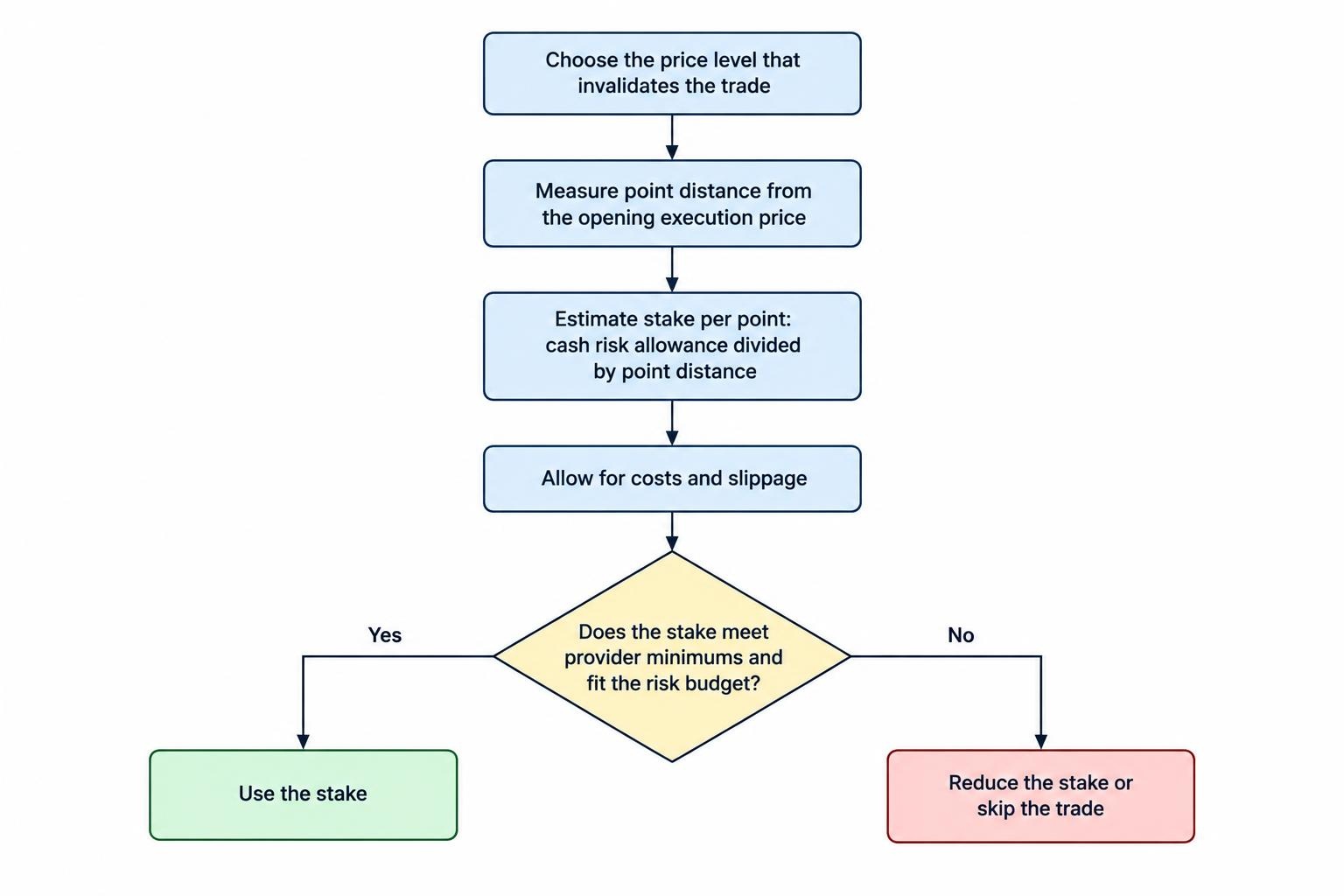
Start with the price level that would invalidate the trade, then calculate whether the resulting position fits your cash risk budget. Starting with the largest stake the margin calculator permits gets the process backwards.
Suppose a hypothetical £5,000 account has a £25 planned risk allowance for one trade. If the intended exit is 80 points from the opening execution price, dividing £25 by 80 gives £0.3125 per point before costs and slippage. At £0.30 per point, the planned price loss would be £24.
That leaves very little room for charges or a worse fill, so the stake may need to be smaller. If the provider’s minimum is £0.50 per point, the same 80-point distance creates £40 of price risk. The answer is not to squeeze the stop closer simply to make the arithmetic fit. Use a smaller permissible stake elsewhere or skip the trade. See position sizing for spread betting for the full calculation.
Distinguish a stop instruction from a guaranteed exit
A standard stop-loss does not guarantee its execution price. If the market jumps past the trigger, the resulting loss can exceed the amount calculated from the stop distance.
Where available, a guaranteed stop provides a contractual exit at the agreed level, subject to the provider’s terms. Check the premium, minimum distance and amendment restrictions before using it. Our guide to managing risk with guaranteed stops covers those decisions.
Count related positions together
A Nasdaq 100 long and several long positions in its larger constituents can express much the same market view. Holding separate tickets does not automatically spread the risk.
Before adding another position, calculate what a shared adverse move could do to the account. The relevant question is total exposure to the same driver, not the number of instruments held. That is the purpose of assessing portfolio correlation and spread betting risk.
What to check before placing the trade
Read the market information attached to the actual ticket. Names such as US Tech 100 or NAS100 are provider labels; confirm the underlying reference and contract structure rather than relying on the name alone.
- Point value: what cash amount does a full index-point move produce?
- Contract type: is this a cash contract or a dated futures or forward bet?
- Trading schedule: when can the position and its attached orders execute?
- Costs and margin: what spread, funding terms and collateral requirement apply to your stake?
- Exit and event exposure: what ends the trade, and which announcements occur before then?
When comparing index spread betting providers, use the contract you would actually trade at the times you would trade it. A smaller advertised spread is less useful if the minimum stake makes your intended risk budget impossible.
A spread betting demo account can help you check ticket settings, order triggers and profit-and-loss calculations before risking money. It cannot establish that live execution will match the simulation or that a strategy will be profitable.
The final test is practical: can you explain the contract’s point value, expected costs, planned exit and effect on account equity without reopening the calculator? If not, reduce the uncertainty before placing the order. The Nasdaq 100 will still be there when the arithmetic is finished.