DAX spread betting lets you take a position on Germany’s leading share index without buying its constituent shares. You choose a stake per index point, then buy if you expect the market to rise or sell if you expect it to fall. Your profit or loss depends on the movement between your opening and closing prices, multiplied by that stake.
The arithmetic is straightforward. The harder decisions concern which DAX contract you are trading, how its price is formed outside the main German share session, and how much exposure your account can absorb. A small stake does not necessarily mean a small position.
This guide covers those decisions within index spread betting, using hypothetical prices rather than live market quotes. Spread betting is a high risk product, and losses can consume the money held in your trading account.
What does the DAX track?
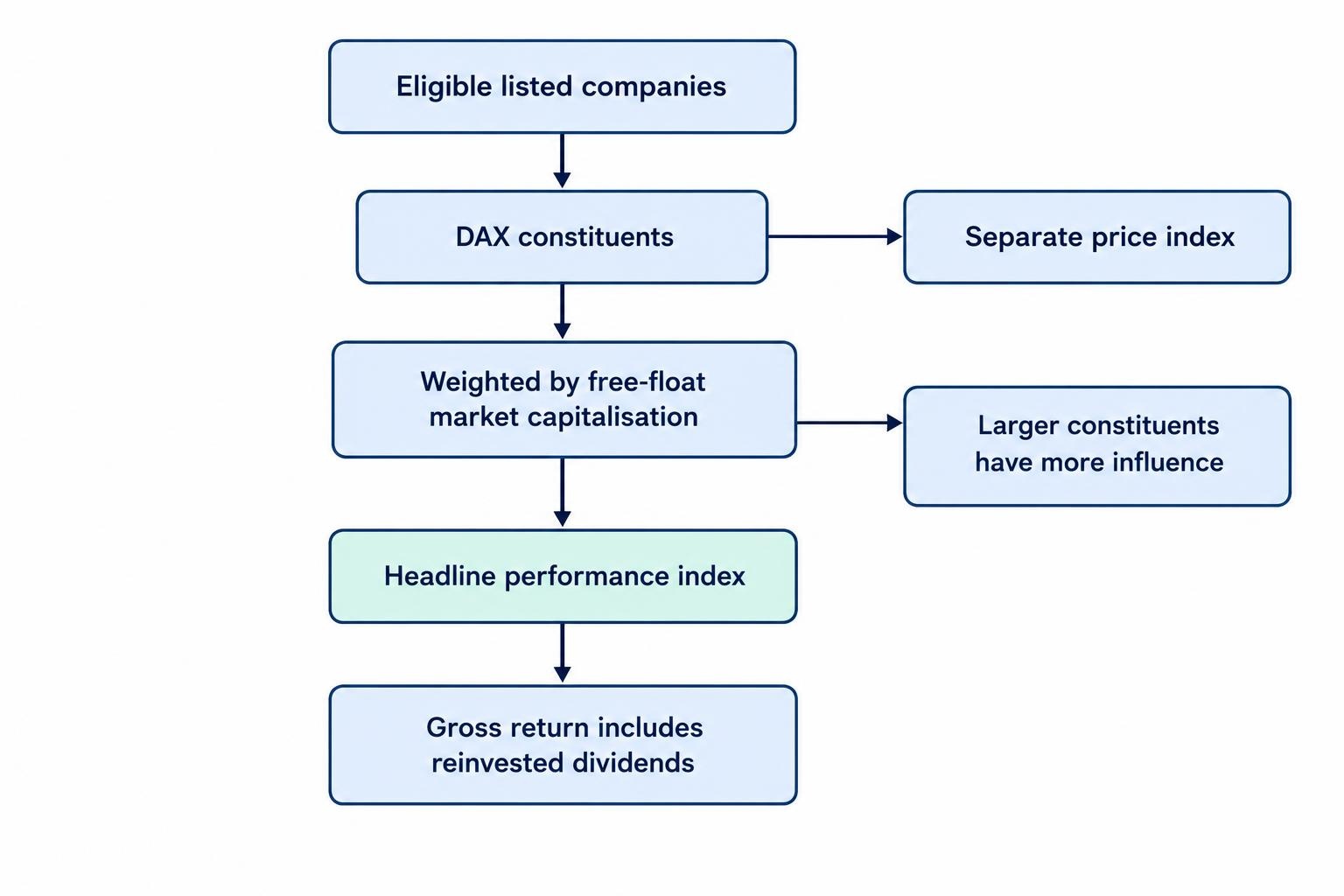
The DAX tracks 40 large companies listed on the Frankfurt Stock Exchange’s regulated market that meet its eligibility requirements. Selection and weighting use free float market capitalisation: broadly, the value of shares available for public trading. It is not an equal weighted index, so a movement in a larger constituent has more influence than the same percentage movement in a smaller one.
The familiar headline DAX is a performance index, also called a gross return index. Its calculation includes the reinvestment of dividends. A separate price index exists, which does not measure returns on the same basis. These distinctions appear in the STOXX DAX factsheet and index versions.
That distinction matters when comparing historical charts. A DAX performance chart and another market’s price index do not provide a like for like comparison of shareholder returns. It also means you should identify the benchmark behind your spread betting contract rather than assume every chart carrying the DAX name represents exactly the same thing.
Your spread bet is a contract with the provider. It does not give you ownership of the 40 constituent companies, voting rights, or a direct entitlement to their dividends.
How a DAX spread bet works
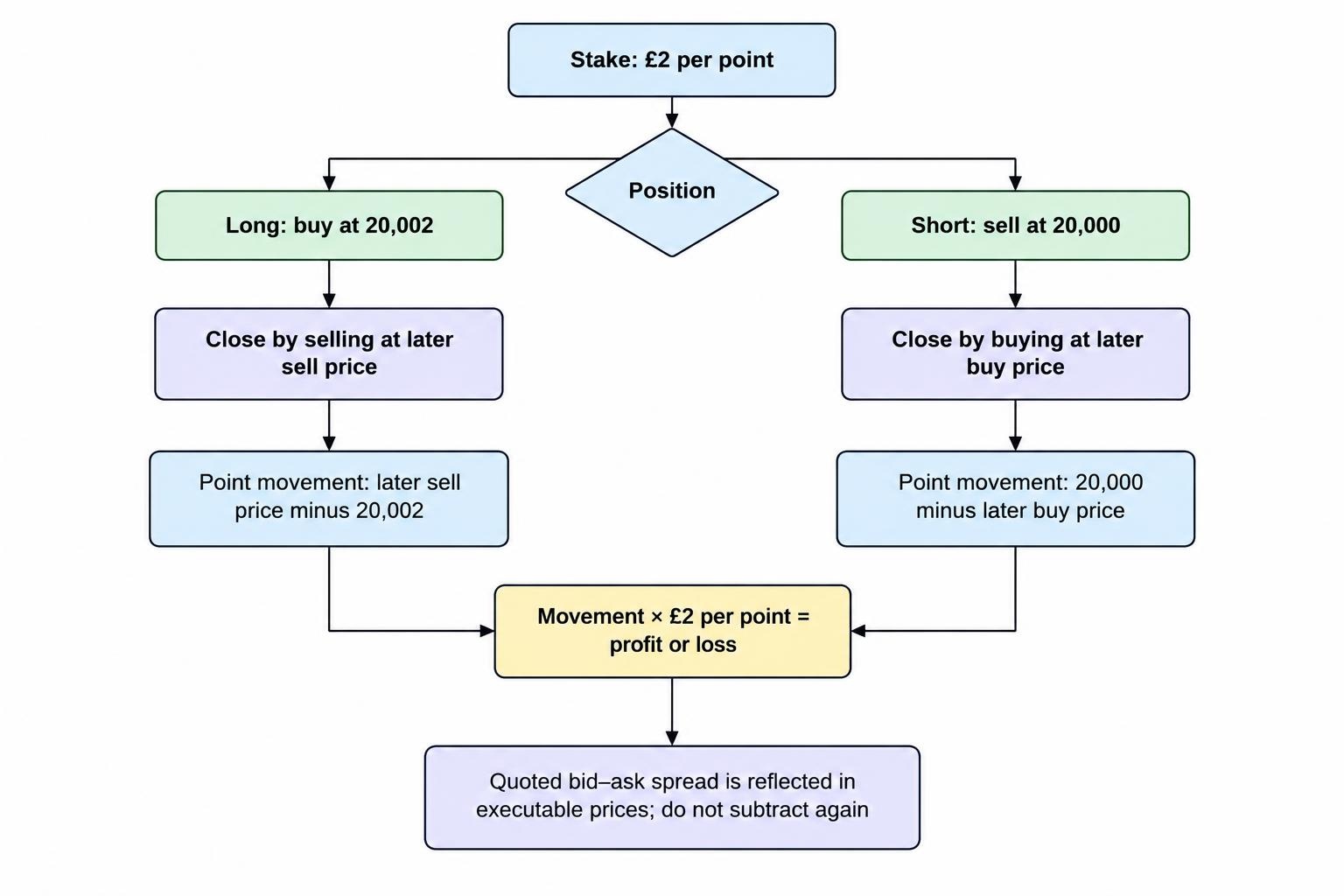
A provider might display a hypothetical DAX quote of 20,000–20,002. The lower number is the sell price, or bid. The higher number is the buy price, or ask.
If you expect a rise, you buy at 20,002 and later close by selling. If you expect a fall, you sell at 20,000 and later close by buying. The two point difference is the spread.
Your stake sets the cash value of each point. At £2 per point, a 50 point movement changes the position’s value by £100. At £10 per point, the same movement changes it by £500. The market has done exactly the same thing; your sizing has changed the financial outcome.
Check the dealing ticket’s definition of a point. Under the convention used here, a move from 20,000 to 20,001 is one point. A displayed decimal, such as 20,000.5, does not automatically turn a half point movement into five points. The stake per point guide covers this distinction across different markets.
A sterling stake also differs from buying a euro denominated investment. Where the contract settles at £2 per DAX point, a 100 point movement produces £200 of trading profit or loss before other charges. There is no separate EUR/GBP conversion in that calculation, although currencies can still affect the underlying companies and index.
DAX spread betting examples
Assume the opening quote is 20,000–20,002 and the stake is £2 per point. The following outcomes use executable closing prices, not the chart’s midpoint.
| Position | Opening price | Closing price | Calculation | Trading result |
|---|---|---|---|---|
| Buy, market rises | 20,002 | Sell at 20,120 | 118 points × £2 | £236 profit |
| Buy, market falls | 20,002 | Sell at 19,942 | −60 points × £2 | £120 loss |
| Sell, market falls | 20,000 | Buy at 19,880 | 120 points × £2 | £240 profit |
| Sell, market rises | 20,000 | Buy at 20,082 | −82 points × £2 | £164 loss |
These results already include the effect of entering and exiting through the quoted bid and ask. Do not subtract the spread again. They exclude overnight financing, guaranteed stop premiums and any other applicable adjustments.
If the opening quote stayed unchanged and you immediately closed a £2 per point purchase, you would buy at 20,002 and sell at 20,000. The resulting loss would be £4. That is why the index must move in your favour before a new position reaches break even.
For a long position, subtract the opening buy price from the closing sell price. For a short position, subtract the closing buy price from the opening sell price. Keeping that order consistent avoids the surprisingly common mistake of recording a profitable short as a loss.
DAX margin and position sizing
For UK retail clients, the minimum opening margin for major stock indices such as the DAX is 5% of exposure, equivalent to maximum gearing of 20:1. Firms can require more. The rules also require position closure when account equity falls below 50% of the relevant margin requirement, as soon as market conditions allow, and provide account level negative balance protection. These requirements sit within the FCA rules for retail CFDs and similar speculative investments, which cover financial spread betting.
Using a rounded index level of 20,000, a £2 per point position represents approximately £40,000 of exposure. At a 5% margin rate, the opening deposit would be approximately £2,000.
That £2,000 is not the trade’s maximum loss. A 200 point adverse movement would lose £400 before charges, regardless of how much margin the provider initially requested. Negative balance protection does not protect your deposit from trading losses.
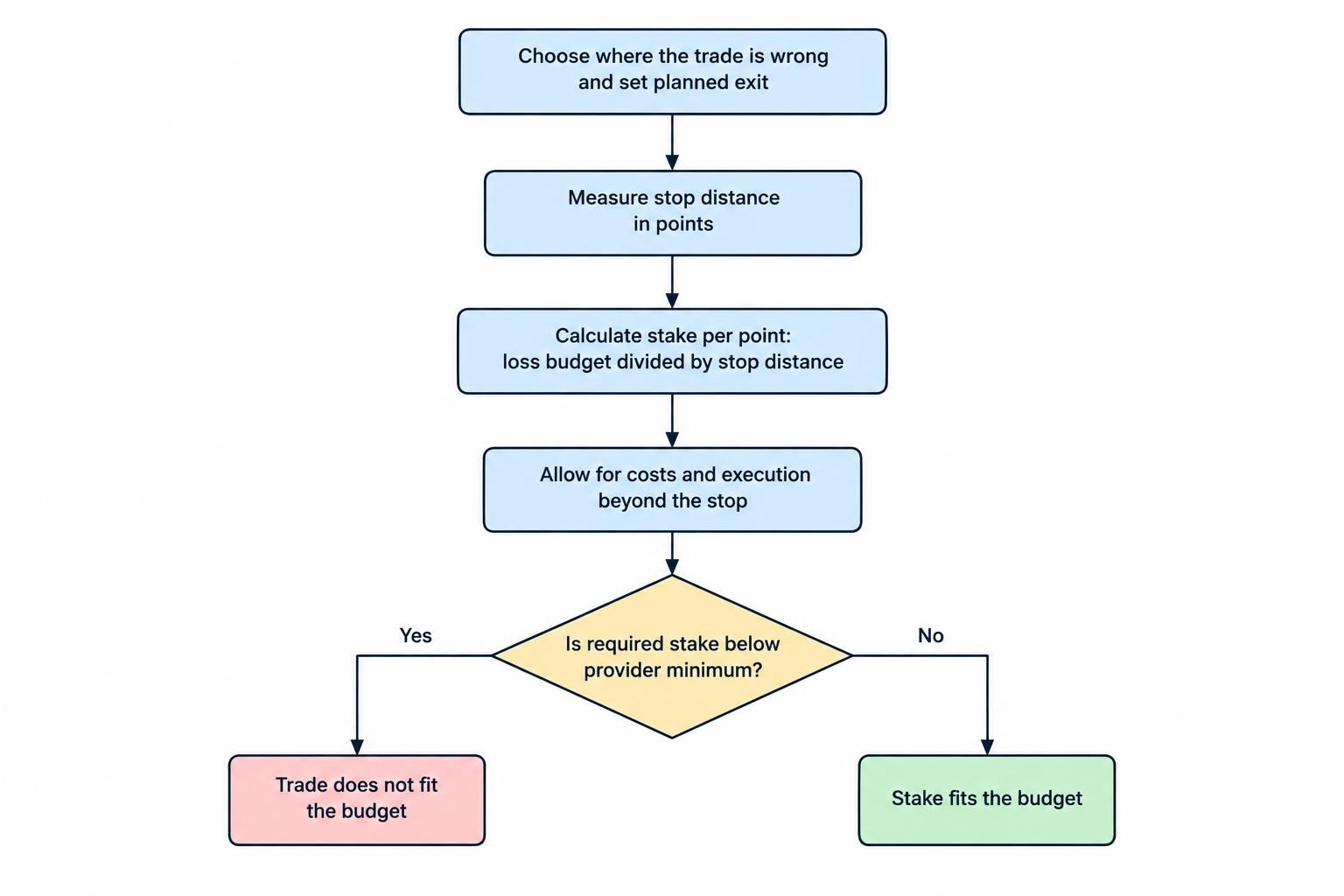
Set the stake from the loss you intend to accept and the distance to your planned exit. A £100 loss budget with an 80 point stop distance gives a stake of £1.25 per point before allowing for costs and possible execution beyond the stop. If that stake is below the provider’s minimum, the trade does not fit the budget.
The practical sequence is to identify where the trade would be wrong, measure the distance, then calculate the stake. Reversing that sequence often produces a conveniently affordable position with an inconveniently placed stop. The position sizing guide develops this approach.
DAX trading hours in UK time
The main Xetra share trading session runs from 09:00 to 17:30 Frankfurt local time, normally 08:00 to 16:30 UK time. Xetra also has an extended retail service before and after that main session. Those additional hours should not be confused with the main session itself. Holiday arrangements and auction details appear in the Deutsche Börse trading calendar and hours.
DAX futures have a longer exchange session. Eurex lists trading from 01:10 to 22:00 CET in winter and 02:10 to 22:00 CEST in summer, subject to its calendar and contract arrangements. The Eurex DAX futures specifications distinguish these sessions from the underlying share market.
Your spread betting provider sets its own dealing hours. It may quote a DAX market outside the main share session, drawing on futures and its pricing methodology. That does not mean you can trade continuously without interruptions, nor that the quoted spread will remain unchanged.
For practical purposes, separate three things: the main share session, the futures session, and your contract’s dealing schedule. The label “Germany 40” or “DAX cash” is not a timetable.
Pay attention to the main session opening, scheduled announcements, and the period around the share market close. Compare the spread and execution conditions during the hours you actually intend to trade. For broader scheduling issues, including holidays and clock changes, see index trading hours.
What can move the DAX?
A useful DAX trading plan considers both company earnings and the financial conditions used to value those earnings. It should not reduce the index to a single story about German manufacturing or the euro.
Interest rates and economic announcements
Changes in monetary policy can affect borrowing costs, market expectations, exchange rates and share prices. These connections form part of the ECB’s monetary policy transmission mechanism. For DAX traders, ECB decisions and inflation releases therefore deserve a place on the trading calendar.
The direction of the next move is not automatic. A rate cut could support valuations, but it could also accompany a weaker economic outlook. An apparently strong economic release could improve earnings expectations while making investors expect tighter policy.
Frame the question around what changed relative to expectations, rather than whether the headline sounds good or bad. Then watch whether the market accepts the first price movement. A headline is not an entry order.
Earnings, currencies and international demand
Consider a company selling products overseas. A weaker euro could increase the euro value of foreign revenue, but imported costs, currency hedges and softer customer demand could offset that benefit. This is a scenario to assess, not a dependable instruction to buy the DAX whenever the euro falls.
Company results also matter through index weighting. A large constituent’s earnings disappointment can outweigh gains across several smaller members. Counting how many shares are rising is therefore not enough to explain the index’s movement.
For an event driven approach, write down the release, expected result and conditions under which you will stay out. The news trading guide covers the execution risks around announcements without assuming that faster clicking creates an advantage.
DAX cash bets, forward bets and trading costs
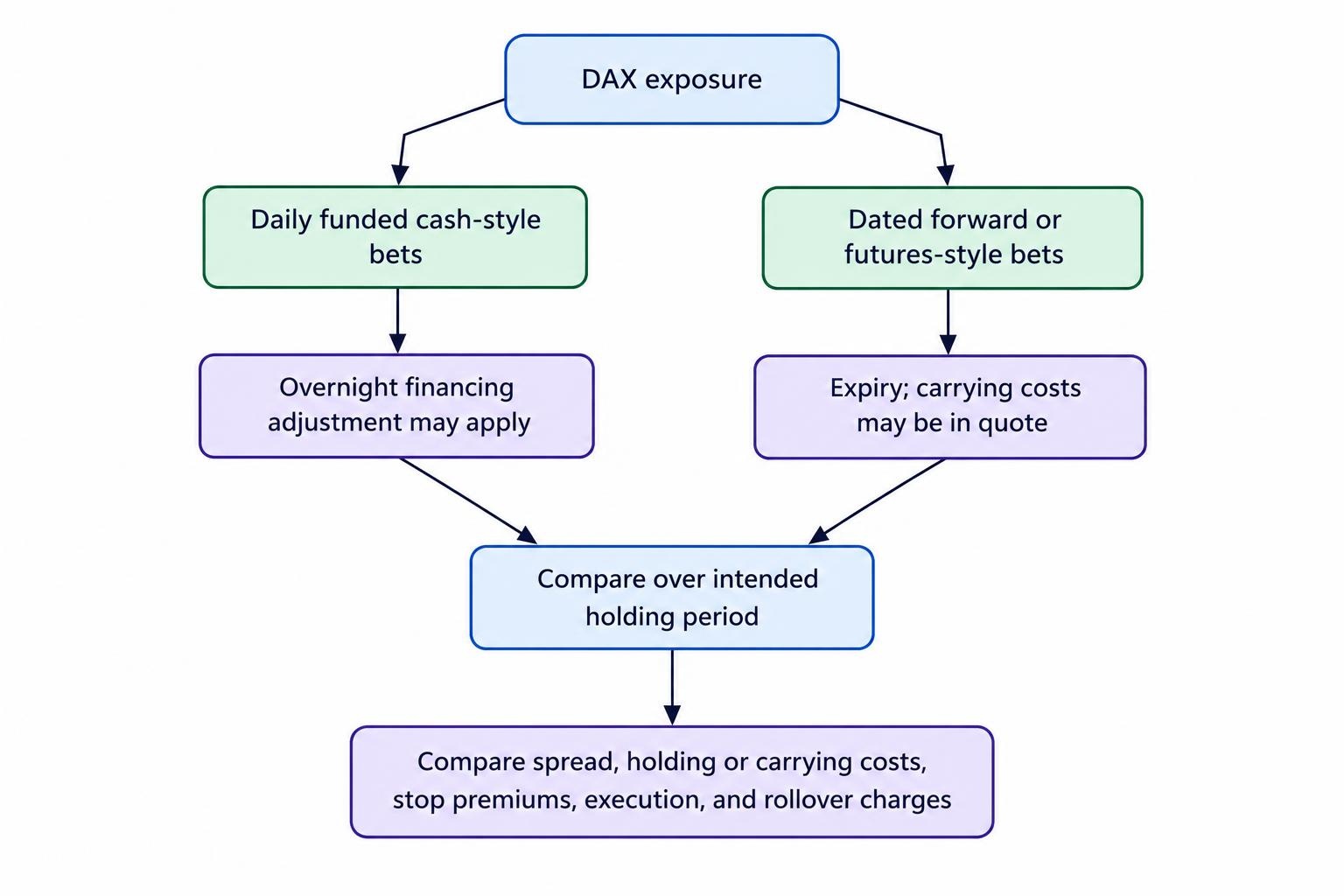
Before comparing spreads, establish whether you are looking at a daily funded cash style bet or a dated forward or futures style bet. Both can provide DAX exposure, but their pricing and holding costs differ.
Daily funded cash bets
A daily funded contract generally carries financing adjustments when held past the provider’s overnight cutoff. The charge depends on the contract terms, financing rate, position value and number of chargeable days. Do not assume that a Friday position attracts only one day’s funding, or that every short position receives a credit.
Funding relates to the exposure rather than just the margin deposit. That distinction matters for a DAX position representing tens of thousands of pounds. A trade that looks inexpensive to open can become expensive to maintain. Check the calculation in the overnight financing costs guide.
Dated forward or futures style bets
A dated contract has an expiry and a settlement method. Its price can differ from a cash style quote because the contracts represent different pricing bases and periods. A higher forward quote does not, by itself, indicate that traders expect the DAX to rise by the difference.
Providers may build carrying costs into a dated quote rather than apply the same daily financing structure used for a cash bet. Check the actual terms, spread, expiry and rollover process. The comparison between daily funded bets and futures style bets helps separate those costs.
Dividend treatment deserves a separate check. The headline DAX performance index already incorporates dividends within its calculation, but your account treatment depends on the referenced contract. Do not assume that a long position earns an extra dividend credit on top. Read the provider’s terms alongside the explanation of spread betting dividend adjustments.
Assess total cost over your expected holding period: the quoted spread, financing or embedded carrying cost, stop premiums, execution differences and any rollover charge. The smallest advertised spread answers only one part of that calculation.
Building a DAX trading approach
A DAX strategy needs a repeatable entry, a reason to exit and a rule for standing aside. Choosing an indicator is not the same as defining those rules.
An opening range approach, for example, could mark the high and low during a chosen period after the main share session opens. A possible trade then requires a break of that range, a defined invalidation level and enough room to the target after costs. The setup is a hypothesis to test, not evidence that the breakout will continue.
False breaks are part of the problem. Price can cross a level, trigger entries, then reverse into the range. Decide beforehand whether you require a closing bar beyond the level, a retest, or another filter. Each choice changes the entry price and the trades you miss. The breakout trading guide covers that trade off.
A pullback approach asks a different question: has price temporarily moved against an established direction, or has the original premise failed? Define that distinction before entering. Otherwise, a planned pullback trade can become an unplanned attempt to catch a falling market.
Record results in cash, points and units of planned risk. Include the time of entry, contract, spread and holding costs. A strategy that appears profitable before charges may not remain so after repeated entries and exits.
Managing DAX execution and gap risk
An ordinary stop loss is an exit instruction, not a promise that the position will close at its trigger price. If the next available price is worse, the realised loss can exceed the amount used in your sizing calculation.
Where offered, a guaranteed stop provides a contractual exit at the accepted level under the provider’s terms. Premiums, minimum distances and availability need checking before entry. Compare those conditions through the guide to guaranteed stop loss orders, rather than treating every stop ticket as equivalent.
Also establish which side of the quote triggers your order. A long position closes through the sell price; a short closes through the buy price. If the chart displays only one side or a midpoint, it may not show the price that triggered the exit. Spread changes can make this difference more noticeable.
Holding through a closed session adds another decision. Your stop may remain recorded on the platform, but the market can reopen beyond it. Review whether the possible loss remains tolerable if execution is worse than planned, not just whether the overnight funding seems affordable.
Finally, assess the rest of the account. A DAX position alongside other equity index bets may express the same broad risk several times. Different market names do not guarantee independent outcomes. The guide to portfolio correlation and spread betting risk explains how to assess that overlap.
Checking a DAX spread betting provider
Compare providers against the contract you intend to use and the hours you expect to trade. A headline spread from the main session tells you little about an overnight position or an order placed around an announcement.
- Contract definition: confirm the benchmark, point size, stake currency and whether the bet is daily funded or dated.
- Trading conditions: check dealing hours, typical spreads during your session, minimum stakes and order restrictions.
- Holding and exit costs: review financing, dividend treatment, expiry, rollover and guaranteed stop terms.
- Account arrangements: identify the legal entity, regulatory status, retail classification and margin closure policy.
A demo account can help you learn the ticket and check your calculations, but it cannot establish how every live order will execute. Use it to prevent operational mistakes, not to certify a strategy. The index spread betting broker guide provides a broader comparison framework.
Before placing a DAX trade, you should be able to state the cash value of a point, the exposure, the planned exit loss and the cost of holding beyond your intended session. If one of those answers is missing, the trade is not ready, however tidy the chart looks.