Index trading hours depend on which market you mean: the underlying share market, an exchange traded futures contract, or your spread betting provider’s own dealing session. Those schedules can overlap without matching. A price moving on your platform at midnight does not mean the shares inside the index are trading normally.
For UK traders, the main reference points are the European cash open and the US cash open. This guide separates those sessions from extended dealing hours, explains the daylight saving changes and shows what to check before placing an index spread bet.
Index Trading Hours in UK Time
The table shows regular underlying share market sessions on a normal trading day, usually Monday to Friday. These are reference hours, not a promise that a spread betting provider opens, closes or changes its spreads at exactly those times.
| Index | Regular session in UK time | Exchange timetable |
|---|---|---|
| FTSE 100 | 08:00–16:30 | London Stock Exchange trading hours |
| DAX | 08:00–16:30 | Xetra core trading hours |
| S&P 500 | Usually 14:30–21:00 | US regular share market session: 09:30–16:00 Eastern Time |
| Nasdaq 100 | Usually 14:30–21:00 | |
| Dow Jones Industrial Average | Usually 14:30–21:00 |
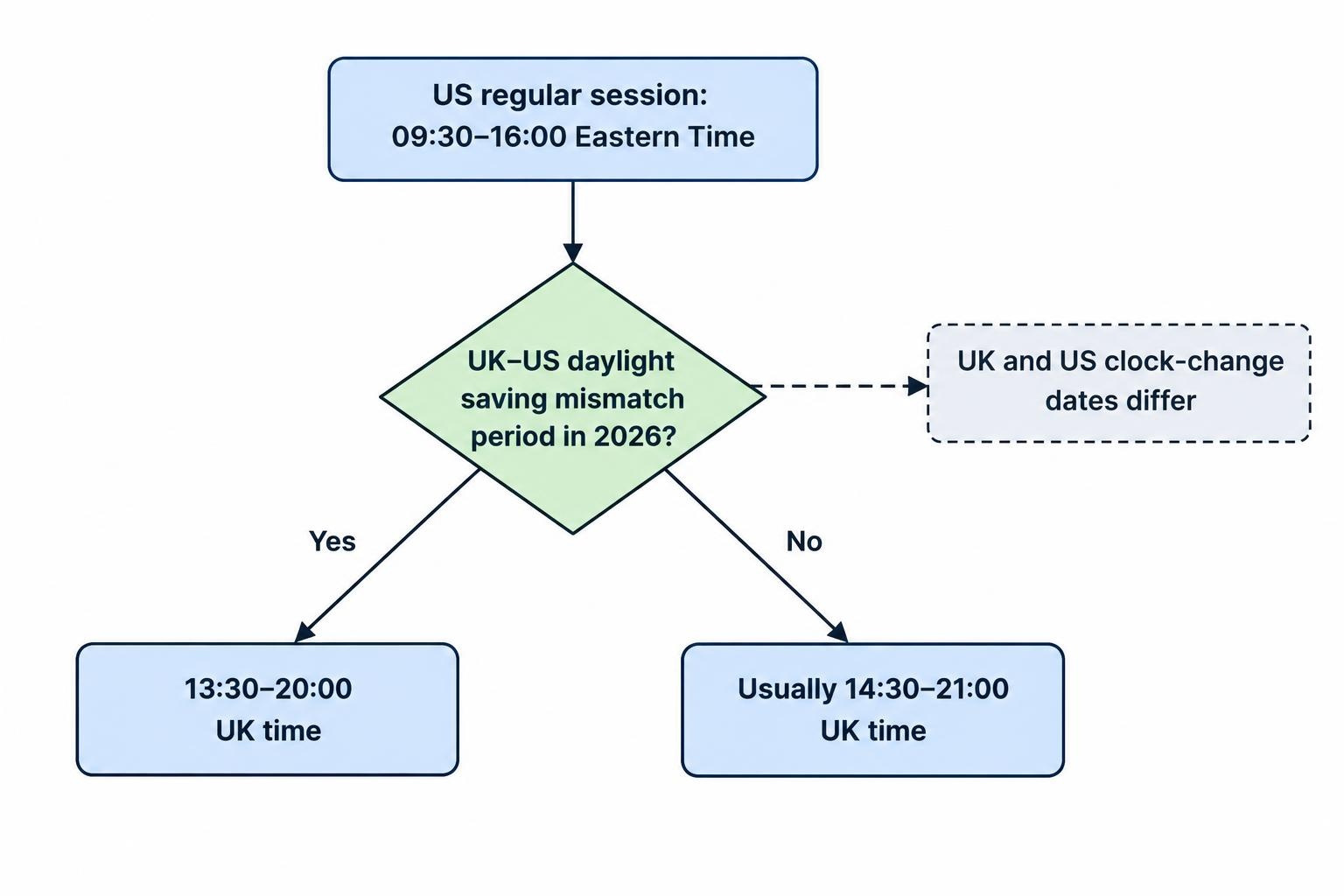
UK time means the local London clock: GMT in winter and British Summer Time in summer. The US session temporarily moves to 13:30–20:00 UK time during the daylight saving mismatch periods covered below.
Xetra also offers extended retail trading outside its core session. Do not confuse those extra dealing windows with the main session shown above. For FTSE 100 spread betting, make the same distinction between the London share session and the hours displayed on your provider’s ticket.
Cash Market Hours, Futures Hours and Broker Hours
Three different schedules can apply to what looks like the same index. Knowing which one you are viewing prevents a common mistake: treating an overnight quote as though it represents normal trading in all the constituent shares.
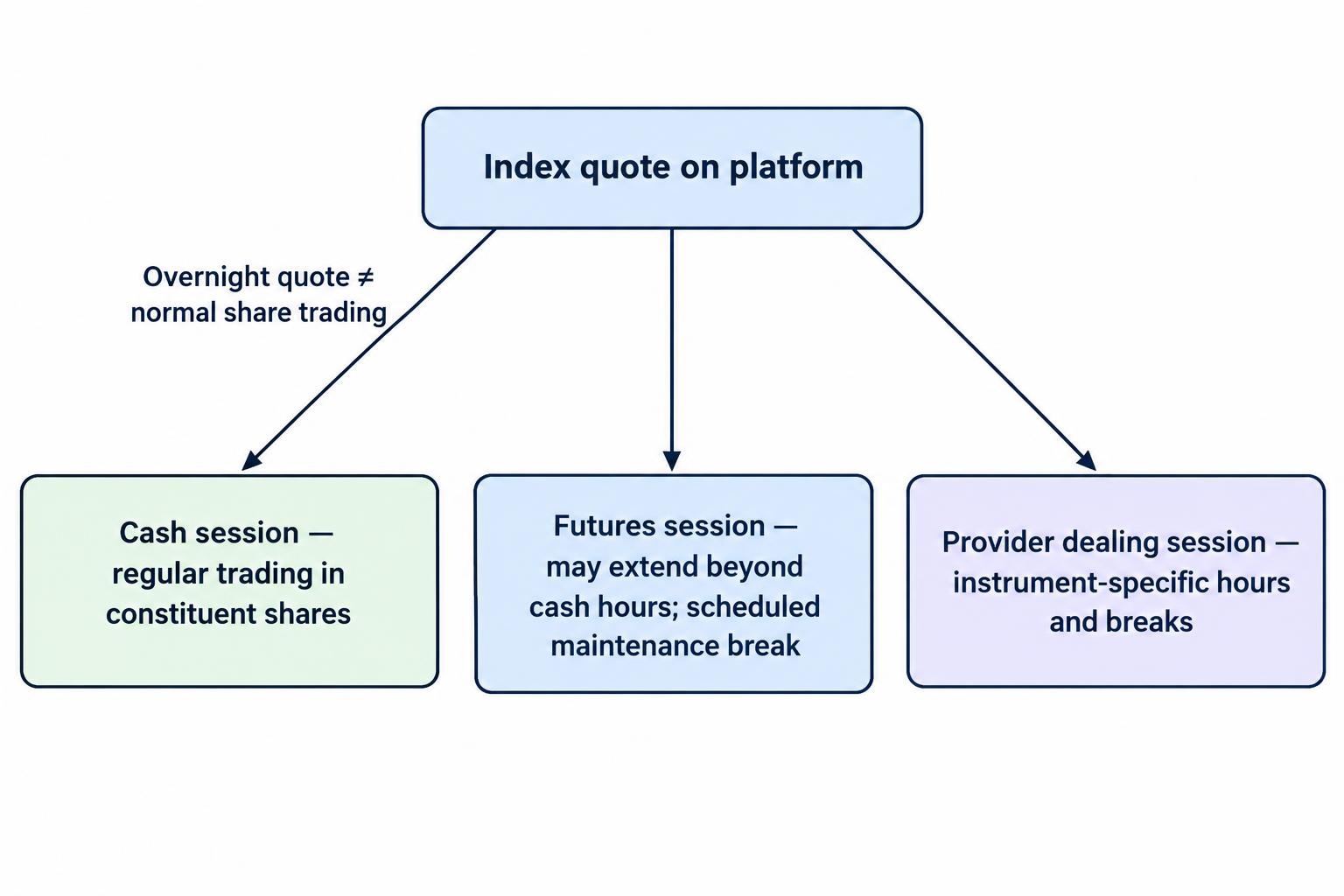
The underlying cash session
The cash session is the regular trading period for the shares used to calculate an index. It provides the main reference window for comparing an index with its constituent stocks. Opening and closing auctions are separate parts of exchange procedures, so a regular session’s end should not be treated as the instant every related pricing process finishes.
The futures session
Index futures can trade well beyond the cash session. CME’s E-mini S&P 500 schedule runs from Sunday at 18:00 to Friday at 17:00 Eastern Time, with a daily maintenance period from 17:00 to 18:00 Eastern Time. That is normally a 22:00–23:00 UK maintenance window, although the UK conversion changes during daylight saving mismatch weeks. The CME E-mini S&P 500 trading timetable provides the exchange reference, rather than a provider’s spread betting schedule.
The spread betting dealing session
Your actual ability to open or close a bet depends on the provider’s terms for that instrument. Check its dealing hours, daily breaks and holiday notices. A cash style product, including a daily funded bet, need not stop dealing when the underlying share market closes.
Outside the cash session, check how the provider constructs its quote. A futures linked or otherwise derived price is not interchangeable with a live cash index reading. Compare like with like before deciding that one chart has moved and another has not.
Daylight Saving Changes: US Index Hours in 2026
The UK and US change their clocks on different dates. In 2026, the UK clock changes fall on 29 March and 25 October, shown in the UK government clock change calendar. A fixed reminder for the US open therefore needs checking around both transitions.
US daylight saving time runs from 8 March to 1 November in 2026, as recorded in the NIST daylight saving schedule. Converting the regular 09:30–16:00 Eastern session into London time gives these exceptions:
- 9–27 March 2026: the US cash session was 13:30–20:00 UK time.
- 26–30 October 2026: the US cash session will be 13:30–20:00 UK time.
Outside those mismatch periods, the usual UK session is 14:30–21:00. Use a calendar set to London time and check the platform’s chart timezone separately. A chart labelled UTC will not show the same hour as a London clock during British Summer Time.
Which Trading Session Should You Use?
There is no universally best hour to trade an index. Choose a session that fits the setup you intend to trade, then check the actual dealing conditions. More movement is not automatically a better opportunity, particularly if it arrives with a wider spread or less predictable execution.
If your setup depends on the cash open, anchor it to the underlying exchange session rather than your first available broker quote. A US opening range measured from 14:30 will be wrong during the 2026 mismatch weeks. The calculation can be flawless and still describe the wrong hour.
If you trade the overlap between European and US cash markets, the normal reference window is 14:30–16:30 UK time. During the mismatch periods it begins at 13:30 instead. This is a scheduling observation, not evidence that trading the overlap produces better returns.
Check the quoted spread at your intended trading time. Do not assume that a provider’s advertised minimum applies throughout the dealing day. Wider spread betting spreads increase the distance a position must move in your favour before it breaks even, even when the market direction is correct.
For a hypothetical example, a two point spread costs £10 at £5 per point. A five point spread costs £25 at the same stake. Nothing about the position size changed; the entry cost did. Session choice should account for that difference rather than focus only on whether the ticket accepts an order.
Overnight Breaks and Weekend Trading
“Nearly 24 hour trading” does not mean uninterrupted access. Separate the scheduled futures maintenance break from any pause imposed by your provider. Check whether you can amend orders during a break and when those orders become eligible to execute again.
If a provider offers a weekend index product, read its terms before treating it as a continuation of the weekday market. Check whether it is a separate instrument, how outstanding positions transfer and what happens to attached orders. Availability alone tells you little about the pricing arrangements.
Holding a position through a closure also creates market gap risk. News can change the next available price while dealing is unavailable. An ordinary stop does not guarantee execution at its trigger price, so a planned exit level is not always the same as a fixed maximum loss.
Public Holidays and Early Closures
Use the relevant exchange calendar rather than assuming a normal weekday schedule. A holiday affecting one underlying market does not tell you whether another index, its futures contract or your spread betting instrument remains available.
For 2026, US cash equity markets are scheduled to close for Thanksgiving on 26 November. Early closes on 27 November and 24 December are scheduled for 13:00 Eastern Time, equivalent to 18:00 UK time. These dates appear in the NYSE holiday and early closing calendar.
Your provider may publish a separate holiday timetable. Check it even if futures continue trading: the provider’s dealing window and spread schedule can differ from the underlying exchange arrangements. An exchange calendar answers the exchange question, not every account question.
What to Check Before Placing an Index Bet
Before trading, confirm the exact instrument name, its dealing hours and the timezone used on both the ticket and chart. Then check the next cash open, daily break, public holiday and any expiry deadline. Do not assume similarly named cash and futures products share the same schedule.
Review whether pending orders remain active outside the session you intend to trade. If your plan covers only the cash session, decide when unfilled orders should expire rather than leaving that decision to a default setting.
Finally, match your stake and position size to the planned exit and the risk of execution beyond it. The useful trading window is one whose hours, costs and order rules you have checked—not simply every hour the platform stays open.