After-hours share trading means trading outside a stock market’s regular session. For a spread bettor, the practical question is narrower: does your provider offer an executable price on that particular share, at that time, under terms you are prepared to accept?
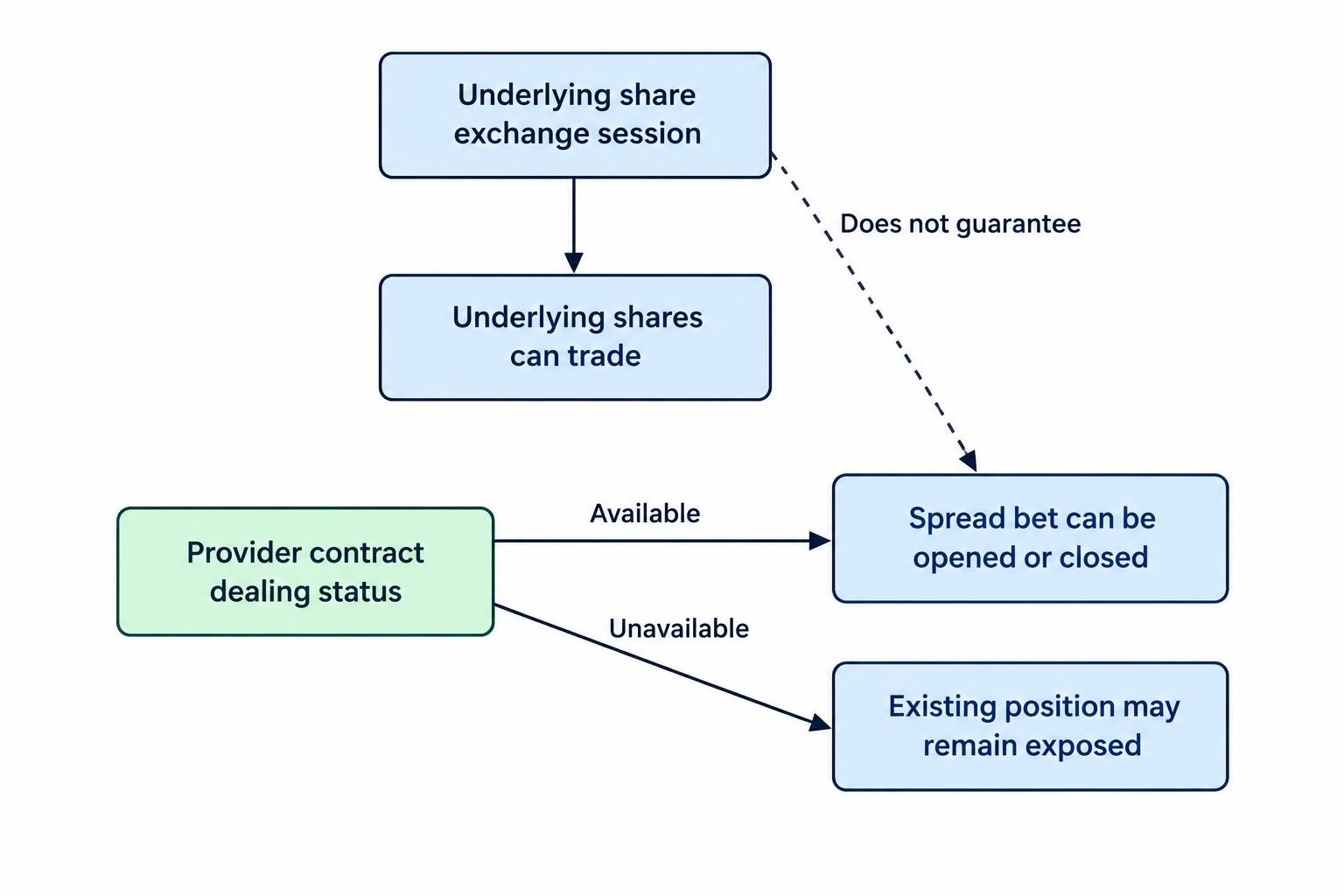
An underlying stock can be trading while your spread betting contract is closed. A provider’s platform can also display a price without accepting new positions. This guide focuses on those differences, the trading hours that matter to UK traders and the costs and risks that deserve attention before placing an order. The broader mechanics are covered in our guide to share spread betting.
What counts as after-hours share trading?
Three activities are easy to confuse: buying or selling actual shares during an extended exchange session, opening or closing a spread bet outside regular exchange hours, and holding an existing position overnight. They are not interchangeable.
With a spread bet, you trade a contract with your provider rather than acquire the underlying shares. Your ability to transact depends on that contract’s dealing hours and execution terms. Do not assume that access to an extended share trading session automatically means access through your spread betting account.
Holding a position overnight does not require the market to remain open. Your exposure continues while dealing is unavailable, but you may have no opportunity to close before the next executable quote. That distinction matters most when a company releases unexpected news during the closed period.
Location creates another common misunderstanding. Buying exposure to a US share at 18:00 London time is normally trading during the US regular session, not after hours. The relevant clock belongs to the underlying market. Our guide to spread betting on US shares covers the wider trading considerations.
Trading hours: US shares versus UK shares
The established Nasdaq sessions provide a useful reference for US equities. The following windows appear in the Nasdaq trading hours and holiday schedule; they are exchange session times, not a promise that a spread betting provider supports them.
| Session | US Eastern Time | Usual London time |
|---|---|---|
| Pre-market | 04:00–09:30 | 09:00–14:30 |
| Regular trading | 09:30–16:00 | 14:30–21:00 |
| After-hours | 16:00–20:00 | 21:00–01:00 the following day |
The London equivalents assume a five-hour difference. UK and US clock changes occur on different dates, so that difference temporarily becomes four hours. Use a calendar showing both time zones rather than treating the UK column as a permanent timetable. Holidays and shortened sessions also require a fresh check.
For UK shares, the standard London Stock Exchange trading day runs from 08:00 to 16:30 London time, as listed in the London Stock Exchange trading FAQs. Do not interpret this as a guarantee that every UK share spread bet can be traded throughout those hours, or beyond them.
Longer exchange schedules also need careful interpretation. As of 21 October 2026, Nasdaq expects a new 21:00–04:00 ET session to begin on 6 December 2026, subject to market data readiness and applicable SEC rule changes. The Nasdaq 23/5 trading timetable does not automatically extend any spread betting contract’s dealing hours.
Why after-hours prices can behave differently
Extended trading can involve lower liquidity, wider spreads, sharper price movements and prices that differ between venues. An evening price may also differ from the next regular session’s opening price. These are established risks in the FINRA extended-hours trading risk disclosure.
For a spread bettor, the useful comparison is between executable bid and offer prices, not just the latest trade shown on a chart. A displayed last price records a transaction; it does not necessarily show where you can open or close your contract now.
Check the timestamp too. A price that looks unchanged may be stale rather than stable. Compare the correct share, currency, session and contract before treating a difference between screens as a trading opportunity.
A wider spread has an immediate effect on your position. A long trade opens at the offer and closes at the bid. If the gap between those prices grows, the market must move further in your favour before the position reaches break-even, even before other charges.
Worked example: the cost of a wider spread
Consider a hypothetical US share spread bet where one point represents a one-cent change in the underlying share price. The provider quotes 10,000–10,004 during regular hours, equivalent to $100.00–$100.04.
At £1 per point, buying at 10,004 and immediately closing at an unchanged bid of 10,000 would produce a £4 loss from the spread.
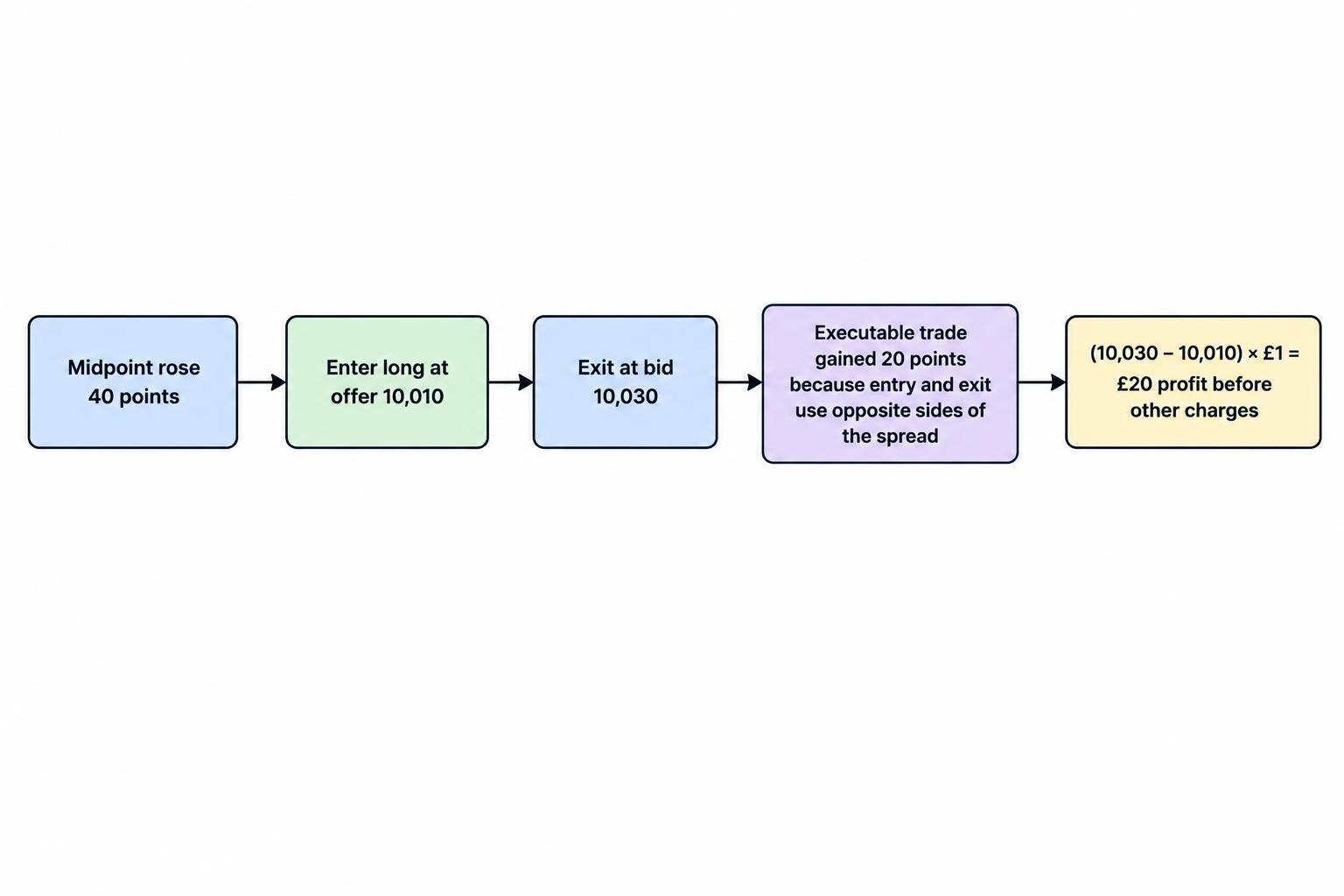
Now assume the after-hours quote is 9,990–10,010. The midpoint remains 10,000, but the spread has widened from four points to 20 points. Buying at 10,010 and immediately closing at 9,990 would produce a £20 loss.
Suppose the quote then rises to 10,030–10,050. Closing the long position at 10,030 produces:
(10,030 − 10,010) × £1 = £20 profit before other charges.
The quoted midpoint has risen by 40 points, but the trade has earned 20 points because entry and exit occur on opposite sides of the spread. A chart showing only the midpoint can make the opportunity look more generous than the executable prices allow.
These figures are illustrative, not representative provider quotes. Always check what one point means on the actual contract. Use the intended exit distance and stake together when calculating position size; the deposit required to open the trade is not the same as the amount at risk.
Orders and stops need a separate check
For direct US share trading, accepted order types and the treatment of unfilled orders can change between sessions. Limit orders control the worst acceptable execution price but may remain unfilled. The SEC investor bulletin on extended-hours trading covers these distinctions. They should not be copied wholesale onto a spread betting account.
For the spread bet itself, establish whether orders remain active outside regular hours, which quote triggers them and what happens when dealing resumes. An order marked as accepted is not necessarily eligible to execute in every session.
An ordinary stop does not guarantee the requested exit price. If the contract stops quoting and reopens beyond the stop level, execution can occur at a worse available price. Our guide to stop-loss orders explains that distinction.
Using the earlier example, a purchase at 10,010 with a stop at 9,960 has a planned distance of 50 points. At £1 per point, that suggests £50 of price risk if execution occurs at the stop. If the next executable exit is instead 9,900, the loss becomes £110 before other charges.
A limit order is not a substitute for a guaranteed exit either: its price restriction can prevent execution. Where available, guaranteed stop-loss orders provide a contractual exit at the agreed level, subject to the product’s terms. Check availability, minimum distance, premiums and whether the guarantee covers the session you intend to trade.
Trading around earnings announcements
An earnings release creates two decisions: whether to hold exposure through the announcement, and whether to trade after the figures arrive. Treat them separately. An existing position already carries event risk; opening another trade because the price has moved does not remove it.
Before acting, read the release rather than relying on a headline. Revenue, margins, cash flow and management guidance can point in different directions. Also establish whether the announcement is complete or whether a presentation or management call is still to come.
A practical plan defines the entry conditions before the event: the largest acceptable spread, maximum stake, price that invalidates the trade and circumstances that mean no trade. The broader process belongs in a news trading strategy, not an improvised response to a flashing quote.
Access is useful when it lets you carry out a prepared decision. It is less useful when it simply makes an impulsive decision easier to execute.
After-hours trading costs are not just the spread
Separate the cost of dealing outside regular hours from the cost of holding a position across a funding cutoff. They answer different questions. An after-hours trade might be opened and closed within one evening, while an untouched position may still cross the contract’s financing time.
For a daily funded share bet, check the financing rate, calculation basis and cutoff in the current contract terms. For a short position, also check any borrowing charge and restrictions. The details belong in a comparison of share spread betting costs, rather than a comparison of advertised spreads alone.
Calculate the likely cost in pounds at your intended stake. A ten-point increase in the spread costs £5 at 50p per point but £50 at £5 per point. The same quoted market can therefore be acceptable for one position size and uneconomic for another.
Available margin deserves a separate check. A price move against the position reduces account equity, and the opening deposit should never be treated as a cap on the trade’s potential loss.
What to check before placing an after-hours share bet
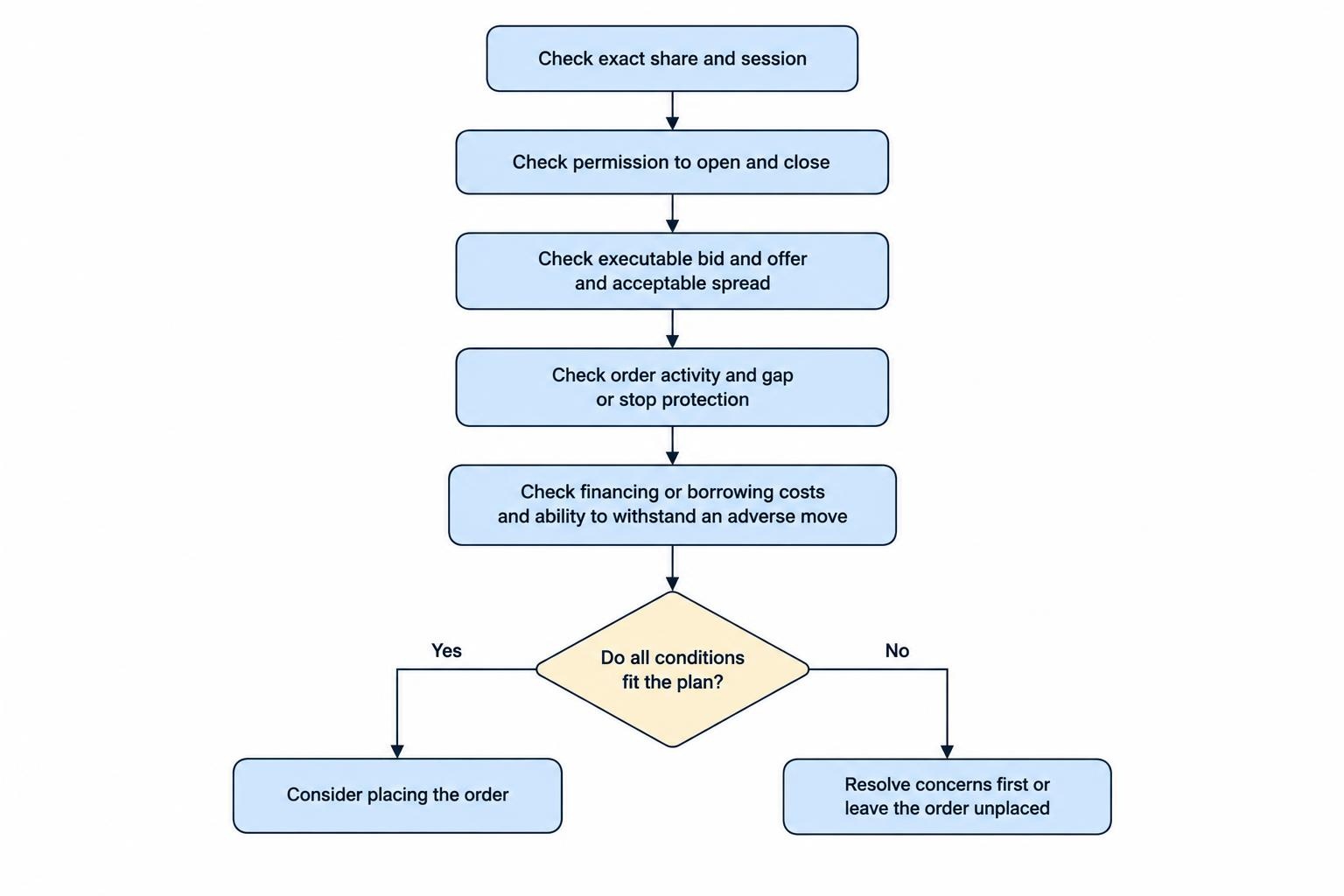
Use the individual market’s information panel and the provider’s execution terms, not a general claim that the platform offers extended trading.
- Contract and session: Is this exact share available now, in the correct spread betting product, and when does dealing next stop?
- Dealing permission: Can you open and close positions, or only reduce existing exposure?
- Executable prices: What are the current bid, offer and maximum acceptable spread?
- Orders and protection: Are your orders active in this session, and what happens if the market gaps while quoting is unavailable?
- Account capacity: What do financing, borrowing charges and an adverse price move do to your available funds?
Also decide how long you intend to hold the trade. An entry made shortly before the provider stops quoting can become overnight exposure by default. That is a different decision from entering with several hours of dealing access remaining.
If the platform’s behaviour is unclear, resolve it before placing a live order. A demonstration account can help with ticket controls, but it should not be treated as proof of the execution price available during a live earnings announcement.
When waiting for regular hours is the better choice
After-hours access is not an obligation to trade. Waiting can be sensible when the spread consumes too much of the expected move, the company’s announcement is incomplete or the available order protection does not fit the planned risk.
Waiting does carry a trade-off: the next available price may be less attractive. There is no rule that the regular session must offer a better entry.
The decision should rest on executable prices, contract terms and a loss you can afford, rather than the fear of missing a move. If those conditions do not support the trade, leaving the order unplaced is a valid outcome.